
We’re the F—ing Champs: Seth Jarvis Gave Raleigh the Line It Needed
Six days after Carolina completed its twenty-year return to the Stanley Cup, Seth Jarvis stepped onto a downtown Raleigh stage, looked toward his teammates and compressed an entire postseason into one unfiltered declaration: they were finally the champions.
By the time Seth Jarvis reached the microphone on June 20, downtown Raleigh no longer resembled a normal Saturday morning. Red jerseys filled the streets, players leaned over parade vehicles toward the crowd, and an estimated 150,000 people had gathered to celebrate the Carolina Hurricanes’ first Stanley Cup championship since 2006.
Jarvis began with family. He thanked his brother, then turned toward what the playoff journey had created around him. “For the 23 brothers I have on this stage,” he said, pausing just long enough for the crowd to understand where the thought was heading, “we’re the f—ing champs.”
The line worked because it did not sound prepared for a corporate celebration. It sounded like the sentence a player might shout inside a dressing room after the final horn, before the emotion had been edited into safer public language. On the parade stage, that private championship vocabulary suddenly belonged to Raleigh.
Carolina had already lifted the Stanley Cup, carried it through Las Vegas and returned it to North Carolina. Jarvis gave the achievement something different: a compact verbal release for every Caniac who had spent years watching strong seasons end before the final celebration.
“For the 23 brothers I have on this stage … we’re the f—ing champs.”
Seth Jarvis • Raleigh championship rally • June 20, 2026The Sentence That Broke Through the Parade Noise
Championship parades generate dozens of images at once. Players raise the Cup from buses. Children sit on shoulders. Champagne appears where water would normally be. Coaches attempt speeches while teammates interrupt them. Music stops and starts according to whatever emotion controls the stage.
Most of those moments blend together into one large celebration. Jarvis’ sentence survived because it gave the day a clean emotional headline.
He did not explain the tactical structure that carried Carolina through four playoff rounds. He did not list the injuries, overtime games or years of postseason disappointment that came before the Cup. He did not attempt to transform the achievement into a polished statement about organizational goals.
He named the relationship first: 23 brothers. Then he named the result with the only amount of restraint that felt appropriate in front of a city celebrating its second Stanley Cup.
Jarvis did not begin with himself. He framed the championship through the group standing behind him. That made the final line feel less like an individual attempt to create a viral clip and more like a spontaneous declaration on behalf of the entire roster.
Why an Unfiltered Line Fit Seth Jarvis
Jarvis has become one of Carolina’s most visible players partly because his personality does not disappear when the game ends. He can speak with the timing of someone who understands the seriousness of professional hockey without allowing that seriousness to flatten every interaction.
That balance makes him especially suited to a championship parade. He can carry the emotional importance of the Cup and still sound like a 24-year-old celebrating with teammates rather than a spokesperson reading from a prepared page.
His stage appearance followed a postseason in which he had already created one of Carolina’s defining on-ice moments. In Game 2 of the Stanley Cup Final, Jarvis scored the overtime power-play goal that completed a comeback from two goals down and evened the series against Vegas.
The goal kept Carolina from returning home in a two-game deficit. It also reinforced the quality that has followed Jarvis throughout his rise: he can operate inside major moments without appearing consumed by them.
At the parade, that composure transformed into release. The pressure was gone. The result could no longer be reversed. Jarvis did not need to describe what the Hurricanes hoped to become. The Cup had already answered.
From Game 2 Overtime to the Championship Stage
Jarvis’ championship story cannot be separated from the overtime winner in Game 2. Carolina entered the third period trailing Vegas by two goals, rallied to move in front and then watched the Golden Knights force overtime late.
Those emotional swings could have left the Hurricanes vulnerable. Instead, a Vegas penalty opened the door early in overtime, and Jarvis finished the power-play sequence at 3:56 to secure a 4–3 victory.
The goal mattered beyond tying the Final. It protected the belief that Carolina’s postseason identity—pressure, structure, persistence and comfort in overtime—could still control the series even when the game became chaotic.
Weeks later, the parade quote supplied a verbal echo of that goal. The overtime winner was the controlled act that kept the championship path open. “We’re the f—ing champs” was the uncontrolled joy that arrived after the path had been completed.
Jarvis’ Game 2 overtime winner turned a dangerous early-series moment into proof that Carolina could recover under Stanley Cup pressure.
Carolina’s 3–0 Game 6 victory in Las Vegas ended the twenty-year wait and transformed years of near-misses into championship memory.
Six days later, Jarvis supplied the sentence Raleigh could repeat after the statistics, series analysis and waiting had finally become secondary.
Why “We” Is the Most Important Word
The profanity made the quote instantly memorable, but the first word carries the deeper meaning.
“We” placed Jarvis inside the group rather than above it. It connected the overtime scorer to the fourth-line shifts, blocked shots, goaltending, coaching decisions and unseen work that allowed Carolina to survive four playoff rounds.
It also allowed the crowd to hear itself inside the sentence. Jarvis was speaking about the roster, but championship parades are built on temporary expansions of the word “we.” Players, staff members, families and fans all gather around one result and claim a different part of the journey.
Caniacs did not take the shifts or absorb the hits. They did, however, carry the rituals surrounding the team: sounding the siren, filling the arena in red, defending Raleigh as a hockey market and returning through the years when another promising playoff run ended too soon.
For a few seconds on the rally stage, “we” became large enough to include the entire street.
Twenty Years of Waiting Needed Something Louder Than Polite
Carolina’s 2006 championship had remained the central reference point in franchise history for two decades. Rod Brind’Amour’s role made the connection unavoidable: captain of the first Cup team, coach of the second.
Yet the 2026 title was not simply a nostalgia exercise. This roster had built its own history through repeated playoff appearances, conference-final frustration and the increasing pressure that arrives when an excellent team remains unable to finish the final journey.
Each unsuccessful run added another layer to the eventual celebration. The Hurricanes were not ending one difficult season. They were ending a long argument about whether their sustained excellence would ever produce the image that validates everything around it.
That is why Jarvis’ language felt proportionate rather than excessive. A carefully moderated phrase would have reduced the emotional scale of the moment. Twenty years of distance, plus years of modern near-misses, had earned a sentence with no interest in indoor volume.
The line survives because it expresses relief, pride and group identity at the same time. It is not a prediction, marketing slogan or request for belief. It is the blunt statement that becomes available only after the Cup has been won.
The Artwork Looks Like a Locker-Room Quote Escaped Into the Street
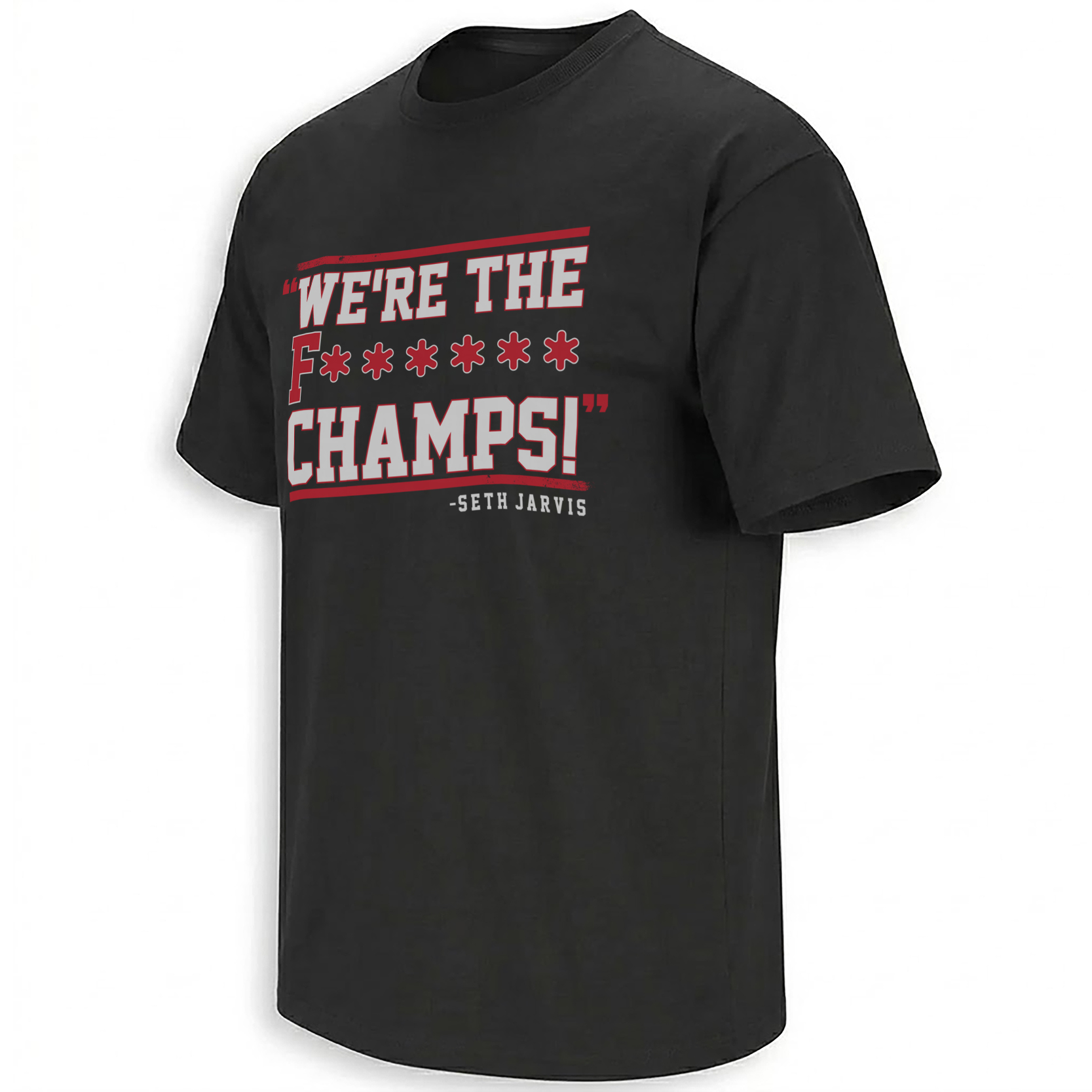
The design is strongest when read as a document of the rally rather than a conventional championship logo. Its central subject is not only the Stanley Cup. It is the human moment in which Jarvis attempts to explain what winning it feels like.
Large, compressed lettering gives the quote the visual force of a newspaper banner or a phrase painted quickly for a parade sign. The words demand attention before the viewer studies the player image, mirroring the way Jarvis’ sentence traveled after the rally.
Red, black and white keep the artwork inside Carolina’s established visual language. The contrast is sharp enough to resemble arena signage, while the distressed surface gives the piece the feeling of something carried through a celebration rather than produced for a quiet display.
Jarvis appears as the source of the line, but the composition prevents the design from becoming a simple portrait. Text, championship context and player image operate together as one memory: the Cup had been won, the team was assembled on stage and the youngest voices were finally free to say the obvious out loud.
Raleigh’s Parade Was Evidence of a Different Hockey City
The size of the June 20 celebration gave the quote a setting worthy of its energy. An estimated 150,000 people filled downtown Raleigh, creating a parade that looked dramatically different from the city’s first Stanley Cup celebration twenty years earlier.
The change was not merely population growth. It represented the maturation of Hurricanes culture across an entire generation. Children who saw the 2006 championship had become adults returning with families. New residents had adopted the siren, Storm Surge and Caniac identity as part of life in the Triangle.
Raleigh had spent years hearing versions of the argument that hockey in North Carolina required explanation. The championship parade made the old debate feel irrelevant. A city does not need to defend the authenticity of its hockey culture when six figures of people are filling downtown streets to celebrate the Cup.
One fan quoted during the celebration observed that Raleigh no longer looked like a small-town hockey parade. That distinction matters. The Hurricanes had not borrowed a championship atmosphere from a traditional northern market. They had built a Southern version with its own music, language, weather, humor and regional pride.
The Parade Was Chaotic Because the Pressure Was Finally Gone
The rally did not present championship emotion in one uniform style. Rod Brind’Amour spoke about the work his players had given the organization and its supporters. Jaccob Slavin placed the Stanley Cup above even the Olympic gold medal he had won earlier in the year.
Nikolaj Ehlers reflected on finding a new hockey home and immediately receiving the championship he had spent his career chasing. Andrei Svechnikov thanked the crowd after a teammate tore off his shirt. Jordan Martinook helped lead what became a downtown version of the Storm Surge.
Elsewhere in the celebration, Nicolas Deslauriers signed a two-year contract extension and announced it to the crowd in language that matched the day’s lack of restraint.
The disorder was not a failure of presentation. It was evidence that the ceremony had stopped belonging to a schedule. Players who had spent months operating inside systems, shifts and controlled routines were finally allowed to move according to joy.
Jarvis’ quote emerged from that environment. It felt memorable precisely because it did not interrupt the chaos. It summarized it.
How a Parade Quote Becomes a Fan Artifact
Championship culture creates two types of memory. The first is official: the final score, series result, trophy presentation and permanent record. The second is emotional: the phrase, gesture or imperfect image that fans use to remember how the official result felt.
Jarvis’ line belongs to the second category. It adds no new statistical information. Anyone hearing it already understands that Carolina won. Its value is in the emotional accuracy of the delivery.
That makes the phrase naturally suited to a graphic artifact. It can return fans to the rally stage without requiring a long explanation. The sentence contains the group, the result and the volume of the celebration.
Years later, the quote may function like an audio cue. A fan will read the words and remember Jarvis holding the microphone, teammates behind him and a downtown crowd reacting before he had fully finished the sentence.
Seth Jarvis Represents Carolina’s Next Championship Era
Brind’Amour links the 2006 and 2026 championships. Jarvis points toward what comes after the second one.
He is young enough for the title to become the foundation of his Carolina identity rather than the closing chapter. His Game 2 overtime winner, personality and championship-stage declaration give the organization a recognizable figure capable of carrying the emotional language of the next era.
That future is not guaranteed to reproduce the same result. Winning the Stanley Cup remains too difficult for any team to assume that one championship naturally becomes several.
What changes after a title is the standard of memory. Jarvis and his teammates will no longer be judged only as talented players attempting to break through. They are now the group that completed the journey. Every later season will exist beside that fact.
The parade quote reflects that permanent shift. Jarvis did not say Carolina might become champions, deserved to become champions or hoped to remain champions. He spoke from the completed tense.
Carolina’s Visual Archive Is Now a Championship Archive
Before the final horn, Carolina graphics documented belief, player personalities, playoff rituals and the tension of a team attempting to finish its run. After Game 6, the vocabulary changed.
The wider Carolina Hurricanes collection now reads as a record of a completed championship journey: trophy lifts, captain moments, player nicknames, Raleigh celebration language and the phrases that emerged once the wait was over.
The broader NHL Shirts collection places those Carolina pieces inside hockey’s larger visual culture, where overtime goals, rivalry series and parade quotes can become as important to fan memory as the official championship mark.
Jarvis’ design occupies a specific point in that archive. It does not document the instant Carolina won. It documents the moment the championship was brought home and spoken back to the people who had been waiting for it.
Why the Line Will Last Beyond the Parade
Viral championship phrases often disappear when separated from the emotion that produced them. Jarvis’ declaration has a stronger foundation because every part of it connects directly to the season.
“We” reflects Carolina’s team identity. “The champs” records the result. The word between them carries the scale of the release.
The sentence also remains flexible. It belongs to the roster, but supporters can repeat it at celebrations, opening night, banner raising and every later moment when the 2026 championship returns to the center of Hurricanes culture.
Most importantly, it sounds like the player who delivered it. Another speaker might have made the language feel staged or unnecessarily provocative. From Jarvis, after the season he had played and in front of the teammates he had just called brothers, it sounded honest.
Carolina waited twenty years for another Stanley Cup. Raleigh needed only a few seconds to recognize the sentence that would define the celebration.
Frequently Asked Questions
When did Seth Jarvis say “we’re the f—ing champs”?
Jarvis delivered the line during the Carolina Hurricanes’ Stanley Cup championship rally in downtown Raleigh on June 20, 2026, six days after the team clinched the Cup.
What did Seth Jarvis say before the championship declaration?
He first thanked his brother and then referred to the teammates standing with him as his 23 brothers before declaring that they were the champions.
How many people attended Carolina’s 2026 Stanley Cup parade?
Contemporary reports estimated that approximately 150,000 people gathered in downtown Raleigh for the parade and championship rally.
What was Seth Jarvis’ defining moment in the Stanley Cup Final?
Jarvis scored the power-play winner at 3:56 of overtime in Game 2, completing Carolina’s comeback and tying the Stanley Cup Final at one game apiece.
Why did the parade quote resonate with Hurricanes fans?
The line combined team brotherhood, twenty years of waiting and the emotional release of finally winning the Cup. Its unfiltered delivery also matched the celebratory atmosphere in Raleigh.
What does the We’re the F—ing Champs artwork represent?
The graphic preserves Jarvis’ rally-stage declaration through bold championship lettering, Carolina’s red-and-black visual identity and an image tied to the 2026 Stanley Cup celebration.
The We’re the F—ing Champs design preserves the unfiltered rally-stage release that followed Carolina’s twenty-year return, while the wider Hurricanes championship archive follows the players, slogans and Raleigh memories that gave the 2026 run its identity.
We’re the F—ing Champs Shirt captures Seth Jarvis’ unforgettable statement at Carolina’s 2026 Stanley Cup parade through bold rally-style typography, Hurricanes red-and-black energy and the emotion of Raleigh’s championship celebration.