Here for the Schwarbombs: Kyle Schwarber Has Turned Power Into a Philadelphia Ritual
Kyle Schwarber’s latest power surge has made every trip to the plate feel like a possible event. In Philadelphia, “Schwarbomb” is no longer merely a nickname for a home run. It is the word fans use for the anticipation, noise and sudden release that arrive when number 12 sends another baseball into the night.
Citizens Bank Park received two historic performances in the same game on June 20. Bryce Harper completed the first cycle of his career, Kyle Schwarber hit three home runs, and the Phillies overwhelmed the New York Mets 15–3 on a night that seemed determined to produce a new headline every few innings.
Schwarber did not simply hit three balls over the fence. He hit two of them in the third inning, turning one explosive frame into a compact demonstration of why his plate appearances now generate their own atmosphere. The first swing creates celebration. The second creates disbelief. By the third, the crowd is no longer reacting to an isolated home run; it is participating in a familiar Philadelphia ritual.
He returned the following night and drove another three-run shot into right-center field, his 29th home run of the season. The Phillies took the series from the Mets, while Schwarber reinforced a truth that has shaped his years in Philadelphia: power can alter a game before the ball has even landed.
That is the emotional territory behind “I’m Just Here for the Schwarbombs.” The phrase does not pretend baseball is only about home runs. It acknowledges that when Schwarber enters the box, an entire ballpark briefly reorganizes itself around the possibility of one.
A Schwarbomb is not only a baseball leaving the park. It is the instant Philadelphia realizes the ball is no longer coming back.
Citizens Bank Park power languageThe Night Philadelphia Could Not Stop Hitting
The Phillies’ June 20 victory became extraordinary because two different types of baseball achievement unfolded beside each other. Harper’s cycle required variety: a single, double, triple and home run. Schwarber’s performance depended on repetition of the sport’s most decisive result.
The contrast gave the night its shape. Harper moved through the geometry of the entire field. Schwarber kept removing the field from consideration altogether.
His first two home runs arrived in the third inning, part of an offensive avalanche that turned a divisional game against the Mets into a stadium-wide celebration. Hitting twice in one inning is already unusual. Going deep in both plate appearances converts the inning into something closer to folklore.
By the time Schwarber completed the three-homer performance, the statistical achievement had fused with the crowd experience. Fans were not only counting his home runs. They were waiting for another opportunity to repeat the same reaction: lift, track, roar.
Two Schwarber home runs in the third inning transformed the game from a strong Phillies performance into a spectacle. The repetition mattered: fans experienced the same explosive swing twice before the inning had finished, making “Schwarbomb” feel less like a nickname and more like the evening’s operating system.
Why “Schwarbomb” Became the Right Word
The nickname works because it describes both the hitter and the effect. “Schwarber” supplies the identity. “Bomb” supplies distance, force and the emotional detonation that follows contact.
Baseball has always produced language for home runs: blasts, shots, moonshots, no-doubters and tape-measure drives. “Schwarbomb” belongs to a more personal category. It attaches the act so closely to the player that the home run begins to feel like a proprietary event.
That distinction matters in Philadelphia. Schwarber’s home runs have become recognizable not only because of their quantity, but because of their visual personality. The swing is compact and violent. The ball often climbs quickly. The crowd begins its reaction while the outfielder is still turning toward the wall.
The nickname also carries humor. It sounds oversized, uncomplicated and slightly cartoonish—qualities that match the physical drama of the longest home runs. Fans do not need a technical explanation when the result is already disappearing into the seats.
Every Schwarber plate appearance carries the possibility that one swing will replace the previous game state with a new one.
The “bomb” language reflects the force, distance and immediate crowd release attached to his biggest drives.
“Schwarbomb” gives broadcasts, social captions and ballpark conversations the same compact name for a familiar event.
A Power Identity Built Across Five Philadelphia Seasons
Schwarber’s relationship with Philadelphia cannot be reduced to one hot week. The nickname carries weight because the home runs have accumulated across seasons, playoff runs and high-pressure moments.
By June 11, his 24th home run of 2026 was also his 211th since joining the Phillies. That total placed him among a rare historical group for home runs through a player’s first five seasons with one club, behind only Babe Ruth with the Yankees, Mark McGwire with the Cardinals and Ralph Kiner with the Pirates.
Historical comparisons of that scale do not mean every hitter shares the same career or context. They do clarify how quickly Schwarber’s power has become embedded in Phillies history. His Philadelphia era is not merely a collection of productive seasons. It is a sustained run of home-run imagery.
The accumulation changes the fan response. Early in a player’s tenure, a home run creates surprise. After hundreds of them, anticipation becomes part of the experience. Fans arrive already expecting the possibility, which is exactly what the phrase “I’m Just Here for the Schwarbombs” captures.
The strongest player nicknames survive because they can hold multiple memories at once. “Schwarbomb” can describe a regular-season blast, a postseason swing, a three-homer game or the next ball that has not yet been hit.
The Artwork Treats Power Like a Vintage Cartoon
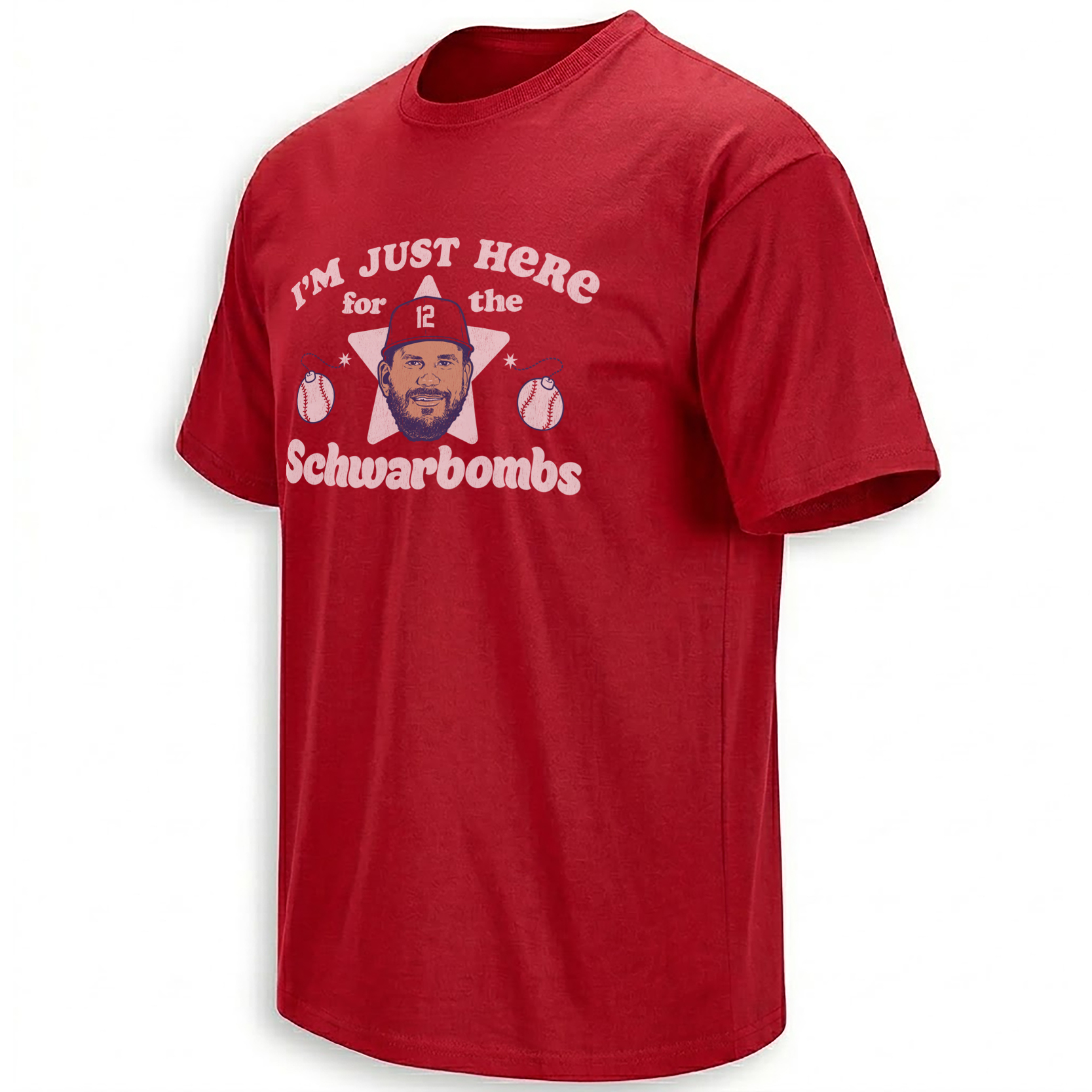
The design avoids the hard-edged visual language usually associated with explosive power. Instead of flames, shattered metal or aggressive military imagery, it uses rounded cream lettering, a smiling portrait and two baseballs with curved cartoon fuses.
That softness is intentional. Schwarber’s power is serious, but the fan language surrounding it is playful. Turning baseballs into illustrated bombs makes the nickname instantly understandable without turning the composition into a technical player poster.
The large star behind the portrait gives the central figure the feeling of a vintage trading-card badge or an old stadium giveaway. Number 12 appears on the cap, allowing the identity to remain legible even before the viewer reaches the oversized “Schwarbombs” lettering at the bottom.
Cream type against a bright red shirt base creates the warmth of older Philadelphia sports graphics. Navy outlines add enough contrast to keep the portrait and lettering structured, while small sparkle marks suggest the instant before or after impact.
The typography carries most of the personality. “I’m Just Here” curves over the illustration like a casual declaration made while entering the ballpark. “Schwarbombs” is heavier, wider and more playful, giving the nickname the final visual word.
Why Schwarber’s Home Runs Feel Different in Philadelphia
Philadelphia crowds do not approach power hitters quietly. The city’s baseball culture is built around visible emotional investment: standing before the pitch, reacting before the ball lands and carrying the result into the next plate appearance.
Citizens Bank Park amplifies that relationship because right-field power can feel physically close to the crowd. A Schwarber drive does not disappear into an abstract outfield. It travels toward a section of the park already trained to read its trajectory.
His personality strengthens the connection. Schwarber has occupied several roles during his Phillies career: leadoff hitter, clubhouse voice, postseason performer, designated hitter and occasional first baseman. Yet power remains the constant through every version.
That reliability gives fans permission to build ritual around him. A Schwarber plate appearance becomes a moment to pause a conversation, look up from the concourse or remain standing after the previous pitch. The possibility of a home run changes how attention is distributed inside the park.
The Mets Series Added Rivalry Weight
Three-home-run games are memorable against any opponent. Producing one against the Mets gives the performance additional meaning because the result lives inside a divisional relationship that both fan bases monitor closely.
The Phillies did not merely win the June 20 game. They overwhelmed New York 15–3, then returned the next night with Schwarber and Harper again supplying home runs in a 6–2 victory. Philadelphia took the series while its two most recognizable left-handed stars controlled the emotional rhythm of the weekend.
Rivalry changes how highlights travel. A home run becomes more than an offensive result; it becomes material for standings conversations, social reactions and the accumulated memory of one fan base enjoying another’s discomfort.
Schwarber’s performance was therefore perfectly suited to the “Schwarbomb” identity. The nickname is playful inside Philadelphia and menacing from the opposing dugout. One side hears celebration. The other hears the same joke repeated as the ball clears the wall again.
Power, Patience and the Shape of a Schwarber At-Bat
The home runs dominate memory, but they are not the only reason Schwarber’s plate appearances carry tension. His willingness to take pitches means the at-bat can develop slowly before ending suddenly.
Pitchers understand the danger and often work carefully around the strike zone. That creates longer confrontations, deep counts and a sense that each pitch is narrowing the path toward either a walk, a strikeout or the swing everyone is waiting to see.
Even while dealing with lower-back tightness after the Mets series, Schwarber contributed a demanding 10-pitch pinch-hit plate appearance and drew a walk during Philadelphia’s late rally against Washington. The moment did not produce a Schwarbomb, but it illustrated the broader pressure his presence places on an opposing pitcher.
This is why his offensive identity cannot be described only through distance. The threat of power affects pitch selection, defensive positioning and crowd anticipation before contact occurs.
From Highlight to Memory Object
Home-run graphics work best when they preserve an emotion rather than attempt to recreate every statistic. The Here for the Schwarbombs design does not include dates, distances or a full season total. Its subject is the repeated feeling underneath all of them.
The cartoon bombs represent the possibility carried into every plate appearance. The smile keeps the composition connected to the affection Philadelphia has developed for the player. The star turns number 12 into the featured character of a visual universe built around one outcome.
In that sense, the graphic functions like an old ballpark slogan. It can belong to the three-homer night against the Mets, the 29th home run the following evening or a future postseason drive that gives the phrase another permanent memory.
The wider Philadelphia Phillies collection follows that process across different players, rivalry moments and postseason memories. Rather than presenting the season as a single official narrative, it records the phrases and visuals fans use while the story is still developing.
The broader MLB Shirts and Apparel archive extends the same idea across baseball, where one swing, nickname or dramatic inning can become a piece of fan language before the next series begins.
Why Fans Are Still Here for the Schwarbombs
Schwarber’s appeal rests partly in predictability and partly in surprise. Everyone understands what he is capable of doing. Nobody knows which pitch will produce it.
That combination keeps the ritual alive. Fans can arrive expecting power without knowing whether they will witness a routine fly ball, a long battle ending in a walk or another drive that changes the scoreboard and sends the right-field seats into motion.
The three-homer performance against New York made the current conversation louder, but it did not invent the language. It confirmed why “Schwarbomb” has lasted through multiple Phillies seasons. The word is flexible enough to describe the hit, the hitter and the crowd reaction simultaneously.
Baseball provides countless reasons to attend a game: pitching matchups, standings, defense, strategy, rivalry and history. Philadelphia has also developed a simpler answer.
Sometimes, everyone really is just there for the Schwarbombs.
Frequently Asked Questions
What does “Schwarbomb” mean in Phillies fan culture?
“Schwarbomb” is the popular nickname for a Kyle Schwarber home run. It combines his surname with the explosive distance, force and crowd reaction associated with his biggest hits.
When did Kyle Schwarber hit three home runs against the Mets?
Schwarber hit three home runs on June 20, 2026, during Philadelphia’s 15–3 victory over the New York Mets at Citizens Bank Park.
Did Kyle Schwarber hit two home runs in the same inning?
Yes. Two of his three home runs against the Mets came during the third inning, making the frame one of the defining offensive sequences of the Phillies’ 2026 season.
How many home runs did Schwarber have after the Mets series?
He hit his 29th home run of the season on June 21, a three-run shot during Philadelphia’s 6–2 victory over New York.
What does the Here for the Schwarbombs artwork represent?
The design turns Schwarber’s home-run nickname into a retro visual joke through a number 12 portrait, curved cream lettering, a star backdrop and two baseballs illustrated as cartoon bombs.
Why does the design use a playful vintage style?
The rounded lettering and cartoon imagery reflect the humorous fan language surrounding Schwarber while the red, cream and navy palette connects the graphic to Philadelphia baseball culture.
The Here for the Schwarbombs design preserves the playful anticipation surrounding every Kyle Schwarber plate appearance, while the wider Philadelphia Phillies visual archive follows the swings, rivalries and fan phrases shaping the season.
Here for the Schwarbombs Shirt captures Kyle Schwarber’s Philadelphia home-run identity through a retro number 12 portrait, cream bubble lettering, a star emblem and two baseballs transformed into playful cartoon bombs.