
Hard Knocks: Seattle Seahawks The Championship Crew Trying to Make NFL History
Seattle entered the 2026 Hard Knocks cameras as something the training-camp series had never followed before: a reigning Super Bowl champion attempting to protect its identity while every meeting, roster battle and personality became television.
Hard Knocks usually begins with uncertainty. A rebuilding team searches for direction. An undrafted player fights for a final roster spot. A coach attempts to install belief before the games become real. Seattle entered the series from the opposite emotional position: the Seahawks already knew what winning the last game of the season felt like.
That changed the camera’s purpose. NFL Films was not documenting whether Seattle could become relevant. It was documenting how a championship organization behaves when success becomes the standard rather than the destination.
The 2026 season marked Seattle’s first appearance in the training-camp edition and the first time the program followed a reigning Super Bowl champion. The cameras therefore entered the Virginia Mason Athletic Center carrying two storylines at once: the familiar drama of jobs being won and lost, and the much rarer pressure of a team trying to repeat.
Hard Knocks was no longer asking whether Seattle could build a winner. It was asking what a winner looks like when nobody believes the work is finished.
Why Seattle Changed the Traditional Hard Knocks Story
Since the series began in 2001, its strongest episodes have found drama in uncertainty. The final wide receiver, backup quarterback and special-teams contributor become emotionally important because the audience knows how narrow the roster margin can be.
Seattle retained that structure, but the championship altered every scene. A player was not simply attempting to make an NFL team. He was attempting to make the team that had just reached the sport’s summit. A veteran was not merely protecting his role. He was defending his place inside a group associated with a title.
The result gave ordinary training-camp drills a heavier frame. Repetition could be interpreted as the discipline behind the championship, while mistakes immediately raised questions about complacency and the difficulty of repeating.
The Official Image That Introduced the Season
The announcement image combined Seattle’s practice fields with the unmistakable Hard Knocks wordmark. That contrast established the season’s visual idea: ordinary football work placed under the scale and scrutiny of prestige sports television.

Mike Macdonald’s Rule: Do Not Perform for the Cameras
Head coach Mike Macdonald offered the most useful instruction for understanding Seattle’s approach. The cameras would capture the team’s work, but the team should not change itself to create better television. His message was essentially to let the process remain recognizable.
That position carried confidence. Coaches often treat Hard Knocks as a potential distraction, especially when private meetings and emotional roster decisions become material for a national audience. Macdonald instead framed the access as an opportunity to show how Seattle operates.
The approach also protected the culture from becoming theatrical. The easiest mistake on a reality series is to become conscious of the edit. Macdonald’s Seahawks were asked to ignore the future episode and remain focused on the next practice period.
Trust the culture
Ignore the edit
Seattle’s most important Hard Knocks storyline was not a manufactured rivalry. It was whether a championship organization could allow unprecedented access without allowing the presence of cameras to alter the habits that produced the championship.
Sam Darnold and the Psychology of Forgetting the Cameras
Quarterback Sam Darnold described an adjustment period in which players initially wondered who might behave differently once the crews arrived. Within several days, the equipment and microphones became part of the environment.
That forgetting is essential to the series. Hard Knocks works when the viewer sees the small interactions players no longer recognize as performances: a correction after a missed read, a joke during recovery work, a quiet conversation after a difficult practice.
Darnold’s comments also revealed the extraordinary production scale. Hundreds of hours can be recorded to create one episode. The final story therefore represents only a narrow editorial path through an enormous amount of daily football activity.
Players must forget the cameras so the audience can believe the footage. The less Seattle performs for Hard Knocks, the more accurately Hard Knocks can document Seattle.
The Crew Is Larger Than the Headline Stars
A championship roster naturally gives the series recognizable faces, but the phrase “Hard Knocks Crew” expands the focus beyond the obvious leaders. Training camp is an ecosystem of established stars, rookies, special-teamers, position coaches, equipment staff and players living on the edge of the final roster.
That collective structure fits Seattle. The team’s previous season could not be reduced to one personality, and the attempt to repeat requires depth that extends well beyond the starting lineup.
The cameras give those supporting figures temporary visibility. A rookie such as Bud Clark can become part of the weekly conversation through a mic’d-up segment, while a veteran’s off-field interest can create a new understanding of a player previously known mainly through game footage.
Why Episode One Felt Like a Championship Sequel
The premiere connected the joy of the previous season with the discomfort of beginning again. Championship rings represented completion, but training-camp drills immediately returned the team to evaluation, correction and competition.
That emotional contrast is the central story of any repeat attempt. The ring ceremony asks players to remember what they accomplished. The next meeting asks them to behave as though last season guarantees nothing.
The audience therefore watched two versions of Seattle occupying the same episode: the completed 2025 champions and the unfinished 2026 team. Hard Knocks became the bridge between those identities.
How the Design Uses Documentary Visual Language
The graphic borrows from television ensemble posters rather than a traditional single-player sports composition. Multiple figures create a cast, while the heavy title treatment gives the piece the feeling of a season premiere.
Navy and action green preserve Seattle’s identity, but the darker background adds studio lighting and documentary tension. The players appear as subjects inside a production rather than isolated athletes placed on a generic team graphic.
That approach makes the design a timestamp of an unusual NFL moment: the defending champion entering camp with microphones attached, story producers nearby and the entire football world waiting to see whether the sequel could match the original.
The wider Seattle Seahawks collection follows the championship personalities and new-season storylines surrounding the team. The broader NFL collection places Seattle’s televised camp inside football’s wider culture of roster battles, documentary access and repeat-championship pressure.
Frequently Asked Questions
Why was the Seahawks’ Hard Knocks season historic?
Seattle became the first reigning Super Bowl champion followed by the training-camp edition of Hard Knocks.
Was this Seattle’s first appearance on Hard Knocks?
Yes. The 2026 training-camp series marked the Seahawks’ first season as the primary Hard Knocks team.
How did Mike Macdonald approach the cameras?
Macdonald encouraged the players to behave naturally and remain proud of the organization’s normal working process rather than performing for television.
What makes the championship storyline different?
Seattle entered camp trying to defend a title, so every roster decision and practice was viewed through the pressure of attempting an NFL repeat.
What does the Hard Knocks Crew design represent?
The design presents Seattle’s players as an ensemble cast inside the documentary season following the defending champions through training camp.
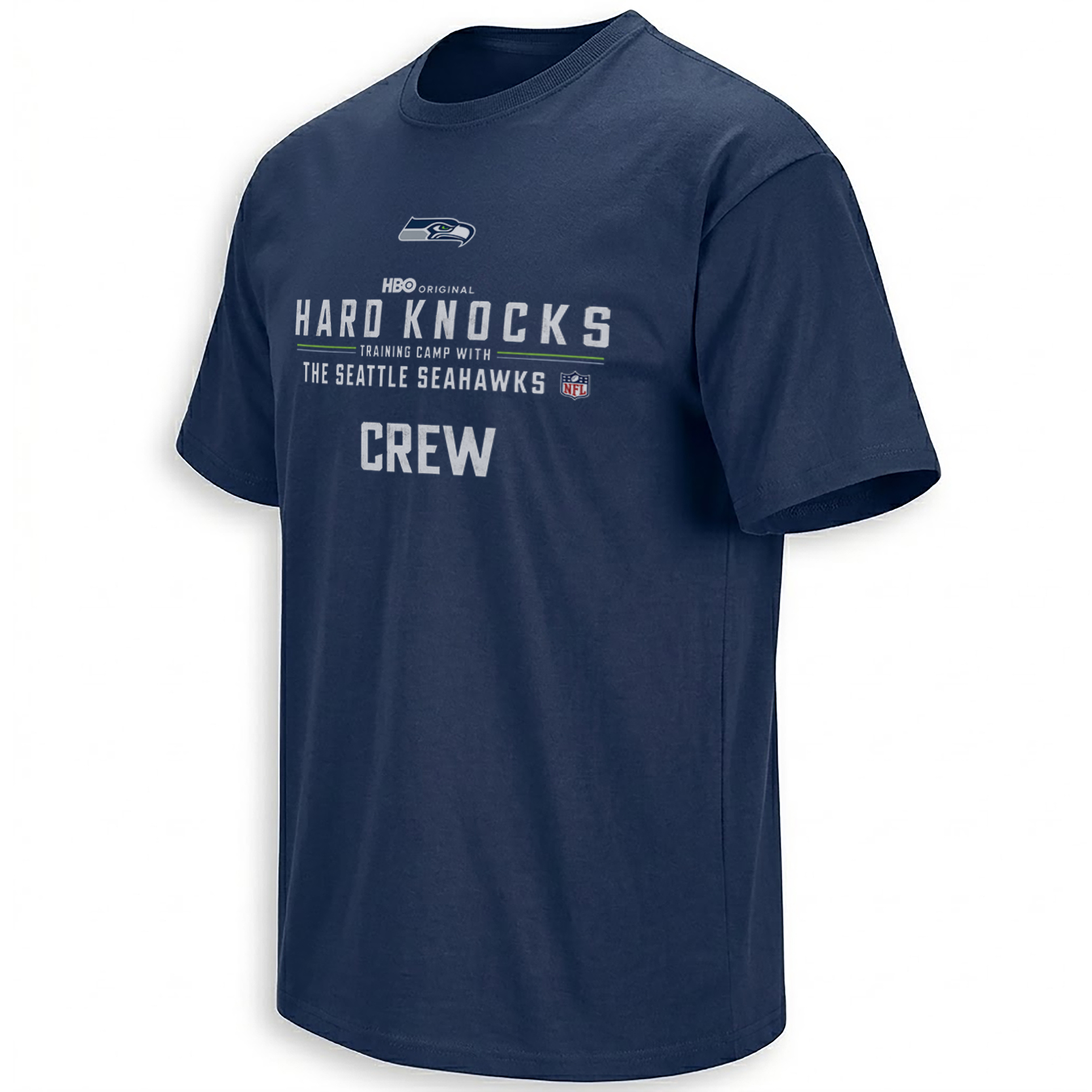
The Hard Knocks Crew graphic preserves Seattle’s televised championship camp, while the Seahawks visual archive follows the personalities and moments behind the attempt to repeat.
Hard Knocks Crew Shirt captures the Seattle Seahawks’ historic 2026 training-camp series, presenting the reigning champions as an ensemble cast preparing for an NFL title defense under the cameras.