
Bryce Harper Returns to Right Field: Why “Anything for Philly” Defines This Playoff Push
Bryce Harper’s return to the Citizens Bank Park outfield was not a nostalgic experiment. It was a four-position reshuffle designed to make room for Luis Arraez and give Philadelphia another way to rescue its 2026 season.
Bryce Harper carried an outfielder’s glove on the road before the Phillies officially needed him to use it. That detail explains the emotional logic of his return to right field better than any lineup card. Philadelphia had reached the trade deadline searching for offense, flexibility and evidence that a difficult summer could still become an October run.
The arrival of Luis Arraez produced the answer—and forced four positions to move at once. Arraez went to second base, Bryson Stott shifted to third, Alec Bohm moved across the diamond to first and Harper returned to the outfield for the first time in a Major League game since April 16, 2022.
Harper had spent years saying he would move back if the Phillies genuinely needed it. When the moment arrived, he repeated the promise in language Philadelphia immediately understood: he would do whatever gave the organization a better chance to win. “Anything for Philly” therefore reads less like marketing copy than a compact interpretation of the decision.
Philadelphia did not ask Harper to revisit the past for ceremony. It asked him to make the present lineup work.
Why the Return Carried Four Years of Meaning
Harper’s absence from the outfield began with damage to the ulnar collateral ligament in his throwing elbow during the 2022 season. He continued hitting as a designated hitter, underwent surgery after Philadelphia’s World Series run and later rebuilt his defensive identity at first base.
The transition was successful enough that first base stopped feeling temporary. Harper became comfortable there, protected his arm and remained central to the Phillies’ daily structure. A return to right field gradually became one of those baseball possibilities discussed every winter but rarely treated as an immediate plan.
That changed when Philadelphia acquired Arraez. The four-time All-Star and batting-title specialist brought the contact skill the lineup needed, but placing him at second required the rest of the diamond to bend around him. Harper became the hinge that allowed the complete move to happen.
The Outside Image Behind the Position Change
The visual story began before Harper reached the grass. Philadelphia’s deadline reshuffle was possible because he remained dangerous enough at the plate to justify changing the defense around him. His swing in Baltimore shortly before the move captured that continuing offensive authority.

The Social Image: Back in the Office
Philadelphia’s official social post needed only four words—“Back in the office.” Fans understood the location immediately. Harper jogging toward the right-field stands restored an old Citizens Bank Park picture, even though the competitive circumstances were entirely new.
The post worked because right field had once been Harper’s normal workplace. He won the 2021 National League MVP while primarily playing there, built a relationship with the fans positioned near the foul line and developed familiar warmup routines that returned almost instantly.
Why “Anything for Philly” Fits Harper’s Public Identity
Harper’s relationship with Philadelphia has always been built around visible emotional investment. He does not present himself as detached from the standings, the crowd or the pressure surrounding the franchise. When the Phillies struggle, his frustration becomes part of the public conversation. When they surge, he performs the city’s confidence just as visibly.
That style creates occasional tension, but it also explains why the right-field move resonated. Harper had openly pushed for the front office to improve the roster. Returning to the outfield ensured that his demand for help came with a personal concession.
He was not asking teammates alone to accommodate Arraez. He was accepting the physically riskier and less familiar role that made the trade’s full lineup effect possible.
“Anything for Philly” connects roster urgency with personal responsibility. It frames Harper not simply as the star requesting reinforcements, but as the player willing to alter his own role once reinforcements arrived.
The Move Is Temporary, but the Memory May Not Be
Harper emphasized that he expects to return to first base in 2027. That distinction matters. Philadelphia is not permanently undoing the defensive solution it created after his elbow surgery. It is using a temporary alignment to maximize one specific postseason chase.
Temporary changes often become powerful fan memories because they reveal the stakes of a season. A player moving positions in April can look like experimentation. The same move after the trade deadline becomes evidence that the club understands how little time remains.
Every ball hit toward Harper now carries a layer of anticipation. Fans are not only evaluating the play. They are measuring whether the risk behind the lineup reshuffle is producing the competitive advantage Philadelphia imagined.
How the Graphic Captures a Philadelphia Type of Loyalty
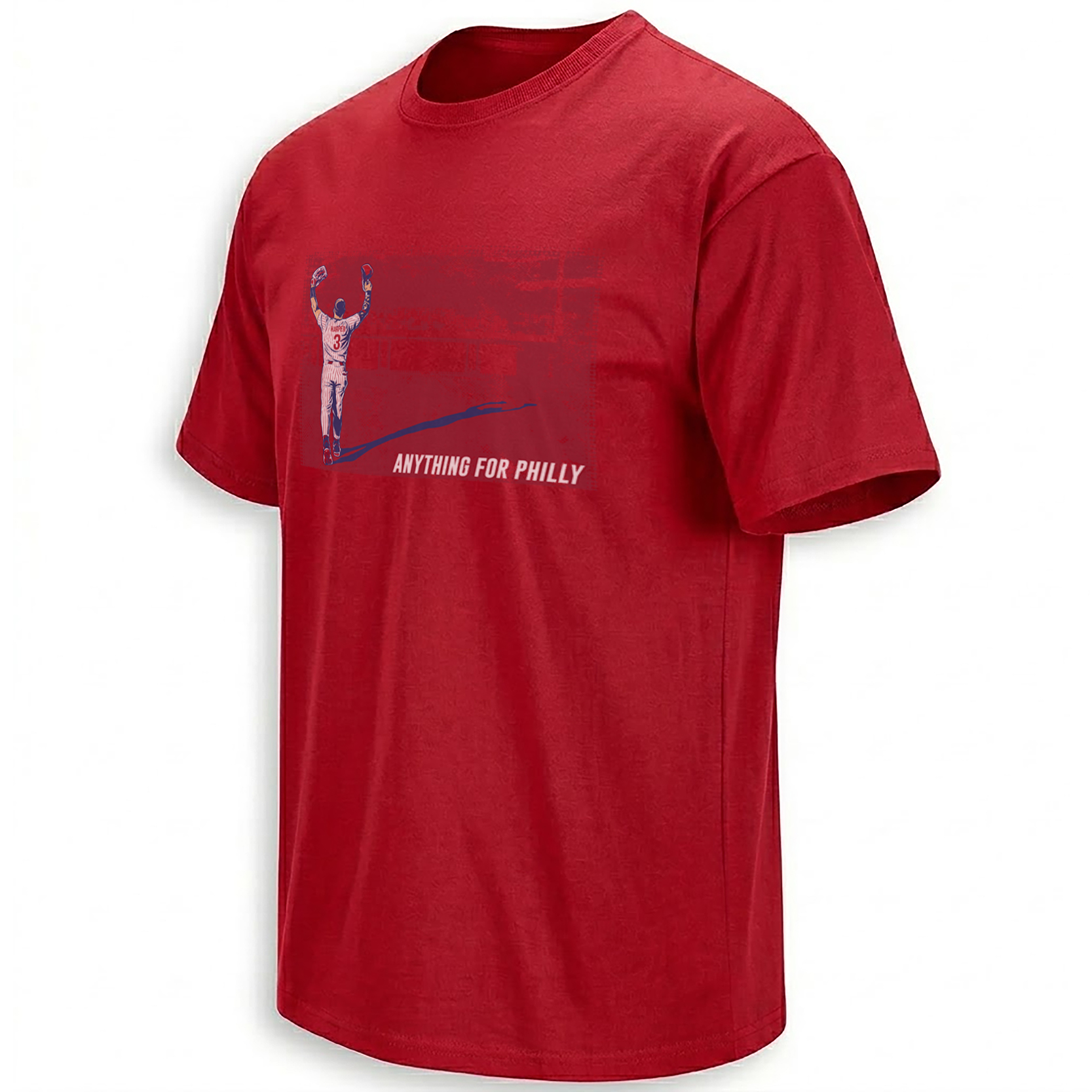
The design uses Harper in motion rather than presenting a static portrait. That decision gives the phrase physical evidence. “Anything for Philly” is connected to action: running, throwing, changing positions and accepting the responsibility attached to unfamiliar defensive work.
Red and cream create a vintage Philadelphia sports-poster feeling, while the distressed lettering gives the message the texture of something painted on a clubhouse wall. The composition does not treat Harper’s return as a clean corporate announcement. It feels urgent, worn and connected to the pressure of late summer.
Within the wider Philadelphia Phillies collection, the graphic becomes part of a running archive of Harper moments, clubhouse slogans and playoff emotions. The broader MLB collection places the position switch inside baseball’s larger culture of trade-deadline sacrifice and postseason reinvention.
Frequently Asked Questions
Why did Bryce Harper return to right field?
Harper moved to right field so Luis Arraez could play second base, Bryson Stott could shift to third and Alec Bohm could take over at first.
When had Harper last played in the outfield?
Before the 2026 return, Harper had not played the outfield in a Major League game since April 16, 2022.
Is Harper’s move to right field permanent?
Harper described it as a temporary move for the remainder of the 2026 season and expects to return to first base in 2027.
What does “Anything for Philly” mean?
The phrase reflects Harper’s willingness to change positions and accept additional physical risk if it improves Philadelphia’s chance to win.
How did the Luis Arraez trade affect the Phillies defense?
The trade triggered a four-position reshuffle involving Arraez, Stott, Bohm and Harper.
The Anything for Philly graphic preserves the right-field return, while the Philadelphia baseball archive follows the players, slogans and lineup changes shaping the postseason chase.
Anything for Philly Shirt captures Bryce Harper’s 2026 return to right field, the defensive reshuffle created by the Luis Arraez trade and his willingness to change roles for Philadelphia’s playoff push.