
Pete Crow-Armstrong Put 40/40 Into Cubs History at Wrigley Field
Pete Crow-Armstrong already had the power number. On September 24, one first-inning sprint to second base completed the equation — 40 home runs, 40 stolen bases, the first 40/40 season in Cubs history and a postseason clinch on the same afternoon.
Wrigley Field knew what was happening before Pete Crow-Armstrong reached second base. He walked to open the bottom of the first against Miami, and with Seiya Suzuki at the plate, the crowd was already waiting for one specific decision. Crow-Armstrong had entered September 24 with 45 home runs and 39 stolen bases. One clean jump would put him into one of baseball’s smallest statistical clubs.
On the first pitch to Suzuki, PCA ran. He slid into second ahead of the play, pointed upward, then stood as the stadium reaction expanded around him. The video boards switched to 40/40. He raised his helmet. Fans in the bleachers waved “MV-Pete” flags. The normal rhythm of the inning briefly disappeared because everyone understood the number.
By the end of the afternoon, the memory had doubled. Chicago beat the Marlins 2–1 and secured a postseason berth. One of the most unusual individual achievements in franchise history and the team’s ticket back to October had happened inside the same Wrigley game.

Why 40/40 Still Feels Like Baseball’s Cleanest Power-Speed Symbol
Baseball produces endless advanced numbers, but 40/40 survives because nobody needs the metric explained. Forty homers means enough power to live among the sport’s elite sluggers. Forty steals means enough speed, timing and confidence to repeatedly change innings with legs alone. Put them together and the contradiction becomes the achievement.
Before Crow-Armstrong, only José Canseco, Barry Bonds, Alex Rodriguez, Alfonso Soriano, Ronald Acuña Jr. and Shohei Ohtani had recorded a 40-homer, 40-steal season. PCA became No. 7 — and the first player ever to put a Cubs uniform into that list.
The number works because it describes two different baseball players at once: the hitter pitchers fear and the runner catchers cannot relax around.
The Home-Run Half Was Finished Weeks Earlier
The milestone did not arrive all at once. Crow-Armstrong had already reached 40 home runs on September 6 in Miami. That swing made him the first left-handed Cubs batter since Billy Williams in 1970 to reach the mark and the first Chicago player of any handedness since Derrek Lee in 2005.
By the time he returned to Wrigley for the September 24 clincher, the home-run total had climbed to 45. That is important visually because the design does not treat 40 and 40 as two identical accomplishments. One half represents something already accumulated through months of violent swings. The other represents the final piece fans were actively waiting to see.
A large PCA batting pose intersects the first 40, representing the home-run side of a season that reached 45 long balls.
A second sliding figure sits beneath the composition, translating the stolen-base half into motion rather than another static player portrait.
The Design Turns the Statistic Into a Visual Equation
The Pete Crow-Armstrong 40/40 Club design works because there is almost no excess language. The giant numbers do the reporting. Small HR and SB labels tell the viewer how to read them, while the two Crow-Armstrong poses explain why a single player owns both sides.
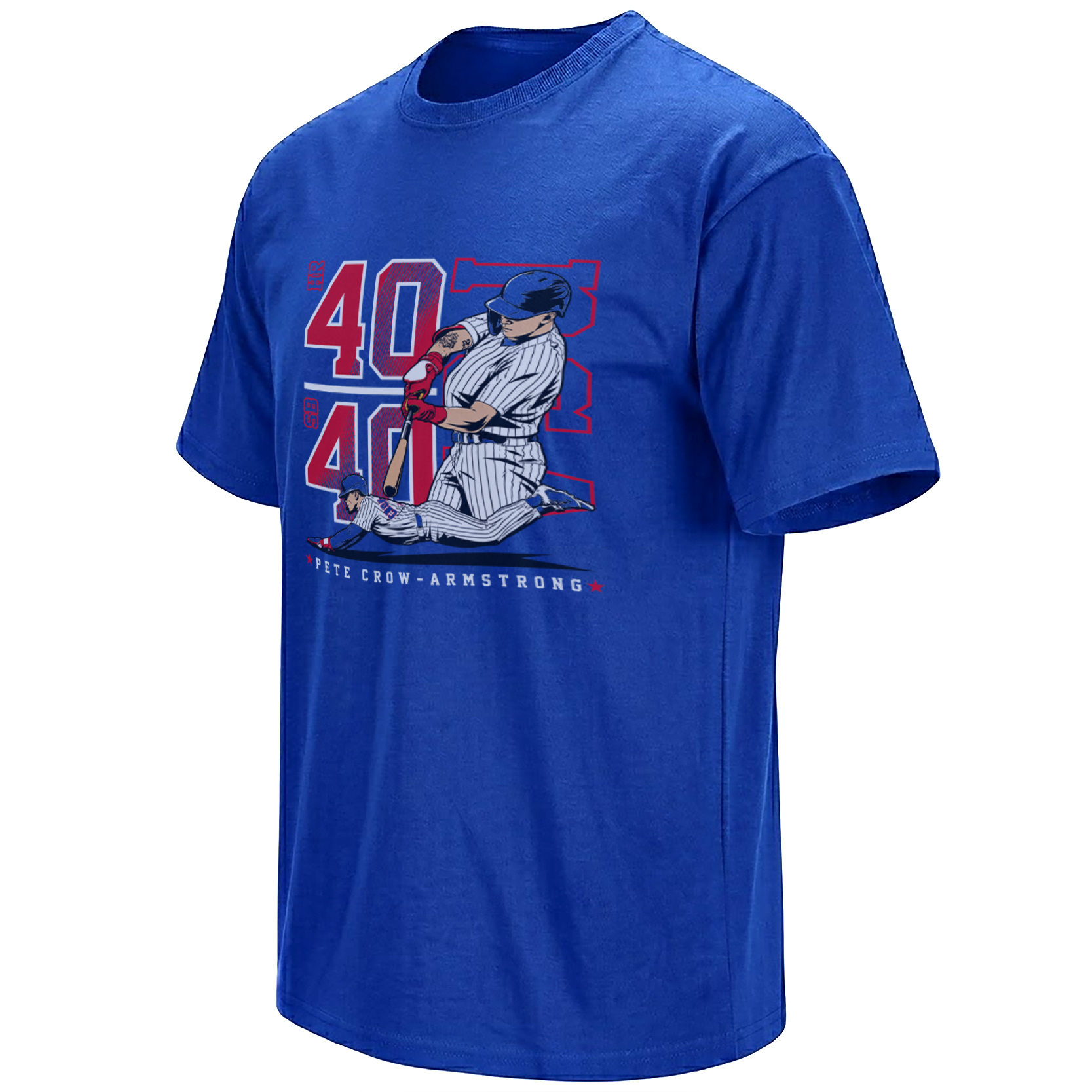
Oversized HR and SB numbers divide the image into power and speed, while the batting and sliding poses turn PCA’s historic season into a simple visual equation.
View the 40/40 piece →Royal blue gives the graphic a strong Chicago base, but red and white breaks keep the giant numerals from becoming flat. The distressed shading matters too. A perfectly polished treatment could look like a generic stat graphic. Texture makes it feel closer to a postseason poster already carrying the wear of a season.
Wrigley Turned the Milestone Into an Emotional Moment
The reaction after the steal gave 40/40 another dimension. Crow-Armstrong later admitted the ovation affected him. He had heard “P-C-A” chants since reaching the majors, but by 2026 those chants had increasingly turned into “M-V-P.” On September 24, the two identities met: the young center fielder fans had adopted and the superstar whose season had become historically difficult to describe without records.
That public reaction is part of why the milestone belongs to Wrigley culture instead of living only on a stat page. PCA did not quietly finish the year with two matching round numbers. The final required piece happened in front of a crowd that knew exactly what it had been waiting for.
45–41 Makes the 40/40 Label Even Better
Crow-Armstrong ultimately finished the regular season with 45 home runs and 41 stolen bases. In other words, 40/40 is not the final stat line. It is the threshold that tells the story best.
That distinction is useful for fan culture. “45 HR, 41 SB” is more precise. “40/40” is more memorable. It places the season beside other famous power-speed campaigns immediately, while still leaving room to remember everything else PCA added through defense, baserunning and center-field range.
Fans following Crow-Armstrong specifically can browse the Pete Crow-Armstrong search archive. The broader Chicago Cubs collection tracks Wrigley moments, postseason graphics and current-player culture, while the MLB collection places the 40/40 achievement inside the wider visual story of the 2026 season.
Frequently Asked Questions
When did Pete Crow-Armstrong join the 40/40 Club?
He reached the milestone on September 24, 2026, by stealing second base in the first inning against the Miami Marlins at Wrigley Field.
Was Pete Crow-Armstrong the first Cub with a 40/40 season?
Yes. Crow-Armstrong became the first player in Chicago Cubs history to record at least 40 home runs and 40 stolen bases in one season.
How many MLB players have recorded a 40/40 season?
Crow-Armstrong became the seventh player in Major League history to join the club.
What were PCA’s final 2026 home-run and stolen-base totals?
He finished the regular season with 45 home runs and 41 stolen bases.
Why does the design feature two Pete Crow-Armstrong poses?
The batting pose represents the home-run side of the achievement, while the sliding figure represents the stolen-base side, visually separating power and speed.
The PCA 40/40 graphic preserves the number Wrigley waited to see, while the wider Chicago Cubs archive follows the postseason story surrounding one of the franchise’s most unusual individual seasons.
Pete Crow-Armstrong 40/40 Club Shirt captures the first 40-homer, 40-steal season in Cubs history through oversized milestone numbers, dual power-and-speed poses and the Wrigley moment that completed it.