
Kyle Tucker’s “King Tuck” Doodle Looks Like the Crown Was Drawn in the Dugout
The nickname is old. The Los Angeles uniform is new. The intentionally ridiculous crown sketch works because it refuses to turn Kyle Tucker into another polished superstar poster — and September finally supplied a Dodgers moment worthy of the joke.
Kyle Tucker did not arrive in Los Angeles needing a nickname. He brought one with him. “King Tuck” had already followed the smooth left-handed outfielder through Houston, Chicago and years of baseball conversation before the Dodgers ever placed No. 23 on his back.
The crown was not invented by a T-shirt designer, either. During Houston’s 2022 postseason run, Astros fans showed up at Minute Maid Park wearing gold crowns specifically for Tucker. Some groups distributed hundreds of them around right field. The visual language was simple enough to travel: Tucker was “King Tuck,” therefore the crowd became his ridiculous baseball court.
When Los Angeles introduced him in January 2026 after signing him to a four-year, $240 million contract, even the Dodgers used the established nickname. Their social post was almost comically concise: “A message from King Tuck.” The crown had crossed state lines with him.
Houston fans were already wearing gold crowns for “King Tuck” during the 2022 postseason. The Dodgers inherited an existing piece of fan language rather than manufacturing a new nickname for their 2026 signing.
The First Dodgers Season Was Not a Clean Coronation
That history actually makes the 2026 version more interesting. Tucker’s first year in Los Angeles did not unfold like a ceremonial transfer of power. By early September his overall production remained well below the career standards that made him one of the offseason’s biggest additions.
There were stretches when the “King” language felt almost deliberately ironic. The roster around him contained Shohei Ohtani, Mookie Betts, Freddie Freeman and a collection of other recognizable stars. A crown alone was never going to guarantee attention in Los Angeles.
Then the bat started looking healthier at exactly the right time. Dodgers manager Dave Roberts pointed to changes in Tucker’s bat path and his ability to stay through the hitting zone. The mechanical explanation mattered because September’s better results were not framed simply as luck.
Great nickname. Expensive new team. Uneven season. One giant September swing. Draw crown badly. Write KING TUCK underneath. Done.
September 11 Gave “King Tuck” a New Los Angeles Image
In Miami on September 11, Tucker produced the kind of game that makes an old nickname feel current again. He went 3-for-3, drove in five runs and finished only a double short of the cycle as the Dodgers beat the Marlins 6–2 for their eighth consecutive victory.
The defining swing came in the seventh inning. Los Angeles led only 2–1 when Miami brought in left-hander Cade Gibson with the bases loaded. Tucker turned on a sweeper and drove it approximately 395 feet to right-center. The ball left his bat at 103.8 mph. Suddenly the margin was 6–1.
It was his sixth career grand slam and his 14th home run of the season. More importantly for the surrounding culture, it looked like the version of Tucker Los Angeles had imagined when the contract was announced: a calm middle-of-the-order hitter turning one pitch into a game-changing result.

The nickname survived the slump. One grand slam did not rewrite the whole season, but it gave the crown a fresh photograph.
The Doodle Is Fun Because It Refuses to Look Professional
That is where the King Tuck Doodle design separates itself from a normal player tribute. The artwork does not attempt to make Tucker handsome, heroic or anatomically convincing.
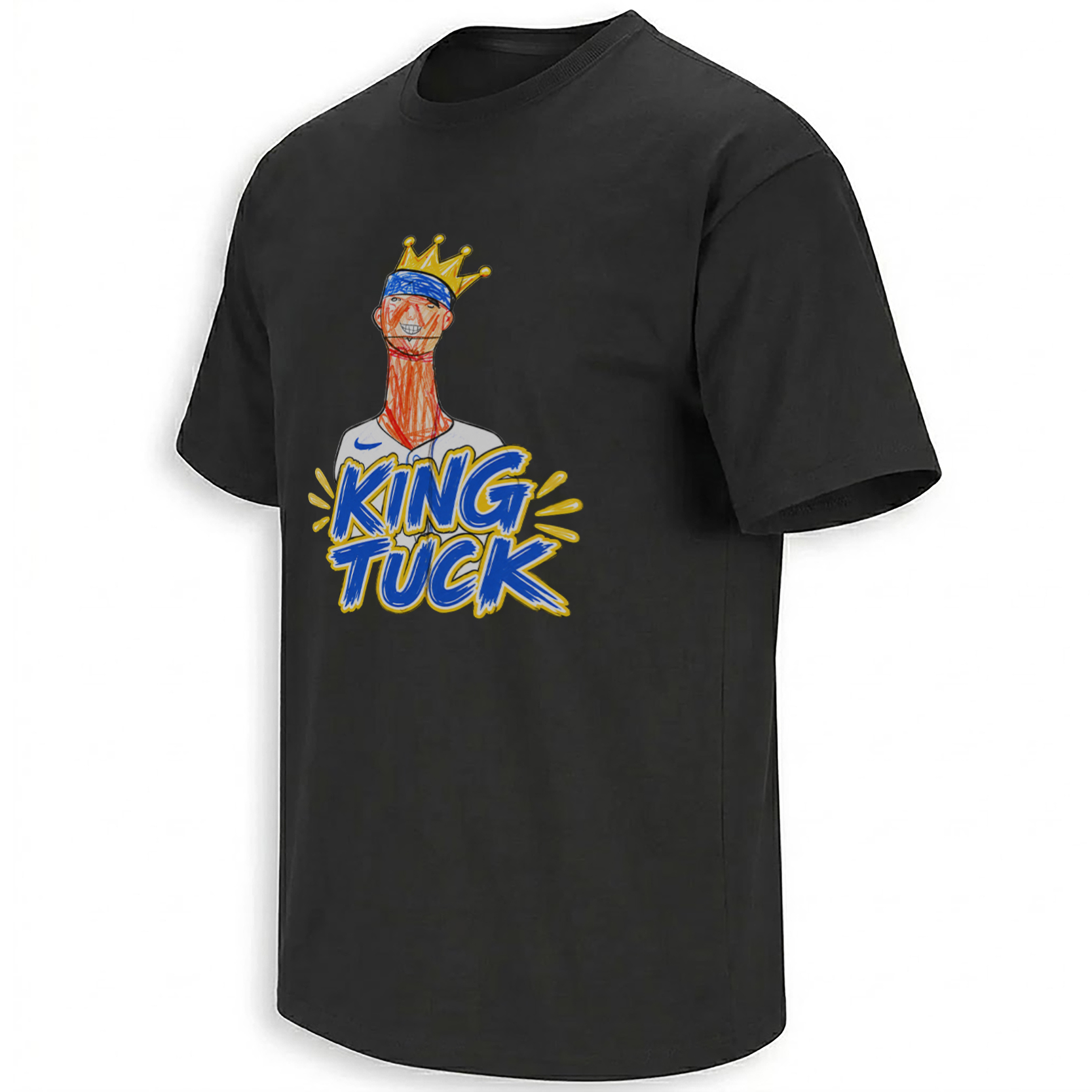
A crooked gold crown, blue headband, exaggerated long-neck portrait and marker-like lettering turn Tucker’s established nickname into something closer to dugout fan art than polished baseball branding.
Open the doodle →The neck is too long. The grin is too wide. The orange-red facial lines look scribbled. The crown is oversized and tilted. Even the proportions feel like someone was drawing Tucker from memory rather than from a photograph.
That imperfection is the entire personality. Internet sports culture increasingly rewards graphics that look accidentally funny: locker-room whiteboard sketches, fan signs, crude MS Paint edits, player caricatures and screenshots that would once have been considered too rough for merchandise. Their value comes from appearing closer to the joke than to the marketing department.
The black background helps because the loose blue, white and gold marks appear almost like paint-pen strokes on a clubhouse board. Huge “KING TUCK” lettering beneath the portrait identifies the idea before the viewer has time to inspect whether the face looks anything like Tucker.
The Dodgers Themselves Kept the Nickname Alive
The January introduction matters because it verifies that “King Tuck” did not disappear when Tucker changed teams. Los Angeles openly used the nickname while welcoming its new right fielder, giving longtime fans an easy bridge between his earlier career and the new No. 23 identity.
September then supplied new material. Tucker followed the Miami grand slam with more strong games, including four hits, two doubles, a home run and three RBI at Cincinnati on September 17, followed by another homer the next night against San Francisco. It was not enough to turn the entire first Dodgers season into a dominant statistical year, but it changed the immediate tone as October approached.
Why a Bad Drawing Can Preserve a Player Better Than a Perfect One
A realistic Tucker portrait would always compete against thousands of professional photographs. The doodle has no such problem. Its ugliness is distinctive. The ridiculous neck, crown and handwritten energy become the identifying features.
That makes the design less about documenting September 11 literally and more about how fan culture absorbs a performance afterward. A strong game produces a nickname revival. The nickname produces a visual joke. The visual joke looks intentionally homemade. The whole sequence feels closer to how fans actually communicate online than another dramatic poster with smoke effects and stat numbers.
Readers following Tucker specifically can browse the Kyle Tucker search archive. The Los Angeles Dodgers collection tracks the wider 2026 Los Angeles playoff culture, while the MLB collection places player nicknames and viral graphics inside the larger baseball season.
Frequently Asked Questions
Why is Kyle Tucker called “King Tuck”?
“King Tuck” is a longstanding Kyle Tucker nickname that predates his Dodgers career and inspired crown-themed fan traditions during his years in Houston.
Did the Dodgers use the King Tuck nickname?
Yes. Los Angeles used the phrase “King Tuck” in its official social media introduction after signing Tucker in January 2026.
What happened in Kyle Tucker’s September 11 game against Miami?
Tucker went 3-for-3 with five RBI, hit a seventh-inning grand slam and finished one double short of the cycle in a 6–2 Dodgers victory.
Why is the King Tuck Doodle intentionally badly drawn?
The crude proportions, scribbled face and oversized crown create the humor. The graphic imitates fan art or a clubhouse sketch rather than polished player illustration.
Is the King Tuck Doodle specifically a grand-slam design?
No. The Miami grand slam gives the graphic timely 2026 context, but the core concept is Tucker’s established King Tuck nickname and crown imagery.
The King Tuck Doodle works because it looks like someone celebrated Tucker’s nickname with a marker and five minutes of free time, while the wider Dodgers archive records the more serious postseason story happening around it.
King Tuck Doodle Shirt turns Kyle Tucker’s longtime nickname into intentionally crude Dodgers fan art, pairing a crooked gold crown and sketchbook portrait with his September 2026 resurgence.