Packers Barbell: Titletown Football Built Under Resistance
Green Bay’s first 2026 preseason result was a 28–9 loss in Pittsburgh, but a Barbell graphic does not need a manufactured winning headline. Its real story was already developing at Ray Nitschke Field, where pads raised the intensity, offensive-line combinations kept changing and the Packers spent August forcing their protection unit to solve increasingly difficult pressure looks.
Few NFL cities connect football and labor as naturally as Green Bay. The market is small, the history is enormous and training camp remains unusually visible to fans through practices, bicycles, Family Night and the daily rhythm around Lambeau Field.
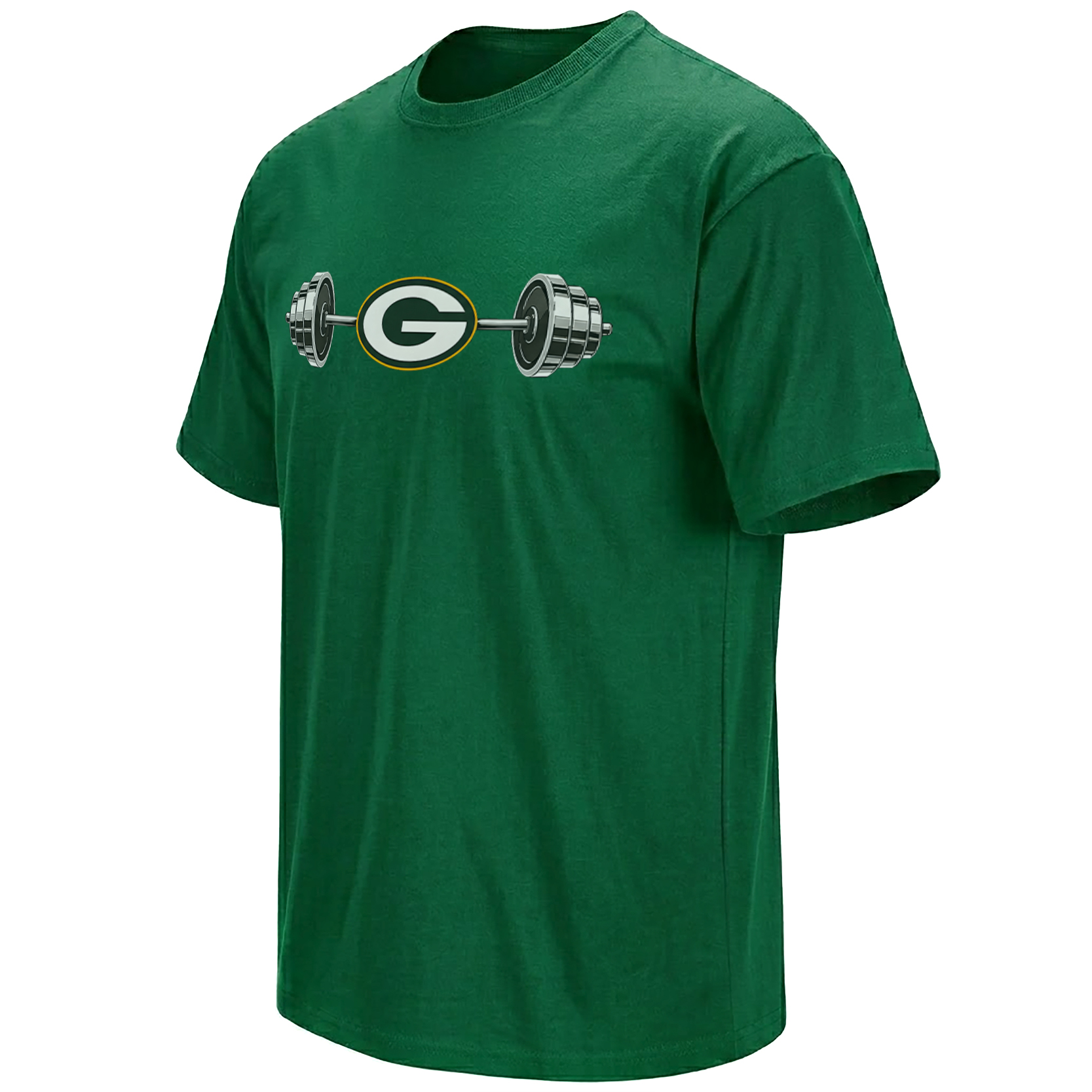
A loaded bar fits that environment because it is almost aggressively uncomplicated. There is no scoreboard attached to it. No championship can be won in the weight room. The athlete either controls the resistance or discovers what still needs work.
That is where Packers Barbell belongs in August 2026. Green Bay has moved through padded practices, experimented with offensive-line combinations and used Jonathan Gannon’s new defensive pressure packages to test the communication protecting Jordan Love.
In Titletown, strength works best as a process rather than a pose: add resistance, protect the technique and find out what survives.
The pads turned Green Bay’s camp into a strength test
Packers coverage described the transition simply: pads went on and intensity went up. That is the point where football strength becomes measurable in a way offseason drills cannot fully reproduce.
An offensive lineman can demonstrate footwork without pads, but once contact becomes realistic the body must manage a completely different type of load. A defender can convert speed into power. A guard has to redirect weight without losing his base. A tackle must keep his hands connected while retreating against force.
Those are the football movements hidden inside the Barbell graphic. The loaded bar is only the symbol. The real meaning is whether a player’s strength can stay useful while another athlete actively tries to break the movement.
Anthony Belton gives Green Bay a natural Barbell figure
Anthony Belton is a useful example because his physical dimensions are impossible to separate from the discussion around his development. Packers coverage has described him as the largest offensive lineman the franchise has drafted by height and weight.
That alone does not make him effective. In fact, it sharpens the central Barbell question. Once an athlete already possesses unusual size, development becomes less about adding an impressive number to a lift and more about learning how to apply the existing physical tools.
Green Bay has moved Belton between guard and tackle work as injuries and camp combinations have shifted. On August 6 he received right-tackle reps while Jacob Monk worked alongside him at right guard, giving the Packers another look at how their pieces communicate against pressure.

Pressure packages make strength more complicated
The August 6 practice supplied one of the more interesting contexts for the design because new defensive coordinator Jonathan Gannon was sending pressure from multiple locations — inside, slot and outside.
Jordan Love described the resulting communication as valuable work for the offensive line, running backs and quarterbacks. That matters because strength by itself cannot solve a pressure look. Five powerful linemen can still allow a free rusher if the protection is identified incorrectly.
That gives the Barbell metaphor another layer. Physical capacity is only one plate on the bar. Communication, recognition and technique add the others.
Dark Packers green gives the page a cold-weather training-room base, while gold acts like aged athletic lettering rather than a flashy accent. Cream and muted surfaces create the atmosphere of an old football program preserved inside a modern camp.
The Pittsburgh loss actually makes the graphic more credible
Green Bay lost its preseason opener 28–9. Pittsburgh’s second half exposed problems that a cleaner marketing story might prefer to ignore, including sacks, stalled drives and depth players still trying to prove they belong on the final roster.
But training culture is useful precisely because weakness gets exposed. The purpose of adding resistance is not to confirm that an athlete is already complete.
Preseason works the same way. The result gives coaches film, reveals protection failures and places inexperienced players against unfamiliar opponents. Packers Barbell therefore works better as a camp artifact than a victory souvenir.
Why Green Bay should feel older than the other Barbell teams
The visual concept also has a natural historical advantage. Packers football carries more than a century of memory, so green and gold already feel capable of holding an old-program aesthetic without forcing artificial distressing into every detail.
Detroit’s Barbell world belongs to industrial steel. Las Vegas belongs to black iron. Tampa feels like heated pewter. Green Bay can feel like a strength manual discovered in a Lambeau equipment room — practical, traditional and built to last through another Wisconsin winter.
Readers looking for Belton-specific products can continue through the Anthony Belton product search, while the Green Bay Packers collection keeps the Barbell graphic connected to the wider Titletown visual archive.
The broader NFL collection shows how one weightlifting framework changes character as it moves from Green Bay to Philadelphia, Baltimore, Kansas City, Dallas and beyond.
Frequently Asked Questions
Why does a barbell fit Green Bay Packers culture?
The barbell represents repetitive preparation, physical resistance and strength translated into football technique, fitting naturally with Green Bay’s work-first training-camp identity.
Why is Packers Barbell relevant during the 2026 training camp?
Green Bay has moved through padded practices, shifting offensive-line combinations and pressure-heavy defensive work designed to test protection and communication.
Is Packers Barbell an Anthony Belton shirt?
No. Belton is a useful current example of Green Bay’s strength-and-development story, but Packers Barbell represents the wider team identity.
What happened in Green Bay’s first 2026 preseason game?
The Packers lost 28–9 to the Pittsburgh Steelers at Acrisure Stadium on August 13, 2026.
Why does the Packers version use a vintage green-and-gold mood?
Green Bay’s long football history allows the strength-program concept to feel like an archival athletic mark rather than simply a modern gym graphic.
The Packers Barbell graphic captures that preparation-first side of Green Bay football, while the Packers archive tracks the players, slogans and cultural moments surrounding the team.
Packers Barbell Shirt turns Green Bay football strength into a green-and-gold weightlifting graphic, connecting Titletown culture with padded 2026 training camp, Anthony Belton and the offensive-line work happening at Ray Nitschke Field.