Commanders Barbell: Raise Hail Starts at the Line of Scrimmage
Washington’s 2026 camp made the transition into football strength unmistakable. On August 3 the pads went on for the first time, linebackers began arriving with audible contact, the offensive and defensive lines moved into pass-protection battles and Sam Cosmi literally put Javon Kinlaw on the ground during one of their early physical matchups.
A barbell is useful as football symbolism because it removes every tactical complication from resistance. Weight sits at both ends. The athlete must control the center.
Washington’s first padded practice added all of football’s complications back in at once.
Sonny Styles met Jacory Croskey-Merritt at the line of scrimmage with a hit that could be heard from the sideline. Laremy Tunsil worked pass protection. Sam Cosmi and Javon Kinlaw traded physical reps. Odafe Oweh tested tackles with speed.
This is where Commanders Barbell stops being a gym crossover and starts becoming a timestamp of Washington’s 2026 build.
The Barbell image makes sense in Washington because camp has already turned strength into something audible: pads colliding, linemen trading leverage and defenders meeting runners at the line.
The first padded snap set the atmosphere
Washington did not ease into the first day of pads. The opening competitive work started near the goal line, and Styles immediately met Croskey-Merritt at the line of scrimmage before producing another run stop later in the session.
That matters because the first padded practice changes the information available to coaches. Speed and spacing still matter, but contact introduces a different truth. A runner has to maintain balance through impact. A linebacker must arrive under control. A blocker needs enough leverage to keep a defender from entering the lane.
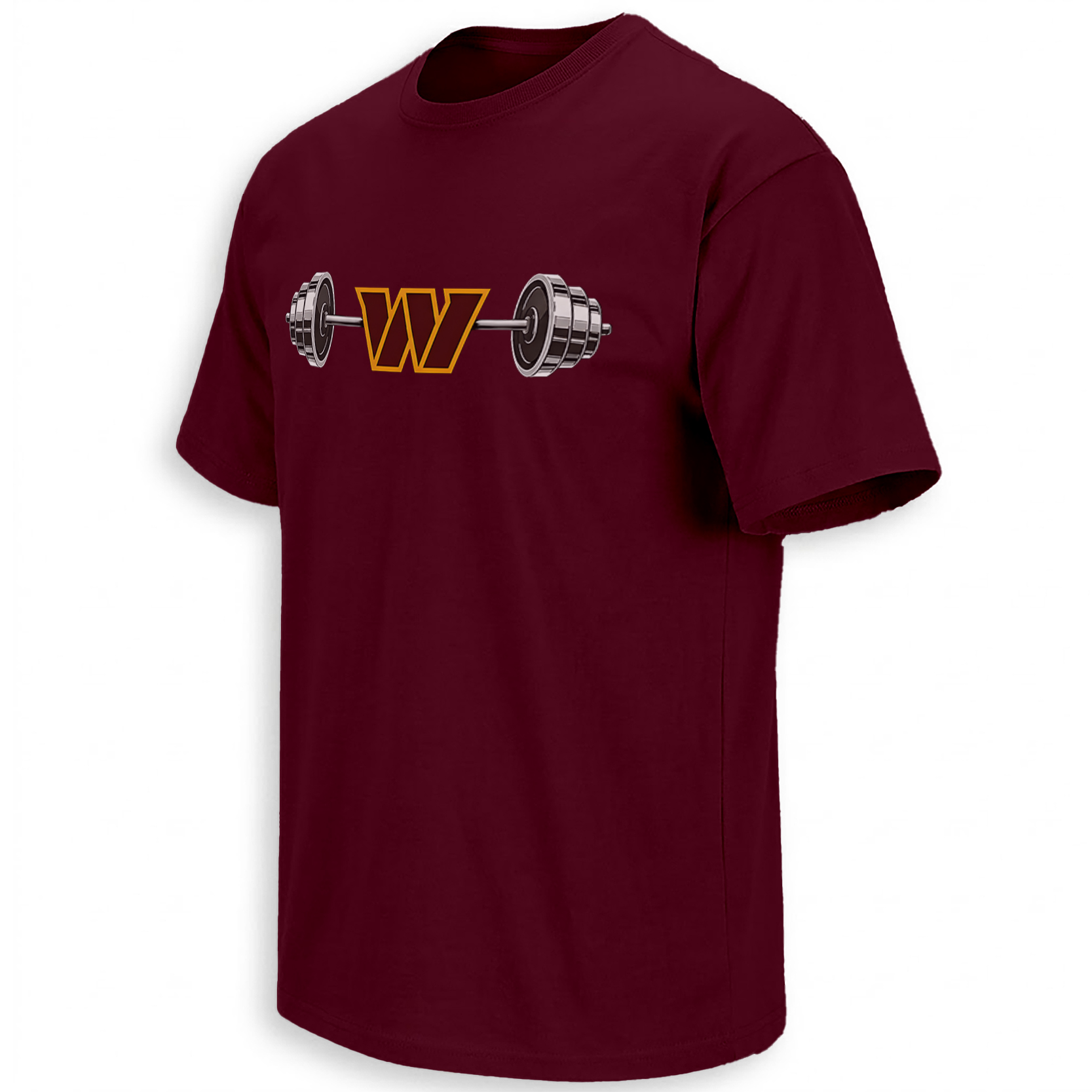
Those are the physical problems hiding inside the Commanders Barbell graphic.
Sam Cosmi provides the clearest trench translation
The offensive and defensive linemen spent part of that first padded practice away from the seven-on-seven attention, running pass-protection drills.
Cosmi faced Kinlaw twice. The first meeting ended with Cosmi putting the defensive tackle on the ground. The second was more balanced.
That two-rep sequence is almost a perfect explanation of football strength. A single dominant rep does not settle the question. The opponent adjusts. The second rep changes. Technique and leverage have to be reproduced.
That is what separates the Barbell concept from simply saying a player is strong. Strength has to work repeatedly against someone capable of changing the problem.

The team itself marked the moment on social
Washington’s official social account distilled the same transition into the shortest possible message. The significance was obvious enough that the post needed only two words and an emoji: the pads were on.
The Miami game turned strength into 174 rushing yards
Washington’s preseason opener supplied the next layer. The Commanders beat Miami 20–7 at Northwest Stadium even while sitting more than two dozen major contributors.
The rushing offense produced 174 yards. Robert Henry Jr. became one of the clearest stories of the night, including a 22-yard touchdown that developed behind a reach block from rookie Matt Gulbin.
Again, the useful Barbell connection lives one level beneath the highlight. Henry supplied the burst, but the lane had to exist first. A blocker had to reach position, control the defender and create enough space for speed to matter.
Washington’s burgundy provides visual weight, gold works as an old athletic-program accent and muted sand gives the page the feeling of a field manual rather than a glossy commercial layout. The Barbell motif stays disciplined and functional.
Laremy Tunsil brings veteran technique into the concept
Tunsil is useful in a different way from Cosmi. Elite tackle play demonstrates why strength and body control cannot be separated.
An edge defender can win with speed, power or a combination of both. The tackle needs enough anchor strength to absorb force but also enough movement to respond when the defender changes direction.
That makes Tunsil a good reference point for a team-level Barbell design without turning the artwork into a player-specific shirt.
Readers following Tunsil specifically can continue through the Laremy Tunsil product search, while Commanders Barbell remains focused on the physical identity of the entire roster.
Why Washington’s version should feel tactical rather than industrial
Detroit’s Barbell world naturally belongs to factories. Las Vegas belongs to steel. Tampa belongs to heated pewter. Washington needs another visual personality.
Burgundy, gold and muted field-manual neutrals let the design feel structured and tactical. The point is not to make a literal military graphic, but to borrow the visual idea of controlled preparation: clearly defined sections, restrained colors and strength serving a larger system.
That tone matches Dan Quinn’s football environment. Physicality is useful only when players remain connected to assignments and technique.
The Barbell idea fits the 2026 reset
Washington entered the season needing progress after a difficult 2025. That gives preseason development more emotional meaning than it would have for a team simply trying to maintain an established formula.
The 20–7 win does not prove the reset is complete, but it offers evidence that younger and depth players are competing within a structure that can produce something positive.
That makes Barbell culture particularly appropriate. The loaded bar is never a symbol of completion. It is a symbol of development.
The broader Washington Commanders collection captures the players, rivalry references and fan language surrounding that rebuild, while the NFL collection places Commanders Barbell inside the wider football-strength series.
Frequently Asked Questions
Why does a barbell fit Washington Commanders football culture?
The barbell represents controlled strength and preparation, themes visible in Washington’s padded practices, OL-DL battles and physical run-game work.
Why is Commanders Barbell timely during August 2026?
Washington began padded practice on August 3, worked heavily in the trenches and then opened the preseason with a 20–7 victory over Miami.
How did Washington’s offensive line connect to the Barbell theme?
Players such as Sam Cosmi, Laremy Tunsil and Matt Gulbin have appeared in physical protection and run-blocking situations that show how weight-room strength transfers onto the field.
How many rushing yards did Washington have against Miami?
The Commanders rushed for 174 yards in their 20–7 preseason-opening victory over the Dolphins.
Is Commanders Barbell a player-specific design?
No. The graphic uses the barbell as a team-level symbol of Washington football strength rather than focusing on one player.
The Commanders Barbell graphic captures that shift into padded football, while the Washington Commanders archive tracks the players and current culture developing around Raise Hail.
Commanders Barbell Shirt turns Washington football strength into a burgundy-and-gold weightlifting graphic, connecting Raise Hail culture with full-pad 2026 training camp, trench battles and the 20–7 preseason win over Miami.