
Colts Barbell: Indianapolis Football Starts Up Front
The Colts opened their 2026 preseason with a 13–13 tie in New England, but Indianapolis had already made the Barbell story unusually clear at Grand Park. Once full pads arrived, the team’s own coverage shifted directly toward an all-homegrown offensive line, Quenton Nelson’s standard and the question every strength program eventually has to answer: can power become useful football?
Some NFL Barbell concepts need interpretation. Indianapolis almost explains itself.
When the Colts put pads on during 2026 training camp, their own video coverage immediately moved the spotlight toward the offensive line. The unit is homegrown, experienced at key positions and anchored by one of the most visually recognizable interior linemen of his generation in Quenton Nelson.
That makes a loaded bar feel less like borrowed gym language and more like a condensed explanation of how Indianapolis wants part of its offense to function. Strength is supposed to create movement. Movement creates space. Space gives Jonathan Taylor a path.
Indianapolis does not need to invent a reason for a Barbell graphic. The offensive line already gives strength a central place in the team’s football language.
Full pads moved the spotlight directly to the offensive line
Colts.com described the transition clearly: the pads were on, the spotlight shifted to the offensive line and Nelson continued setting the tone for a unit viewed as one of Indianapolis’ strengths.
That framing is almost ideal for this design. A barbell has no tactical meaning by itself. The tactical meaning arrives when the strength is turned into a block — a guard pulling into space, a tackle anchoring against an edge rush or a center maintaining enough control to keep the quarterback’s platform clean.
The first padded practices allowed Indianapolis to evaluate those movements with real contact again. Day 6 was specifically described as a practice where physicality intensified during the Colts’ second padded session.
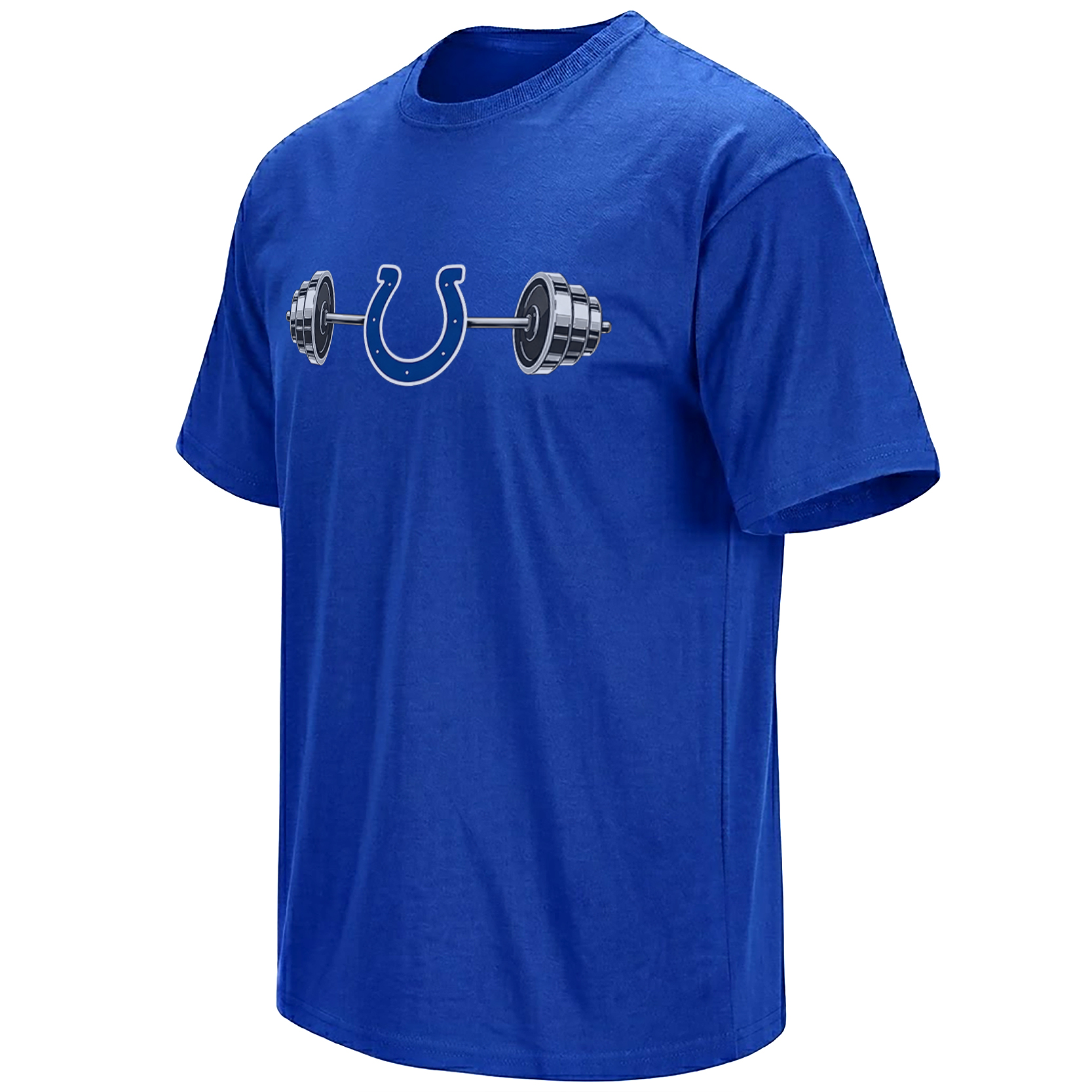
Quenton Nelson gives the Barbell concept instant credibility
Few NFL players make a football-strength graphic easier to understand than Nelson. Guard is a position where physical power appears almost immediately after the snap. The space is compressed, defenders are heavy and the collision arrives before a casual viewer has time to study the technique behind it.
But Nelson’s value has never been reducible to size or weight-room numbers. Interior offensive-line play requires the ability to generate force without losing balance, recover when the initial leverage is imperfect and coordinate movement with the linemen on either side.
That is why Colts.com describing Nelson as the player continuing to “set the tone” matters. The phrase is not a statistical award. It describes culture. Younger linemen inherit expectations from watching how a veteran prepares and practices.

An all-homegrown front changes the emotional meaning
The phrase “all-homegrown” gives the offensive-line story another layer. Indianapolis is not treating the group as a temporary collection of veteran fixes. Much of the unit has been drafted and developed inside the organization.
That creates continuity in a part of football where communication matters enormously. Linemen have to identify fronts together, understand how adjacent defenders may exchange responsibilities and feel when a teammate needs help without turning every snap into an explicit conversation.
Strength therefore becomes collective. One powerful guard cannot solve an entire pressure design if the line fails to communicate. The Barbell graphic can symbolize physical power, but Indianapolis’ current OL story reminds readers that football strength works best when five bodies act like one system.
Colts blue supplies a clean athletic identity while pale blue and white keep the page lighter than the steel-heavy Barbell versions used for Detroit or Las Vegas. A small leather-tone accent adds football texture without weakening the simple blue-and-white strength-program aesthetic.
Jonathan Taylor turns blocking strength into visible production
Running backs provide the easiest visual payoff for offensive-line work. The crease opens, the back reaches the second level and television naturally follows the football. The block that created the path may disappear from the frame almost immediately.
Jonathan Taylor’s role in Indianapolis makes that invisible labor especially important. Colts camp coverage has focused not only on Taylor’s presence but also on the depth behind him, partly because his 2025 workload was so substantial.
That places the Barbell design inside a broader offensive ecosystem. The guard moving a defensive tackle, the tackle securing the edge and the runner accelerating through the created space are all different stages of the same physical idea.
For readers interested specifically in Nelson-related designs, the Quenton Nelson product search extends naturally from this article without turning Colts Barbell itself into a player shirt.
The Patriots tie gave Indianapolis another resistance test
After joint work in Foxborough, Indianapolis and New England played to a 13–13 tie on August 13. Anthony Richardson Sr. completed 11 of 14 passes and rushed for 53 yards with a touchdown during his extended first-half opportunity.
The score is useful current context, but it does not need to define the Barbell design. For the line, the more important element was finally working against a different defensive system after weeks of seeing familiar teammates.
Joint practice and preseason football alter the resistance. The opponent’s hands arrive differently. Blitz communication changes. Defensive linemen use counters that Indianapolis blockers have not watched every day in meetings.
The strength has to remain useful even when familiarity disappears.
Why Colts Barbell should look cleaner than most of the series
Indianapolis has one of the simplest major color identities in football: blue and white. Rather than forcing additional visual noise into the concept, the Barbell design benefits from respecting that restraint.
Dallas can incorporate polished silver. Tampa can use weathered pewter. Baltimore can feel dark and pressurized. Indianapolis should feel like a clean football strength facility — blue equipment labels, white walls and the Horseshoe identity implied rather than repeated everywhere.
That clean visual direction mirrors Nelson’s role in the article. He does not need a complicated cultural explanation. His position and style already provide the connection between lifting and football.
Within the Indianapolis Colts collection, Barbell therefore works as the foundational physical piece beside player-specific and moment-specific designs.
The broader NFL collection turns the entire Barbell run into a map of football strength culture: one piece of equipment, many cities and very different interpretations of what physical identity means.
Frequently Asked Questions
Why does a barbell fit Indianapolis Colts football culture?
The current Colts offensive line gives the concept a natural connection to strength, leverage and physical preparation, with full-pad practices placing that unit at the center of camp coverage.
Why is Colts Barbell especially relevant during the 2026 training camp?
Indianapolis has emphasized its all-homegrown offensive line during padded work, with Quenton Nelson continuing to set the standard for the group.
Is Colts Barbell a Quenton Nelson shirt?
No. Nelson provides the clearest current example of Indianapolis offensive-line strength culture, but Colts Barbell represents the team rather than one player.
What happened in the Colts’ first 2026 preseason game?
Indianapolis and New England finished tied 13–13 at Gillette Stadium on August 13, 2026.
Why is offensive-line continuity important to the Barbell theme?
Football strength depends on more than individual power. Offensive linemen must coordinate leverage, assignments and communication, making collective strength as important as individual physical ability.
The Colts Barbell graphic captures that foundation, while the Indianapolis Colts archive follows the broader players and moments surrounding the 2026 team.
Colts Barbell Shirt turns Indianapolis football strength into a clean blue-and-white weightlifting graphic, connecting Colts culture with Quenton Nelson, full-pad 2026 training camp and an offensive line built around physical continuity.