Owens Smash: Tyler Owens Turned One Punt Rep Into a Week 1 Battle Cry
The Incredible Tyler Owens was the superhero framing. “Owens Smash” is simpler and more useful: it takes the physical verb already hiding inside Washington No. 18’s viral play and turns it into a player identity.
Tyler Owens finished Washington’s season opener with two tackles. If someone only read the official stat sheet, they could move past his name without stopping.
The internet stopped.
During the Commanders’ 24–22 loss to Philadelphia on September 13, Owens lined up as a gunner on punt coverage and ran directly into the least glamorous problem in football: blockers whose only job was to make sure he disappeared from the play.
He did the opposite.
Owens absorbed the first contact, fought through a double-team, continued downfield through more traffic and still reached returner Britain Covey. Within hours, the clip was moving across football accounts not because it produced points, but because the effort looked almost ridiculous in real time.
“Owens Smash” works because nobody needs a diagram. The phrase sounds exactly like the play looked.
The Real Play Was Already More Dramatic Than Most Illustrations
The viral sequence starts before Covey has anything to do with the story. Owens’ real opponent is the wall between him and the returner.
SB Nation’s breakdown focused on that pursuit, describing the rep as the type of special-teams film coaches should show younger players. It was not a trick play or busted assignment. Owens simply kept winning the same rep again and again until he reached the ball.

That distinction matters for the artwork. The shirt is not pretending to reproduce one exact television frame. It compresses the physical idea of the play — blockers collapsing, Owens driving through the center, impact everywhere — into one exaggerated image.
Why “Owens Smash” Is a Better Long-Term Phrase Than One Highlight Caption
“The Incredible Tyler Owens” belongs naturally to the superhero parody designs created around the first viral wave. “Owens Smash” has a different advantage: it can follow the player.
If Owens produces another violent coverage play, a defensive collision or a goal-line stop later in the season, “Owens Smash” still works. It does not require the viewer to remember exactly which blocker fell first in Philadelphia.
It turns style into identity.
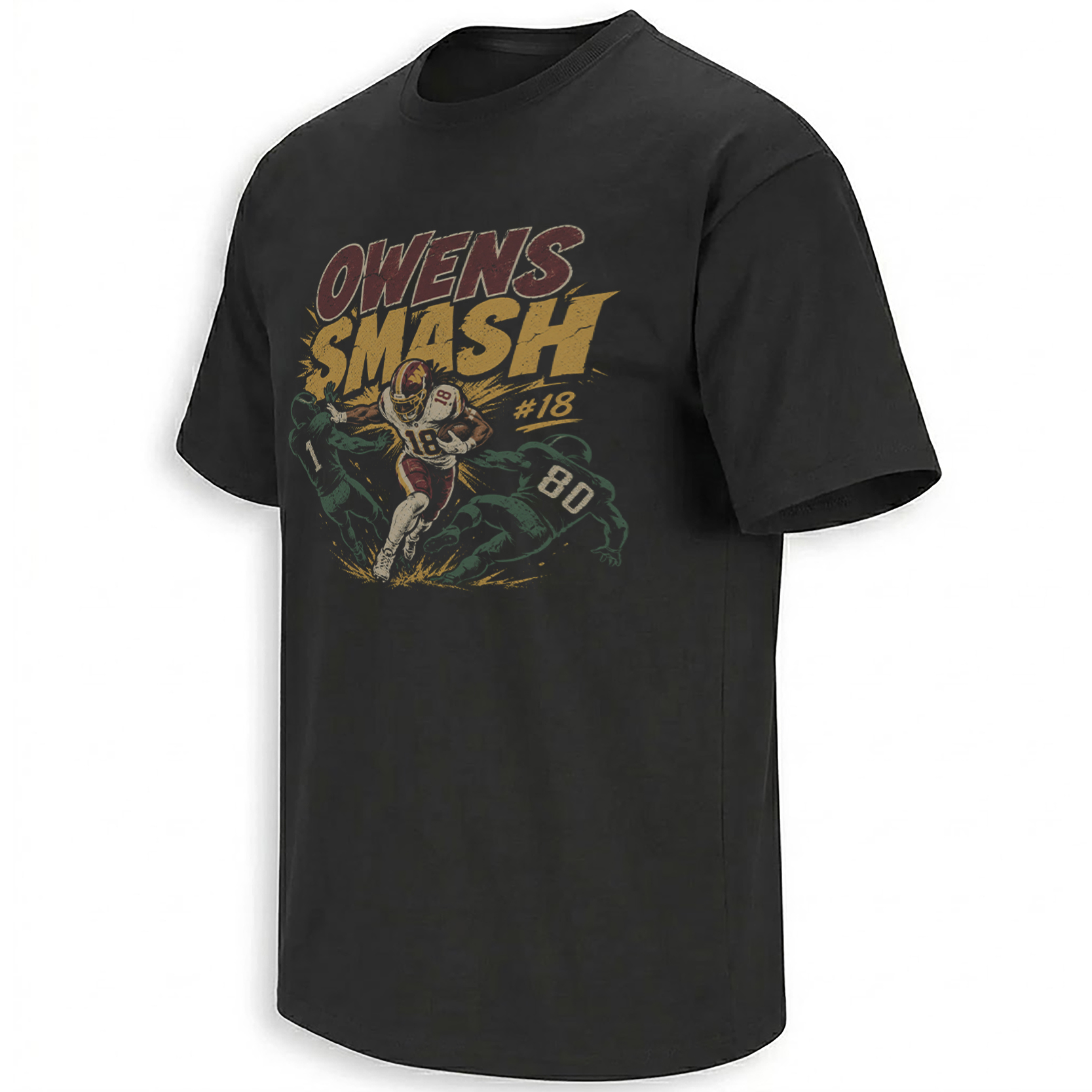
Unlike the Hulk versions, Owens is not transformed into a fantasy creature. The exaggeration lives in the movement: collapsing opponents, yellow impact strokes, distressed typography and the giant action verb “SMASH.” That keeps the identity closer to football while still matching the absurd physical energy of the real clip.
J.J. Watt Helped Turn a Viral Clip Into Football Doctrine
The moment grew beyond Washington fan spaces when J.J. Watt reacted publicly. Watt called it one of the greatest football plays he had seen and said coaches around the country would show the rep to their teams.
That praise matters because Watt’s reaction shifted the conversation away from novelty. This was not only “look how hard he hit somebody.” The play became an example of effort, leverage, pursuit and refusing to accept that the first block had ended the assignment.
Washington coach Dan Quinn made a similar point a day later. He acknowledged that the play had gone viral but said the physical effort itself was not surprising to people inside the building. That comment gives Owens an important next step: the internet has discovered something Washington already believed was part of his game.
The Box Score Is Almost the Joke
Owens’ official Week 1 line remains almost aggressively ordinary: two solo tackles, no interception, no sack and no forced fumble.
That is part of why football people loved the play. Special teams can contain enormous physical effort without producing a statistic casual viewers recognize. A gunner can defeat two blocks, cover forty yards and make the tackle only to receive the same single “TKL” notation as a defender who was standing nearby.
“Owens Smash” gives that invisible labor an oversized title.
There is also immediate uncertainty around what comes next. Quinn said Owens had an ankle issue after the opener and Washington would learn more about his recovery as the week progressed. That means the first viral moment of his 2026 season arrived with an unfinished second chapter already attached.
The wider Washington Commanders collection tracks the player stories emerging around the season, while the NFL collection places the Week 1 clip inside the league’s broader culture. Readers following No. 18 specifically can continue through the Tyler Owens product archive.
Frequently Asked Questions
What does “Owens Smash” refer to?
The phrase is inspired by Tyler Owens’ viral Week 1 punt-coverage rep against Philadelphia, where he fought through multiple blockers and still reached the returner for the tackle.
Who was the Eagles returner on Tyler Owens’ viral play?
The returner was Britain Covey. Owens battled through Philadelphia blockers before reaching Covey and finishing the tackle.
What did J.J. Watt say about the Tyler Owens play?
Watt described it as one of the greatest football plays he had seen and predicted that coaches across the country would show the rep to their teams.
Why did the play go viral if Owens only had two tackles?
The attention came from how the tackle happened, not the statistical total. Viewers watched Owens repeatedly overcome blockers and refuse to leave the play.
How is Owens Smash different from The Incredible Tyler Owens designs?
The Incredible graphics lean into superhero parody, while Owens Smash keeps Tyler Owens visually closer to football and turns the physical action itself into the central identity.
The Owens Smash graphic distills Washington No. 18’s viral effort into one action phrase, while the Commanders archive follows whether the Week 1 cult hero can keep building that identity.
Owens Smash Shirt captures Tyler Owens’ viral Week 1 Commanders special-teams play through oversized burgundy-and-gold type, No. 18 and an explosive collision scene built around the physical effort that took over NFL social media.