
Inside Oregon’s Caucasian Collision Unit
Bryce Boettcher and Dillon Thieneman did more than invent a funny nickname. They gave Oregon’s 2025 defense its own buddy-movie identity—and then wore the evidence to the postgame microphone.
College football nicknames usually arrive from television commentators, message boards or marketing departments. “Caucasian Collision Unit” became memorable because Oregon linebacker Bryce Boettcher and safety Dillon Thieneman appeared to understand the joke before anyone else could explain it.
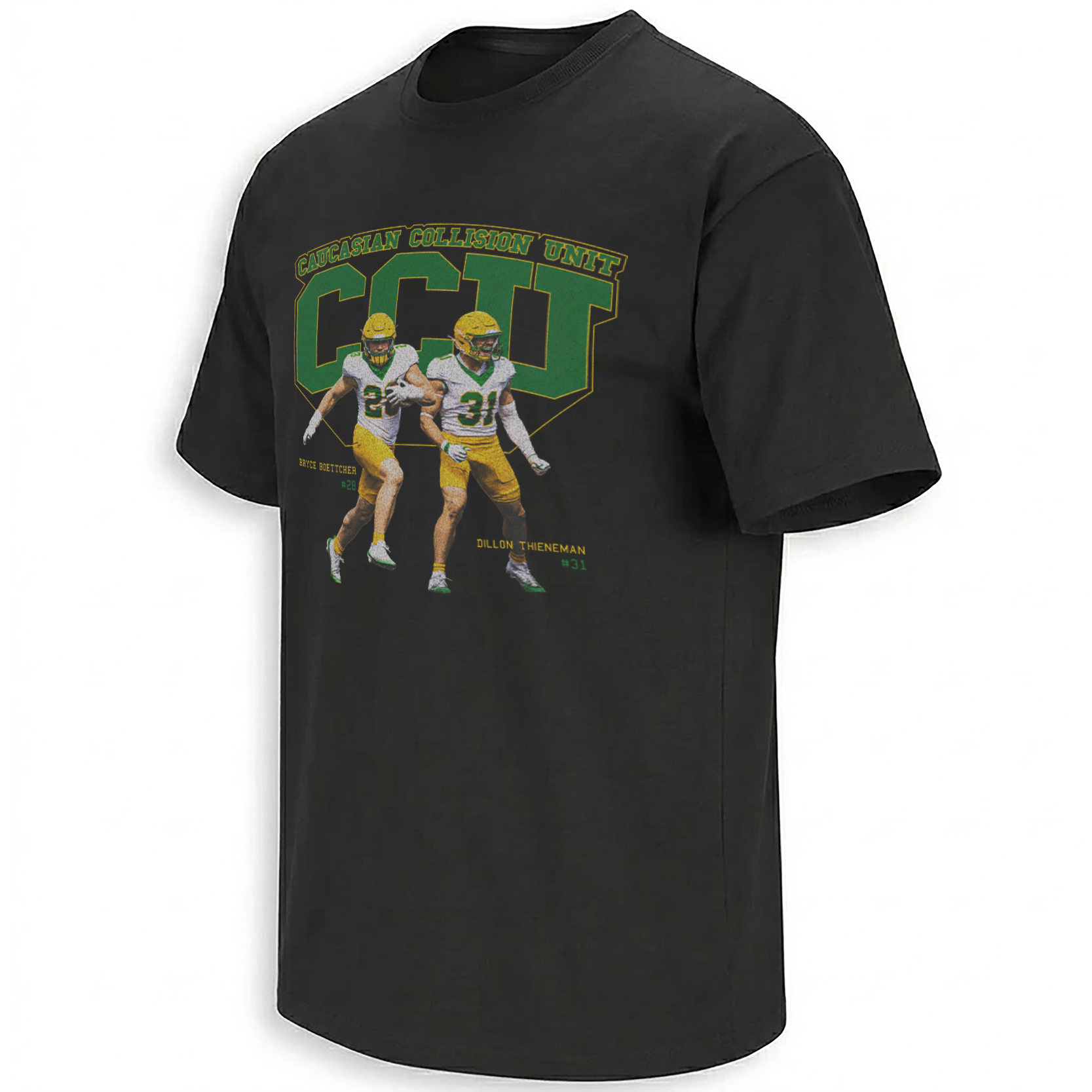
Following Oregon’s 2025 win over Washington, the two defenders arrived at their postgame media availability wearing matching black shirts. Across the chest sat an enormous “CCU,” the full phrase “Caucasian Collision Unit,” images of Boettcher and Thieneman in uniform and their respective numbers 28 and 31.
The shirts immediately transformed a defensive partnership into a piece of Oregon lore. This was not an unofficial nickname attached to the players months later. The teammates presented it themselves, smiled through the explanation and allowed the press-conference image to circulate as the final punchline to rivalry week.
CCU sounds like a tactical department, looks like vintage college apparel and behaves like a perfectly self-aware locker-room joke.
Why Boettcher and Thieneman made sense as a unit
Boettcher and Thieneman occupied different levels of Oregon’s defense. Boettcher worked from the linebacker position, where his pursuit, tackling and ability to close space placed him near the center of the action. Thieneman operated at safety, diagnosing plays from depth before arriving at the ball with the speed and force that made him one of the nation’s most recognizable defensive backs.
The alignment created a natural two-stage collision system. Boettcher could disrupt a play closer to the line of scrimmage; Thieneman could erase what escaped into the secondary. Their partnership offered the nickname more substance than a random pairing of two popular players.
Oregon’s official 2025 materials already documented the statistical basis for the pairing. Boettcher entered the season as one of the defense’s established leaders after recording 94 tackles in 2024. Thieneman came to Eugene after consecutive 100-tackle seasons at Purdue and brought a résumé built around production rather than projection.
Their personalities made the partnership even more effective. Boettcher was the hometown veteran and rare football-baseball crossover athlete. Thieneman was the high-profile transfer trusted to stabilize the secondary. CCU turned those separate stories into one compact defensive brand.
 CCU
The press-conference joke preserved as college-football ephemera
Oversized varsity lettering, Oregon green and yellow, player numbers and distressed texture make the design resemble a recovered piece of defensive-unit apparel.
CCU
The press-conference joke preserved as college-football ephemera
Oversized varsity lettering, Oregon green and yellow, player numbers and distressed texture make the design resemble a recovered piece of defensive-unit apparel.
The Washington press conference completed the joke
Context is what separates the CCU shirt from an ordinary player collage. Boettcher and Thieneman wore it after Oregon defeated Washington, placing the design inside one of the Ducks’ most emotionally charged rivalry settings.
Postgame press conferences are usually controlled spaces. Players repeat team-first language, explain assignments and avoid producing material for the opponent. Matching CCU shirts interrupted that routine with exactly enough absurdity. The visual communicated that the defenders knew how their partnership appeared from the outside and were willing to turn it into a character.
Contemporary video and reporting from the postgame availability documented both players wearing the matching design and explaining the nickname following the Washington victory.
The moment also illustrates how athlete-driven culture works in the NIL era. A team identity no longer needs months of institutional promotion. Two players can appear in the right graphic at the right moment, and a private locker-room joke can become a public shorthand before the press conference ends.
How the artwork speaks the language of defensive units
The design begins with enormous green CCU initials outlined in yellow. They are large enough to resemble a collegiate monogram but broad enough to feel like the insignia of a fictional tactical team. The full nickname arches above the initials, ensuring that the acronym’s meaning remains part of the joke.
Boettcher and Thieneman appear in front of the lettering rather than inside separate portrait frames. That choice matters: the viewer sees movement and partnership, not two isolated roster photographs. Number 28 drives from one side while number 31 advances from the other, visually closing the available space between them.
The distressed texture creates the impression that the graphic existed before the viral moment. Instead of polished contemporary recruiting art, it resembles a defense-specific shirt that might have been passed around a locker room during an earlier era of Oregon football.
Black fabric gives the green and yellow palette greater weight. Oregon colors remain recognizable, but the overall mood is tougher and less celebratory than a standard fan design. It looks built for the part of football where jokes end with contact.
A nickname that became a timestamp
The partnership was always destined to have a limited lifespan in Eugene. After the 2025 season, both players moved into the professional football pipeline: Boettcher with Indianapolis and Thieneman with Chicago. That separation gives CCU an additional layer of meaning in 2026.
It now represents one specific Oregon season, one defensive pairing and one rivalry-week press conference. Fans do not need the nickname to remain active forever. Its value comes from accurately returning them to the period when numbers 28 and 31 occupied the same defense.
That is why the Caucasian Collision Unit Shirt works as a cultural artifact rather than a generic Oregon product. It records the players’ own joke, the public image that made it spread and the physical style that made the phrase credible.
Within the broader Oregon Ducks collection, CCU occupies an unusual category. It is not built around a championship slogan or traditional university mark. It preserves the personality of a defensive partnership that briefly gave itself a name.
Understanding Oregon’s CCU nickname
What does CCU mean in Oregon football culture?
CCU stands for “Caucasian Collision Unit,” the humorous defensive nickname associated with Oregon linebacker Bryce Boettcher and safety Dillon Thieneman during the 2025 season.
Did Boettcher and Thieneman actually wear CCU shirts?
Yes. Both players appeared in matching Caucasian Collision Unit shirts during their postgame media availability following Oregon’s victory over Washington in November 2025.
Why were the two Oregon defenders paired together?
Boettcher was a physical inside linebacker and Thieneman a productive safety. Their positions allowed them to make forceful plays at different levels of the defense, while their chemistry and self-aware humor made the partnership memorable.
What do numbers 28 and 31 represent?
Bryce Boettcher wore number 28 for Oregon, while Dillon Thieneman wore number 31. Both numbers appear beside the players in the CCU artwork.
Where can fans find more Oregon football designs?
Additional Oregon-related designs are available through Ellie Shirt’s full Oregon Ducks collection at https://ellieshirt.com/collections/ncaa/oregon-ducks/.
The CCU artwork preserves a rare moment when defensive production, locker-room humor and rivalry-week swagger all arrived at the same postgame microphone.
Oregon’s Caucasian Collision Unit Shirt records the viral defensive partnership of Bryce Boettcher and Dillon Thieneman through their self-created CCU nickname, numbers 28 and 31, and unmistakable Ducks colors.