
Why Mountain Dew Nocturne Feels Like a Lost Gaming Ad From the End of the World
Demi-Fiend belongs to a severe post-apocalyptic RPG about ideology, demons and remaking reality. Naturally, internet culture handed him a bottle of soda.
Some crossover jokes succeed because two subjects fit together perfectly. Mountain Dew Nocturne succeeds because they should not fit together at all—and because anyone who remembers early-2000s gaming culture can imagine a marketing executive trying it anyway.
Shin Megami Tensei III: Nocturne opens with the destruction and transformation of Tokyo. Its silent protagonist survives the Conception, ingests a parasitic Magatama and becomes the Demi-Fiend: part human, part demon, marked by luminous tattoos and forced to navigate a Vortex World where competing ideologies seek to determine what reality will become.
Mountain Dew occupies a considerably less metaphysical corner of American culture. Yet the brand’s fluorescent colors, extreme-sports attitude and long association with gaming make it an irresistible object for parody. Put the two together and Nocturne’s existential darkness suddenly resembles the most aggressive beverage campaign never produced.
In the Vortex World, there is no ordinary refreshment—only alignment, Magatama and radioactive citrus branding.
The joke starts with Nocturne’s absolute seriousness
Nocturne has always carried an unusually austere reputation, even within the Megami Tensei family. Its empty spaces, oppressive sound design, philosophical factions and demanding combat create a game that seems almost hostile to casual interpretation. Demi-Fiend rarely speaks, but his silhouette communicates isolation, danger and transformation.
That severity gives meme culture something firm to push against. A cheerful product mascot might already feel absurd inside the Vortex World; a neon soft-drink promotion feels almost profane. The harder Nocturne commits to apocalypse, the funnier it becomes to imagine Demi-Fiend pausing his war against cosmic forces for an energy-coded slogan.
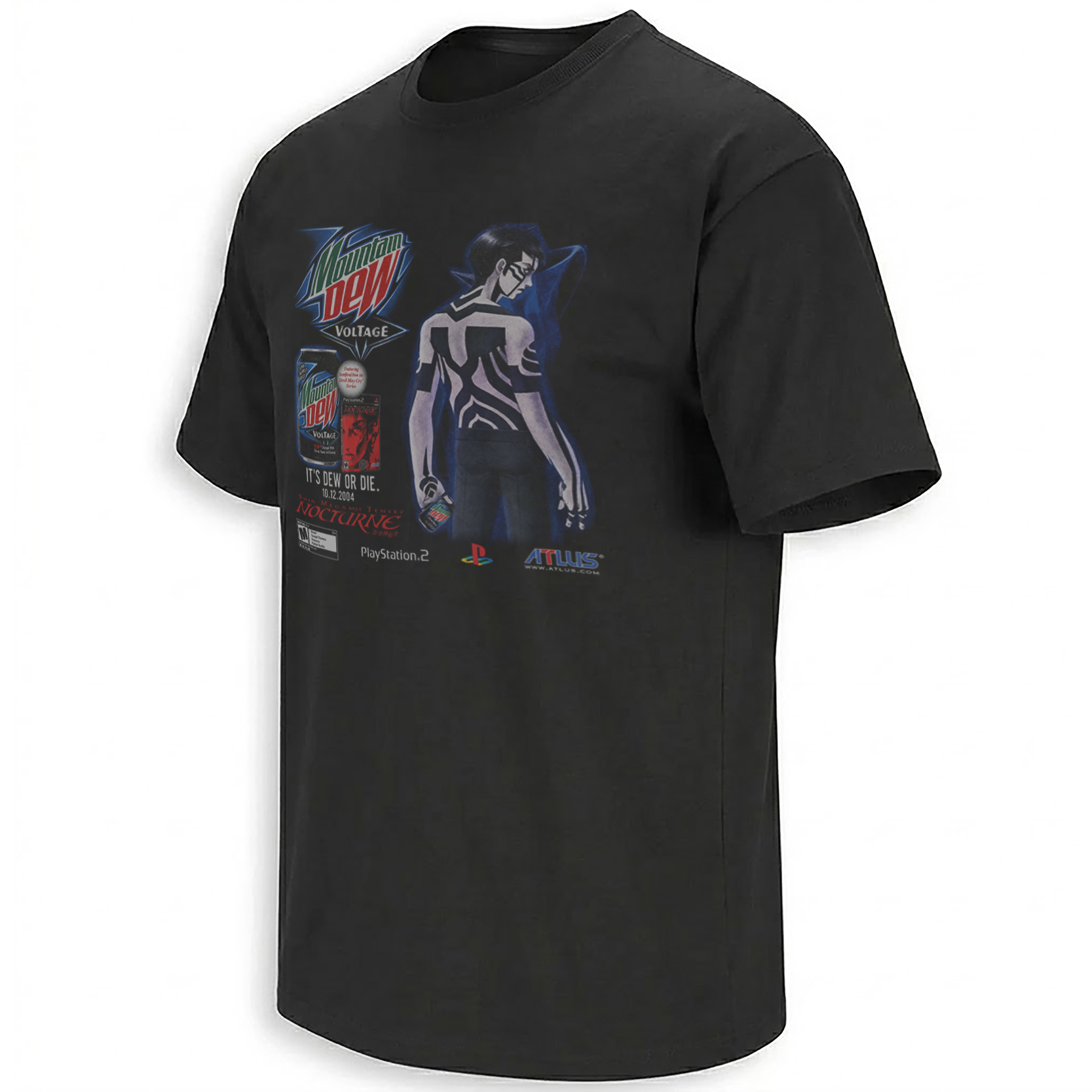 Archive File 03: Beverage alignment detected
The artwork compresses Nocturne’s demonic imagery and Mountain Dew’s loud commercial color language into a deliberately implausible piece of retro gaming history.
Archive File 03: Beverage alignment detected
The artwork compresses Nocturne’s demonic imagery and Mountain Dew’s loud commercial color language into a deliberately implausible piece of retro gaming history.
Why Mountain Dew already speaks fluent gamer
The parody would be weaker with an arbitrary drink. Mountain Dew arrives with decades of cultural baggage: convenience stores, LAN-party nights, console launches, “extreme” branding and the overstimulated visual language that surrounded games in the late 1990s and early 2000s.
For players who lived through that period, the connection can feel almost historically plausible. Video-game magazines were filled with advertisements whose colors fought for attention. Mascots, snack foods, soda and hardware shared the same adolescent vocabulary of speed, danger and forbidden intensity. Even a deeply Japanese occult RPG could be pulled into the orbit of Western youth marketing.
The Mountain Dew Nocturne graphic behaves like an artifact from that ecosystem. It does not merely place a logo next to a character. It imagines the entire tonal mistake: someone attempting to sell the end of the world as a flavor.
Demi-Fiend is the perfect unwilling spokesperson
Brand mascots normally smile, gesture and explain the product. Demi-Fiend does none of those things. His blank intensity makes him funny in the role because the viewer must supply the promotional enthusiasm on his behalf.
Visually, his glowing body markings also connect surprisingly well with the artificial greens and high-voltage colors associated with Mountain Dew advertising. The collision is ridiculous at the narrative level but coherent at the graphic level. His supernatural energy can be misread—intentionally—as beverage energy.
This is a familiar technique in bootleg and internet-born streetwear: locate an accidental resemblance, exaggerate it and present the resulting fiction with absolute confidence. The artwork does not pause to explain why an Atlus protagonist is selling soda. Its refusal to justify itself is part of the joke.
Design language from the CRT era
Acid green does most of the immediate cultural work. Against a dark Nocturne palette, it reads as toxic, demonic and commercially caffeinated at the same time. Heavy contrast allows the character silhouette and parody branding to remain legible from a distance, while the composition evokes promotional graphics designed to seize attention on a crowded magazine page.
The image also benefits from visual overload. Contemporary minimalist branding would weaken the premise; this concept needs the sensation of too much—too much flavor, too much power, too much apocalypse. That excess places it within the period when game marketing regularly promised players a transformative experience using chrome lettering, radioactive gradients and impossible amounts of attitude.
In that sense, the graphic is not simply nostalgia for Shin Megami Tensei III. It is nostalgia for how games once reached players: demo discs, store shelves, printed strategy guides, forum signatures and advertisements remembered more for their atmosphere than their information.
How niche fandom keeps old games culturally active
Nocturne’s identity has endured because players continue translating its difficulty and imagery into community language. Demi-Fiend can remain an intimidating RPG icon while also appearing in jokes, reaction images and deliberately cursed crossovers. Those uses do not erase the original atmosphere; they depend on viewers knowing it.
The design therefore functions like a recognition test. A general viewer sees a strange energy-drink parody. A Megami Tensei player sees the Demi-Fiend, remembers the Conception and understands precisely why reducing that cosmic ordeal to branded refreshment is funny.
Because Ellie Shirt does not currently maintain a verified Shin Megami Tensei-specific collection, the safest broader pathway is the continuously updated Newest collection, where gaming references sit beside other fast-moving pieces of internet and pop-culture language without inventing a category that does not exist.
Decoding Mountain Dew Nocturne
Who is Demi-Fiend in Shin Megami Tensei III: Nocturne?
Demi-Fiend is Nocturne’s protagonist. Originally human, he survives the Conception and is transformed after ingesting a Magatama, gaining demonic powers and luminous markings while traveling through the Vortex World.
Why does Mountain Dew fit a retro gaming parody?
Mountain Dew has long been culturally associated with gaming, late-night play sessions and the extreme advertising style of the late 1990s and early 2000s. That history makes the fictional crossover feel absurd but strangely believable.
Why is the Mountain Dew Nocturne crossover funny?
The humor comes from tonal contrast. Nocturne treats apocalypse, ideology and demonic transformation with intense seriousness, while soda advertising turns everything into colorful, energetic promotion.
What visual style does the design reference?
It recalls crowded game-magazine advertising, radioactive color palettes, bootleg crossover graphics and the maximalist promotional language that surrounded console culture in the CRT era.
The Mountain Dew Nocturne artwork belongs to the specific category of fan object that looks like a recovered advertisement from a timeline that was wisely—or unfortunately—never created.
Mountain Dew Nocturne Shirt turns Demi-Fiend and the apocalyptic world of Shin Megami Tensei III into a chaotic piece of early-2000s gaming-ad nostalgia, powered by acid color and deliberately cursed crossover logic.