
New York Forever: When Wu-Tang, the Knicks and an Impossible Comeback Became One Story
Wu-Tang Clan walked onto the Madison Square Garden court at halftime of Game 4 with the Knicks trailing San Antonio by 27 points. What followed was the largest comeback in NBA Finals history—and the night basketball, hip-hop and New York mythology became impossible to separate.
Madison Square Garden did not feel like the center of the basketball universe when halftime arrived on June 10. The Knicks trailed the Spurs 76–49, the largest deficit had reached 29 points, and a Finals night built to celebrate New York culture appeared to be collapsing beneath the score.
Then Wu-Tang Clan took the floor. The Staten Island group performed inside an arena carrying five decades of Knicks frustration, 27 years of Finals absence and the uncomfortable possibility that the most New York halftime show imaginable would become decoration around a devastating loss.
Instead, the performance became the dividing line in one of the defining nights in franchise history. The Knicks returned from halftime, erased the deficit and defeated San Antonio 107–106 on OG Anunoby’s tip-in with 1.2 seconds remaining. Days later, New York completed its first NBA championship run since 1973.
New York Forever does not describe a moment that refuses to end. It describes a city that keeps carrying its moments forward.
The Halftime Show Arrived at the Lowest Point of the Night
Halftime performances are usually positioned as spectacle between two halves of a game. Wu-Tang’s appearance became part of the game’s emotional architecture because of the score surrounding it.
The Spurs had controlled the opening half. San Antonio’s shooting, length and pace had silenced stretches of the Garden, while the Knicks appeared unable to generate the defensive pressure or offensive rhythm required to make the game competitive.
Wu-Tang therefore entered an arena searching for belief rather than entertainment. The group’s catalogue already belonged to New York’s collective memory. The performance did not have to introduce itself. It had to remind the building where it was.
Method Man reportedly predicted “Knicks in five” during the appearance. RZA later said he believed the performance helped energize the comeback. The claim belongs to celebration and folklore rather than basketball analytics, but that is precisely why it endured. Fans did not need the music to explain the adjustments. They needed it to explain how the building changed.
Why Wu-Tang Belonged Inside a Knicks Finals Game
Wu-Tang Clan did not enter Madison Square Garden as a celebrity booking disconnected from the city hosting the event. The group emerged from Staten Island and built a mythology around borough identity, collective strength, martial-arts imagery, street-level storytelling and the idea that New York could produce its own universe.
The Knicks carry a similar relationship with geography. The franchise is not simply located in New York. It is repeatedly asked to represent the entire city: Manhattan spectacle, outer-borough loyalty, playground memory, fashion, music, celebrity and the emotional history accumulated inside the Garden.
That is why the halftime pairing felt natural before the comeback made it legendary. Wu-Tang represented a version of New York confidence formed outside conventional approval. The Knicks were attempting to end a championship drought that had survived generations of disappointment.
Both stories revolve around collective identity. Wu-Tang’s power has always come from the group containing distinct voices without losing the larger symbol. The championship Knicks similarly depended on a roster whose personalities and roles became most powerful when they operated as one New York unit.
Wu-Tang brought the vocabulary of Staten Island, ’90s New York and collective mythology onto the Finals stage.
The Knicks carried the pain of 1973, 1994, 1999 and every season when the Garden waited for another championship ending.
Game 4 combined music, basketball, celebrity and borough identity into one night the city could claim as its own.
The Comeback Turned a Performance Into Mythology
Had the Knicks lost by 25 points, Wu-Tang’s halftime show would still have been culturally important. It would have remained a major New York group performing during the franchise’s first Finals appearance in 27 years.
The comeback changed the event’s category. The performance became a before-and-after marker.
New York entered halftime buried beneath the game. It emerged with enough energy to reduce the deficit, push the Garden toward disbelief and eventually create one of the most valuable possessions in franchise history: Anunoby’s game-winning tip-in.
Basketball analysis can identify the second-half shooting, defensive pressure and individual performances that produced the result. Cultural memory works differently. It remembers the sequence as music, noise, momentum and miracle.
The Wu-Tang set therefore became part of the story fans used to explain the unexplained. It functioned like a rally cap, a lucky seat or a song played before everything changed. Nobody had to prove causation for the association to become permanent.
Down 27 at halftime. Wu-Tang at center court. Fourteen Knicks three-pointers after the break. OG Anunoby at the rim. The Garden shaking. A 107–106 final score. By the end, the night already felt edited like a championship documentary.
“Forever” Meant Something Different After the Championship
Before the title, “New York Forever” could be read as loyalty: a declaration that the city, team and culture remain meaningful regardless of the standings.
After the championship, the phrase gained another layer. It began to describe permanence.
A title changes which images survive. Game 4 no longer exists as a spectacular victory inside a losing Finals run. It became the turning point inside the season that ended the 53-year wait.
Wu-Tang’s halftime appearance, Anunoby’s tip-in, Jalen Brunson’s missed three, the celebrity reactions and the sound of Madison Square Garden now belong to the championship archive. They are no longer temporary content from one June night. They are pieces of the story New York will repeat whenever the 2026 team is discussed.
“Forever” also fits Wu-Tang’s cultural position. The group’s imagery and language have continued moving through music, fashion and streetwear decades after their early-1990s emergence. The symbol survives because each generation finds a new way to wear or reinterpret it.
A Championship Timeline Written in New York Languages
The title became inherited memory as generations of supporters grew up without seeing another trophy arrive.
Its collective symbol became one of the most recognizable visual marks associated with New York music.
Images from that run resurfaced as the city tried to understand the emotional scale of another championship opportunity.
Separate city histories converged inside one Finals night and became part of the same championship memory.
How the Artwork Creates a Championship Seal
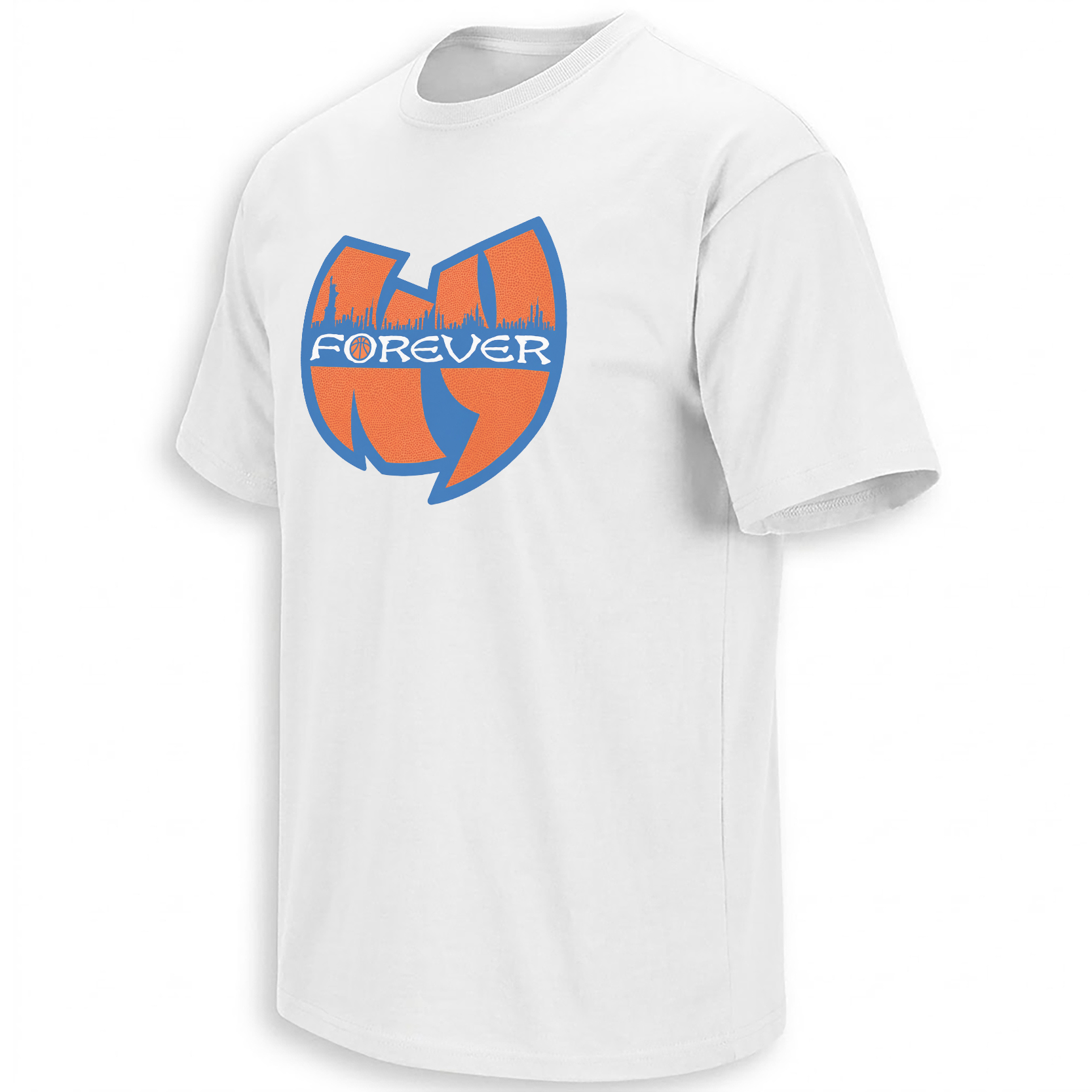
The New York Forever design avoids the crowded language of a conventional roster collage. It uses a single emblem to suggest something older, larger and more permanent than one game.
A basketball forms the central structure, keeping the Knicks championship run at the heart of the image. “New York” follows the upper arc in bold city lettering, while “Forever” anchors the lower section like a motto stamped beneath a civic seal.
The winged gold form behind the ball introduces the Wu-Tang reference through silhouette and visual rhythm. It does not require a portrait of the performers or a literal halftime photograph. The cultural connection is communicated through shape.
That restraint matters. The design is not attempting to summarize the complete concert or every possession in the comeback. It compresses the relationship between basketball and hip-hop into one mark that can be read before the viewer identifies every detail.
Gold gives the emblem the authority of a championship object. Black provides streetwear weight and ties the composition to Wu-Tang’s archive-poster language. Knicks orange and blue appear as controlled accents, ensuring the basketball identity remains visible without overpowering the crossover.
Why the White Colorway Changes the Mood
On white fabric, the graphic feels less like a dark concert flyer and more like a championship insignia pulled from an old New York sports program.
The negative space allows the gold and black silhouette to remain crisp, while orange and blue details read as small flashes of Knicks identity. This creates a cleaner visual relationship between the basketball and the winged shape.
White also reflects the emotional position of the design. The article is not centered on outrage, rivalry or unfinished business. It is about a city looking back at a completed championship story and choosing the emblem that will carry the memory forward.
The aged texture prevents the composition from becoming sterile. It gives the mark the quality of something discovered rather than newly announced—as though “New York Forever” had always existed and the 2026 title finally gave it the correct context.
The Graphic Works Like a Bootleg Mixtape Cover
Hip-hop bootleg design often combines familiar cultural symbols without asking permission from the boundaries separating them. A sports logo can behave like an album emblem. A musician can appear inside championship typography. A city slogan can become both a fan statement and a streetwear identity.
New York Forever belongs to that visual tradition. It does not treat Knicks basketball and Wu-Tang culture as separate categories joined by a promotional partnership. It presents them as neighboring parts of the same city archive.
The result resembles a graphic that could have circulated outside Madison Square Garden after Game 4, appeared on a hand-printed flyer or been placed on the cover of a commemorative mixtape about the championship run.
That fan-made energy is essential. Official championship imagery records the result. Bootleg culture records what the result felt like in the street, online and inside the city’s imagination.
Why New York Sports and Hip-Hop Keep Returning to Each Other
Basketball and hip-hop grew through overlapping urban spaces: playgrounds, school gyms, record stores, radio, street fashion and neighborhood competition. In New York, the connection is not decorative. It is structural.
Players enter the Garden to songs created in the same city. Musicians sit courtside and become part of the television image. Sneakers, jerseys and album artwork circulate through the same visual economy. A Knicks playoff run therefore produces cultural material far beyond basketball analysis.
Wu-Tang’s Game 4 performance made that relationship visible at the most dramatic possible moment. The group did not merely soundtrack a basketball event. Its appearance became part of how fans remembered the emotional turn of the game.
That is why a design combining the two does not feel like a random crossover. It feels like an accurate description of how New York experienced the championship.
The Knicks Archive Became a City Archive
The 2026 championship produced more than trophy images. It generated a map of New York emotion: Brunson’s leadership, Anunoby’s tip-in, Madison Square Garden noise, celebrity reactions, parade anticipation and the music used to make sense of the run.
Ellie Shirt’s New York Knicks Shirts collection follows those moments as a continuing visual archive, moving between player graphics, championship slogans, city references and designs shaped by the culture surrounding the team.
The broader NBA Shirts collection places New York’s title inside the wider language of playoff basketball, rivalry, historic comebacks and moments that become larger than the final score.
Within that archive, New York Forever represents the city-level meaning of the championship. It is not only about who won. It is about which sounds, symbols and neighborhoods entered the memory of the win.
Frequently Asked Questions
When did Wu-Tang Clan perform during the Knicks’ 2026 Finals run?
Wu-Tang Clan performed at halftime of Game 4 of the 2026 NBA Finals between the New York Knicks and San Antonio Spurs at Madison Square Garden on June 10, 2026.
How far behind were the Knicks before the historic comeback?
New York trailed by as many as 29 points and entered halftime down 76–49 before recovering to win 107–106.
Who scored the winning basket in Knicks–Spurs Game 4?
OG Anunoby tipped in Jalen Brunson’s missed three-point attempt with 1.2 seconds remaining to give New York its first and final lead of the game.
Why did fans connect Wu-Tang’s performance to the comeback?
The performance occurred at halftime, immediately before the Knicks began erasing the enormous deficit. Fans and RZA later treated the set as the emotional spark that changed the atmosphere inside Madison Square Garden.
What does “New York Forever” represent?
The phrase represents lasting loyalty to New York while also describing how the 2026 championship, Wu-Tang halftime performance and Game 4 comeback entered permanent city memory.
What does the New York Forever design symbolize?
The graphic combines a championship basketball, New York typography, Knicks color accents and Wu-Tang-influenced visual language to preserve the connection between basketball, hip-hop and the city’s 2026 title.
The New York Forever design preserves the night Wu-Tang and Knicks history occupied the same Madison Square Garden stage, while the wider New York Knicks visual archive follows the players, slogans and city memories that defined the championship run.
New York Forever Shirt connects the Knicks’ historic 2026 championship run with Wu-Tang halftime energy through a gold-and-black basketball emblem, New York typography and controlled orange-and-blue accents.