
Ace of Diamonds: Cristopher Sánchez Has Become Philadelphia’s Defining Pitcher
Seven shutout innings, nine strikeouts and the first 10-win record by an MLB starter in 2026 gave Cristopher Sánchez another dominant night. The numbers now match what Philadelphia has been learning for months: the Phillies are no longer waiting for him to become an ace.
Cristopher Sánchez opened the night by striking out five of the first six Pirates he faced. Seven innings later, Pittsburgh still had not scored, the Phillies were on their way to an 8–0 victory and Sánchez had become the first starting pitcher in Major League Baseball to reach 10 wins in 2026.
The June 30 performance at Citizens Bank Park required no dramatic rescue. Sánchez allowed three hits, walked two and struck out nine. Philadelphia’s offense gradually expanded the lead, but the emotional direction of the game had been established almost immediately by the left-hander on the mound.
The outing lowered his ERA to 2.00 and extended his dominance over Pittsburgh to 16 scoreless innings across two starts. It also returned the season’s conversation to the same question that has followed Sánchez through every historic stretch: when did the Phillies’ developmental success story become one of baseball’s most complete aces?
An ace is not simply the pitcher scheduled for the first game. He is the player who makes an entire night feel decided before the lineup finishes its second trip through the order.
The Pirates Saw the Same Problem Twice
Pittsburgh had already encountered Sánchez at his most overwhelming on May 16. That afternoon, he completed all nine innings, struck out a career-high 13 and shut out the Pirates in a 6–0 Phillies victory.
The rematch arrived six weeks later, and Pittsburgh adjusted its lineup in search of a different result. Sánchez responded by striking out the side in the first inning and retiring the first six hitters he faced.
His second shutout performance against the Pirates did not look identical to the first. He allowed more traffic, including two walks, and worked while managing a blister. Yet the essential experience for the opposing lineup remained unchanged. Hitters struggled to lift the ball, could not create a sustained inning and spent most of the night reacting to pitches that appeared to move after they had already committed.
Across the two meetings, Sánchez worked 16 scoreless innings against Pittsburgh with 22 strikeouts. The repetition gave the matchup the quality of a controlled experiment: new date, modified lineup, same left-handed answer.
Why Sánchez Now Owns the Word “Ace”
The word is used casually in baseball. It can describe the pitcher with the best current ERA, the Opening Day starter or the arm a team would choose for one postseason game.
Sánchez now satisfies every version of the definition. He finished second in the 2025 National League Cy Young Award voting, earned his first Opening Day assignment in 2026 and entered July as the league’s first 10-game winner.
More importantly, his pitching carries the emotional effect associated with an ace. When Sánchez takes the ball, the bullpen can imagine a lighter workload, the lineup can operate without believing it needs eight runs and the crowd enters the game expecting something historically unusual to remain possible.
That last quality intensified during his scoreless streak. From April into early June, Sánchez delivered 50⅔ consecutive innings without allowing a run. The streak established a Phillies record for a left-handed pitcher and pushed his season beyond excellent performance into franchise-history territory.
Sánchez’s 50⅔-inning scoreless streak made each start feel connected to the previous one. Philadelphia was no longer watching isolated victories; the city was counting outs, innings and every runner who threatened to end the run.
A Scoreless Streak Changes How Fans Watch a Pitcher
During an ordinary dominant start, the crowd reacts to strikeouts, difficult escapes and the possibility of a win. During a historic streak, even a routine single carries additional tension.
Every baserunner becomes a threat to the larger story. Every inning creates another number that must be remembered. When the streak finally ended against San Diego, Phillies fans gave Sánchez an extended standing ovation because the achievement had become communal.
The applause did not celebrate the run that scored. It recognized the extraordinary amount of time that had passed before anyone managed to score one.
Sánchez acknowledged the crowd from the mound, briefly stepping outside the competitive rhythm of the game. The moment confirmed his changed place inside Philadelphia baseball culture. He was no longer only a pitcher producing useful innings. Fans understood that they had been watching a chapter of club history.
The Ace Was Developed, Not Announced
Sánchez’s rise does not follow the usual shape of a top pitching prospect. He did not arrive with the expectation that an organization would eventually build a rotation around him.
Philadelphia acquired him from Tampa Bay in a relatively low-profile 2019 trade. He moved between the Major Leagues and Triple-A, worked in relief and spent years refining the command and pitch shapes required to remain in a starting rotation.
The development of his changeup changed the trajectory. Thrown with the same arm action as his sinker, it forces right-handed hitters to make decisions against two pitches beginning along similar visual paths before separating in opposite ways.
His sinker produces ground balls and uncomfortable contact. The changeup removes timing. A slider gives him another direction to attack. The combination allows Sánchez to dominate without needing to turn every at-bat into a velocity contest.
Heavy movement attacks the lower part of the zone and turns many aggressive swings into ground balls before rallies can develop.
Matching arm speed disguises the pitch until hitters have already committed to the faster movement they expected.
Sánchez rarely changes his visible pace, allowing traffic, strikeouts and historic moments to pass through the same controlled rhythm.
Philadelphia Has Watched the Rotation Hierarchy Change
For years, the Phillies’ rotation identity was organized around established star power. Zack Wheeler became the October standard, the dependable starter capable of making postseason games feel shorter for the opponent.
Sánchez did not replace that history. He grew beside it.
Wheeler’s health issues during the previous season created more responsibility for the younger left-hander, and Sánchez answered by becoming one of the National League’s strongest pitchers. By the time he received the 2026 Opening Day assignment, the decision felt less like a temporary adjustment and more like formal recognition.
That transition matters for a team with championship ambitions. Philadelphia does not have to imagine whether Sánchez can become a frontline postseason starter. His recent work has already moved the question toward how opposing teams would arrange their lineups against him in a short series.
“Ace of Diamonds” captures that hierarchy without requiring the Phillies to possess only one elite pitcher. A deck can contain several valuable cards. The ace remains the one placed above the rest.
Why the Diamond Is the Correct Symbol
Baseball already plays on a diamond, making the playing-card reference feel unusually natural. The suit does not have to be forced into the sport; it shares the field’s most familiar geometric name.
Diamonds also imply rarity and value. That symbolism fits a pitcher whose development transformed a modest acquisition into a long-term centerpiece of Philadelphia’s rotation.
The red diamond suit connects immediately to the Phillies palette. Unlike a black spade or club, it allows the card to remain visually tied to the team while still functioning as a complete independent symbol.
The title therefore works in three directions at once. Sánchez is the ace of the rotation, the diamond is the baseball field and the playing card frames him as Philadelphia’s strongest hand.
How the Artwork Rebuilds a Baseball Card as a Playing Card
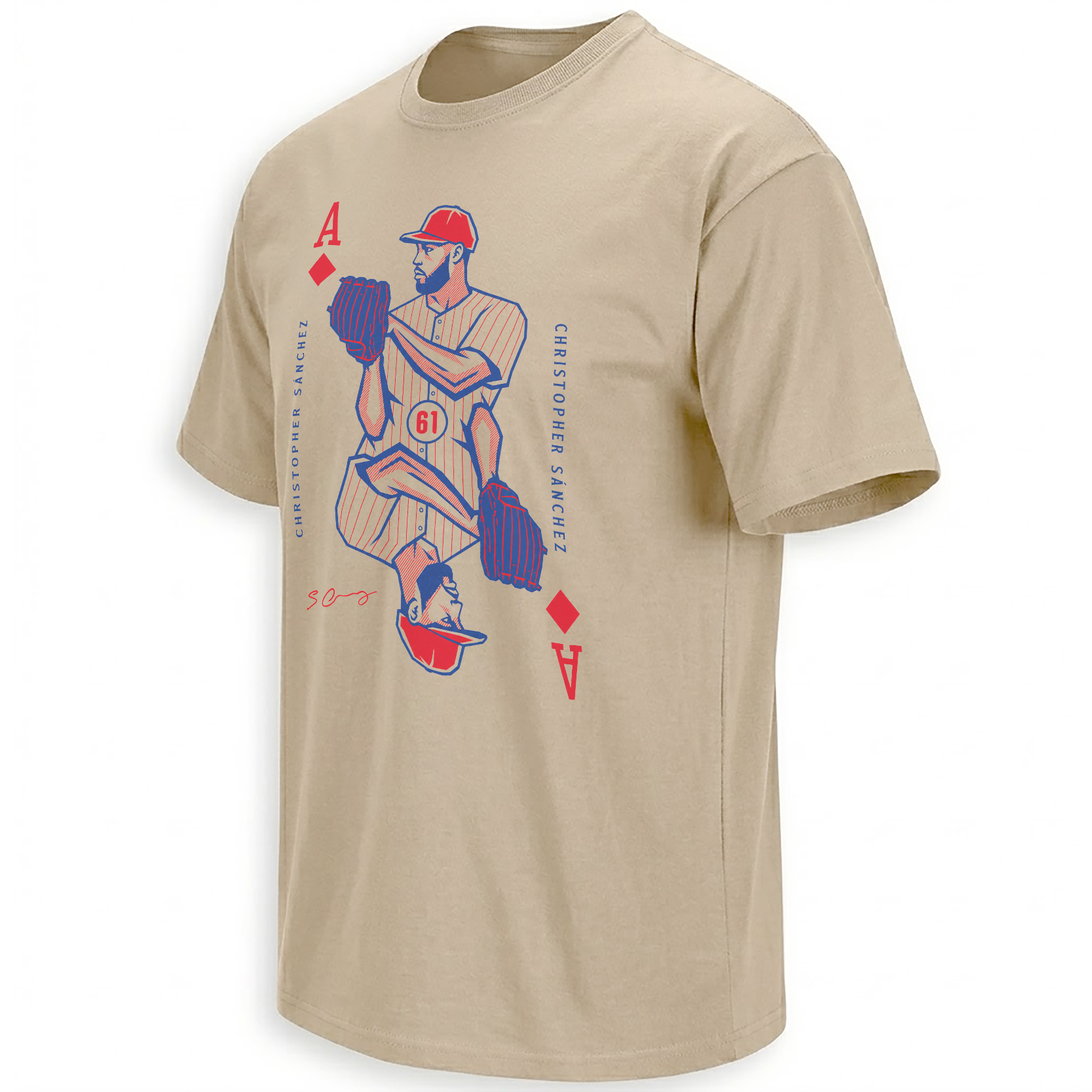
The design uses the mirrored structure associated with traditional court cards. Sánchez appears twice inside the composition, creating the impression that the image could be turned upside down without losing its central identity.
The upper figure captures the pitching motion with the ball separated from his hand, while the lower portrait gives the card a calmer, almost royal presence. Together they combine performance and status: the pitcher doing the work and the ace recognized after the work is complete.
Red diamonds occupy the corners where a playing card would normally identify its suit. The letter “A” establishes rank immediately, allowing the viewer to understand the concept before reading the player’s name.
Ornamental borders give the design the authority of an antique card deck, while the distressed printing keeps it connected to vintage baseball collectibles and old tobacco-card texture.
Phillies red supplies the strongest accents. Blue shadows add depth and connect to Philadelphia’s secondary team color. Cream replaces bright digital white, giving the composition the feeling of a card preserved from another baseball era.
The viewer understands “ace” before encountering any statistics, making the card concept immediate rather than decorative.
It identifies Sánchez inside Philadelphia’s current roster rather than presenting a generic playing-card character.
The symbol represents baseball geography, Phillies color and the rarity associated with a true frontline starter.
The Design Feels Like an Artifact From an Older Rotation
Baseball cards have always converted seasons into portable memory. A photograph, player name, uniform and small statistical line can represent months of watching someone perform.
The Ace of Diamonds design borrows that archival feeling while refusing the rectangular realism of a conventional trading card. It imagines how a pitcher’s identity might have been represented if a baseball program, casino deck and vintage poster had shared the same printing press.
That historical mood matches Sánchez’s pitching style. His dominance does not depend on theatrical celebrations or triple-digit fastballs. It feels controlled, repeatable and quietly severe—the type of performance easily imagined inside the slower visual language of an earlier baseball era.
The card therefore preserves more than his current numbers. It preserves the way those numbers feel: deliberate, balanced and difficult to disturb.
Why the Latest Pittsburgh Start Matters Now
Dominant first halves can disappear quickly once the schedule reaches July. Hitters adjust, physical issues accumulate and one difficult outing can change the public conversation around a Cy Young race.
Sánchez entered the June 30 game looking to rebound from a rougher start against Washington. His response was seven scoreless innings while pitching through a blister.
That response reinforced the difference between a hot streak and an ace season. A pitcher does not have to remain unhittable every week. He has to limit how long the opposition can make him look ordinary.
Sánchez answered one difficult night with another performance that returned him to the front of the National League pitching conversation. The Phillies did not need to wait through a prolonged correction. Their ace restored the familiar order almost immediately.
Philadelphia’s Visual Archive Has a New Top Card
Phillies culture has always made room for pitchers who control the emotional temperature of the ballpark. Strikeout totals, complete games and postseason starts become part of how the city remembers an era.
Ellie Shirt’s Philadelphia Phillies collection follows that evolving identity through player performances, clubhouse language and graphics connected to the moments Philadelphia keeps carrying beyond the final out.
The broader MLB collection places Sánchez’s ace-card image inside baseball’s larger culture of pitching milestones, Cy Young conversations, historic streaks and the visual mythology built around dominant starters.
Within that archive, Ace of Diamonds records the moment the language around Sánchez changed. Philadelphia is no longer describing his potential. It is arranging the rotation around what he has already become.
Frequently Asked Questions
What did Cristopher Sánchez do against the Pirates on June 30, 2026?
Sánchez pitched seven scoreless innings, allowed three hits and two walks, and struck out nine as the Philadelphia Phillies defeated Pittsburgh 8–0.
What was Cristopher Sánchez’s record after the Pittsburgh win?
The victory improved Sánchez to 10–3 and made him the first starting pitcher in Major League Baseball to reach 10 wins during the 2026 season.
How long was Sánchez’s 2026 scoreless-inning streak?
Sánchez worked 50⅔ consecutive innings without allowing a run, establishing a Phillies record for a left-handed pitcher before the streak ended in early June.
Why is Cristopher Sánchez considered the Phillies’ ace?
He finished second in the 2025 National League Cy Young Award voting, started Opening Day in 2026 and entered July with a 10–3 record, a 2.00 ERA and one of baseball’s most dominant first halves.
Why does the design use the Ace of Diamonds?
The ace represents Sánchez’s place at the top of Philadelphia’s rotation, while the diamond connects the playing-card suit to the shape of a baseball field and the Phillies’ red color identity.
What does the Ace of Diamonds design represent?
The graphic reimagines Sánchez as an ornate playing card, combining his pitching motion, No. 61, red diamond symbols and vintage baseball-card texture to preserve his emergence as Philadelphia’s defining pitcher.
The Ace of Diamonds design preserves Cristopher Sánchez’s historic 2026 rise through the visual language of a vintage playing card, while the wider Phillies visual archive follows the pitchers, sluggers and season-defining performances shaping Philadelphia baseball.
Ace of Diamonds Shirt frames Cristopher Sánchez as the Phillies’ defining pitcher through an ornate playing-card layout, red diamond symbols, No. 61 details and vintage artwork inspired by his dominant 2026 season.