Wrigley Has a New Sound: Pete Crow-Armstrong’s MVP Push Became “MVPete”
Pete Crow-Armstrong entered September as an MVP candidate. After two more home runs, another Cubs record and an increasingly deafening Wrigley Field chorus, the award campaign now has something statistics cannot manufacture: its own sound.
By the seventh inning on September 16, the MVP conversation around Pete Crow-Armstrong no longer felt like an argument taking place somewhere outside the ballpark. The chants were already gathering through Wrigley Field when PCA drove his second home run of the night into right-center. As he circled the bases with No. 44 secured, the noise became the story.
Chicago beat Atlanta 8–4, but the box score only explains part of what happened. Crow-Armstrong homered twice, added an RBI triple and continued rewriting sections of Cubs history that had remained untouched for more than half a century. His first homer, No. 43, moved him past Billy Williams’ 1970 mark for the most home runs by a left-handed hitter in one Cubs season.
His next swing pushed the total to 44. Around him, the familiar Wrigley call of “P-C-A!” was giving way to the language of an award race: “M-V-P!” On shirts, signs and internet shorthand, that sound has an obvious Chicago translation — MVPete.
MVPete works because the nickname did not create the campaign. The season created the campaign, Wrigley supplied the chant, and the word simply gave fans something compact enough to carry with them.
The Night the MVP Argument Became a Wrigley Experience
Crow-Armstrong’s September 16 line read like something designed to accelerate an award campaign: two home runs, a triple, three RBIs and three runs scored. The first homer broke Williams’ Cubs record for a left-handed hitter. The second tied another piece of franchise history, matching Ernie Banks’ 44 home runs in 1955 for the most in a season by a Cubs player age 24 or younger.
What separated the night from an ordinary milestone game was the interaction between player and ballpark. Craig Counsell described the season as the kind fans would eventually tell their children and grandchildren about. That may sound oversized in September, but it captures the unusual combination Crow-Armstrong has assembled: elite center-field defense, power usually associated with corner sluggers and enough speed to remain within three stolen bases of 40.

August Turned a Hot Streak Into an Award Campaign
The September chants did not appear from nowhere. Crow-Armstrong had already been named National League Player of the Month for August after leading the Majors with 14 home runs. He slugged .703 during the month, produced a 1.069 OPS and scored 29 runs. It was his second NL Player of the Month award of the season after also winning in June.
By September 17, MLB ranked PCA first in its Hitter Power Rankings for a second consecutive edition and identified him as the leader of its latest MVP poll. With only the final stretch of the regular season remaining, the conversation had moved from “Can Pete Crow-Armstrong enter the race?” to whether anyone could catch him.
The 40-40 possibility gives the closing weeks another piece of tension. With 37 steals and 44 home runs, three more stolen bases would make Crow-Armstrong only the seventh player in MLB history to produce a 40-homer, 40-steal season — and the first Cub to do it.
MVPete is strongest as a September artifact because nearly every part of the phrase is now supported by the atmosphere around the player: an actual MVP race, real Wrigley chants, franchise records falling and a 40-40 pursuit still alive.
Why Repeating “MVPETE!” Three Times Makes the Design Work
The artwork avoids turning the MVP race into a statistical poster. There is no dense list of home runs, steals, WAR or award odds. Instead, “MVPETE!” appears three times in heavy stacked lettering. White, blue and red alternate down the composition while a monochrome Crow-Armstrong figure rises from behind the typography with one arm pointed upward.
Repetition is the important choice. A single “MVPETE” would behave like a logo. Three rows behave more like sound. The eye moves through the phrase again and again in the same way a chant gains force when one section of the crowd becomes several.
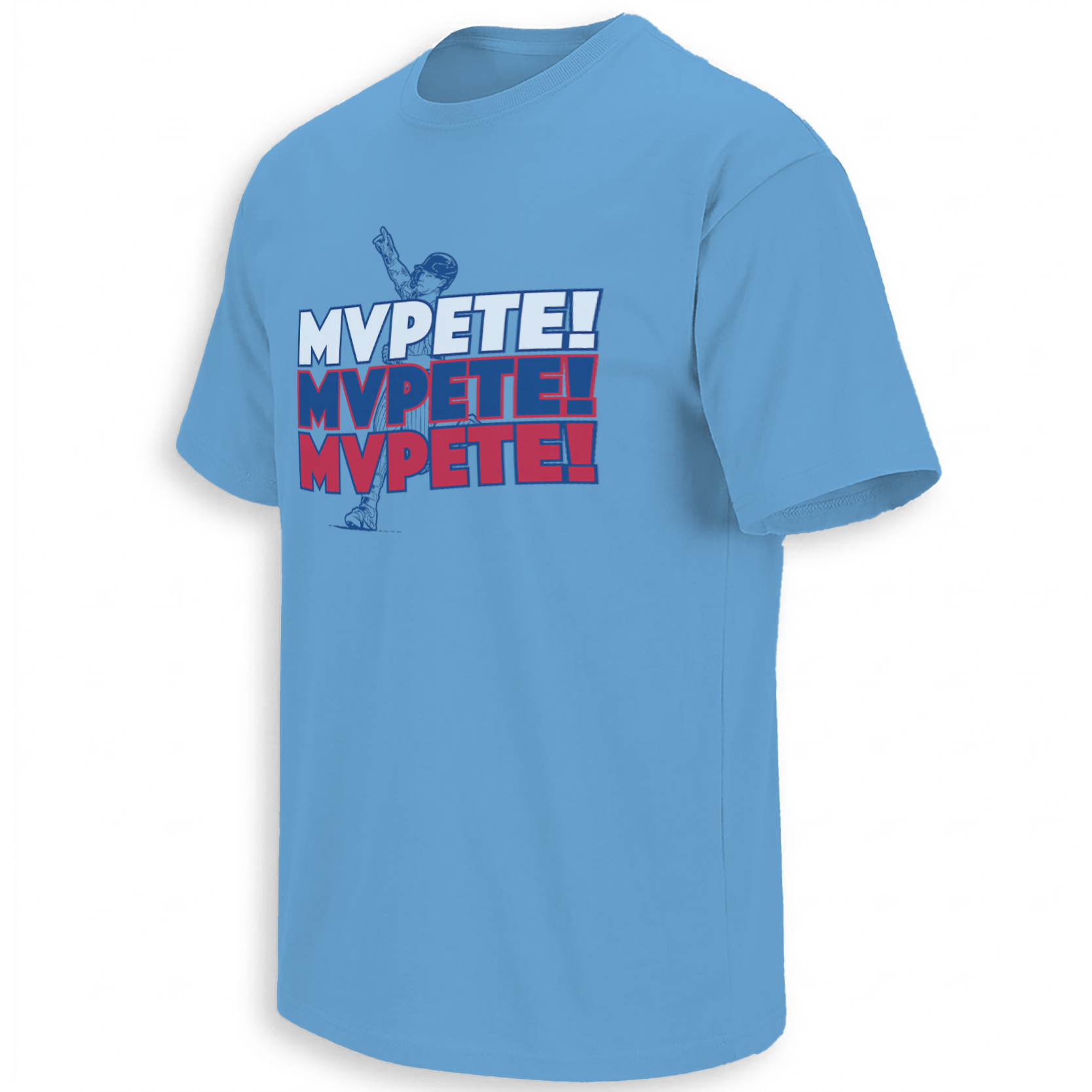
The graphic treats fan language as the artifact: three repetitions of the nickname create the visual rhythm of an MVP chant instead of reducing PCA’s season to a list of numbers.
View the chant graphic →MLB Has Started Using the Same “MV-Pete?” Language
The nickname is no longer confined to Cubs-specific fan spaces. MLB had already used “M-V-Pete?” while examining Crow-Armstrong’s award case in July. By September 17, the league’s own social feed was again framing him as the National League MVP frontrunner.
That progression matters culturally. Fan language usually begins locally: inside a stadium, a group chat, a sign or a joke. Once league-wide coverage adopts the same framing, the phrase becomes shorthand for a national baseball story rather than only a Chicago one.
MLB’s official highlight package shows both Crow-Armstrong home runs and the RBI triple from the 8–4 win over Atlanta. Watch the MLB highlight →
Chicago Is Already Treating This Like a Season Worth Archiving
The MVP race will eventually produce a ballot and a winner. Fan memory works differently. Chicago is already collecting the pieces it will use to remember the season: No. 43 passing Billy Williams, No. 44, the dirt-covered uniform, the stolen-base chase, the impossible center-field routes and the sound of Wrigley changing from “P-C-A” to “M-V-P.”
That is where a design such as MVPete belongs. It does not need to predict the final award result. It records the point when the campaign felt real enough for the ballpark to participate.
The wider Chicago Cubs collection works as a visual archive of those current Chicago moments, while Ellie Shirt’s broader MLB collection connects the MVP race to the wider culture of pennant chases, individual milestones and September baseball.
For designs centered specifically on PCA, the Pete Crow-Armstrong product search gathers the different visual languages that have followed his 2026 rise.
Frequently Asked Questions
What does MVPete mean?
MVPete combines “MVP” with Pete Crow-Armstrong’s first name. It has become fan shorthand for his 2026 National League MVP campaign.
What happened during Pete Crow-Armstrong’s September 16 game?
Crow-Armstrong hit two home runs and an RBI triple in Chicago’s 8–4 win over Atlanta, raising his season total to 44 home runs.
What Cubs record did PCA break with home run No. 43?
His 43rd homer moved him past Billy Williams’ 1970 record for the most home runs by a left-handed hitter in a single Cubs season.
Is Pete Crow-Armstrong currently an NL MVP frontrunner?
MLB’s September 17 Hitter Power Rankings placed him first for a second consecutive edition and identified him as the leader of the latest MVP poll.
How close is Pete Crow-Armstrong to a 40-40 season?
After September 16, he had 44 home runs and 37 stolen bases, leaving him three steals away from 40-40.
Why does the MVPete design repeat the phrase three times?
The repetition visually mimics a stadium chant building through the crowd, making fan sound and rhythm more important than a traditional statistical player poster.
The MVPete graphic preserves the chant-driven side of Pete Crow-Armstrong’s 2026 run, while the Chicago Cubs archive follows the milestones and fan language surrounding the rest of the season.
MVPete Shirt captures Pete Crow-Armstrong’s 2026 NL MVP surge through stacked chant-style typography inspired by the Wrigley Field atmosphere surrounding his 44-home-run season, Cubs records and ongoing 40-40 chase.