
Mike Vasil Cannot Pitch in 2026. Somehow, He Is Still Creating White Sox Magic.
A season-ending elbow injury removed Mike Vasil from Chicago’s pitching staff, but it did not remove him from the story. With a toy wand, perfectly timed home-run predictions and a growing mythology inside the dugout, the injured right-hander has become the unofficial magician of the White Sox’s unlikely 2026 revival.
On June 24, Mike Vasil joined the White Sox broadcast booth to discuss the season he was supposed to spend pitching. Instead, he spoke about Tommy John recovery, life around a first-place clubhouse and the small plastic wand that had somehow become one of the most recognizable objects in Chicago baseball.
By then, the wand was no longer an isolated dugout joke. It had appeared before White Sox home runs, moved through televised celebrations and become part of the language surrounding a team that entered the season with modest expectations before climbing into the American League Central race.
The central image was almost too neat: a pitcher unable to throw competitive innings standing near the dugout rail, pointing a toy wand toward the field and appearing to summon another blast. Baseball supplied the coincidence. Vasil and his teammates understood how to turn that coincidence into culture.
The wand became funny because the timing kept working. It became meaningful because Vasil found a way to remain inside the season.
The Pitcher Who Lost His Season Before It Began
Vasil entered 2026 with a legitimate place in Chicago’s pitching plans. During his 2025 rookie season, he had moved between relief work, late-inning situations and occasional starts, finishing with a 2.50 ERA across 101 innings. His versatility made him useful to a staff still determining how its young arms would fit together.
Spring training initially suggested that progress would continue. Then right elbow soreness changed the direction of his year. The White Sox announced in March that Vasil would undergo Tommy John surgery, removing him from the active roster for the season and beginning a long rehabilitation process with no quick version of recovery.
For an athlete, that type of injury creates two absences at once. There is the obvious physical absence from competition, but there is also the danger of disappearing from the team’s daily emotional rhythm. Games continue. Roles change. New players arrive. The season develops its own personality without waiting for the injured player to return.
Vasil refused that second disappearance. He remained around the club, participated in broadcasts, supported teammates and slowly became attached to one of the most playful rituals of the White Sox season.
Point the wand toward the hitter. Time the gesture with the pitch. Hope the baseball disappears over the wall. When the sequence works, repeat it until coincidence starts feeling like belief.
How a Toy Wand Became “Vasil Magic”
The magic-wand ritual spread because baseball is unusually receptive to superstition. Players repeat meals, clothing choices, handshakes and dugout movements when the results begin to align. The logical connection matters less than the emotional permission the ritual gives everyone involved.
Vasil’s version was visual enough for television. Rather than quietly occupying the same seat or wearing the same pair of socks, he could raise the wand, direct it toward the field and turn the next swing into a small public performance.
During the May 16 game against the Cubs, the White Sox broadcast captured the wand appearing to work again as Munetaka Murakami launched his 16th home run of the season. The clip supplied everything a baseball meme needs: a clear prop, an immediate result and a celebration simple enough to understand without explanation.
Other calls followed. Miguel Vargas became part of the magic-wand mythology. Home-run clips circulated with Vasil positioned as the dugout sorcerer, and the team’s own coverage leaned into the question already built into the joke: do you believe in magic?
Why the Joke Became Larger Than One Home Run
The wand would have remained a brief visual gag if the White Sox had continued losing at the pace expected before the season. Winning changed its meaning. Each successful prediction began to feel connected to the larger improbability unfolding around the club.
Chicago had lost a modern-era record 121 games in 2024 and another 102 in 2025. The rebuild had supplied prospects and cautious optimism, but very little reason to expect an immediate divisional race. When the 2026 group began winning, fans needed a language capable of expressing how strange the turnaround felt.
“Magic” provided that language without requiring anyone to pretend the results were literally supernatural. It described the emotional experience of watching young players improve at the same time, close games turn in Chicago’s direction and a clubhouse once defined by prolonged losing rediscover the pleasure of its own personality.
By mid-June, the possibility of a future magic-wand giveaway had entered official MLB coverage. The imagined scene was no longer limited to Vasil at the dugout rail. It was an October crowd at Rate Field, thousands of fans raising wands during a playoff moment that would have sounded absurd only months earlier.
The Artwork Turns Injury Rehab Into Baseball Folklore
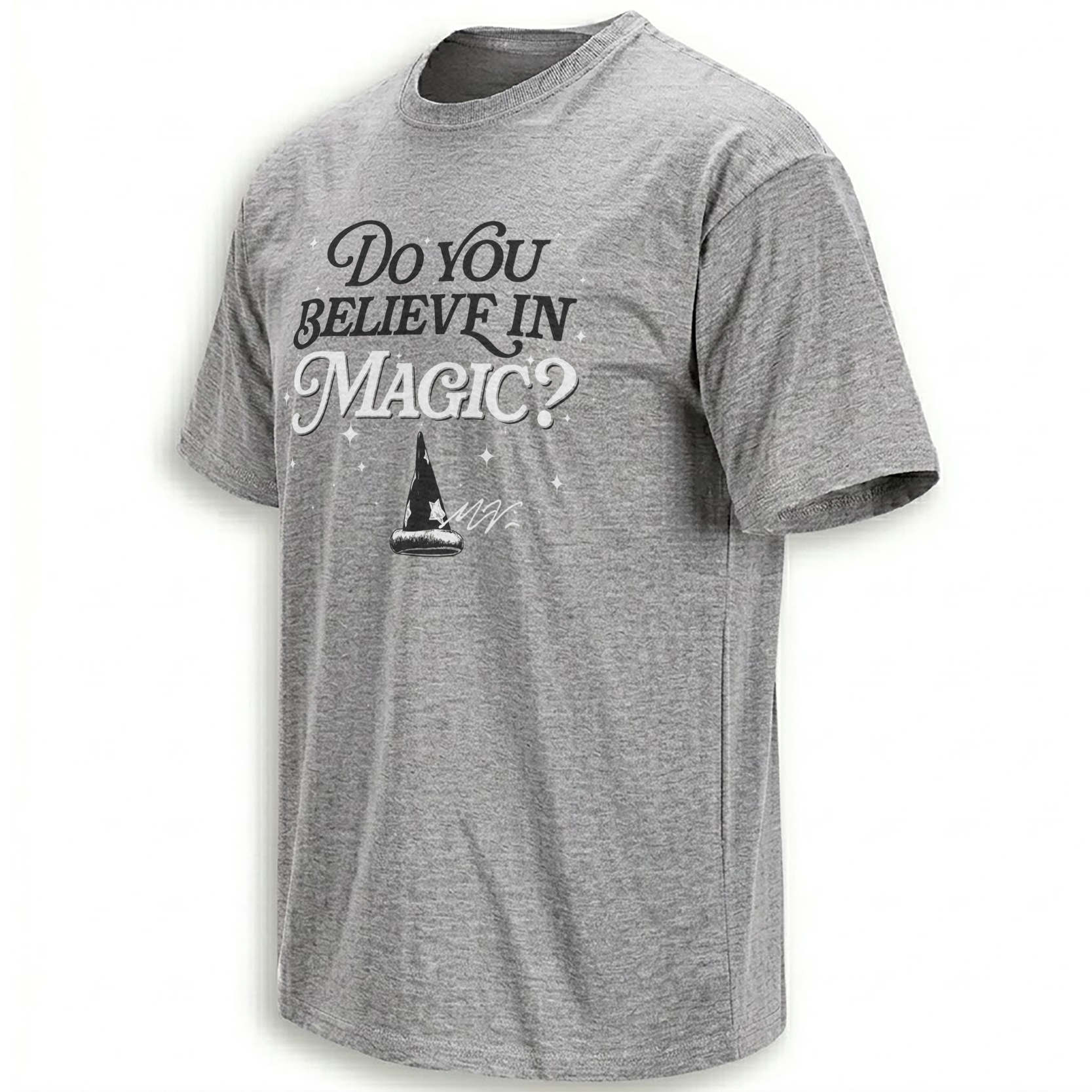
The Do You Believe in Magic Shirt does not present Vasil as a conventional pitcher. There is no mid-delivery action pose, no strikeout total and no attempt to disguise the fact that his 2026 influence has come from outside the active bullpen.
Instead, the artwork accepts the season’s internal mythology. Vasil becomes a wizard figure holding the wand that transformed him from injured observer into a recurring part of the broadcast. The visual exaggeration is the point: baseball already turned a piece of plastic into a symbol, and the graphic finishes the transformation.
The phrase “Do You Believe in Magic?” curves above the image like the title of an old fantasy poster or novelty baseball card. It asks a question rather than announcing a result, preserving the playful uncertainty that makes superstition enjoyable. Belief remains optional. Participation is not.
The wizard portrait, raised wand, scattered stars and curved fantasy lettering remove the story from ordinary player-merch language. The design treats Vasil’s dugout role as South Side folklore: part injury-season improvisation, part clubhouse comedy and part symbol of a team exceeding expectations.
Why the Wizard Styling Fits the White Sox Moment
Chicago’s black-and-white baseball identity is usually associated with toughness, minimalism and South Side streetwear. The wizard concept introduces another visual world without abandoning that foundation.
Black gives the composition its White Sox connection and allows the lighter magical elements to appear illuminated. Stars and flashes create motion around the wand, while the illustrated portrait carries the exaggerated energy of a hand-drawn clubhouse legend rather than a polished official photograph.
That contrast is important. A literal image of Vasil standing in the dugout would document the prop but not the feeling. The wizard treatment visualizes how teammates and fans began speaking about the ritual after the timing repeatedly aligned with home runs.
The composition also resembles the playful bootleg sports graphics that preserve moments too strange for conventional team branding. Those designs often succeed because they capture the fan version of an athlete rather than the formal résumé. In 2026, the fan version of Vasil carries a wand.
Four Reasons the Wand Connected With Fans
Viewers did not need a long explanation. Vasil pointed the wand, a teammate homered and the joke completed itself within seconds.
The ritual kept Vasil emotionally present during a season in which surgery prevented him from contributing through his arm.
A club rising faster than expected naturally made “magic” feel like the right description for the larger baseball story.
Unlike a complicated handshake, a wand can be understood and repeated by an entire stadium, giving the ritual genuine fan-culture potential.
Vasil’s Real Value Came Before the Wand
The character works because Vasil had already earned credibility as a pitcher. Claimed by the White Sox before the 2025 season, he entered the majors without the certainty usually attached to a highly protected prospect and became one of the club’s most useful arms.
His 2025 workload included 47 appearances, three starts and four saves. He finished 5–3 with a 2.50 ERA, striking out 82 hitters across 101 innings while proving capable of covering several different pitching roles.
That performance made the spring injury especially costly. Chicago did not lose a fringe player waiting for a role. It lost a flexible right-hander who had already shown he could stabilize innings and adapt to whatever the staff required.
The wand should therefore not reduce him to comic relief. It reveals another form of competitiveness. Unable to participate physically, Vasil looked for a way to contribute to the environment surrounding the players who could.
The Clubhouse Needed Joy as Much as Talent
Rebuilding teams are often discussed entirely through acquisition and development. Those elements matter, but a roster emerging from historic losing must also rebuild its relationship with the daily experience of baseball.
One hundred sixty-two games create too much emotional repetition for a clubhouse to survive on strategic planning alone. Players need rituals, jokes and celebrations capable of turning a six-month schedule into something shared.
The 2026 White Sox developed several of them. Sam Antonacci bowed at home plate. Miguel Vargas barked after home runs. Players built personalized greetings and pregame routines. Vasil’s wand became the clearest object inside that larger culture of fun.
None of those details explain the standings by themselves. Murakami still has to hit the baseball. Pitchers still have to record outs. Defenders still have to convert chances. Yet rituals reveal whether a group is beginning to enjoy the pressure it once merely endured.
South Side Magic Is Really a Story About Belonging
Vasil’s place in the story carries emotional weight because injury can make athletes feel separate from the team they are still officially part of. Rehabilitation happens away from the visible action, while healthy teammates accumulate moments that define the season.
The wand reversed that dynamic. Vasil’s physical absence from the mound became the reason he was visible somewhere else. Every time the broadcast found him preparing another “spell,” it reinforced the idea that his season had not disappeared. It had simply changed form.
That is why the image fits naturally inside the growing archive of Chicago White Sox graphics. The strongest pieces in that archive do not only record wins or star players. They preserve the internal language through which fans understood a particular team.
The wider MLB Shirts collection follows the same process across baseball, capturing the nicknames, dugout rituals, unexpected breakouts and visual jokes that turn a long season into recognizable fan memory.
Could the Magic Wand Reach October?
The image proposed in June was ambitious: Rate Field filled for postseason baseball, fans holding wands and attempting to summon the type of late home run that changes a series. For a franchise coming directly from consecutive seasons with more than 100 losses, even imagining that scene represented a major shift.
Whether the White Sox reach October will be decided by pitching depth, lineup health, divisional competition and several months of ordinary baseball uncertainty. The wand cannot solve those variables.
It can, however, preserve the point when October stopped sounding ridiculous. That may be the real cultural value of “Vasil Magic.” It marks the moment Chicago’s clubhouse allowed itself to behave like something good was possible.
Baseball superstition is rarely about proving that an object controls an outcome. It is about giving hope a physical form. In 2026, White Sox belief looked like a pitcher recovering from elbow surgery, smiling near the dugout rail and raising a plastic wand toward the next hitter.
Frequently Asked Questions
Why is Mike Vasil not pitching for the White Sox in 2026?
Vasil underwent Tommy John surgery after experiencing right elbow trouble during spring training. He was moved to the 60-day injured list and is expected to miss the entire 2026 season while completing rehabilitation.
What is the story behind Mike Vasil’s magic wand?
Vasil began using a toy wand in the White Sox dugout as a playful way to predict or summon teammates’ home runs. Several well-timed appearances helped the ritual become a recurring broadcast image and clubhouse joke.
Which White Sox home run helped make the wand famous?
One widely shared example occurred on May 16, 2026, when Vasil used the wand before Munetaka Murakami hit his 16th home run of the season against the Chicago Cubs.
How did Mike Vasil perform for Chicago in 2025?
Vasil went 5–3 with a 2.50 ERA, four saves and 82 strikeouts in 101 innings. He appeared in 47 games and worked in relief, late-inning situations and three starts.
What does the Do You Believe in Magic design represent?
The design turns Vasil into a South Side wizard and preserves the wand, home-run predictions and clubhouse optimism that made him part of the White Sox’s 2026 identity despite his injury.
The Do You Believe in Magic graphic preserves Mike Vasil’s transformation into the White Sox dugout wizard, while the broader South Side visual archive follows the names, rituals and unexpected belief defining Chicago’s 2026 revival.
Do You Believe in Magic Shirt captures Mike Vasil’s 2026 White Sox dugout ritual through a wizard portrait, home-run wand and the playful South Side belief surrounding Chicago’s unexpected rise.