The White Sox Are Relevant Again. The South Side Is Learning a New Set of Names.
Two years after baseball’s worst modern-era season, the 2026 Chicago White Sox have become an unexpected contender through young power, international star appeal, breakout pitching and a roster whose names now read like the vocabulary of a South Side revival.
On the final night of June, the Chicago White Sox sent eleven hits across Camden Yards, scored seven runs in one inning and beat Baltimore 9–3. Colson Montgomery homered. Tristan Peters collected two hits and scored twice. The victory was Chicago’s sixth in eight games and guaranteed the franchise its first series win over the Orioles since 2021.
It was the type of ordinary winning night that had become extraordinary on the South Side. The White Sox entered July at 42–38 and in first place in the American League Central, a position almost impossible to reconcile with the team that lost a modern-era record 121 games in 2024 and another 102 in 2025.
The turnaround has not been carried by one temporary hot streak or one veteran hired to stabilize the room. It has developed through an entire cluster of names: Munetaka Murakami, Colson Montgomery, Miguel Vargas, Davis Martin, Sam Antonacci, Chase Meidroth, Tristan Peters and other players whose individual breakthroughs have begun to form a recognizable team identity.
The surprise is no longer that Chicago has promising players. The surprise is how quickly those players have started to look like a team.
From Historic Collapse to a Real Pennant Race
Rebuilding language becomes empty when a fan base hears it for too long. Every losing club talks about timelines, development systems and future flexibility. On the South Side, those phrases became especially difficult to trust after the scale of the 2024 collapse.
That season was not merely bad. It set a modern MLB record for losses and transformed each new defeat into another national reference point. The following year brought improvement, but 102 losses still left the organization far from credibility.
The 2026 team has changed the emotional temperature because its progress can be seen without projection. The standings are real. The winning record is real. The rotation has produced front-line performances. Young hitters have supplied power, patience and athleticism. Games that once felt like development exercises now carry divisional consequences.
None of that guarantees how September will look. An 80-game sample can produce excitement without resolving every weakness. But White Sox supporters no longer have to pretend that the future is visible somewhere beyond the current roster. The future is already taking at-bats.
The Names That Changed the Conversation
The 2026 White Sox are compelling because their identity is distributed. Munetaka Murakami arrived with international attention and immediately supplied the type of left-handed power capable of changing how opponents pitch the entire lineup.
Colson Montgomery represents a different kind of promise fulfilled. After enduring a difficult stretch in the minor leagues, he reset, reached Chicago in 2025 and developed into a power-hitting shortstop whose defense gives the lineup another layer of value.
Miguel Vargas has turned an uneven arrival on the South Side into a broader offensive breakout. Davis Martin has transformed from depth starter into one of the most important pitchers in Chicago’s season. Sam Antonacci has supplied the grinding, disruptive at-bats that make a lineup harder to navigate than its home-run totals alone suggest.
Chase Meidroth, Tristan Peters and the wider group deepen the sense that the roster is becoming a collective story rather than a collection of isolated prospects. Even the less established names matter because contenders are rarely built only from stars. They become real when the lower half of the lineup, the bullpen and the back of the rotation begin to contribute to the same momentum.
A Shirt Designed Like a South Side Roster Chant
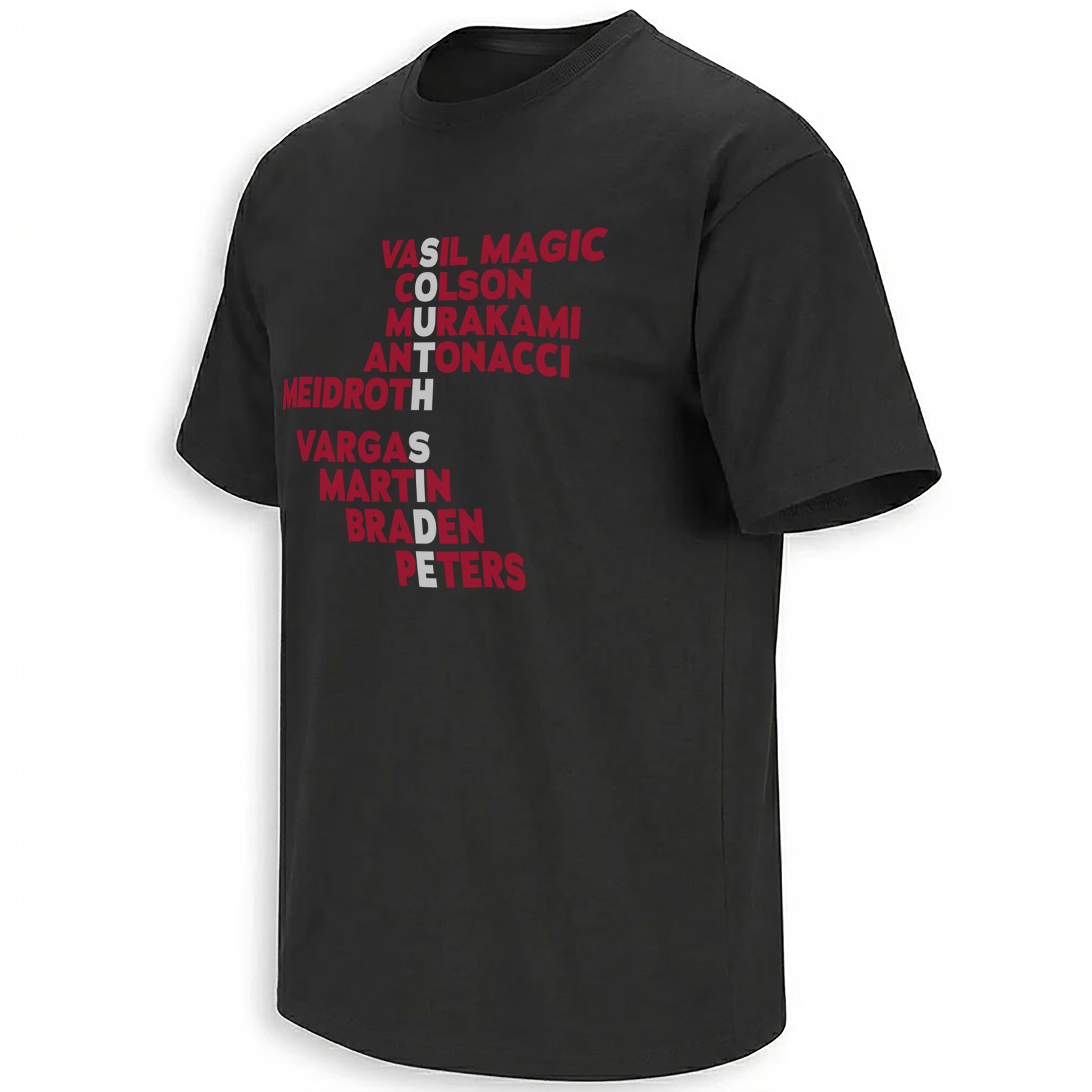
The South Side Shirt does not use a conventional team photograph or a single-player portrait. Instead, the artwork stacks selected 2026 names into the shape of “Sox,” turning the roster itself into the visual identity.
That decision fits the current White Sox moment. Chicago’s resurgence cannot be explained through one face alone. Murakami may carry the largest international profile, while Montgomery provides homegrown star energy and Martin anchors the pitching story, but the larger emotional appeal comes from watching several careers rise at once.
Why the Typography Matters
The black base gives the artwork the immediate visual weight associated with White Sox streetwear. Red replaces the expected white-and-silver treatment, introducing a sharper sense of urgency and separating the graphic from traditional licensed-logo layouts.
The names are arranged with irregular spacing rather than placed inside a clean roster grid. That uneven construction makes the design feel closer to hand-cut poster lettering, neighborhood wheatpaste graphics and fan signage than a formal team-issued composition.
White letters hidden inside selected names complete the larger word shape. This visual device rewards a second look: first the viewer reads individual players, then the roster resolves into the team identity. It is an effective metaphor for the season itself. Chicago’s players arrived as separate development stories. By July, they had begun to read as one club.
The artwork turns names into architecture. Black creates the South Side foundation, red supplies momentum, and the white letter fragments reveal “Sox” only after the individual players have been read. The team identity emerges from the roster rather than being placed above it.
Four Different Forms of the White Sox Breakout
Murakami brought Japanese baseball prestige and immediate home-run gravity to Chicago, giving the rebuild a star capable of expanding the team’s identity beyond its local market.
Montgomery’s path from minor-league struggle to impact shortstop has become one of the clearest examples of player development changing the organization’s direction.
Martin’s rise gave Chicago something rebuilds often lack: a starter outperforming expectations quickly enough to change the meaning of every five-game stretch.
Younger complementary players have supplied difficult at-bats, speed, defense and timely production, preventing the season from becoming dependent on one or two headline names.
“South Side” Means More Than Geography
The White Sox have always carried a stronger neighborhood identity than their citywide branding can fully express. “South Side” communicates place, class, loyalty and a particular relationship with baseball that exists independently of the standings.
It is also a defensive phrase. White Sox fans are accustomed to watching Chicago baseball conversation tilt toward the North Side, national television windows and the mythology surrounding Wrigley Field. South Side identity has therefore developed partly through the belief that outside attention is optional.
The 2026 season complicates that posture in the best possible way. A team that had become synonymous with losing is now forcing the wider baseball public to relearn its roster. National attention may remain cautious, but the standings have created a reason for every opponent to understand names that were unfamiliar in March.
The broader MLB shirts and baseball culture archive follows that process across the league, preserving the players, phrases and unexpected team stories that begin as local conversation before spreading into the national season.
Why Team-Name Graphics Become Time Capsules
A roster shirt is always attached to a particular year. Players move. Prospects arrive. Veterans are traded. A name that defines one summer may occupy a different uniform before the next one begins.
That impermanence gives team-name artwork its emotional value. It records who fans were learning, debating and cheering for at one exact stage of a franchise. The design does not claim to be a permanent or complete organizational history. It functions as a fan-facing snapshot of the names shaping the 2026 conversation.
Years from now, some of those names may represent long White Sox careers. Others may become reminders of one memorable stretch. Together, however, they will continue to point back to the season when a club that had reached the bottom of modern baseball suddenly occupied first place.
Frequently Asked Questions
Why are the 2026 Chicago White Sox receiving renewed attention?
Chicago entered July 2026 with a winning record and the lead in the American League Central, a dramatic change after losing 121 games in 2024 and 102 games in 2025.
Which players have shaped the White Sox turnaround?
Munetaka Murakami, Colson Montgomery, Miguel Vargas, Davis Martin and Sam Antonacci have been central to the season, while players such as Chase Meidroth and Tristan Peters have strengthened the wider roster.
What does the South Side Shirt design spell?
The selected player names are arranged into a condensed visual form of “Sox,” allowing individual roster names to create the larger team identity.
Why is Munetaka Murakami important to the 2026 White Sox?
Murakami brought elite left-handed power and major international recognition to Chicago, becoming one of the most visible figures in the club’s return to contention.
Why does “South Side” carry special meaning for White Sox fans?
The phrase represents the team’s geographic home, neighborhood culture and independent baseball identity within a city whose national baseball attention often centers on the North Side.
The South Side team-names graphic preserves the group shaping Chicago’s 2026 revival, while the wider MLB visual archive follows the players and season-defining moments rewriting baseball’s current map.
South Side Shirt captures the Chicago White Sox’s unexpected 2026 resurgence by arranging names including Murakami, Colson, Antonacci, Meidroth, Vargas, Martin and Peters into a bold roster-built Sox graphic.