
Miami Built a Score Machine — Now It Has to Travel
Seventy-seven points. A school-record 856 yards. Forty-two first downs. Eleven touchdowns. Miami’s 2026 home opener stopped looking like a football game and started looking like a machine being tested at full throttle.
Miami did not need the entire night to explain why “Score Machine” suddenly felt like a reasonable nickname.
Against Florida A&M on September 10, the Hurricanes scored touchdowns on every possession of the first half. By halftime the scoreboard read 49–0. By the end of the third quarter it was 77–0. The teams eventually agreed to shorten the fourth quarter to ten minutes, but by then Miami had already produced one of the most extreme offensive performances in program history.
The final was 77–7. The point total tied Miami’s single-game school record. The 856 yards established a new program record, and the Hurricanes’ 42 first downs set a new ACC mark.
Even more striking was how little of the performance depended on one player remaining on the field all night.
A “score machine” is supposed to keep working when the parts change. Miami replaced quarterbacks, running backs and receivers — and the scoreboard kept moving.
The Starting Offense Barely Had Time to Finish Its Work
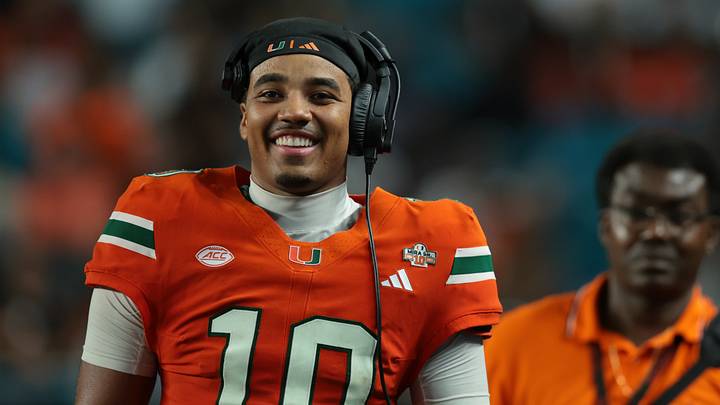
Darian Mensah completed 14 of 15 passes for 252 yards and three touchdowns. Mark Fletcher Jr. needed only seven carries to reach 105 rushing yards and two scores. Malachi Toney caught another touchdown. Miami’s first unit did what an elite offense is expected to do against an overmatched opponent: take control immediately.
The more revealing part came afterward.
Backup quarterback Luke Nickel completed all eight of his passes and threw three touchdowns. Freshman Javian Mallory rushed for 142 yards and two scores. Sixteen different Hurricanes caught a pass. Nine different players reached the end zone.
The Artwork Treats an Offense Like a Piece of Machinery
The Miami Score Machine design deliberately avoids turning the night into a Darian Mensah shirt, a Fletcher shirt or a Malachi Toney shirt. That choice is important because the most unusual part of the FAMU performance was the depth of the production.
The centerpiece is a football helmet built into a winged mechanical emblem. Orange, white and green stripes extend outward like the bodywork of a vintage racing machine before dissolving into feathered wings. Above it, distressed collegiate lettering announces “MIAMI SCORE MACHINE.”
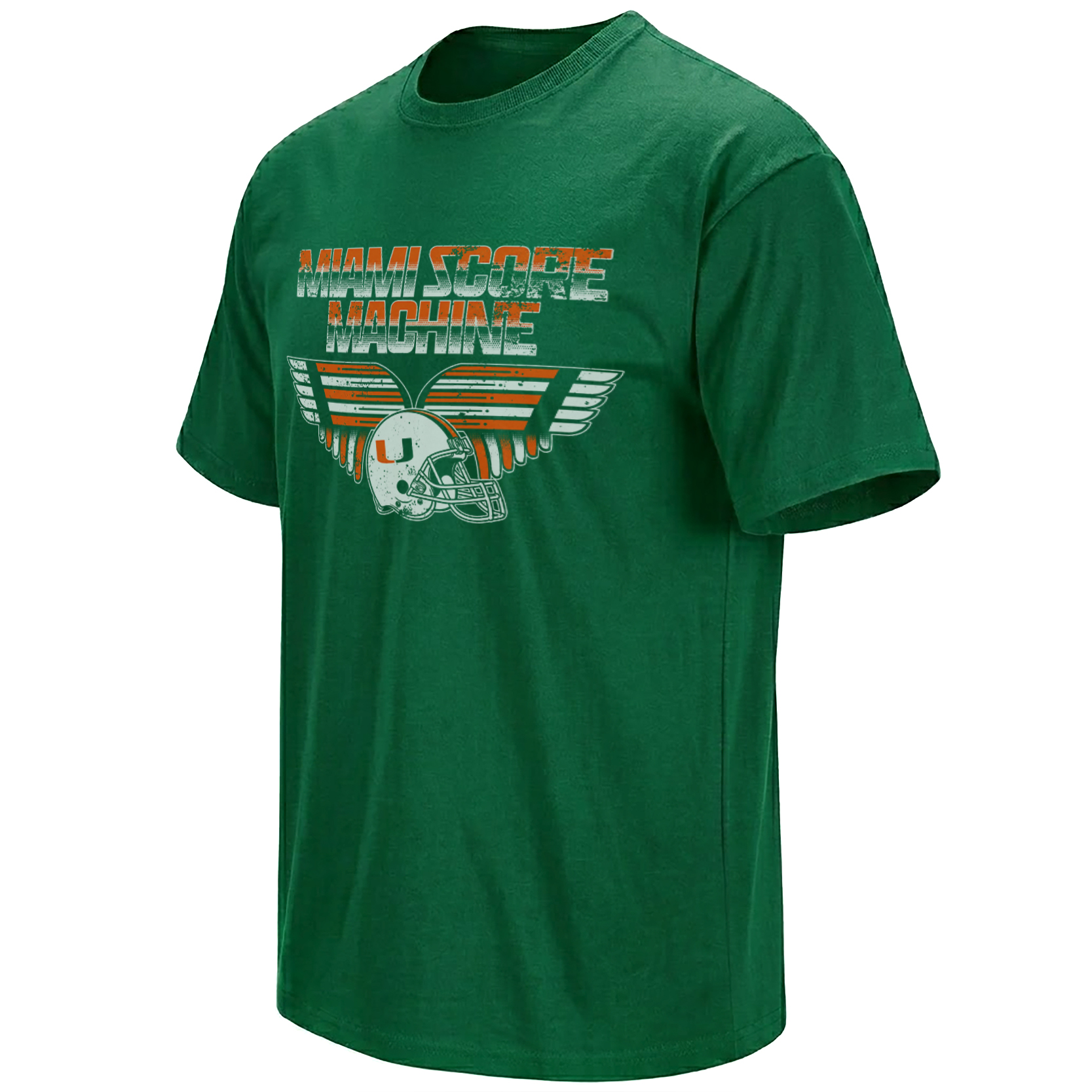
Dark green creates the chassis, orange supplies speed and heat, while the symmetrical wings make the graphic feel engineered rather than illustrated. The worn ink texture keeps the composition closer to an old collegiate garage emblem than a slick modern digital poster.
The Numbers Are Absurd — but FAMU Is Not the Final Test
The right way to read 77–7 is neither to dismiss it nor to pretend it proves Miami has the best offense in America.
Florida A&M is an FCS opponent that entered the game on short rest. Miami was expected to win comfortably. What mattered was the efficiency with which the Hurricanes handled that mismatch: 11 scores on their first 12 possessions, production from the starters, production from the backups and almost no offensive slowdown as the depth chart rotated.
Miami has now opened 2026 by beating Stanford 45–6 and FAMU 77–7, producing 122 points in two games. The performance helped move the Hurricanes from No. 7 to No. 5 in the AP poll.
Friday night at Wake Forest provides a better test of whether “Score Machine” can become an identity rather than a one-week headline. It is an ACC road game, Miami’s first trip to Winston-Salem since 2009, and the first chance after the record night to see how the offense responds outside Hard Rock Stadium.
The fan reaction reflected how surreal the night became. Even after 77 points, supporters were joking that Miami could have scored more. That is exactly the mood captured by the graphic: less celebration of one touchdown than disbelief at a scoreboard that refused to stop changing.
Miami Now Has to Prove the Machine Travels
That is what gives this design a useful life beyond the FAMU box score. If Miami continues producing at an elite level, the phrase becomes shorthand for the 2026 offense. If the pace slows, the shirt remains a timestamp from the night the Hurricanes tied their scoring record and rewrote their yardage record.
The confirmed Miami Hurricanes collection gathers the broader visual story around The U, while Miami Hurricanes search results surface other current player and team moments.
Frequently Asked Questions
Did Miami really score 77 points against Florida A&M?
Yes. Miami won 77–7 on September 10, 2026, tying the Hurricanes’ single-game program record for points.
How many yards did the Hurricanes produce?
Miami generated 856 total yards, establishing a new school record.
What ACC record did Miami break?
The Hurricanes recorded 42 first downs against FAMU, setting a new Atlantic Coast Conference record.
Who is Miami’s starting quarterback in 2026?
Darian Mensah is the starter. He completed 14 of 15 passes for 252 yards and three touchdowns against FAMU.
What is Miami’s next game?
The Hurricanes travel to Wake Forest on September 18 for their next ACC matchup.
The Miami Score Machine graphic preserves the record-setting night, while the Miami Hurricanes archive follows what happens when the machine leaves South Florida.
Miami Score Machine Shirt captures the Hurricanes’ explosive 77-point home opener, school-record 856 yards and ACC-record 42 first downs through a distressed vintage winged-helmet design inspired by the entire 2026 offense.