
Like Phantoms, Forever
Before it announced My Chemical Romance’s resurrection, the phrase belonged to a scarce 2002 EP. Its journey from an obscure first artifact to a reunion message explains why MCR has always understood absence as part of its mythology.
My Chemical Romance did not return in 2019 with a conventional announcement. There was no cheerful band photograph, carefully worded press release or promise that everything would resume exactly where it had stopped.
Instead, the band accompanied its reunion with an older phrase: “Like Phantoms, Forever.” For longtime listeners, those words reached back to one of the earliest and scarcest artifacts in the MCR story. For everyone else, they sounded like a description of what the band had become during its absence—unseen, unresolved and still present.
That double meaning is why the phrase continues to carry unusual weight. It belongs simultaneously to 2002, when My Chemical Romance was still building an identity, and to 2019, when millions of listeners discovered that the identity had survived the breakup.
Transmission recovered A phantom is absent from the room but present in the imagination. That is almost exactly how My Chemical Romance existed between breakup and return.
The phrase began before the mythology was complete
Like Phantoms, Forever was an early My Chemical Romance EP associated with the band’s 2002 emergence. It contained only three tracks and arrived immediately before the group’s debut album, I Brought You My Bullets, You Brought Me Your Love.
The release included “Vampires Will Never Hurt You,” “This Is the Best Day Ever” and a live cover of Morrissey’s “Jack the Ripper.” Those titles already carried the collision that would become central to MCR: horror imagery, emotional urgency, theatrical language and everyday vulnerability.
Only a small number of original copies circulated. That scarcity eventually made the EP feel less like an ordinary item in a discography and more like physical evidence from the band’s prehistory.
Gerard Way understood that a band could look like a world
Gerard Way’s importance to My Chemical Romance extends beyond lead vocals. His background in visual art helped the group build an environment around its music: characters, uniforms, colors, symbols and narratives that shifted from one era to another.
The early “Bullets” period appeared raw and unstable. Three Cheers for Sweet Revenge sharpened death and devotion into a romantic tragedy. The Black Parade transformed grief into a theatrical procession, while Danger Days rebuilt the band as brightly colored fugitives in a dystopian desert.
Across those changes, death rarely represented a clean ending. Ghosts, vampires, corpses, mourners and memory repeatedly returned as ways to discuss love, fear, identity and survival.
“Like Phantoms, Forever” therefore feels less like an isolated title and more like an early thesis. The band would change its costumes and stories, but it would continue haunting the people who found themselves inside those records.
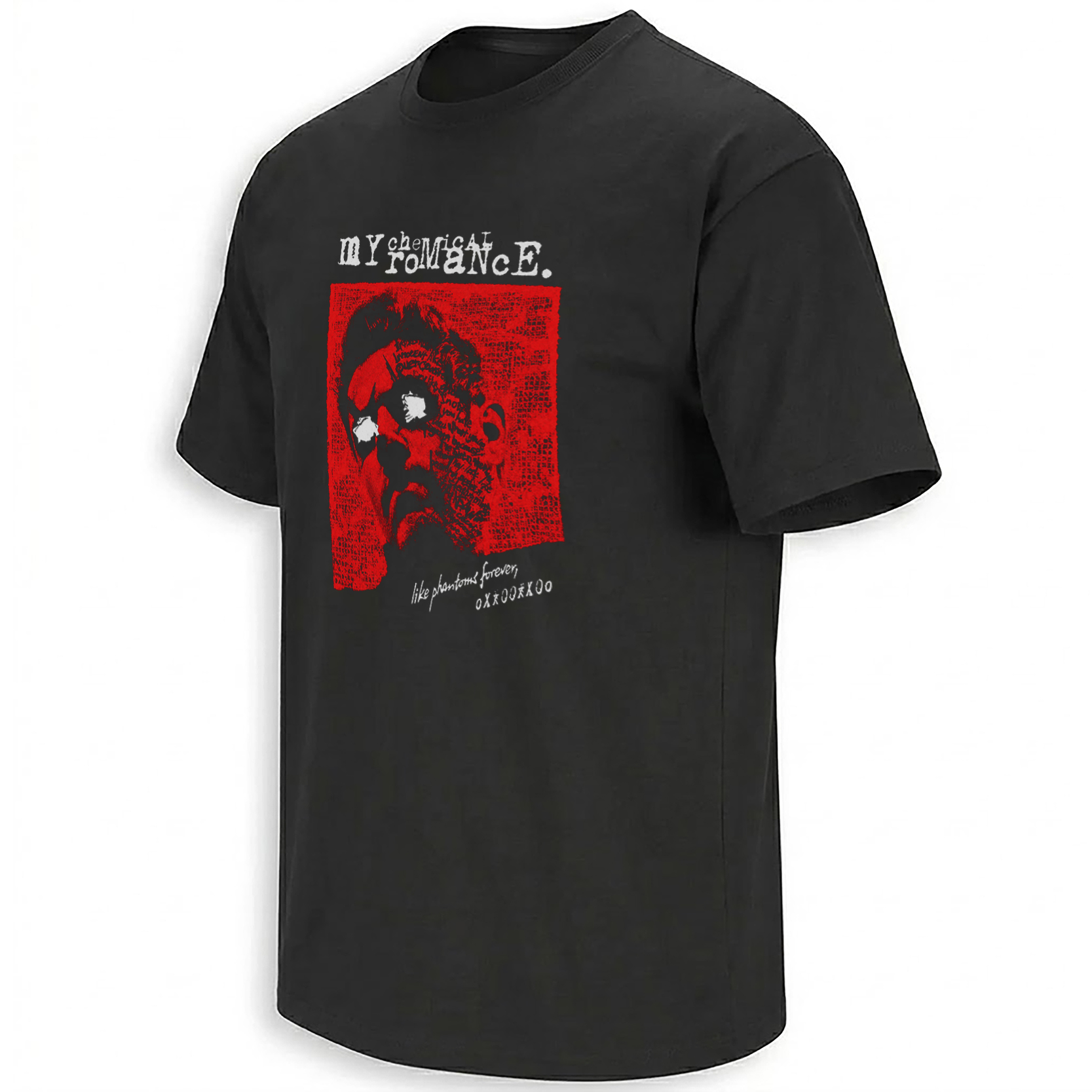 LPF
Gerard Way appears as both performer and apparition
The distressed portrait, dark field and spectral lettering connect a living stage figure to a phrase built around memory, disappearance and return.
LPF
Gerard Way appears as both performer and apparition
The distressed portrait, dark field and spectral lettering connect a living stage figure to a phrase built around memory, disappearance and return.
Why the 2019 reunion returned to 2002
My Chemical Romance announced its breakup in March 2013. The decision did not make the culture surrounding the band disappear. Listeners continued trading live footage, explaining album narratives, rediscovering deep cuts and introducing the music to people who had been too young to experience its original release.
In that sense, MCR spent six years behaving exactly like a phantom. The active institution was gone, but the emotional presence remained unusually strong.
When the band announced a December 2019 reunion performance in Los Angeles, it reused “Like Phantoms, Forever.” Choosing the title of an obscure early release allowed the group to speak directly to devoted listeners without reducing the comeback to nostalgia for its commercially largest era.
The words also described the reunion itself. My Chemical Romance had not returned as if nothing happened. It arrived carrying the memory of its own disappearance.
The portrait turns Gerard Way into a cultural apparition
The artwork centers Gerard Way because his face operates as a visual shorthand for the band’s theatrical imagination. Yet the portrait is not presented as a clean celebrity photograph.
Its distressed treatment makes the image appear recovered rather than newly produced—closer to a deteriorating poster, photocopied show flyer or damaged transmission from a previous era.
This visual deterioration matters. A conventional portrait would say only “Gerard Way.” The spectral treatment instead says “Gerard Way remembered, transmitted and summoned again.”
Dark negative space surrounds the figure, allowing the human image to appear temporarily illuminated. The composition does not require a literal ghost because its printing language already makes the subject feel halfway between presence and memory.
“Forever” describes the fans as much as the band
Pop-cultural permanence is rarely literal. Bands stop recording, tours end, scenes fragment and the style associated with one generation becomes a historical reference for the next.
What persists is the audience’s willingness to reactivate the work. A listener plays an old album during a new crisis. Someone recognizes a lyric on a stranger’s shirt. A teenager finds The Black Parade years after its release and experiences it as urgently as an original listener did.
“Forever” in the MCR context is therefore participatory. The band remains present because people continue carrying the songs, visual codes and personal memories forward.
“Like Phantoms, Forever” should not be mistaken for a lyric from one famous MCR single. It is the title of an early EP and was later reused in the band’s 2019 reunion messaging.
Why the phrase still feels current
My Chemical Romance has always made older material feel capable of reappearing in a new form. Album anniversaries, reunion performances, archival discoveries and cryptic imagery continually rearrange the relationship between past and present.
The phrase avoids becoming trapped in one record because it names a condition rather than a plot. To exist “like phantoms” is to remain capable of appearing wherever memory opens a door.
That quality also explains why the design works as a cultural artifact instead of merely a tour souvenir. It does not depend on one venue, date or setlist. It represents the larger lifecycle through which MCR disappeared, remained emotionally visible and returned.
The Like Phantoms Forever Shirt places Gerard Way inside that lifecycle, connecting the band’s earliest recorded era to the reunion phrase that later gave those words a second existence.
Readers looking for other recent music, internet-culture and fan-driven designs can explore Ellie Shirt’s complete Newest collection. No unverified My Chemical Romance collection URL has been inserted into this article.
Understanding “Like Phantoms, Forever”
What does “Like Phantoms, Forever” refer to?
It is the title of an early My Chemical Romance EP and a phrase the band later reused when announcing its 2019 reunion.
When was the Like Phantoms, Forever EP released?
The scarce three-track EP is associated with My Chemical Romance’s early 2002 period, shortly before the release of the band’s debut album.
Which songs appeared on the EP?
The release contained “Vampires Will Never Hurt You,” “This Is the Best Day Ever” and a live cover of Morrissey’s “Jack the Ripper.”
Is “Like Phantoms, Forever” a My Chemical Romance song lyric?
It is best known as an EP title and reunion phrase rather than a lyric from one of the band’s major singles.
How was the phrase connected to the MCR reunion?
My Chemical Romance used “Like Phantoms, Forever” in the messaging surrounding its 2019 return show announcement.
Who is featured in the Ellie Shirt artwork?
The design uses a stylized portrait of My Chemical Romance lead vocalist and visual storyteller Gerard Way.
The Gerard Way artwork treats “Like Phantoms, Forever” as more than an archival title: it is a message sent from MCR’s beginning, recovered at the reunion and kept alive by the listeners who never stopped seeing the band.
A spectral Gerard Way portrait connects My Chemical Romance’s rare 2002 EP to the phrase that announced its return, turning absence, memory and fandom into one enduring image.