
Harvey’s Wallbangers Cross Again
Five Milwaukee hitters walk across baseball’s most recognizable crosswalk, turning the Brewers’ explosive 1982 lineup into an album-cover-style reunion of power, personality and unfinished championship memory.
Some baseball teams are remembered by a championship. The 1982 Milwaukee Brewers are remembered by a name that still sounds like something crashing through a stadium wall: Harvey’s Wallbangers.
The nickname contained an entire personality. “Harvey” referred to manager Harvey Kuenn, the Milwaukee native who took over a talented but slow-starting club in June. “Wallbangers” described an offense built to punish baseballs, overwhelm scoreboards and make County Stadium feel dangerously small.
Four decades later, the name remains one of baseball’s great pieces of shorthand. It immediately evokes powder-blue uniforms, home-run power, overflowing Wisconsin crowds and a lineup that carried Milwaukee to its first American League pennant.
Harvey’s Wallbangers did not need to win the final game of 1982 to become immortal. Their style was so distinctive that the nickname became a permanent part of Milwaukee baseball language.
Why the Brewers became Harvey’s Wallbangers
Milwaukee entered 1982 with enormous expectations after reaching the postseason in the strike-shortened 1981 campaign. The roster included established stars, dangerous middle-of-the-order hitters and elite pitching, but the season began unevenly under Buck Rodgers.
When Kuenn assumed control in early June, the Brewers were 23–24. From June 2 forward, Milwaukee went 72–43 and completed the regular season with a 95–67 record—the best mark in Major League Baseball.
The turnaround was not based on a subtle offensive philosophy. Milwaukee scored 891 runs and hit 216 home runs, leading MLB in both categories. The Brewers also led the majors in slugging percentage, OPS, total bases and extra-base hits.
Kuenn’s relaxed presence and the lineup’s punishing production produced a nickname modeled on the Harvey Wallbanger cocktail. Unlike a temporary marketing slogan, it felt naturally connected to the people involved: one part manager, one part power and one part Milwaukee barroom humor.
The five hitters crossing the road
The artwork selects five names from the heart of the Wallbangers’ offensive identity: Robin Yount, Paul Molitor, Ben Oglivie, Cecil Cooper and Gorman Thomas. Each is labeled below the crosswalk and accompanied by a signature-style flourish.
The design is not attempting to reproduce every contributor. Ted Simmons, Jim Gantner, Charlie Moore, Pete Vuckovich, Rollie Fingers, Don Sutton and others remain essential to the complete story. The five-man procession functions instead like a band portrait: a concise visual lineup built around the offense’s most recognizable stars.
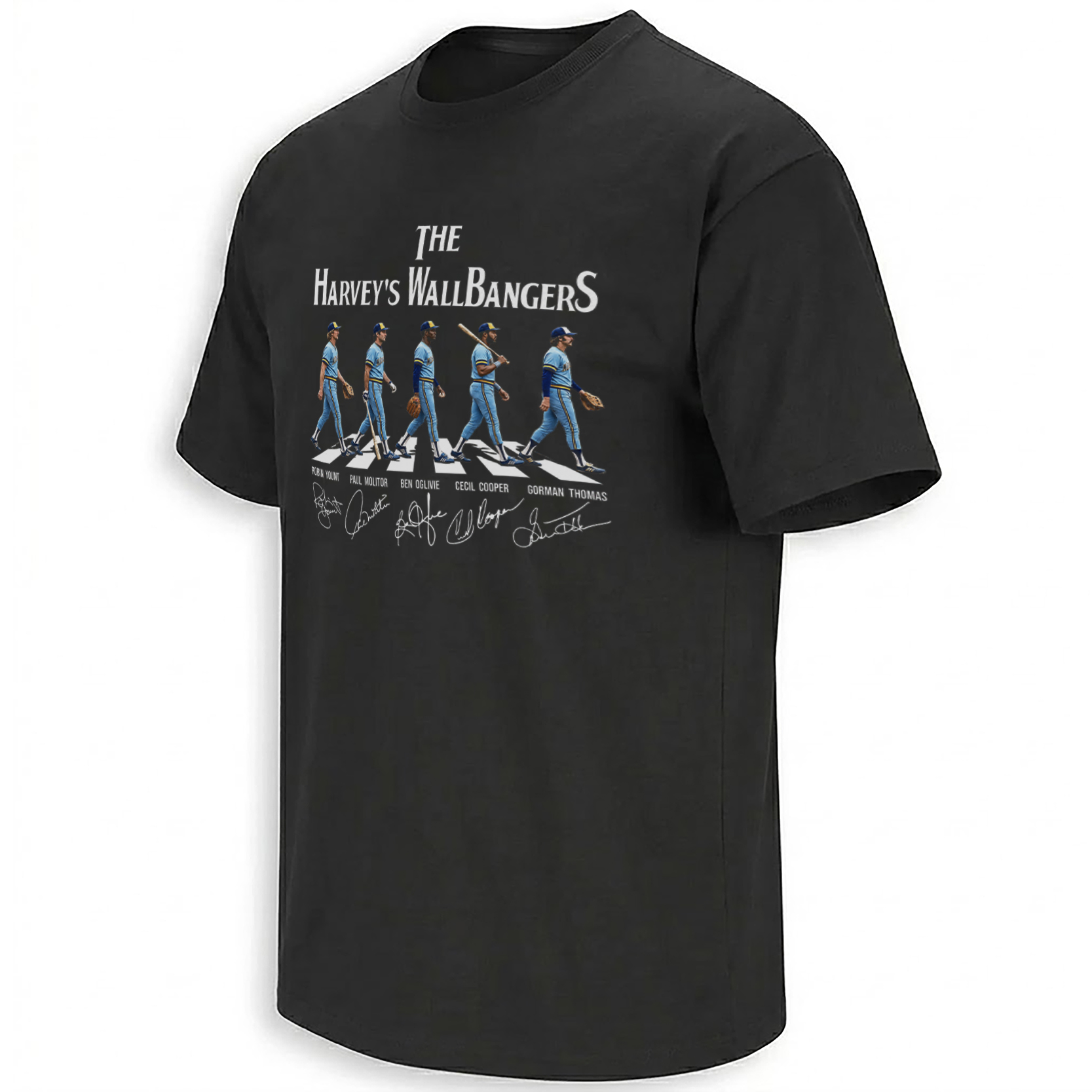 THE FIVE
A championship-era batting order staged like a legendary band
Yount, Molitor, Oglivie, Cooper and Thomas move across a striped road in powder-blue uniforms, with names and signatures turning the composition into a piece of Milwaukee baseball memorabilia.
THE FIVE
A championship-era batting order staged like a legendary band
Yount, Molitor, Oglivie, Cooper and Thomas move across a striped road in powder-blue uniforms, with names and signatures turning the composition into a piece of Milwaukee baseball memorabilia.
Why the Abbey Road composition fits this team
The famous crosswalk format is commonly used when a group has become larger than its individual members. Four figures walking in sequence can suggest a band, a movement, a shared era or one final image of people whose names no longer require introduction.
That visual grammar fits the Wallbangers because the 1982 Brewers are remembered collectively. Fans may debate which hitter was most important, but the nickname belongs to the lineup as a unit.
Replacing musicians with ballplayers also produces a quiet joke about rhythm. A great batting order has its own sequencing: Molitor reaching base, Yount driving the ball, Cooper producing runs and the power hitters behind them changing a game with one swing.
The crosswalk turns that sequence into a literal procession. Each player follows the next, but all five are traveling in the same direction.
Robin Yount supplied the masterpiece season
Yount’s 1982 campaign anchors the mythology. He hit .331 with 29 home runs, 114 RBI, 46 doubles and 210 hits while playing shortstop. He led the American League in hits, doubles, slugging percentage and total bases and received the league’s Most Valuable Player award.
His year was exceptional even within an exceptional lineup. On the final day of the regular season, with Milwaukee needing a victory over Baltimore to secure the AL East, Yount hit two home runs and helped the Brewers avoid the collapse that had begun to feel possible.
The artwork places Yount at the front of the crossing. Whether intended as a ranking or simply a compositional choice, the position makes historical sense: he was the player leading Milwaukee into its defining October.
The pennant required more than home runs
Milwaukee fell behind the California Angels two games to none in the best-of-five American League Championship Series. No team had previously recovered from that deficit under the format.
The Brewers returned home and won three consecutive games. In Game 5, Cecil Cooper delivered the go-ahead two-run single in the seventh inning, producing a 4–3 victory and the first World Series appearance in franchise history.
The comeback expanded the meaning of “Wallbangers.” It no longer described only a team that could hit home runs. It described a group capable of absorbing a near-ending and striking back.
Why losing the World Series did not erase the legend
The 1982 World Series against St. Louis became known as the “Suds Series,” connecting two beer-producing cities and two sharply contrasting styles of baseball. Milwaukee brought power; the Cardinals relied more heavily on speed, defense and pressure.
The series reached Game 7 before St. Louis prevailed. For Milwaukee, the loss created a complicated inheritance: the greatest season in franchise history had reached the final possible game without delivering the final victory.
Yet that incompleteness may be one reason the Wallbangers remain so emotionally vivid. A championship can close a story. The 1982 Brewers left supporters with a season they can continue replaying, debating and carrying forward.
The Brewers played in the American League in 1982. They did not move to the National League until 1998, so the Wallbangers’ defining pennant was an American League championship.
A design built like a memory, not a scoreboard
The powder-blue uniforms immediately locate the figures in an earlier baseball era. The black ground removes stadium details and places the emphasis on silhouette, movement and identification.
Beneath the players, the printed names make the historical reference accessible. The signature treatment then moves the artwork closer to the visual language of an autographed team photograph or treasured program.
Most importantly, the five players are walking rather than batting. That decision removes them from one specific game and allows them to exist as an eternal lineup—always crossing, always together and always approaching the next moment.
Milwaukee still carries the Wallbangers forward
Modern Brewers teams play in a different league, stadium and strategic era, but the 1982 club remains a measuring point for offensive force and postseason possibility.
The Harvey’s Wallbangers Shirt preserves that history through a recognizable pop-cultural composition. It does not merely say that five famous players once shared a roster. It presents them as Milwaukee’s house band—the group responsible for one unforgettable summer’s soundtrack.
More current and historical Milwaukee designs can be explored through the complete Milwaukee Brewers collection.
Harvey’s Wallbangers: 1982 Brewers FAQ
Who were Harvey’s Wallbangers?
Harvey’s Wallbangers was the nickname given to the power-hitting 1982 Milwaukee Brewers managed by Harvey Kuenn.
Why were they called Harvey’s Wallbangers?
“Harvey” referred to manager Harvey Kuenn, while “Wallbangers” described the team’s powerful offense and played on the name of the Harvey Wallbanger cocktail.
Which players appear in the Abbey Road-inspired artwork?
The design identifies Robin Yount, Paul Molitor, Ben Oglivie, Cecil Cooper and Gorman Thomas.
How many home runs did the 1982 Brewers hit?
Milwaukee hit 216 regular-season home runs, the highest total in Major League Baseball that year.
Did Harvey’s Wallbangers reach the World Series?
Yes. Milwaukee won the 1982 American League pennant and then lost a seven-game World Series to the St. Louis Cardinals.
Who won the 1982 American League MVP award?
Brewers shortstop Robin Yount won the award after producing one of the finest seasons in franchise history.
Where can fans find more Milwaukee Brewers designs?
More designs are available at https://ellieshirt.com/collections/mlb/milwaukee-brewers/.
The Abbey Road-inspired Wallbangers artwork lets Milwaukee’s legendary five cross together again—Yount, Molitor, Oglivie, Cooper and Thomas, forever moving through the summer of 1982.
Five power-hitting Milwaukee legends cross baseball history together in an Abbey Road-inspired tribute to Harvey Kuenn’s unforgettable 1982 American League champions.