
Houston’s 2026 Roster Written Across the Space City Skyline
The Astros’ current roster contains familiar championship-era names, established stars, injured cornerstones and a changing supporting cast. The Space City graphic turns that movement into one concentrated piece of Houston baseball memory.
By mid-July, a baseball roster no longer looks like the clean list introduced in spring training. Injuries have changed roles, depth pieces have moved between Houston and Sugar Land, pitchers have been asked to cover unexpected innings, and names that appeared permanent in March have acquired new context.
The Astros’ official roster still carries recognizable anchors. Jose Altuve remains the figure most closely connected to the franchise’s long competitive era. Jeremy Peña, Yainer Diaz, Christian Walker and Isaac Paredes shape the everyday lineup, while Hunter Brown and Josh Hader give the pitching staff two of its strongest identities.
Yet the 2026 team is also a story of interruption and transition. Carlos Correa appears on the 60-day injured list, several pitchers occupy shorter injured-list designations, and younger or less established names have been required to fill the spaces created by a long season. That instability is exactly why a roster graphic can feel culturally meaningful: it records not merely the ideal team, but the names associated with one particular year.
A roster shirt becomes valuable when the season changes, because it preserves the version of the team fans were trying to understand in real time.
Why “Space City” Remains Houston’s Strongest Baseball Language
Houston’s connection to space exploration is larger than a uniform theme. NASA, Mission Control and the city’s aerospace history have given Houston a visual vocabulary unlike that of any other Major League Baseball market. Stars, orbital rings, launch imagery and horizon lines all feel geographically specific.
The Astros name already points upward. “Space City” extends that identity into a phrase fans can use without explaining it. It connects the ballclub to Houston itself, allowing a roster graphic to operate as both a baseball image and a civic statement.
That distinction matters because rosters are temporary. Players arrive, depart, recover, decline and reemerge. The city remains. Placing the names inside a Space City composition gives changing personnel a stable frame: whoever appears on the list becomes part of Houston’s baseball orbit for that season.
The Graphic Turns Player Names Into Architecture
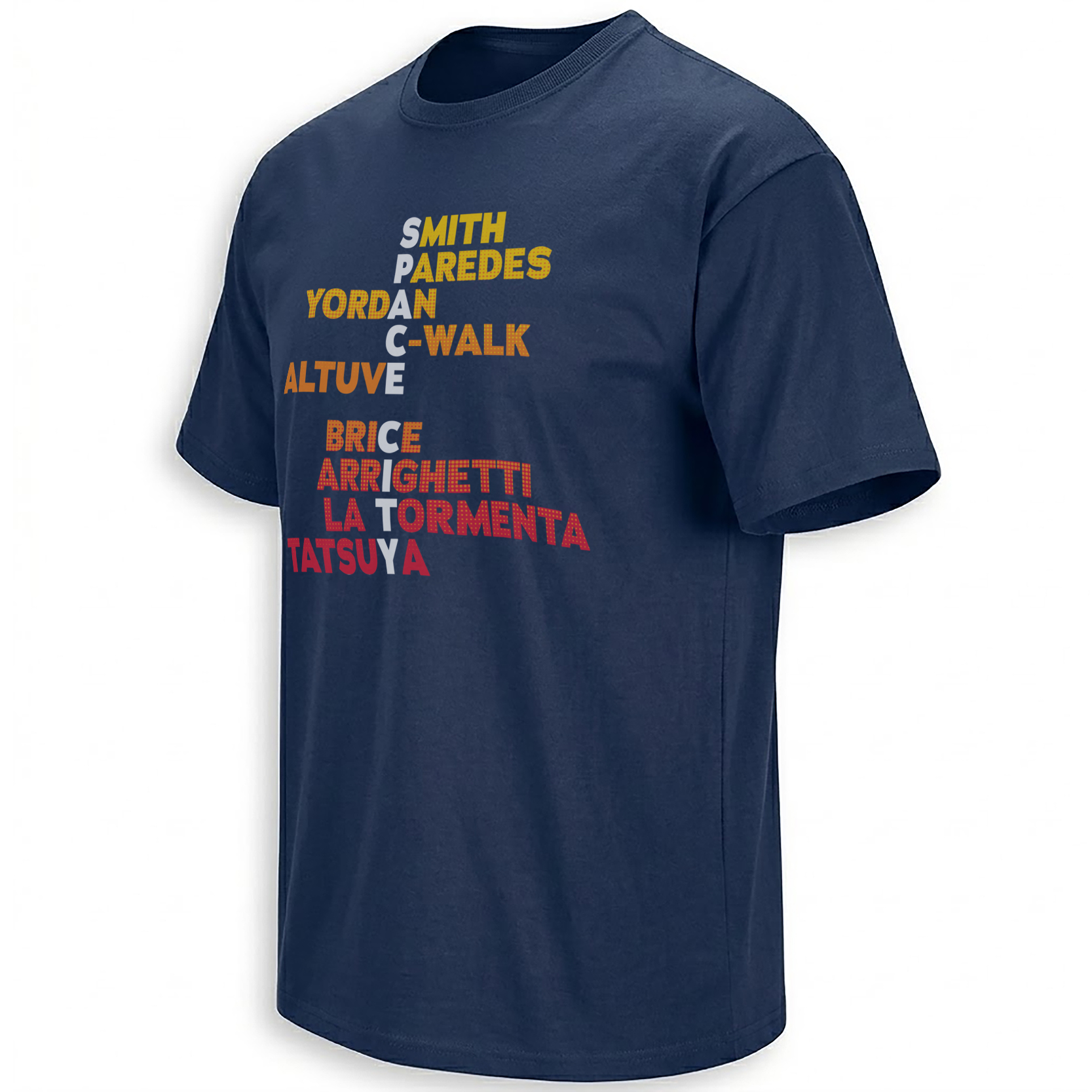
The Space City Houston Astros 2026 player-names graphic is built around typography rather than a single portrait. That decision shifts the emphasis from individual celebrity to collective identity.
Names form the visual mass of the design, functioning almost like windows, beams or streets inside a city silhouette. The viewer first recognizes Houston and Space City, then begins reading inward to find particular players.
The Names That Define the Current Team
The longest-running emotional reference point, connecting the current roster with Houston’s previous championship and postseason chapters.
A central infield identity whose name represents both the club’s recent history and its continuing everyday core.
A catcher whose presence reflects the younger portion of the lineup and Houston’s attempt to keep producing offense from premium positions.
One of the clearest pitching anchors, carrying the expectations attached to a rotation that has repeatedly needed stability.
The bullpen’s most recognizable late-inning name, bringing a different kind of star power to the roster composition.
A veteran power presence whose place in the design records how Houston’s lineup has evolved beyond its earlier championship core.
Why Roster Graphics Become More Interesting Over Time
A roster appears factual when it is first published. Years later, it becomes emotional. Fans notice which players stayed, which names represented brief experiments and which young call-ups became essential. Injured players remind people of what the season might have looked like under different circumstances.
That retrospective quality gives name-based graphics their archival strength. A single-player image can preserve one star. A roster design preserves relationships. It shows which names occupied the same visual space and therefore belonged to the same chapter, regardless of whether their paths remained connected afterward.
Houston fans understand this particularly well because the franchise’s identity has changed repeatedly while remaining competitive. The names surrounding Altuve today are not the names that surrounded him at the beginning of the Astros’ long run. Each roster therefore becomes a map of transition.
Major League rosters change throughout the season through injuries, transactions, options and call-ups. The graphic should be read as a visual record of the 2026 team context rather than a permanent or exhaustive active-roster document.
The Visual Psychology of Navy and Orange
Navy gives the design its structural weight. It suggests night sky, deep space and the darker foundation of Houston’s baseball palette. Orange provides ignition, drawing attention to major words and preventing the name field from becoming visually flat.
Together, the colors create the sensation of a city illuminated after dark. Smaller names become lights within the larger shape, while the strongest orange accents operate like launch trails or stadium signage.
This is why the composition feels closer to a poster than a conventional team logo. It does not ask one symbol to carry the entire story. It allows density to become meaning, reflecting the way a long baseball season accumulates players, injuries, roles and memories.
From Championship Core to a Changing Astros Identity
Houston’s recent baseball history created an unusually strong association between the franchise and continuity. For years, fans could identify a familiar group that returned to October and treated postseason baseball as part of the annual calendar.
The 2026 roster demonstrates how complicated that continuity has become. Altuve remains, but the surrounding architecture is different. Peña and Diaz belong to a younger phase. Walker and Paredes represent outside additions. Brown has moved into greater pitching responsibility, while injuries have forced the organization to continually adjust.
That mixture makes the current team culturally interesting even when the season does not follow a perfect narrative. Fans are watching one era overlap with another. The Space City graphic preserves the overlap instead of pretending the roster belongs wholly to the past or future.
The Wider MLB Visual Archive
The broader MLB collection places Houston’s roster image inside the larger visual culture of baseball: city nicknames, clubhouse language, player milestones, lineup jokes and the typography through which a 162-game season becomes memorable.
Baseball produces more daily narrative than almost any other sport. A lineup can change by afternoon, a prospect can arrive overnight and one injured-list move can alter the shape of a month. Graphics become cultural timestamps because they freeze that constant motion.
Frequently Asked Questions
What does “Space City” mean in Houston baseball culture?
The phrase connects the Astros with Houston’s history in aerospace, NASA and Mission Control, creating a city-specific identity larger than the team alone.
Which Astros players are represented by the 2026 roster theme?
The current team context includes names such as Jose Altuve, Jeremy Peña, Yainer Diaz, Christian Walker, Isaac Paredes, Hunter Brown and Josh Hader, among others.
Is the graphic an official permanent roster list?
No. MLB rosters change throughout the season, so the names should be understood as a visual record of the 2026 team period rather than a permanent roster document.
Why are player names used to build the main image?
The typography turns individual players into parts of one collective Houston structure, emphasizing team memory instead of one portrait.
Why do roster graphics become nostalgic?
As players leave, develop or change roles, the collection of names preserves the relationships and expectations associated with one specific season.
The Space City 2026 roster graphic preserves Houston’s changing team through typography, while the broader MLB visual archive follows the player moments and city identities that define each baseball year.
Space City Shirt transforms the Houston Astros’ 2026 player names into a navy-and-orange roster monument, preserving the familiar stars, changing core and civic identity of one specific Houston baseball season.