Dylan Crews Is Turning the Outfield Into Must-Watch Defense
The Nationals are still measuring their future in wins, prospects and development curves, but Dylan Crews keeps offering a simpler image of where Washington wants to go: full speed toward the baseball, glove extended, body leaving the ground.
Diving catches change the emotional temperature of a baseball game because the outcome is visible before it is certain. An outfielder accelerates, realizes the ball is dying faster than expected, lowers his body and commits. For a fraction of a second, there is no backup plan. Dylan Crews has made that fraction of a second one of the most recognizable parts of his 2026 season.
On July 17 against the Athletics, Washington’s young outfielder raced after Donovan Walton’s line drive and went to the ground to finish the second inning. The ball left the bat at 99.7 mph, traveled an estimated 268 feet and carried just enough uncertainty to force Crews into a full commitment. He secured it before the grass could.
It was not an isolated clip. Six days earlier at Nationals Park, Crews had robbed Paul Goldschmidt with another diving catch in center. MLB’s running highlight archive also includes defensive plays from June, including a sliding grab near the line and another diving catch in right-center. The repetition is what changes the story. A spectacular catch can be a highlight. Several of them begin to look like identity.
Crews’ best defensive highlights do not look cautious. They look like a young outfielder deciding that the baseball belongs to him before gravity has finished arguing.
The July 17 Catch Was a Perfect Crews Play
The line drive against Oakland is useful because it compresses the whole defensive skill set into a few seconds. Crews had to read the contact immediately, close ground quickly and then decide whether the risk of leaving his feet was worth it. With two outs, there was no reason to save anything for the next batter. The inning could simply end.
That is exactly what happened. Crews caught the ball at full extension, and Cade Cavalli walked off the mound without having to face another hitter. The official MLB highlight is only sixteen seconds long, but the play contains the sort of defensive aggression Washington has been trying to build into the identity of its younger core.
MLB’s video archive identifies the play as Dylan Crews’ “inning-ending diving catch,” recorded against the Athletics. The official clip can be viewed at MLB.com →
Crews Was Supposed to Be a Five-Tool Player — Defense Makes That Idea Visible
Prospect language can become abstract very quickly. “Five-tool player” is one of baseball’s most repeated labels, covering hitting, power, speed, throwing and fielding. It sounds impressive, but fans rarely experience all five tools at once.
Defense solves that problem because it is immediate. Earlier in the summer, Nationals manager Blake Butera described Crews as the kind of five-tool player who can change a game in several different areas. That description followed a June performance in which Crews contributed at the plate, on the bases and in the outfield.

The diving catches make the label understandable without requiring a scouting glossary. Speed closes the space. Instinct establishes the route. Glove work finishes the play. Athletic confidence determines whether the player is willing to leave his feet at all.
A Defensive Highlight Can Matter Even When the Season Is Complicated
Washington’s 2026 season has not been a clean upward line, and Crews’ offensive development has also contained normal young-player friction. As of the first week of August, he remained an everyday part of the Nationals lineup while continuing to work through the inconsistency that often comes with learning major-league pitching.
That context actually makes the defensive identity more useful. A player does not need to be locked in at the plate to affect the game in center or right field. The glove offers another route into the night. One catch can save a hit, shorten an inning and alter the way a pitcher experiences the next several outs.
For a franchise still trying to imagine its next competitive version, these are meaningful flashes. Young cores become emotionally real to fans when prospects stop being rankings and start producing recognizable baseball moments. A diving catch is ideal material for that transition because nobody needs projection models to understand it.
The Crews Diving Catch Graphic Is Built Around Flight, Not Pose
That is also why the Dylan Crews Diving Catch Shirt works best as a piece of visual memory rather than a conventional player portrait. Crews is not standing for the camera. The body is the story.
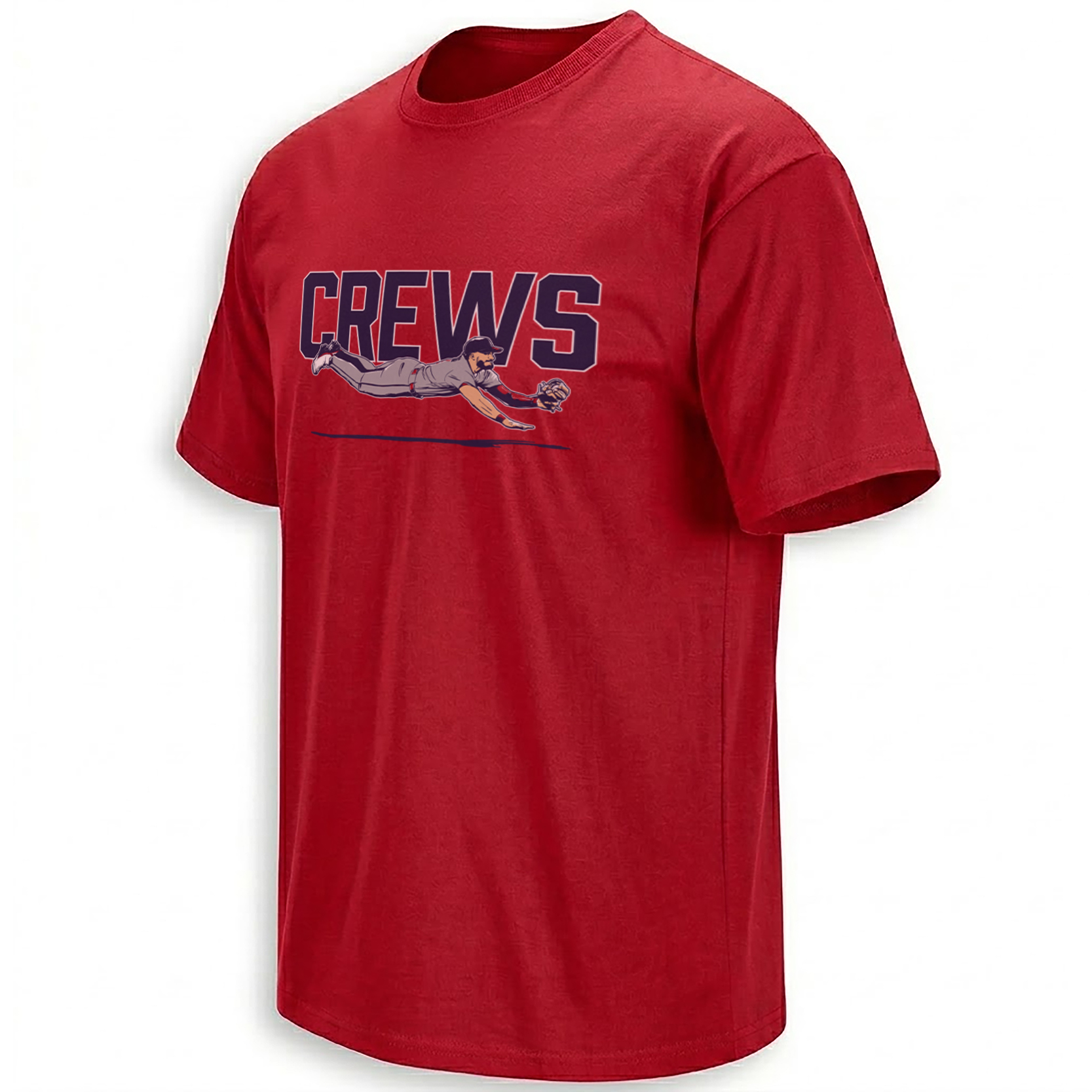
The strongest design choice is the horizontal body position. Baseball imagery often depends on vertical power — a hitter finishing a swing or a pitcher standing tall through release. A diving outfielder creates the opposite geometry. The figure is almost parallel to the ground, which makes the empty space underneath him part of the graphic.
Nationals red adds urgency against the darker baseball tones, while the composition treats Crews less like a posed star and more like a frame pulled out of a live broadcast. That visual language suits the moment because defensive reputation is built from exactly these frozen frames: glove open, ball approaching, outcome still technically unresolved.
Horizontal movement, suspended body position and Washington’s red-and-navy palette turn the artwork into a freeze-frame rather than a portrait. It remembers Crews through action — the way Nationals fans are increasingly seeing him.
Washington’s Young Core Needs Plays Fans Can Claim as Their Own
Rebuilding teams spend years discussing potential. Fans hear about draft position, prospect grades and future payroll flexibility. Eventually, though, potential has to become something visible enough to cheer in real time.
Crews diving into the outfield grass provides exactly that kind of image. Alongside players such as James Wood, CJ Abrams and Brady House, his development remains central to the Nationals’ attempt to turn a collection of young talent into a recognizable baseball era.
The broader Washington Nationals collection follows those individual moments as they accumulate — catches, home runs, player phrases and snapshots of a roster still discovering what it can become. The wider MLB collection places those Washington moments inside the larger visual culture of the 2026 season.
Frequently Asked Questions
When did Dylan Crews make the July 2026 diving catch against the Athletics?
Crews made the inning-ending diving catch on July 17, 2026, during the second inning of Washington’s game against the Athletics.
Who hit the ball on Dylan Crews’ July 17 diving catch?
Donovan Walton hit the line drive. MLB recorded a 99.7 mph exit velocity, with Crews making the catch to record the third out of the inning.
Did Dylan Crews make other diving catches in 2026?
Yes. MLB’s 2026 highlight archive includes several Crews defensive gems, including a July 11 diving catch that robbed Paul Goldschmidt and additional sliding and diving plays in June.
Why is defense important to Dylan Crews’ five-tool reputation?
His range, speed and glove allow him to influence games even when his bat is not driving the offense, giving Washington value in multiple phases of the game.
What does the Dylan Crews Diving Catch design represent?
The graphic preserves the airborne defensive image that has become part of Crews’ 2026 identity — a young Nationals outfielder turning athletic range into memorable outs.
The Dylan Crews Diving Catch graphic preserves one of those moments: a Nationals outfielder leaving his feet because letting the baseball land was never the plan.
Dylan Crews Diving Catch Shirt captures the Washington Nationals outfielder’s airborne defensive identity during the 2026 season, turning one of his signature full-extension plays into a visual record of Washington’s young core.