Defend New Orleans: How the Skull and Fleur-de-Lis Became a Symbol of Fierce NOLA Pride
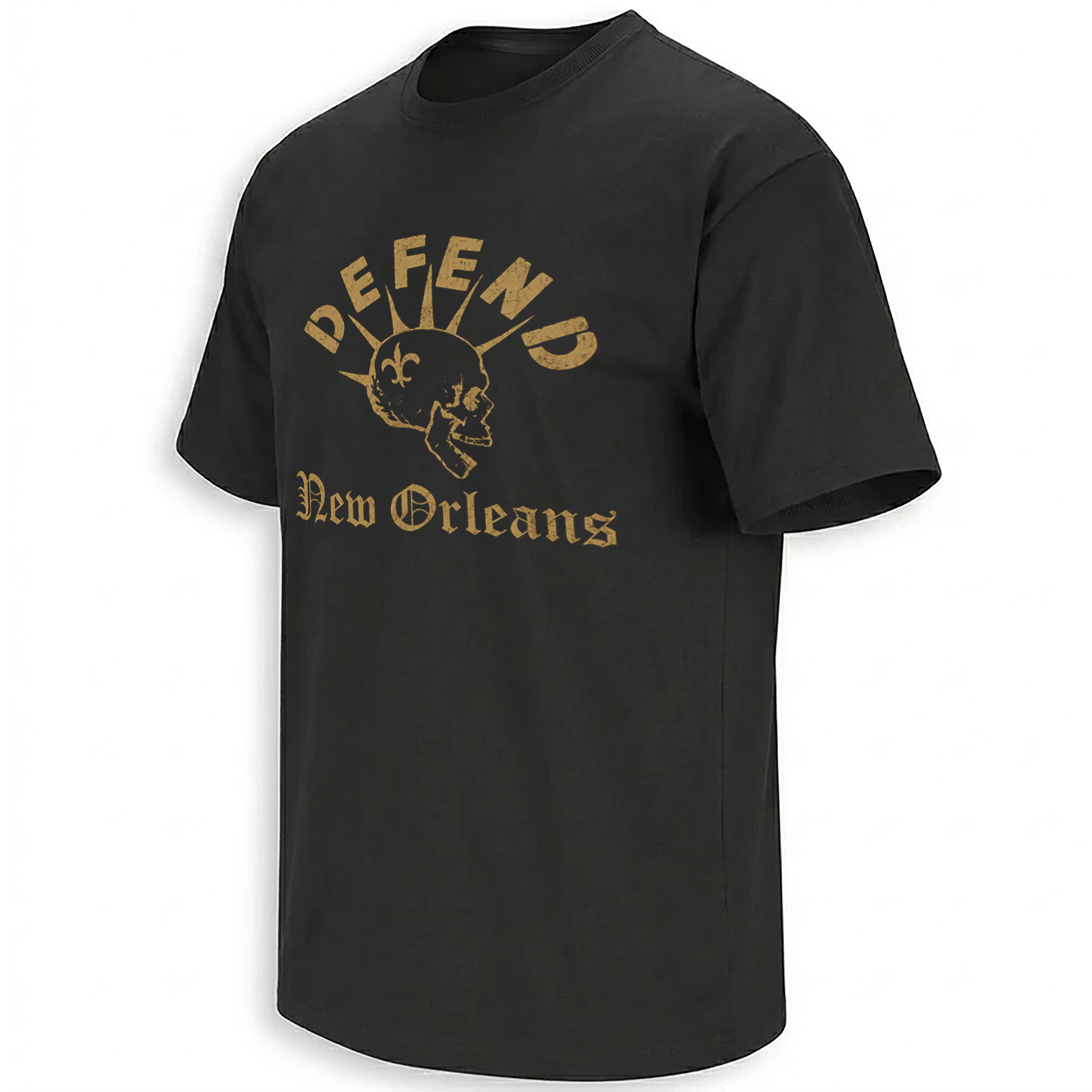
In New Orleans, city pride is rarely quiet. It appears through music, neighborhood language, wrought-iron architecture and symbols that carry both beauty and warning. A skull wearing the fleur-de-lis turns that identity into a direct message: protect the culture that makes the city impossible to replace.
“Defend New Orleans” does not sound like a tourism slogan. It sounds like something painted on a wall after the floodwater recedes, printed on a neighborhood poster or spoken by someone who believes the city’s culture is valuable precisely because it cannot be reconstructed from generic parts.
The phrase carries several possible forms of defense. It can mean protecting architecture from careless redevelopment, preserving music and neighborhood traditions, supporting local businesses or refusing to let the city’s identity be reduced to a simplified party destination.
The skull intensifies that message. In ordinary visual language, a skull can represent danger, mortality or resistance. Combined with the fleur-de-lis, it becomes specifically New Orleans: elegant and severe, historic and rebellious, decorative and unwilling to surrender.
The strongest New Orleans symbols do not ask the city to become easier to understand. They protect its right to remain layered, local and unlike anywhere else.
Why the Fleur-de-Lis Belongs to New Orleans
The fleur-de-lis existed centuries before New Orleans. It is a stylized flower historically connected with French monarchy, Catholic imagery, heraldry and European decorative traditions.
Its New Orleans meaning developed through Louisiana’s French colonial history. The symbol entered flags, architecture, gates, civic designs and eventually the everyday visual vocabulary of the city.
Today it appears far beyond one institution. It can be seen in jewelry, tattoos, street signs, ironwork, local artwork and sports culture. Louisiana formally recognized the fleur-de-lis as an official state symbol in 2008, confirming how deeply the image had entered regional identity.
The symbol’s history is not entirely uncomplicated. During French colonial rule, versions of the fleur-de-lis were also connected with systems of royal authority and punishment. A responsible cultural reading should acknowledge that history rather than presenting the image as a purely decorative flower.
Why the Skull Changes the Message
A fleur-de-lis by itself can appear formal, ceremonial or decorative. The skull removes that politeness. It suggests that the cultural identity behind the symbol has limits and boundaries worth defending.
New Orleans has always carried a close visual relationship with mortality. Cemeteries sit above ground, funeral traditions can combine grief with music, and spiritual imagery moves through Catholic, African diasporic and folk-cultural influences.
The skull therefore does not feel imported into the design only for aggression. It belongs to a city where death, memory and celebration frequently occupy the same cultural space.
The result is neither a simple gothic graphic nor a conventional heritage emblem. The skull and fleur-de-lis together suggest survival: the city has endured loss, but its identity remains visible.
Bone tones provide mortality and memory. Black creates warning and resistance. Purple, green and gold recall New Orleans festival color without turning the artwork into a parade poster. The fleur-de-lis anchors every darker element to the city.
See the Original Defend New Orleans Cultural Post
The Instagram post below presents “Defend New Orleans” through its original local-culture context. Its caption emphasizes that the phrase and fleur-de-lis are understood as expressions of the city rather than only references to professional sports.
The complete Instagram post is embedded directly through the platform’s official widget, allowing readers to view the original image, account and caption inside the blog.
From Heritage Symbol to Living Street Language
Symbols remain culturally powerful when people continue changing how they use them. The fleur-de-lis is not confined to a museum description of French Louisiana. It appears in contemporary murals, music scenes, clothing, neighborhood identities and civic projects.
New Orleans’ recent Walk of Fame project even uses fleur-de-lis-shaped plaques on Canal Street to honor important cultural figures. The project demonstrates how the historic symbol continues to be rewritten through present-day local recognition.
“Defend New Orleans” belongs to that same process. The words bring urgency to an image that might otherwise be treated as background decoration.
The fleur-de-lis entered Louisiana through French colonial culture and became part of the region’s architecture, civic imagery and everyday design. Its modern New Orleans meaning is created not only by historical origin but by generations of residents repeatedly using it as a badge of place.
The Post-Katrina Meaning of “Defend”
Hurricane Katrina changed how many local symbols were read. In the years after 2005, phrases about defending, rebuilding and preserving New Orleans gained sharper emotional meaning.
The danger was not limited to physical destruction. Displacement threatened neighborhood continuity, local businesses struggled to return and debates emerged over who would shape the rebuilt city.
Under those conditions, “Defend New Orleans” could function as a cultural instruction. Rebuilding structures was necessary, but rebuilding without the people, traditions and local texture that created the city would produce only an imitation.
That history explains why the phrase remains forceful even outside a disaster anniversary. It speaks to an ongoing concern that distinctive cities can be weakened through displacement, commercialization and development that ignores local memory.
New Orleans Pride Is More Than Sports Identity
The fleur-de-lis is strongly associated with New Orleans sports, but the city’s relationship with the symbol is broader. Residents encounter it through architectural details, family objects, neighborhood art and local businesses long before or beyond a stadium.
This distinction matters for the Defend New Orleans design. Its language addresses the entire city rather than one team or season. The skull does not wear a player number, and the phrase does not depend on a scoreboard.
That broader meaning allows the image to connect with people who understand New Orleans through music, food, architecture, family history or neighborhood loyalty.
Why the Design Feels Like a Local Warning Sign
The graphic is structured more like an emblem than an illustration. The skull provides a central face, the fleur-de-lis provides location and the wording supplies a command.
This direct arrangement resembles a patch, tattoo flash, metal-band mark or hand-printed street poster. It can be understood quickly from a distance, which is important for a design built around warning and allegiance.
At closer range, the symbolic contradiction becomes more interesting. The fleur-de-lis is floral and ornamental; the skull is severe. New Orleans culture frequently creates meaning through similar contrasts: mourning and dancing, decay and beauty, tradition and improvisation.
Defending a City Without Freezing It
Cultural preservation does not mean preventing New Orleans from changing. The city has always been shaped by movement, exchange and reinvention across African, Caribbean, French, Spanish, Indigenous and American influences.
The more meaningful form of defense is protecting the conditions that allow local culture to keep evolving: affordable neighborhoods, independent creative spaces, working musicians, family businesses and communities able to remain connected to place.
The design cannot express every part of that conversation. It can act as a visual entry point—a declaration that New Orleans possesses something living enough to require care.
The newest collection places the Defend New Orleans graphic among Ellie Shirt’s latest city-pride and cultural-moment pieces. A dedicated New Orleans collection has not been linked here because no confirmed Ellie Shirt collection path was provided.
Frequently Asked Questions
What does “Defend New Orleans” mean?
It expresses the desire to protect New Orleans’ local identity, neighborhoods, music, architecture, businesses and cultural traditions from erasure or careless replacement.
Why is the fleur-de-lis associated with New Orleans?
The symbol arrived through Louisiana’s French colonial history and became deeply embedded in the region’s architecture, civic imagery and popular culture.
Why does the design include a skull?
The skull introduces mortality, warning and resistance while connecting with New Orleans’ distinctive cultural relationship between death, remembrance and celebration.
Is the design only about New Orleans sports?
No. The fleur-de-lis appears throughout New Orleans culture, and the design addresses broader city identity rather than one specific team.
The Defend New Orleans design combines the fleur-de-lis, skull imagery and NOLA city-pride language in one direct cultural emblem. Explore the latest Ellie Shirt releases for more city and cultural-moment graphics.
Defend New Orleans Shirt combines a skull, fleur-de-lis and uncompromising city-pride message inspired by NOLA’s French heritage, cultural resilience and determination to protect its local identity.