
The Names Raleigh Will Remember: Carolina’s 2026 Championship Team Became History
The Carolina Hurricanes’ second Stanley Cup will always have its defining images: the shutout in Las Vegas, Jordan Staal raising the trophy and Rod Brind’Amour watching a new generation complete the journey. The team roster preserves everything outside the frame—the full group whose names made the moment possible.
When the final horn sounded on June 14, the Carolina Hurricanes had completed one of the most commanding playoff runs in franchise history. Their 3–0 victory over the Vegas Golden Knights ended the Stanley Cup Final in six games, finished a 16–3 postseason and gave Raleigh a new championship team to remember alongside the heroes of 2006.
The Cup lift became the defining photograph. Brandon Bussi’s 22-save shutout became the final performance. Jordan Staal’s Conn Smythe Trophy became the emotional headline. Yet every championship eventually expands beyond the few people standing at the center of the first images.
It becomes a story about the complete roster: the top-line forwards who carried expectations, the depth players who changed difficult shifts, the defensemen who protected the middle of the ice, the goaltenders whose roles evolved during the run and the coaching staff that kept the team recognizable through every adjustment.
That is why a team roster graphic ages differently from an ordinary championship wordmark. It does not only preserve what Carolina won. It preserves who Carolina was when it won.
The trophy records the victory. The roster records every player whose work allowed Raleigh to raise it again.
Twenty Years Later, Carolina Had a New Roll Call
For two decades, the names attached to Carolina’s Stanley Cup history belonged almost entirely to the 2006 team. Fans could recall Rod Brind’Amour as captain, Cam Ward’s rookie postseason and the group that gave the franchise its first championship.
Those names became part of Raleigh sports history because championships create permanent associations. Players may leave, retire or return in different roles, but the roster remains intact in collective memory.
The 2026 team created a second roll call. Sebastian Aho, Andrei Svechnikov and Seth Jarvis formed the offensive core. Jordan Staal and Jordan Martinook brought veteran continuity. Jaccob Slavin anchored a defensive group built to deny space, while the goaltending story changed dramatically during the Final.
Taylor Hall, Logan Stankoven, Jackson Blake and Nikolaj Ehlers gave the lineup different forms of speed and scoring. William Carrier, Mark Jankowski and Eric Robinson handled the shifts that rarely become promotional highlights but often determine whether a team can maintain its pressure across four lines.
The championship transformed those individuals into one permanent unit. From that night forward, their names would always share the same season.

The Front Announces the Cup; the Back Preserves the Team
The two-sided layout separates championship emotion into two distinct stages. The front belongs to the immediate reaction. “Sound the Siren” draws from the arena ritual associated with Hurricanes hockey and turns it into a victory announcement.
It captures the noise of the final horn, the first social posts, the crowd reaction and the moment the Hurricanes became champions again.
The back performs a quieter but more permanent role. It presents the team roster in a structured composition, surrounding the Hurricanes championship identity with the players who completed the run.
Unlike the signature version, this roster treatment feels closer to an official championship program, team poster or commemorative lineup card. The names are organized rather than handwritten, giving the graphic the authority of a permanent record.
Together, the two sides move from emotion to documentation. The front says what happened. The back identifies who made it happen.
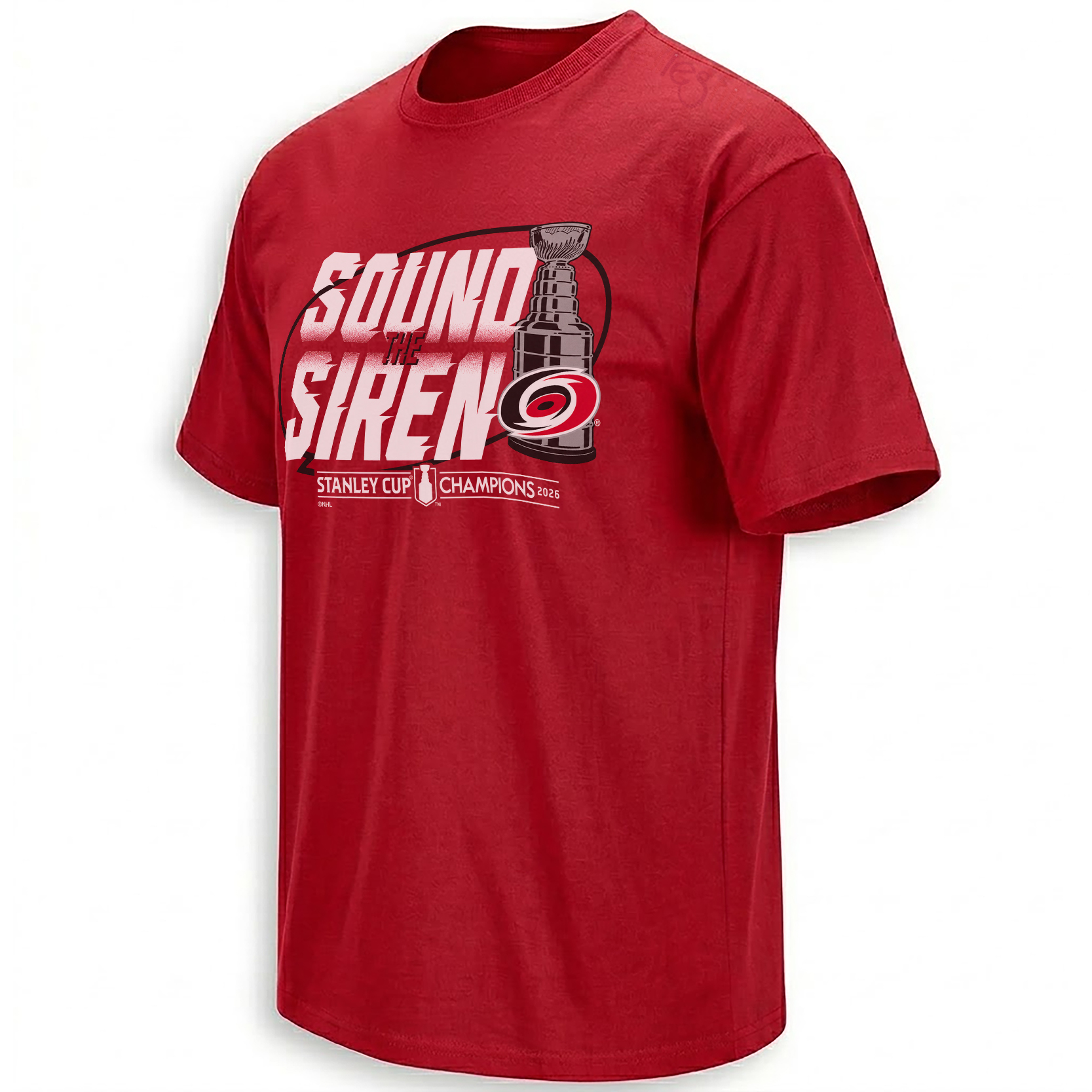
The Sound the Siren front translates Carolina’s arena ritual into the first emotional language of the Cup celebration.
See the front graphic →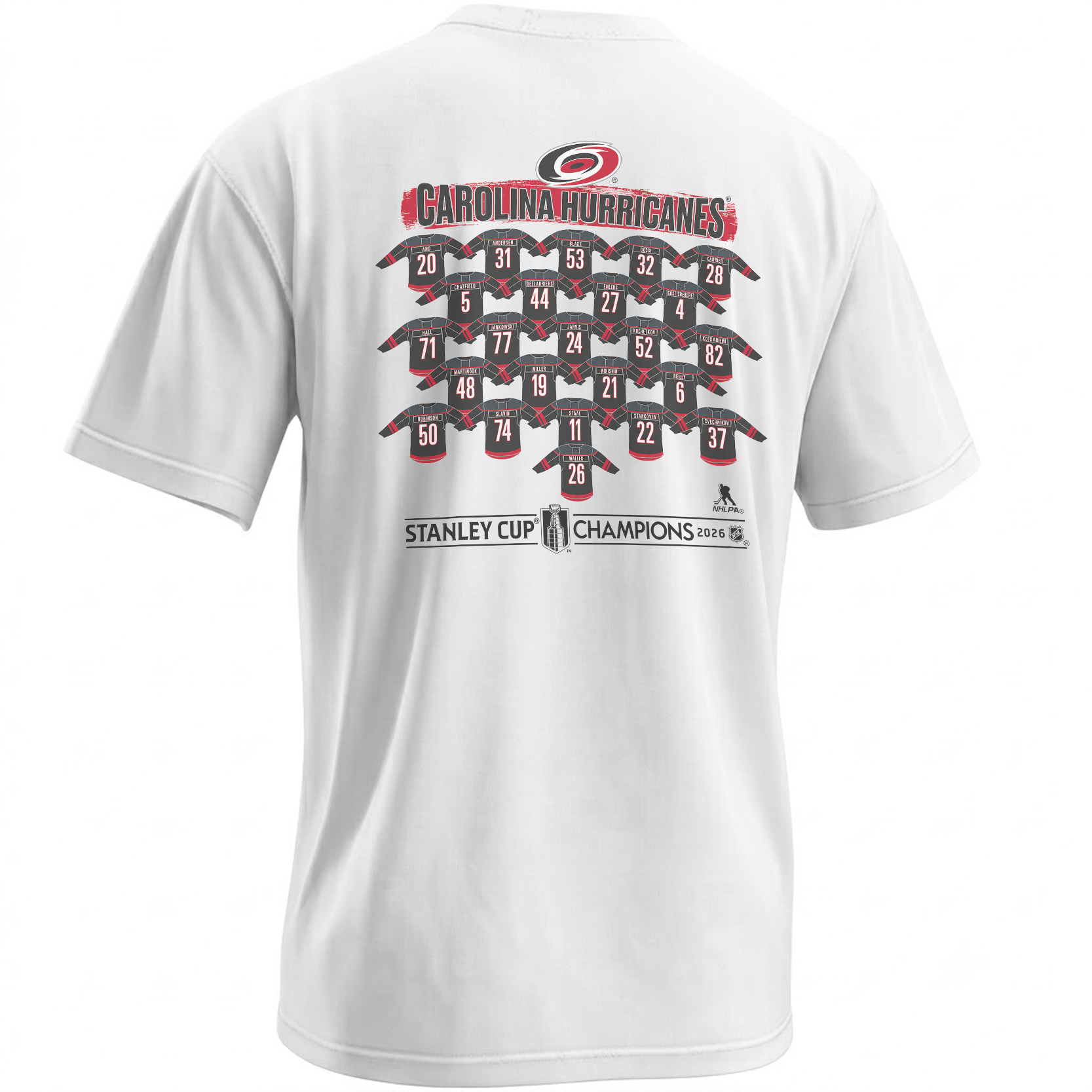
The organized roster treatment preserves Carolina’s championship lineup like a team poster produced for one historic season.
Explore the roster back →Why a Team Roster Means Something Different From Signatures
Signature graphics create intimacy. Their handwritten marks suggest an autographed object, locker-room wall or commemorative program passed between players.
A structured team roster creates a different feeling. It organizes the championship like an official archive. The names are not presented as personal gestures; they are arranged as parts of one competitive system.
That distinction fits the way Carolina won. The Hurricanes were not built around one isolated superstar carrying every round. They advanced through layers of pressure, disciplined defense, lineup depth and contributions that changed from series to series.
The back graphic reflects that structure. Each name occupies a defined place, but no name stands outside the collective championship frame.
The roster layout resembles a commemorative team poster rather than a collection of individual autographs. Its visual order mirrors Carolina’s identity: many connected roles operating inside one disciplined structure.
Jordan Staal Gave the Roster Its Emotional Center
Championship rosters are collective, but they still develop emotional centers. For Carolina, Jordan Staal became the player whose career arc seemed to carry the weight of the entire run.
Staal had already won the Stanley Cup with Pittsburgh in 2009, but seventeen years passed before he reached that moment again. During those years, he became Carolina’s captain and one of the central figures in the franchise’s transformation from rebuilding team to annual contender.
In the 2026 Final, he scored six goals across the series and became the second Hurricanes player to receive the Conn Smythe Trophy, following Cam Ward in 2006.
His name on the roster therefore carries multiple timelines. It represents the current championship, his years of leadership in Raleigh and the long personal wait between Cup victories.
The trophy may have made Staal the central image, but the roster places his achievement where it belongs: inside the complete group that enabled it.
Brandon Bussi Became the Name Nobody Could Have Predicted
Every championship team includes a story that would have seemed unlikely when the playoffs began. Brandon Bussi became that story for Carolina.
Frederik Andersen started Carolina’s first sixteen playoff games before Bussi assumed the larger role during the Stanley Cup Final. The change could have destabilized the team at the most dangerous time of the season. Instead, it became one of the adjustments that defined the title.
Bussi won the final three games and stopped all 22 Vegas shots in Game 6. The shutout gave the championship a clean final score and attached his name permanently to the night the Hurricanes lifted the Cup.
A roster graphic preserves that type of transformation particularly well. Before the Final, Bussi’s name represented a depth option. After Game 6, it represented the goaltender who completed Carolina’s twenty-year return.
The lettering remains the same. History changes what the name means.
The Forward Lines Gave Carolina Multiple Ways to Win
The Hurricanes’ forward group was built in layers. Svechnikov, Aho and Jarvis formed a top line capable of combining speed, skill and physical pressure. Each player could create offense differently, making the group difficult to reduce to one defensive solution.
Hall, Stankoven and Blake added another form of attack. Hall brought veteran scoring instinct, Stankoven supplied pace through the middle and Blake gave the lineup youthful directness.
Ehlers, Staal and Martinook combined speed with experience and defensive responsibility. Carrier, Jankowski and Robinson supplied the fourth-line pressure needed to keep Carolina’s forecheck active beyond the stars.
The design does not need to explain those combinations directly. The names themselves become retrieval points for fans. One surname recalls a goal. Another recalls a forecheck, blocked shot or bench reaction. Together, they reconstruct the texture of the postseason.
Carolina’s high-end offensive core combined creativity, pace and the ability to apply pressure in different ways.
Veteran instinct and emerging speed gave the Hurricanes another line capable of creating decisive moments.
Speed, leadership and two-way responsibility gave Carolina a group built for difficult playoff assignments.
The fourth line helped maintain physical pressure and denied opponents comfortable shifts against Carolina’s depth.
The Defense Protected the Shape of the Run
The Hurricanes’ 16–3 record was not produced through scoring alone. Carolina’s defense kept games inside the structure Rod Brind’Amour had spent years developing.
Jaccob Slavin remained the foundational presence. His positioning and ability to recover without panic allowed Carolina to defend aggressively without appearing reckless.
Jalen Chatfield added mobility and pressure. K’Andre Miller and Sean Walker gave the group another balanced pairing, while Shayne Gostisbehere and Alexander Nikishin contributed puck movement and offensive support from the back end.
Defensive value often appears through events that never occur: the cross-ice pass that is intercepted, the rebound cleared before a second attempt or the opposing forward forced away from the center.
Those moments rarely become championship graphics on their own. The roster ensures the players responsible for them remain visible inside the complete story.
Rod Brind’Amour Connected the Two Cups
No figure carried the connection between 2006 and 2026 more clearly than Rod Brind’Amour. He raised Carolina’s first Stanley Cup as captain and returned twenty years later as the coach responsible for guiding a different roster toward the same trophy.
The symmetry made the championship feel cinematic, but the 2026 team was never simply reenacting the past. Brind’Amour’s task was to transfer standards rather than memories—to build a group capable of producing its own identity and its own ending.
The roster back makes that distinction visible. It does not rely on nostalgia alone. It records the current players whose work created a new chapter beside the old one.
Brind’Amour connected the eras. The names on the shirt ensured the second era belonged to itself.
Why Championship Names Become Family Memory
A fan does not experience a roster as a neutral list after a championship. Each name begins to carry a personal association.
One player may recall the game watched with a parent. Another may recall a save seen from a specific seat, a goal that changed a group chat or the moment someone finally believed the Cup was coming back to Raleigh.
That is how championship teams move from sports records into family memory. The names are repeated in stories, compared with earlier eras and passed to supporters who may have been too young to understand the season while it was happening.
Carolina’s 2006 roster already functions that way. The 2026 team now begins the same process.
The roster graphic gives those memories a stable visual home before trades, retirements and future seasons begin separating the group.
Raleigh Now Has Two Championship Generations
The Hurricanes’ second Cup changed the shape of hockey memory in North Carolina. The franchise no longer had one championship team representing its entire history.
Longtime supporters could place the 2026 roster beside the 2006 group. Younger fans received a championship they had experienced in real time rather than inherited through old highlights.
That distinction matters because current championships create personal timestamps. Fans remember where they watched, who was beside them and how the city felt before and after the final horn.
The wider Carolina Hurricanes collection now works as a running visual archive of that new generation, moving through playoff slogans, individual player stories and the championship pieces produced after the Cup was secured.
The broader NHL Shirts collection places Carolina’s roster graphic inside hockey’s larger tradition of preserving team identity through Cup years, final scores, trophy imagery and complete championship lineups.
Why the Organized Roster Will Gain Meaning Over Time
On championship night, every name is still current. Fans have recently watched the players compete, heard them speak and debated their performances.
Time changes the design. Players move to other teams. Roles change. Some careers grow larger, while others become defined by a brief but decisive postseason contribution.
The back print remains unchanged. It preserves the roster before history begins dividing it into stars, veterans, role players and unexpected heroes.
That is why a team-list design can become more powerful years after its release. It allows the viewer to recover the complete group at once, before memory naturally narrows the season into only its most famous images.
The 2026 Stanley Cup belonged to Staal, Bussi and the players at the center of the celebration. It also belonged to every name arranged around them.
Frequently Asked Questions
When did the Carolina Hurricanes win the 2026 Stanley Cup?
Carolina clinched the championship on June 14, 2026, with a 3–0 victory over the Vegas Golden Knights in Game 6, completing a 4–2 series win.
What was Carolina’s record during the 2026 Stanley Cup Playoffs?
The Hurricanes finished the postseason with a 16–3 record, losing only three games across four playoff rounds.
What does the team roster back represent?
The back graphic preserves the players associated with Carolina’s second Stanley Cup as one organized championship unit, similar to a commemorative team poster or official lineup archive.
How is this roster design different from the signature roster version?
The signature version has the personal feeling of an autographed artifact, while this team roster version uses a structured name layout that feels closer to an official championship program.
Who won the 2026 Conn Smythe Trophy?
Carolina captain Jordan Staal received the Conn Smythe Trophy after scoring six goals in the Stanley Cup Final and becoming the emotional center of the Hurricanes’ championship run.
Who recorded the shutout in the championship-clinching game?
Brandon Bussi stopped all 22 shots he faced in Game 6, completing Carolina’s championship with a 3–0 shutout.
What do the front and back graphics mean together?
The Sound the Siren front captures the immediate championship announcement, while the organized roster back documents the complete team connected to Raleigh’s twenty-year return.
The 2026 Stanley Cup Champions team roster design preserves Carolina’s celebration as both an arena cry and an organized record of the players behind the title, while the wider Hurricanes archive follows the moments, personalities and visual language of Raleigh’s second championship.
2026 Stanley Cup Champions Shirt preserves the Carolina Hurricanes’ second title through a Sound the Siren front graphic and an organized team roster back recording the names behind Raleigh’s dominant 16–3 playoff run.