
Every Name Behind the Cup: Carolina’s 2026 Championship Roster Became History
The Carolina Hurricanes’ second Stanley Cup will always be remembered through the trophy lift, the Game 6 shutout and Raleigh’s twenty-year release. But championships are not created by one photograph. They are built by a roster whose names eventually become the permanent record of the run.
When the final horn sounded in Las Vegas on June 14, Carolina’s 3–0 victory completed more than a six-game Stanley Cup Final. It completed a collective story—one shaped by the captain who had carried years of playoff disappointment, a rookie goaltender who seized the crease, established stars, deadline additions, defensive anchors and the depth players whose work made the entire structure hold.
The Hurricanes finished the postseason 16–3 and defeated the Vegas Golden Knights 4–2 in the Final. Those numbers explain how commanding the run was, but a championship roster explains why it endured. Every round asked for a different contribution. Every shift reduced the distance between another promising season and the image Raleigh had waited two decades to see again.
That is why a roster graphic carries a different emotional weight from a standard championship logo. A trophy image records the result. A list of names records the people who made the result possible.
Years from now, fans will not read the back print as a simple collection of surnames. They will see individual games, goals, saves, blocked shots, line combinations and stories compressed into one championship roll call.
The Cup lift becomes the photograph. The roster becomes the evidence of everything it took to reach it.
The Championship Was Collective Before It Became Iconic
Sports history naturally narrows itself into a few unforgettable images. Jordan Staal receiving the Conn Smythe Trophy. Brandon Bussi protecting a shutout in the championship-clinching game. Rod Brind’Amour standing behind the bench twenty years after raising the Cup as Carolina’s captain.
Those images deserve their place, but they exist because the Hurricanes built a postseason identity that was broader than any one star. Carolina could win with pressure, defensive structure, transition speed, special teams and the kind of depth that allowed the team to survive changes without losing its shape.
Sebastian Aho, Andrei Svechnikov and Seth Jarvis carried the threat of Carolina’s top-end attack. Taylor Hall, Logan Stankoven and Jackson Blake gave the lineup another layer of skill and urgency. Nikolaj Ehlers added speed and finished the championship game with the empty-net goal that made the final seconds feel inevitable.
The lower lines turned difficult shifts into territorial pressure. The defense prevented Vegas from finding the open ice it needed. The goaltenders absorbed the most public pressure of the series. The coaching staff adjusted without making the Hurricanes look like a different team.
The championship therefore belonged to the roster before it belonged to the parade, the banners or the future highlight reels.
Why the Front and Back Tell Two Different Parts of the Story
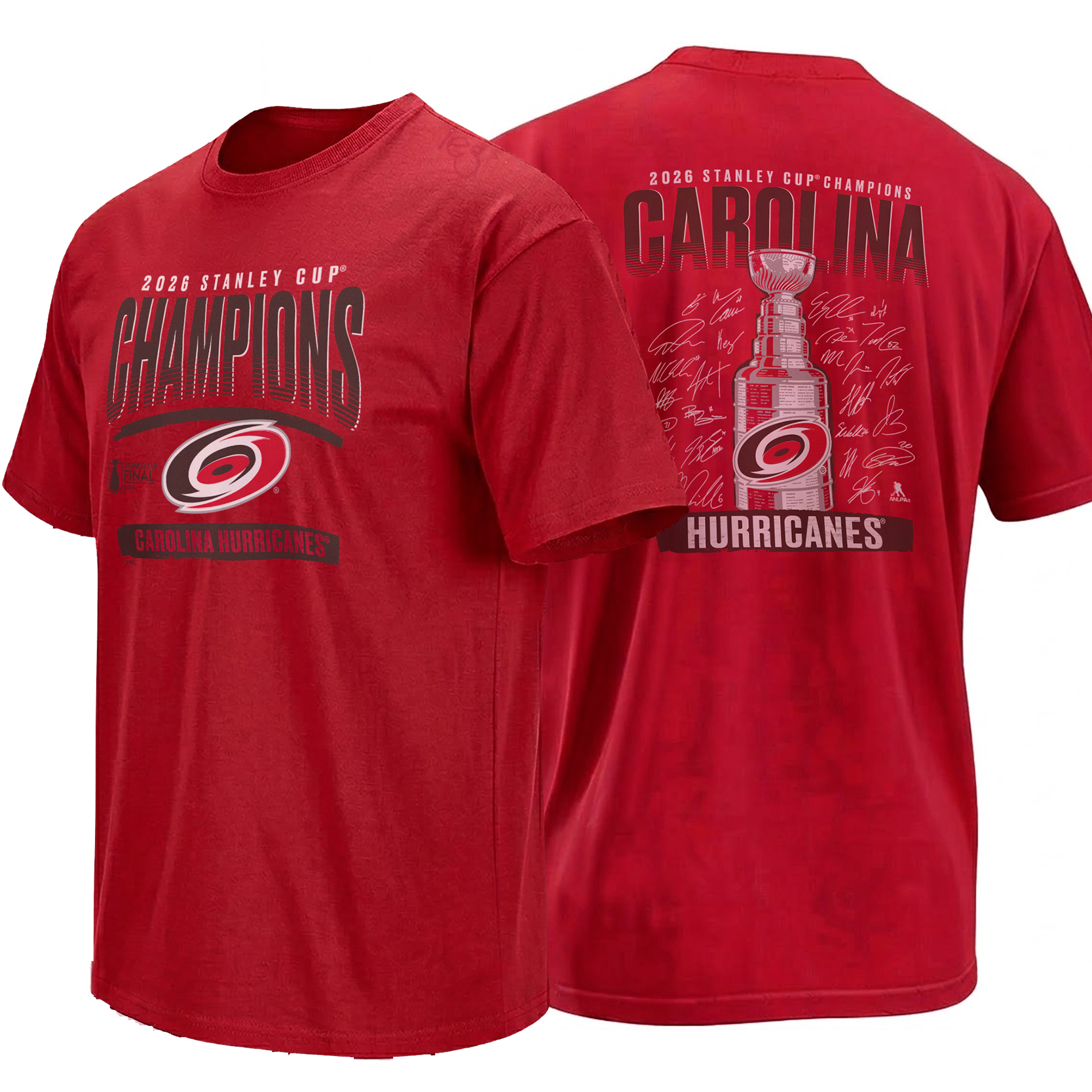
The design is structured like the emotional timeline of championship night. The front captures the instant reaction. “Sound the Siren” is direct, loud and rooted in the arena culture that helped distinguish Hurricanes hockey in Raleigh.
It works as the announcement: the warning signal has become the victory signal, and the Hurricanes are Stanley Cup champions.
The back slows the moment down. Instead of one explosive slogan, it presents the names associated with the run. That shift changes the piece from celebration into documentation.
Together, the two sides recreate the way fans experience a championship. First comes the noise—the final horn, the celebration and the instant language spreading through the crowd. Then comes the remembering: who scored, who defended, who stepped into a new role and which names will forever be connected to that season.

“Sound the Siren” transforms Carolina’s arena ritual into the immediate championship cry that followed the final horn.
See the front graphic →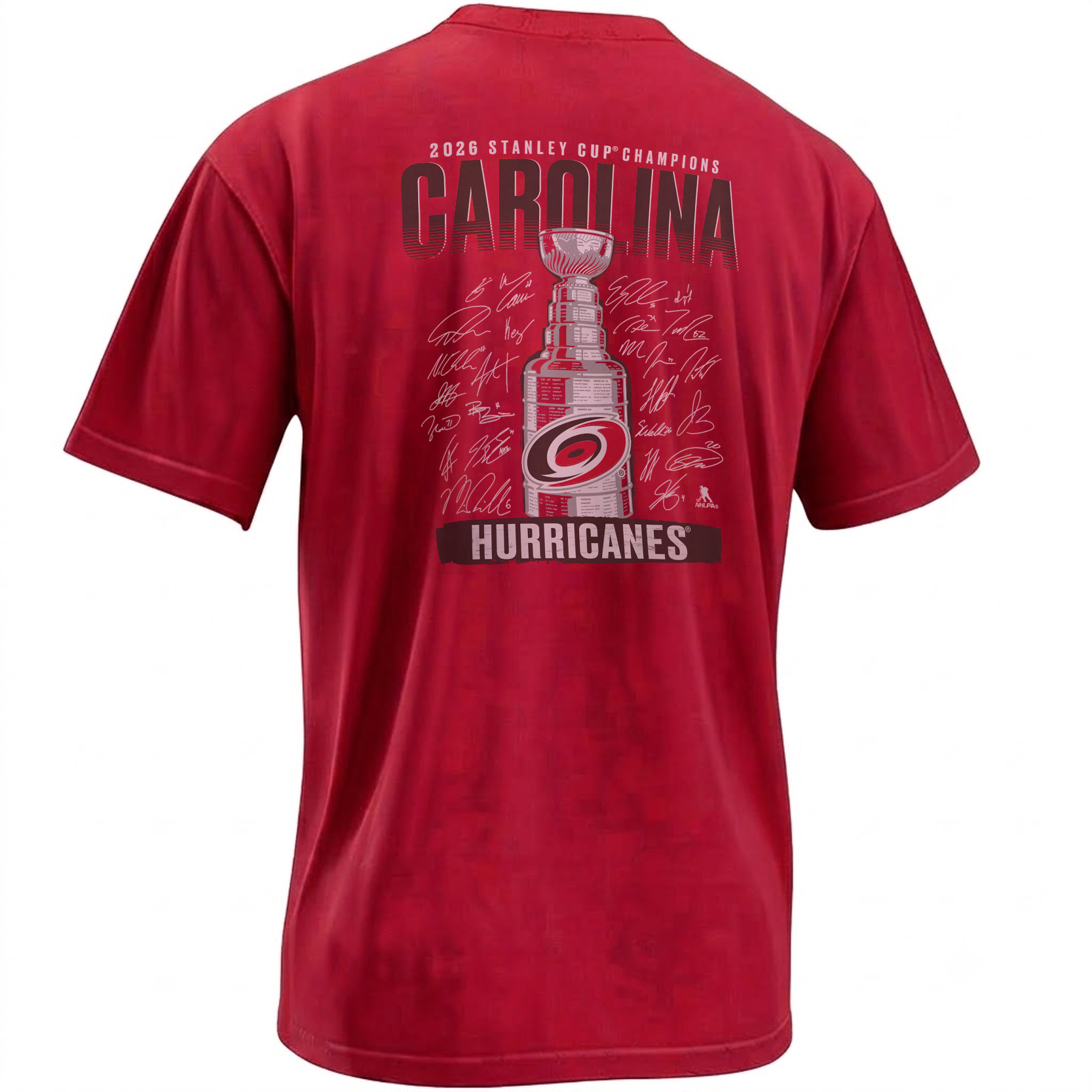
The signature-style roster converts a list of players into a visual archive of the group that completed Carolina’s twenty-year return.
Explore the roster back →A Roster Graphic Works Like a Championship Program
Long before online highlights became permanent, fans preserved championship seasons through newspapers, programs, ticket stubs and team photographs. The value of those objects was not only visual. They kept names and dates attached to the emotion.
The signature roster back belongs to that same tradition. Its purpose is not to rank the players or suggest that every role was identical. It places the team together as one complete championship unit.
The handwritten treatment softens the rigid structure of a normal roster list. Instead of looking like administrative data, the names resemble marks left behind by the people who were there. The effect is closer to an autographed team page, a locker-room artifact or the back of a commemorative program.
That feeling matters because the 2026 championship will eventually move from breaking news into history. As that transition happens, fans will look for objects that can recover not only the final score but the identity of the group.
The signature arrangement turns the back print into a championship roll call. Every name occupies the same visual field, reinforcing the idea that Carolina’s second Cup was assembled through connected roles rather than one isolated performance.
Jordan Staal Became the Emotional Center of the Group
A roster can be collective and still have an emotional center. For Carolina, Jordan Staal carried that role.
The captain had been part of the franchise through rebuilding seasons, playoff returns and the repeated frustration of strong teams stopping short of the Final. By 2026, his career with the Hurricanes had become inseparable from the organization’s modern identity.
Staal scored in five consecutive games during the Stanley Cup Final and received the Conn Smythe Trophy as the postseason’s most valuable player. The award gave the run a recognizable face, but his importance extended beyond a scoring streak.
He represented continuity. His championship connected the years when Carolina was attempting to reestablish itself with the night it finally reached the summit again.
On a signature roster graphic, Staal’s name does not need to be separated from the group to feel significant. Its emotional meaning already comes from everything fans remember around it.
Brandon Bussi Gave the Roster Its Unlikely Championship Story
Every championship roster contains at least one name that later feels impossible to separate from the postseason, even if few people predicted that role when the playoffs began.
Brandon Bussi became that figure for Carolina. After entering the Final under extraordinary pressure, he won three consecutive games and finished the season with a 22-save shutout in Game 6.
His performance illustrates why roster pieces become more meaningful with time. On the night the graphic is released, a name may represent a current player. Years later, it can trigger an entire sequence of memory: the goaltending change, the growing confidence, the saves in Las Vegas and the realization that Carolina was not going to allow the series to return home.
The back print therefore preserves not only established stars but the unexpected turns that gave the championship its personality.
The Forwards Created Different Forms of Pressure
Carolina’s attack was not built around one kind of threat. Aho’s intelligence, Svechnikov’s physical power and Jarvis’s timing allowed the top of the lineup to challenge opponents in different ways.
Hall brought veteran experience and scored the opening goal in the clinching game. Blake supplied both speed and youthful fearlessness, adding a goal and an assist in Game 6. Ehlers could stretch defensive coverage and eventually placed the final puck into the empty net.
Stankoven added energy through the middle of the lineup, while Martinook, Carrier, Jankowski and Robinson contributed the grinding shifts that championship teams need when the open ice disappears.
These roles do not all produce the same highlight volume. That is precisely why the roster format matters. It restores visibility to the complete structure of the team rather than reducing the season to the most replayed goals.
Aho, Svechnikov and Jarvis provided the skill, pressure and offensive expectation that shaped how opponents defended Carolina.
Hall, Blake and Ehlers supplied the three goals in the championship-clinching victory.
Staal and Martinook carried years of institutional memory into the most demanding shifts of the run.
Carolina’s lower-line work maintained forechecking energy and prevented opponents from finding comfortable matchups.
The Defense Made the Final Shutout Possible
A 3–0 championship game naturally directs attention toward the goaltender, but shutouts are also products of structure. Carolina’s defense limited second chances, protected dangerous areas and allowed Bussi to remain composed behind a system that did not collapse under the weight of the occasion.
Jaccob Slavin remained the foundational figure, combining positioning, recovery and calm decision-making. Jalen Chatfield, K’Andre Miller, Sean Walker, Shayne Gostisbehere and Alexander Nikishin gave the Hurricanes a group capable of handling different situations without abandoning the team’s aggressive identity.
The value of defensive work is often clearest in what does not happen: the open passing lane that never develops, the rebound cleared before a second shot and the opposing star forced toward a less dangerous angle.
Those invisible details rarely fit inside a single championship photograph. A roster archive gives the people responsible for them a permanent place in the story.
Rod Brind’Amour Connected Two Generations Without Repeating the Past
No name carried more direct historical continuity than Rod Brind’Amour. He captained Carolina’s first Stanley Cup team in 2006 and coached the franchise to its second title in 2026.
The symmetry is powerful, but the new championship was not a recreation of the old one. Brind’Amour’s role had changed. The league had changed. The players had their own identities, their own pressure and their own path through the playoffs.
His importance came from understanding what a championship required while still allowing the 2026 roster to create its own memory. The Cup connected the eras, but the names on the new roster made the second chapter distinct.
That is why the shirt’s visual balance works. The championship language recognizes the franchise’s history, while the roster back keeps the focus on the group that earned this particular title.
Why Fans Remember Names Differently After a Championship
During a season, fans evaluate players individually. They debate line combinations, contracts, mistakes, production and whether each role is being filled correctly.
A championship changes the emotional organization of those names. Players who were once discussed separately become members of one permanent group. Their careers may move in different directions afterward, but the title keeps them connected.
That is the cultural power of a championship roster. It does not freeze every player at the same level of fame. It freezes the relationship between them at the moment the team completed its goal.
Years later, one name may recall a decisive goal. Another may recall a blocked shot, a bench reaction or a difficult series. Some will trigger memories that statistics never fully capture.
The signatures function as doors into those stories.
Raleigh Finally Has a New Team to Remember Forever
For two decades, Carolina’s championship memory centered on the 2006 roster. That team established the franchise’s place in hockey history and gave Raleigh its first Stanley Cup celebration.
The 2026 team does not replace it. It expands the archive.
Younger supporters now have a roster connected to a championship they witnessed themselves. Longtime fans have a second group to place beside the first. Families can compare where they were during the two Cup runs and which names defined each era.
The wider Carolina Hurricanes collection now operates like a running record of that second championship story, moving from playoff slogans and player moments to the imagery that emerged after the Cup was secured.
The broader NHL collection places the roster piece inside hockey’s larger commemorative tradition, where team names, trophy imagery and championship dates become the objects through which fans preserve a season.
Why the Signature Back May Age Better Than the Final Score
Scores remain factual, but names become emotional. A fan can always look up the result of Game 6. The deeper memory comes from recalling who occupied each role and how the pieces fit together.
The signature back print gives the championship a human scale. It turns “Carolina Hurricanes, 2026 Stanley Cup champions” from a historical statement into a collection of individuals.
That is what can make a roster graphic more meaningful as time passes. Trades occur. Players retire. Coaches move on. The league changes. The names on the back remain grouped exactly as they were during the season Raleigh returned to the top.
In that sense, the design is not only celebrating a championship. It is protecting the identity of the team before history begins separating its members.
Frequently Asked Questions
When did the Carolina Hurricanes win the 2026 Stanley Cup?
Carolina clinched the championship on June 14, 2026, with a 3–0 Game 6 victory over the Vegas Golden Knights, completing a 4–2 series win.
What was Carolina’s record during the 2026 Stanley Cup Playoffs?
The Hurricanes completed the postseason with a 16–3 record, losing only three games across their championship run.
Why is a roster graphic meaningful after a championship?
A roster graphic preserves the complete group associated with the title, allowing fans to remember the stars, depth players, defenders and goaltenders as one connected championship team.
Why does the design use signatures instead of a standard name list?
The signature treatment makes the roster feel closer to an autographed team archive or commemorative program, giving each name a more personal connection to the championship.
Who won the Conn Smythe Trophy for Carolina in 2026?
Hurricanes captain Jordan Staal received the Conn Smythe Trophy after serving as the emotional and competitive center of Carolina’s playoff run.
Who recorded the shutout in the championship-clinching game?
Brandon Bussi stopped all 22 shots he faced in Game 6, completing Carolina’s championship with a 3–0 shutout.
What do the front and back graphics represent?
The “Sound the Siren” front represents the immediate celebration, while the signature roster back documents the players connected to Carolina’s second Stanley Cup.
The 2026 Stanley Cup Champions signature roster design preserves both sides of Carolina’s celebration—the siren-like announcement on the front and the complete team memory on the back—while the wider Hurricanes archive follows the players, phrases and images that defined Raleigh’s twenty-year return.
2026 Stanley Cup Champions Shirt preserves the Carolina Hurricanes’ second championship through a Sound the Siren front graphic and a signature roster back honoring the complete team behind Raleigh’s twenty-year return.