BOB Three letters now carrying Toronto’s largest goaltending expectations
Sergei Bobrovsky arrives in Toronto with a long name, a historic résumé and one nickname compact enough to fit the emotional rhythm of a save: Bob.
Toronto officially introduced Sergei Bobrovsky as its newest goaltender during the first week of July 2026, but hockey culture did not require his full name to understand the move. Across headlines, broadcasts and fan conversation, the identity was already compressed into three letters: Bob.
That compression is not disrespectful. It signals familiarity. Bobrovsky has been present in the NHL long enough, won often enough and produced enough recognizable playoff images that his surname no longer needs to do all the work. “Bob” carries the mask, the No. 72, the two Vezina Trophies and the championship years behind it.
In Toronto, the nickname takes on a fresh function. It becomes a compact language for one of the largest questions surrounding the 2026–27 Maple Leafs: can a decorated veteran goaltender bring stability to a position that the city rarely experiences calmly?
The best sports nicknames do not explain a player. They allow an entire fan base to summon his reputation in a single breath.
How Sergei Bobrovsky Became “Bob”
Hockey naturally shortens names. Locker-room speech values speed, repetition and familiarity, producing a vocabulary filled with clipped surnames and improvised endings. Bobrovsky’s name offered an especially clean solution.
“Bob” is ordinary enough to feel affectionate and blunt enough to match the position. It sounds like something shouted after a glove save, typed during a playoff sequence or repeated in a crowd when a goalie begins controlling the emotional pace of a game.
Over time, the nickname became larger than casual shorthand. It developed into a recognizable hockey identity, especially during Bobrovsky’s championship years in Florida. “Playoff Bob” described not merely the person but a particular version of him: composed, reactive and capable of producing the kind of save that changes a series.
Why Minimalism Fits a Goaltender
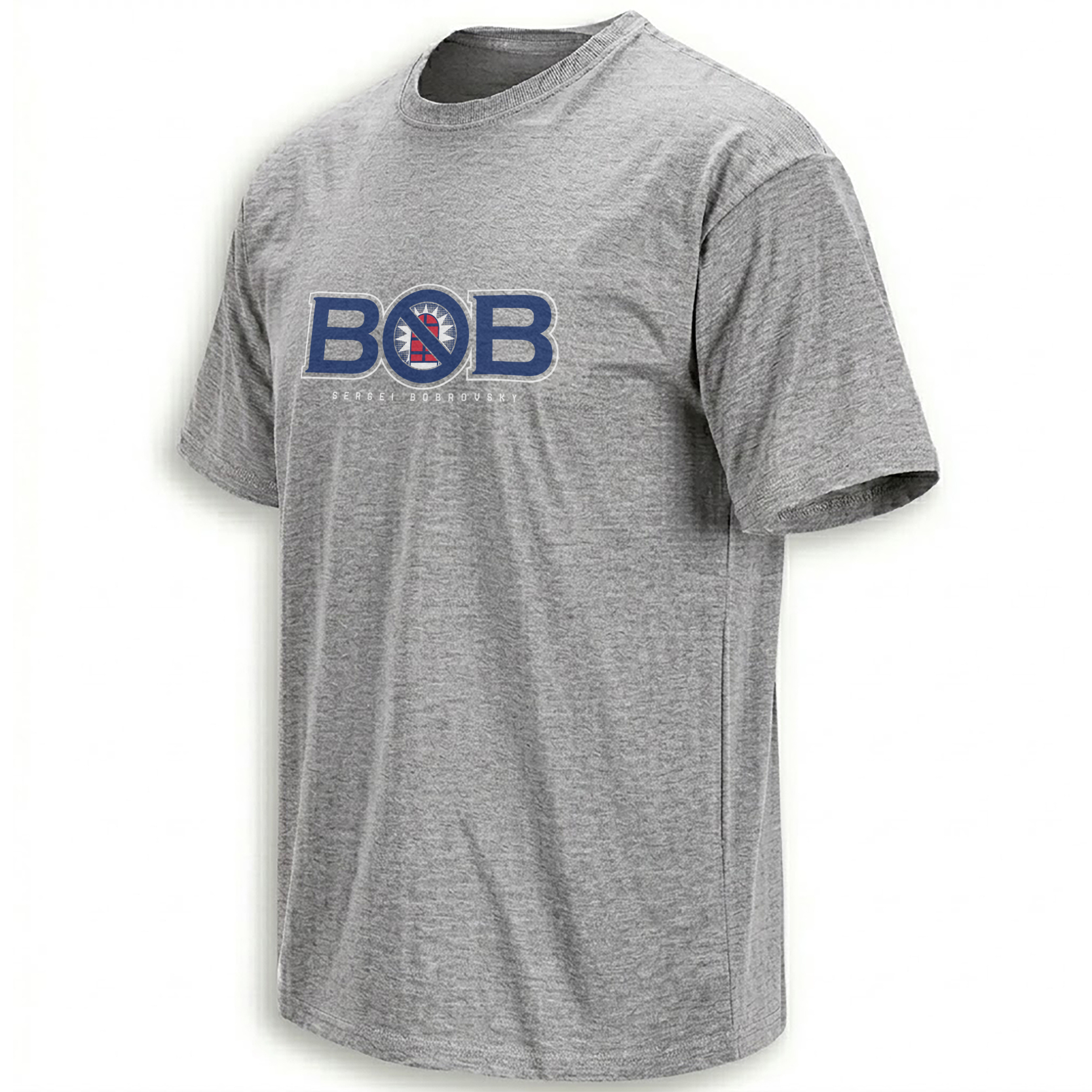
Goaltending is visually elaborate. Masks carry custom artwork. Pads cover most of the body. Creases, posts, sticks and layers of protective equipment create one of the most recognizable silhouettes in sport. A minimalist graphic moves in the opposite direction.
Instead of reproducing every detail, it asks how little information is required before recognition occurs. In this case, the answer is almost nothing: one nickname, a Toronto color system and the cultural context created by the signing.
That restraint gives the design confidence. It does not need to list the Vezina years, championship seasons or career victories because the nickname already points toward them. The empty space becomes part of the meaning, allowing the viewer’s hockey memory to complete the image.
Large lettering, controlled Maple Leafs blue and deliberate negative space turn a familiar nickname into a clean identity mark. The graphic functions less like a player poster and more like a piece of hockey shorthand shared between people who already understand the reference.
Three Letters, Three Layers of Meaning
Bobrovsky the established veteran: seventh on the NHL’s all-time wins list when he signed with Toronto.
The open question: whether championship experience can overcome age, workload and a difficult final season in Florida.
The version Toronto hopes to see: calm, technically sharp and capable of becoming “Playoff Bob” when the pressure rises.
Toronto Is Importing More Than Career Statistics
Bobrovsky’s numbers provide the obvious introduction. He won the Vezina Trophy twice, helped Florida capture consecutive Stanley Cups and arrived in Toronto with 456 regular-season victories. Those achievements establish the scale of the career.
Yet the Maple Leafs are also importing a reputation for recovery. Bobrovsky’s career has repeatedly moved between criticism and control. His early Florida contract became a source of debate before his playoff performances changed the way the entire agreement was remembered.
That ability to survive narrative swings may be particularly valuable in Toronto. The market does not merely evaluate performance. It produces stories around performance at high speed. One loss can generate a tactical debate, a psychological diagnosis and a referendum on roster construction before the next practice begins.
“Bob” Is Both a Comforting Name and a Demand
The nickname feels friendly, but the expectation attached to it is severe. Maple Leafs supporters are not invoking “Bob” simply because it is easier to pronounce. They are invoking the version of the goalie who has controlled playoff games and recovered after difficult goals.
Every established nickname creates this kind of double meaning. It produces intimacy between player and fan, while also creating a standard the player is expected to meet. Toronto does not merely want Sergei Bobrovsky on the roster. It wants the most trusted interpretation of Bob.
That distinction will become important during the season’s first difficult stretch. A veteran goaltender is not protected from volatility by his past. His past only determines how quickly supporters expect him to respond.
Why Goalies Become Characters in Fan Culture
Goaltenders occupy an unusually dramatic position. They remain on the ice for nearly the entire game, separated from teammates by geography and equipment. When a mistake occurs, there is rarely another defender behind them to erase it.
That isolation encourages fans to interpret goalies as characters rather than merely players. Their movements become personality traits. Calm positioning reads as authority. An aggressive challenge reads as confidence. A spectacular recovery save becomes proof of stubbornness or refusal.
Nicknames help organize those interpretations. “Bob” is not a technical scouting report, but it gives supporters a simple label for the figure inside the mask. It humanizes one of hockey’s most specialized positions without removing its mythology.
From Panthers Red to Maple Leafs Blue
Minimalism also makes the color change more visible. Bobrovsky spent seven seasons associated with Florida’s red, gold and championship imagery. Toronto blue immediately relocates the nickname into a different hockey world.
The transformation illustrates how quickly free agency can rewrite visual identity. The player remains recognizable, but familiar signals are rearranged. A number moves to a new sweater. A nickname appears inside a new palette. Old rivals begin imagining the same saves from the opposite emotional perspective.
The BOB design preserves the earliest stage of that transition, before Toronto has accumulated a full archive of Bobrovsky moments. It marks the summer when the nickname crossed the Atlantic Division and became part of Maple Leafs language.
The Internet Value of a One-Word Reaction
Sports conversation increasingly favors expressions that can function as both identity and reaction. A single name can become a caption after a save, a reply beneath a highlight or a headline when a player dominates.
“BOB” is especially effective because it remains legible in almost any context. It can communicate approval, relief, recognition or disbelief depending on what happened seconds earlier. The word stays the same while the emotional tone changes around it.
That flexibility gives the minimalist graphic a life beyond a standard player portrait. It resembles the language fans will actually use during games: direct, compressed and dependent on shared knowledge.
What Happens When the Season Begins
Before training camp, the nickname remains attached primarily to previous achievements and future imagination. Once Bobrovsky starts playing in Toronto, those associations will begin changing.
A sharp opening month could make “Bob” sound reassuring. A difficult stretch could turn it into a debate over workload and age. A major playoff save could permanently connect the nickname to a new Toronto image.
That uncertainty is why the signing matters now. The story has not yet hardened into hindsight. The wider NHL Shirts collection preserves similar transitional moments when player names, numbers and fan language shift before the season determines what they will ultimately mean.
Frequently Asked Questions
Why is Sergei Bobrovsky called Bob?
“Bob” is a natural shortening of Bobrovsky that became widely used by teammates, broadcasters and hockey fans throughout his NHL career.
What does “Playoff Bob” mean?
“Playoff Bob” refers to the high-performing postseason version of Bobrovsky associated with major saves, deep playoff runs and Florida’s championship seasons.
Why does the BOB design use so little imagery?
Its minimalism assumes that fans already recognize the nickname, allowing typography, Toronto blue and negative space to carry the entire cultural reference.
When did Bobrovsky join the Maple Leafs?
Toronto announced his three-year contract on July 1, 2026, after his seven-season tenure with the Florida Panthers ended.
What does the BOB Shirt represent?
The graphic marks Bobrovsky’s arrival in Toronto by turning his familiar hockey nickname into a minimalist Maple Leafs identity piece.
The BOB minimalist design captures the shorthand surrounding Toronto’s new goalie, while the broader NHL visual archive follows the player identities and roster changes reshaping hockey conversation.
BOB Shirt reduces Sergei Bobrovsky’s Toronto arrival to the three-letter nickname already carrying his Vezina résumé, championship identity and the Maple Leafs’ new goaltending expectations.