
I’m a Better Christian Than Any Trump Supporter—and I’m an Atheist
The slogan is not a profession of faith. It is an accusation that a religious identity means little when political loyalty repeatedly overrides the values attached to it.
“I’m a better Christian than any Trump supporter—and I’m an atheist” is designed as a contradiction. The speaker explicitly rejects Christian belief while claiming to practice Christian ethics more consistently than people who publicly embrace both Christianity and Donald Trump.
Its target is not every Christian, nor does it seriously attempt to award the speaker a religious identity. The line challenges a specific political alliance: the strong and durable relationship between Trump and many white evangelical Protestants in the United States.
The accusation is deliberately severe. It asks whether Christianity should be measured by what a person calls themselves, by the political coalition they join or by how closely their behavior reflects teachings associated with mercy, truth, humility, hospitality and concern for vulnerable people.
The slogan’s real question is not “Who believes?” It is “What visible moral obligations should belief create?” The ethical challenge inside the political provocation
How the paradox works
An atheist cannot literally be a Christian in the conventional theological sense because Christianity includes belief in Jesus Christ and participation in a religious tradition. The speaker knows this. The apparent impossibility is the mechanism of the joke.
By claiming to be the “better Christian,” the atheist separates Christian identity from Christian conduct. The line suggests that someone who does not believe may nevertheless show more compassion, honesty or solidarity than someone who invokes Christianity while supporting conduct the speaker considers cruel or dishonest.
That distinction transforms the statement from an argument about doctrine into an argument about hypocrisy.
Why the Trump–Christian alliance gives the line force
The statement depends on a documented political reality rather than a merely imagined stereotype. White evangelical Protestants have remained one of Trump’s strongest constituencies across multiple election cycles.
In February 2026, the Pew Research Center reported that 69% of white evangelical Protestants approved of Trump’s job performance, compared with 37% of American adults overall. Fifty-eight percent of white evangelicals said they supported all or most of his plans and policies.
Those numbers do not mean all Christians support Trump. American Christianity includes many traditions, racial communities and political commitments. Black Protestants, progressive Christians, many Catholics and numerous other believers have criticized Trump or opposed the merging of Christian identity with partisan power.
The slogan compresses those distinctions for rhetorical impact, but understanding them prevents the design from being mistaken for a neutral description of Christianity as a whole.
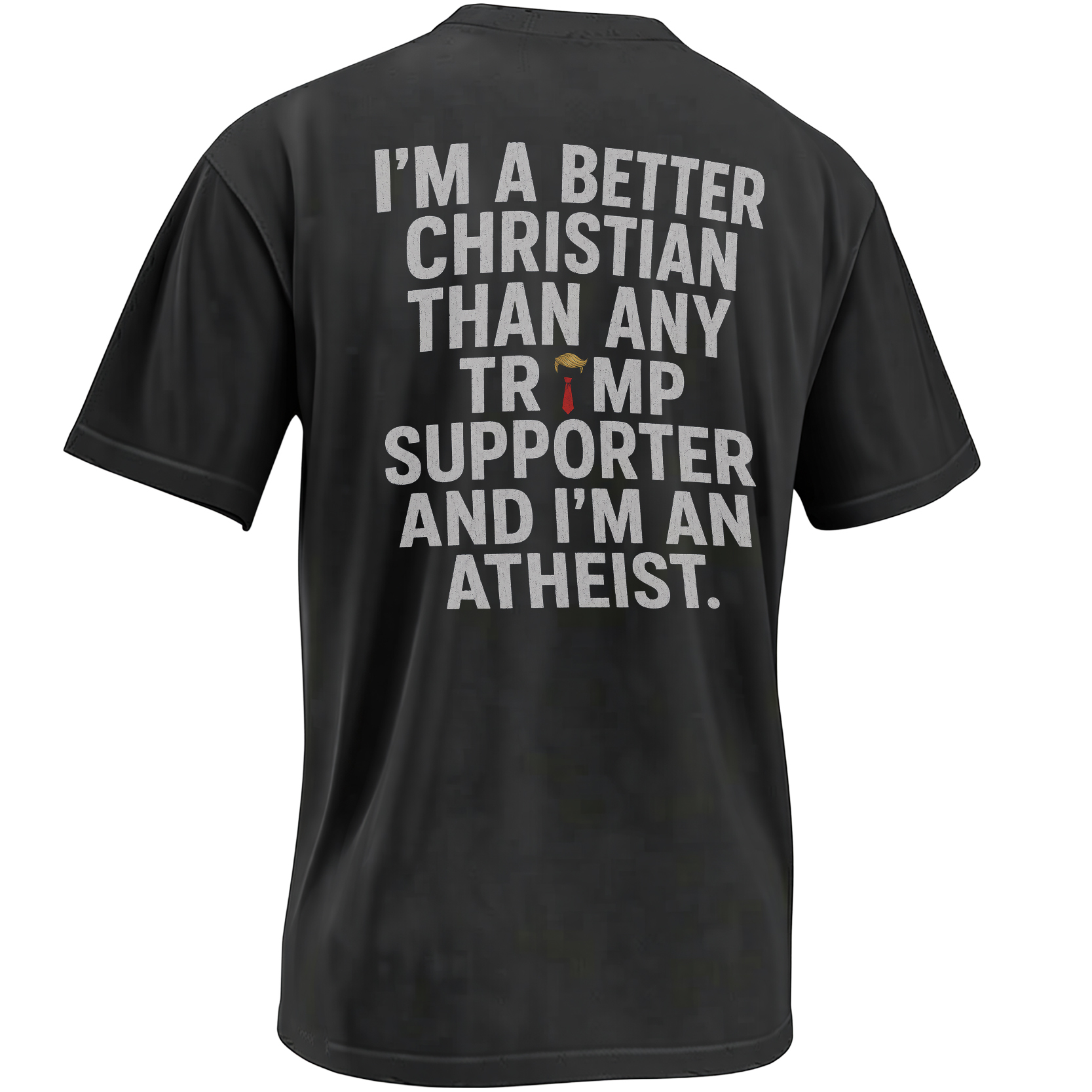 The political artifact
A confrontational anti-Trump statement uses the atheist punchline to question whether religious labels retain meaning when moral conduct appears inconsistent with them.
The political artifact
A confrontational anti-Trump statement uses the atheist punchline to question whether religious labels retain meaning when moral conduct appears inconsistent with them.
A struggle over who gets to define Christian values
American political arguments frequently treat “Christian values” as though the term has one uncontested definition. In practice, believers emphasize different doctrines and reach sharply different conclusions about government, authority, sexuality, poverty, immigration, punishment, war and social responsibility.
Conservative Christians may support Trump because of abortion policy, judicial appointments, religious-liberty disputes or opposition to progressive cultural change. Some regard him less as a spiritual model than as a political instrument capable of advancing their priorities.
Critics evaluate the alliance through a different group of concerns: honesty, treatment of immigrants, political vengeance, wealth, humility, peacemaking and care for people with less power. From that perspective, supporting Trump appears incompatible with the ethical example they associate with Jesus.
The shirt belongs to that second tradition of criticism. It does not defeat the conservative argument by itself. It refuses to allow religious identity to function as automatic proof of moral authority.
Trump is supported without being viewed as deeply religious
The political alliance becomes more complicated because supporting Trump does not necessarily mean considering him personally devout.
In an April 2026 Pew Research Center survey, 70% of American adults said Trump was “not too” or “not at all” religious. Even among white evangelical Protestants, 51% placed him in those categories, while only 5% described him as very religious.
That distinction helps explain why debates about hypocrisy do not always weaken his Christian support. Many supporters do not require Trump to be a model Christian. They evaluate him as a protector, negotiator or political weapon acting on behalf of their priorities.
The atheist speaker rejects that separation. The slogan argues that repeatedly excusing conduct for political results is itself a moral decision—and one that religious language cannot automatically cleanse.
Pew Research Center’s 2026 surveys found both continued white evangelical support for Trump and widespread doubt that Trump is personally religious. These facts can coexist because political support and perceptions of personal devotion measure different things.
Why “any Trump supporter” is intentionally absolute
The word “any” makes the sentence emotionally forceful but analytically broad. Millions of Trump supporters do not share identical beliefs, motivations, religious practices or personal conduct.
Some vote primarily on economic policy. Others prioritize immigration, abortion, judges, gun rights, foreign policy or partisan identity. Some are devout Christians, some culturally Christian, some members of other faiths and some nonreligious.
The design does not attempt to preserve those differences. Like protest signs and political cartoons, it uses exaggeration to establish a clear moral boundary.
That makes the artwork effective as protest rhetoric but insufficient as a literal judgment of every individual. Its strongest defensible meaning is that supporting Trump can conflict with values the speaker regards as central to Christian moral teaching.
The atheist punchline reverses assumed moral authority
In some political environments, atheists are portrayed as lacking the religious foundation supposedly required for morality. The closing phrase turns that accusation backward.
The atheist does not claim divine permission, biblical authority or spiritual superiority. Instead, the speaker argues that observable conduct provides a more credible moral measure than religious affiliation.
This reversal explains why the last four words carry most of the design’s impact. Without “and I’m an atheist,” the statement would be an internal dispute between competing Christians. With it, the criticism arrives from outside the faith and questions whether outsiders may sometimes embody its ethical ideals more convincingly than insiders.
Criticism of political Christianity is not criticism of every Christian
The relationship between religion and Trump has generated resistance from within Christianity as well as from atheists and secular organizations.
Progressive Christians, Black church traditions, Catholic social-justice advocates and other religious communities have argued that Christian nationalism distorts their faith by attaching it too closely to state power, nationalism or one political personality.
That internal opposition matters. It demonstrates that the debate is not simply Christianity versus atheism. It is also a struggle among Christians over what their religion requires in public life.
The design chooses an atheist narrator because that produces the sharpest paradox, but its underlying ethical criticism overlaps with arguments made by many practicing believers.
A wearable challenge rather than a theological conclusion
Political clothing operates through compression. It does not carry a sermon, policy paper or survey methodology. It carries one sentence designed to create recognition, disagreement or conversation before the wearer has said anything aloud.
This statement is unlikely to persuade a committed Trump supporter through careful argument. Its function is different: it allows critics to express disgust at what they see as the moral contradiction between Christian symbolism and Trump-aligned politics.
The I’m a Better Christian Than Any Trump Supporter—and I’m an Atheist Shirt preserves that accusation as a deliberately confrontational artifact of America’s continuing struggle over religion, character and political power.
More verified protest graphics and anti-Trump political satire can be explored through Ellie Shirt’s Anti-Trump collection.
Atheist and Trump supporter phrase FAQ
What does “I’m a better Christian than any Trump supporter—and I’m an atheist” mean?
It argues that moral conduct can reflect values associated with Christianity more convincingly than merely claiming a Christian identity while supporting Trump.
Is the speaker literally claiming to be Christian?
No. The atheist declaration creates an intentional contradiction used to criticize perceived religious hypocrisy.
Does the phrase attack every Christian?
No. Its direct target is the alliance between Christian identity and Trump support, although the word “any” deliberately uses broad protest-language exaggeration.
Do all American Christians support Donald Trump?
No. Christian political attitudes vary substantially by denomination, race, theology and party affiliation.
Why do many white evangelical Christians support Trump?
Common explanations include abortion policy, conservative judges, religious-liberty disputes, cultural conflict and the belief that Trump protects their political interests.
Do Trump’s Christian supporters necessarily consider him deeply religious?
No. Pew Research Center found strong white evangelical support for Trump even though relatively few Americans, including relatively few white evangelicals, described him as very religious.
Where can readers find more anti-Trump designs?
Additional protest and political-satire designs are available at https://ellieshirt.com/collections/anti-trump/.
See the atheist anti-Trump political statement challenging the distance between religious identity and moral conduct.
A confrontational atheist critique of Trump-aligned Christianity and the gap between professed religious identity and observable moral conduct.