
“Jesus Is a Black Man,” Psalm 27:1 and the Power of Seeing Faith Differently
A provocative declaration, a psalm about courage and a Black image of Christ come together in a graphic that asks who has traditionally been allowed to see themselves inside sacred art.
“Jesus Is a Black Man” is the kind of phrase that stops a casual scroll. It is direct enough to sound confrontational, but its deeper cultural history is rooted in representation, liberation theology and the long relationship between Black communities and Christian faith.
Historically, Jesus was a first-century Jewish man from Roman Judea—not the pale, European figure that became dominant in much of Western religious art. Calling Jesus “Black” in modern religious discourse therefore does not need to function as a forensic claim about a contemporary racial category. In Black theology, the language often identifies Christ with people who have experienced oppression, exclusion and state violence.
That distinction matters. The graphic is best understood as a declaration about spiritual belonging: sacred identity does not belong exclusively to the visual traditions that once presented whiteness as the default face of Christianity.
The message is not merely about changing the color of a familiar portrait. It is about changing who is permitted to recognize themselves in the sacred story.
Why Psalm 27:1 changes the emotional register
Psalm 27 opens with a declaration traditionally attributed to David: “The Lord is my light and my salvation; whom shall I fear?” The verse describes trust under pressure. Light represents direction in darkness; salvation suggests deliverance; the stronghold becomes an image of security when the surrounding world feels hostile.
Read beside the words “Jesus Is a Black Man,” the verse adds spiritual weight to the visual. The composition does not rely solely on provocation. It places the declaration inside a biblical vocabulary of courage, protection and freedom from fear.
Psalm 27 is used across Jewish and Christian traditions. Its central theme is confidence in God rather than confidence in personal power. That makes the verse especially resonant in communities where faith has historically operated as both refuge and resistance.
A visual artifact of Black Christian identity
Black Christian visual culture has never been confined to church walls. It lives in gospel albums, community murals, memorial programs, protest placards and graphic apparel. Each form allows theology to move into ordinary public life.
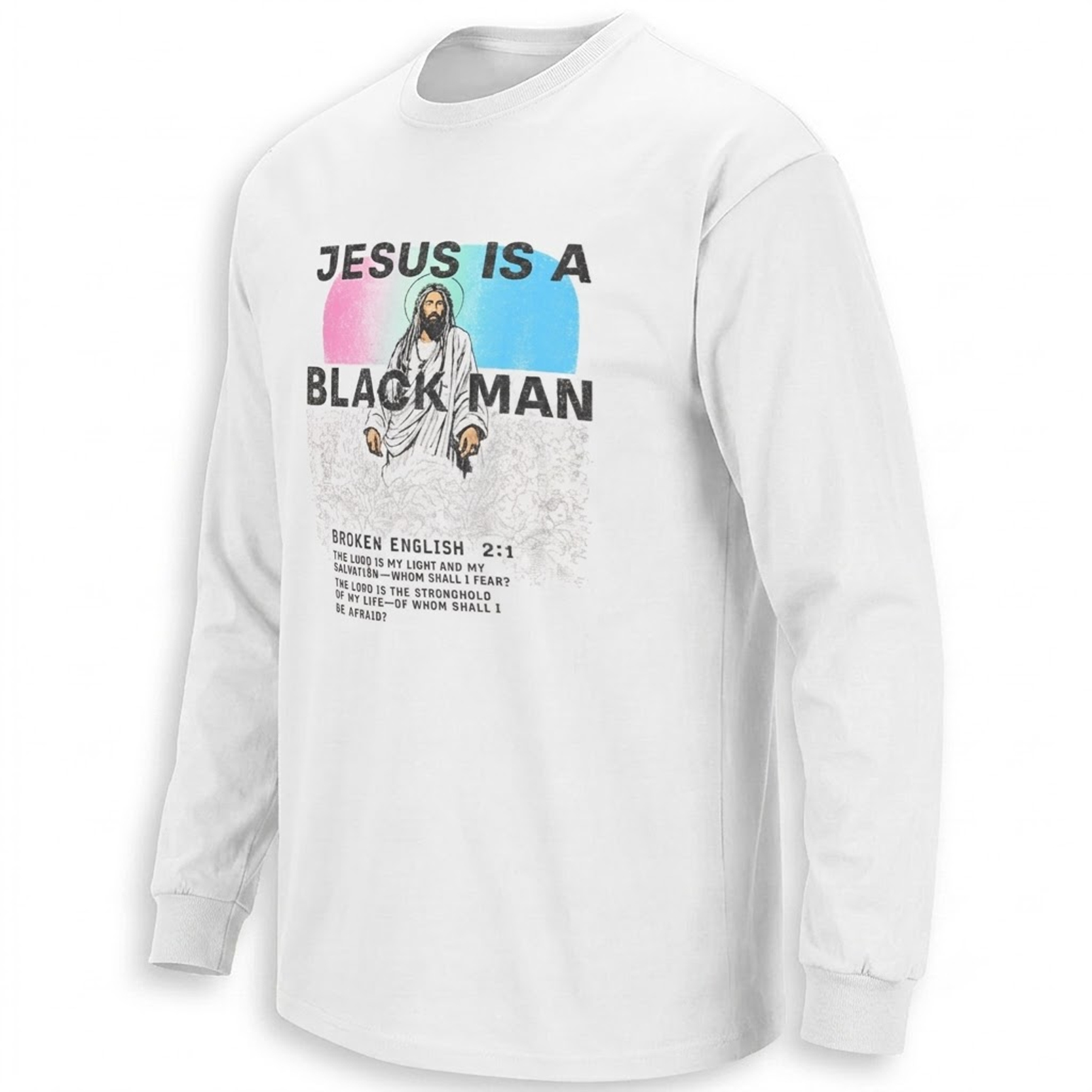
Within that tradition, the Jesus Is a Black Man Shirt functions like a portable devotional poster. The long-sleeve mockup gives the artwork the scale of an illustrated testimony, while the T-shirt version compresses the same message into a sharper streetwear silhouette.
How the design uses contrast and testimony
The artwork depends on a meeting of portraiture and proclamation. The central figure supplies the sacred focal point, while the large declarative wording works like testimony—language designed to be read before every illustration detail is absorbed.
Psalm 27:1 anchors the composition. Without the scripture reference, the phrase could be interpreted only as cultural argument. With it, the design moves between identity, theology and encouragement. Its message becomes: the face represented here belongs inside Christian imagination, and the believer standing beneath that image does not have to live in fear.
Why images of Jesus remain culturally contested
The canonical Gospels provide no detailed physical portrait of Jesus. As Christianity moved through different societies, artists repeatedly depicted Christ using the features, clothing and visual languages familiar to their own communities.
The controversy usually begins when one regional depiction is treated as historically neutral while other depictions are dismissed as political. In reality, sacred imagery has always carried cultural choices. Black portrayals of Jesus make those choices visible and restore a form of identification that Western religious art often denied.
Scholars of Black theology have also emphasized Jesus as a suffering and socially marginalized figure. That connection helps explain why Black congregations could hold together sorrow, endurance and hope through spirituals, preaching and religious art. The graphic belongs to that wider cultural lineage, even while using the faster language of contemporary apparel.
Faith language that can be worn in public
Some religious graphics whisper. This one declares. Its strength comes from allowing scripture and representation to occupy the same visual space without apologizing for either.
Readers interested in how new cultural and faith-centered graphics enter the Ellie Shirt catalog can also explore the newest design archive. The contextual connection here is not a generic category label, but the way current graphic language records conversations about identity, belief and public expression.
Frequently Asked Questions
Does “Jesus Is a Black Man” claim that Jesus belonged to a modern racial category?
The historical Jesus was a Jewish man from Roman Judea. In Black theology and cultural art, describing Jesus as Black often expresses solidarity with oppressed people and challenges the dominance of European-looking depictions.
What does Psalm 27:1 mean?
Psalm 27:1 describes God as light, salvation and the stronghold of life. Its central message is confidence in divine protection when fear, danger or uncertainty surrounds the believer.
Why are there different cultural portrayals of Jesus?
Because the Gospels do not supply a detailed physical portrait, Christian communities have historically represented Jesus through their own artistic traditions and cultural features.
Why does this graphic matter within Black Christian culture?
It joins scripture with visible representation, affirming that Black identity belongs within Christian sacred imagery and its continuing public conversation.
Seen in full context, the design operates as a piece of contemporary faith art: part scripture meditation, part cultural correction and part visual testimony. The complete T-shirt and long-sleeve presentation can be viewed on the product’s visual page.
Jesus Is a Black Man Shirt pairs Black Christian representation with the fearless message of Psalm 27:1. The graphic frames faith, divine protection and cultural identity as one direct visual testimony.