Colston Loveland’s Hurdle TD vs Saints: Chicago Bears Surf Club
One catch from Caleb Williams, one airborne tight end and one Saints defender left beneath him. Colston Loveland’s spectacular 15-yard touchdown gave Chicago a new highlight — and turned a football hurdle into an unlikely surfing metaphor.
Colston Loveland appeared to defy gravity for a moment at Soldier Field. On November 22, 2026, the Chicago Bears tight end caught a Caleb Williams pass, approached New Orleans Saints safety Julian Blackmon and launched himself over the attempted tackle. He landed running, continued into the end zone and completed one of the most spectacular touchdowns of Chicago’s season.
The play covered 15 yards and extended the Bears’ lead to 16–0 during the second quarter. Chicago eventually defeated New Orleans 21–13, improving to 8–2 and recording its fifth consecutive victory. But the result only tells part of the story. The image of Loveland suspended above Blackmon was the moment made for replay.
Fans immediately had a visual they could recognize without a scoreboard. Loveland’s body was horizontal in the air, the football secured against his chest, as Blackmon went low beneath him. In a sport built on violent collisions and tight spaces, the tight end found a brief, improbable route over the traffic.
That scene inspired three related illustrations — Surfs Up, Cleared the Wave and Chicago Surf Club — that connect the jump to a playful coastal metaphor. All three belong to the broader story of Chicago Bears football culture, where a single standout play can become a recognizable graphic reference.
The Hurdle That Changed a Routine Red-Zone Play
Loveland’s touchdown began with a conventional football idea. The Bears were near the Saints’ goal line, and Caleb Williams found his tight end open during a second-quarter scoring possession. Loveland secured the pass and turned upfield looking for the end zone.
Julian Blackmon moved forward to make the tackle. Instead of absorbing contact or trying to run through the defender, Loveland jumped. The choice was remarkable because of the player’s size and the short distance available to complete the maneuver.
At approximately 6-foot-6, Loveland is not the kind of athlete casual viewers expect to see clearing an opposing defensive back in one fluid motion. But the hurdle was controlled enough that he never lost possession of the ball, and he completed the touchdown immediately after landing.
NBC Chicago documented the play as one of the afternoon’s standout highlights, while the Chicago Bears’ official highlight video confirmed both the hurdle and the 15-yard touchdown.
For one moment, Loveland was not running through the Saints defense. He was flying over it.
Watch the Original Moment: Loveland Clears Julian Blackmon
The broadcast view is essential to understanding the play. From the moment Loveland catches the ball, Blackmon is moving toward him to close off the route to the end zone. The hurdle turns that attempted tackle into a dramatic piece of movement.
Colston Loveland hurdle and TD!
— NFL (@NFL) November 22, 2026
Original game footage of Loveland’s hurdle touchdown against New Orleans, also featured in the NFL’s Week 11 coverage. The moving image documents the real leap rather than a later illustration of it.
The exact hurdle was also featured in reporting from NBC Chicago and USA Today, with sports outlets emphasizing how unexpectedly athletic the move appeared for a tight end. Social-media discussion focused on the height of the jump, the clean landing and the visual contrast between Loveland and the defender beneath him.
A still photograph from the same sequence offers another way to see it. The Bears’ game-day gallery preserves the surrounding visual context at Soldier Field, including the Chicago uniform, the Saints’ white-and-gold colors and the physical intensity of the matchup.
View the Chicago Bears’ official November 22, 2026 photo gallery. The gallery documents the Saints game from which the hurdle originated. For the exact airborne frame, the original NFL video embedded above is the primary visual record.
Why a Chicago Hurdle Became a Surfing Metaphor
Chicago is not a surfing capital in the traditional sense. It is a city defined by Lake Michigan, wind, winter weather and one of football’s strongest regional identities. That contrast makes the surfing interpretation entertaining rather than literal.
The visual comparison starts with Loveland’s movement. His leap has the rising arc of someone clearing a breaking wave. Blackmon becomes the obstacle beneath him, while the open route to the end zone resembles the clear water beyond a crest.
In that context, the phrases “Surfs Up” and “Cleared the Wave” do not describe an official team celebration or a nickname given to the play by the Bears. They are artistic interpretations of the hurdle. The artwork uses a familiar beach-culture image to give the football highlight an unexpected visual identity.
The joke is particularly effective because the act of hurdling already suggests flying above a surface. The surfing theme replaces the defender with a wave without erasing what made the play recognizable.
Three Ways to Illustrate the Same Incredible Leap
The three Chicago surfing designs take different approaches to the same moment. One turns the airborne player into a dramatic crest-of-the-wave illustration. Another emphasizes clearing the obstacle, while the third gives the whole idea the identity of a fictional retro surfing club.
All three pieces reference the November 22 touchdown against New Orleans. Their surf imagery is symbolic; the actual documented event remains a football hurdle at Soldier Field.
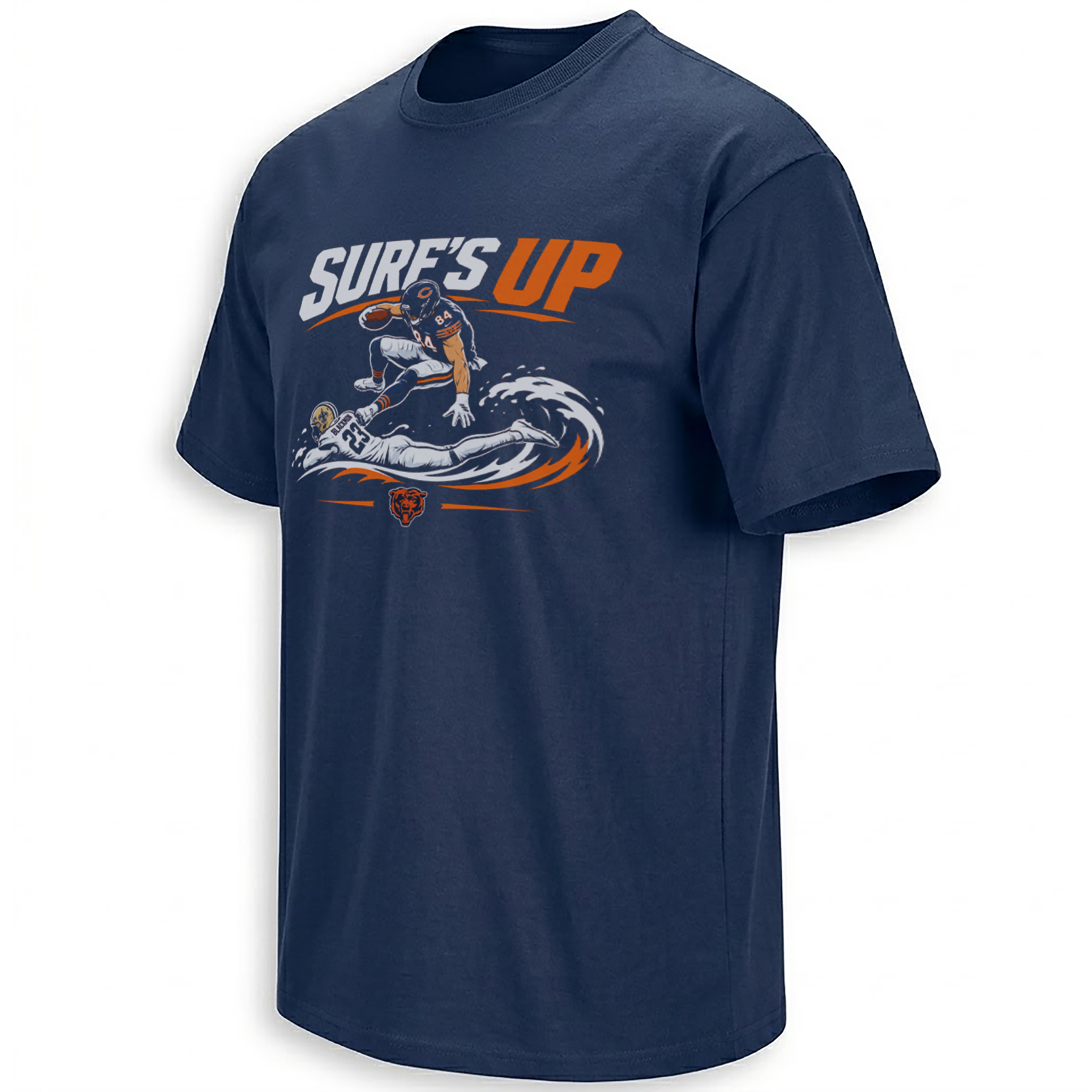 01 / The Wave
The hurdle is reimagined as a ride over a breaking wave. Chicago’s navy and orange football identity meets the fluid motion of ocean imagery, turning a vertical leap into a playful surf-culture poster.
Explore the wave graphic →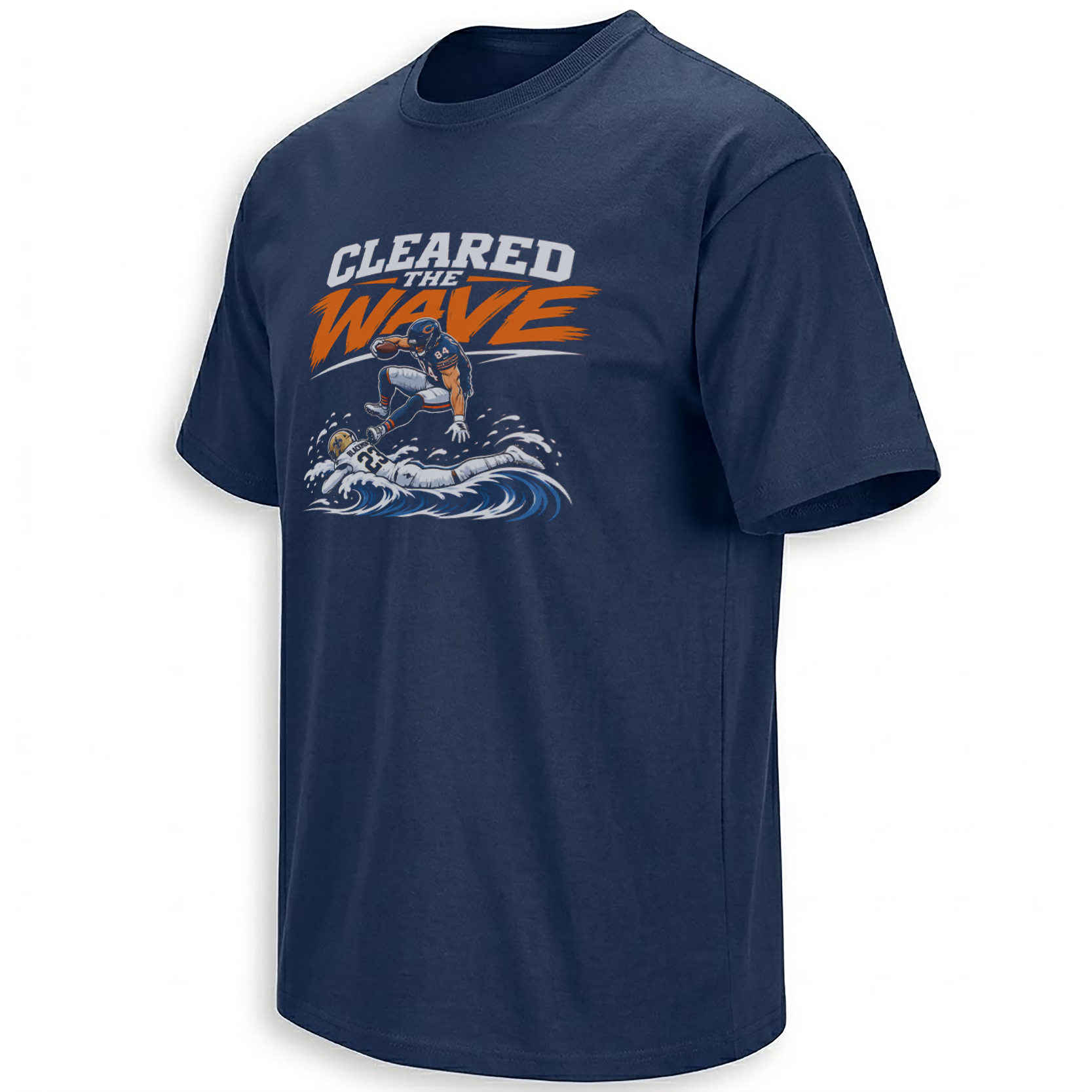 02 / The Clearance
This treatment focuses on the dramatic separation between the airborne Loveland and the defender below him. The phrase emphasizes the successful clearance, preserving the athletic achievement behind the surf metaphor.
View the hurdle composition →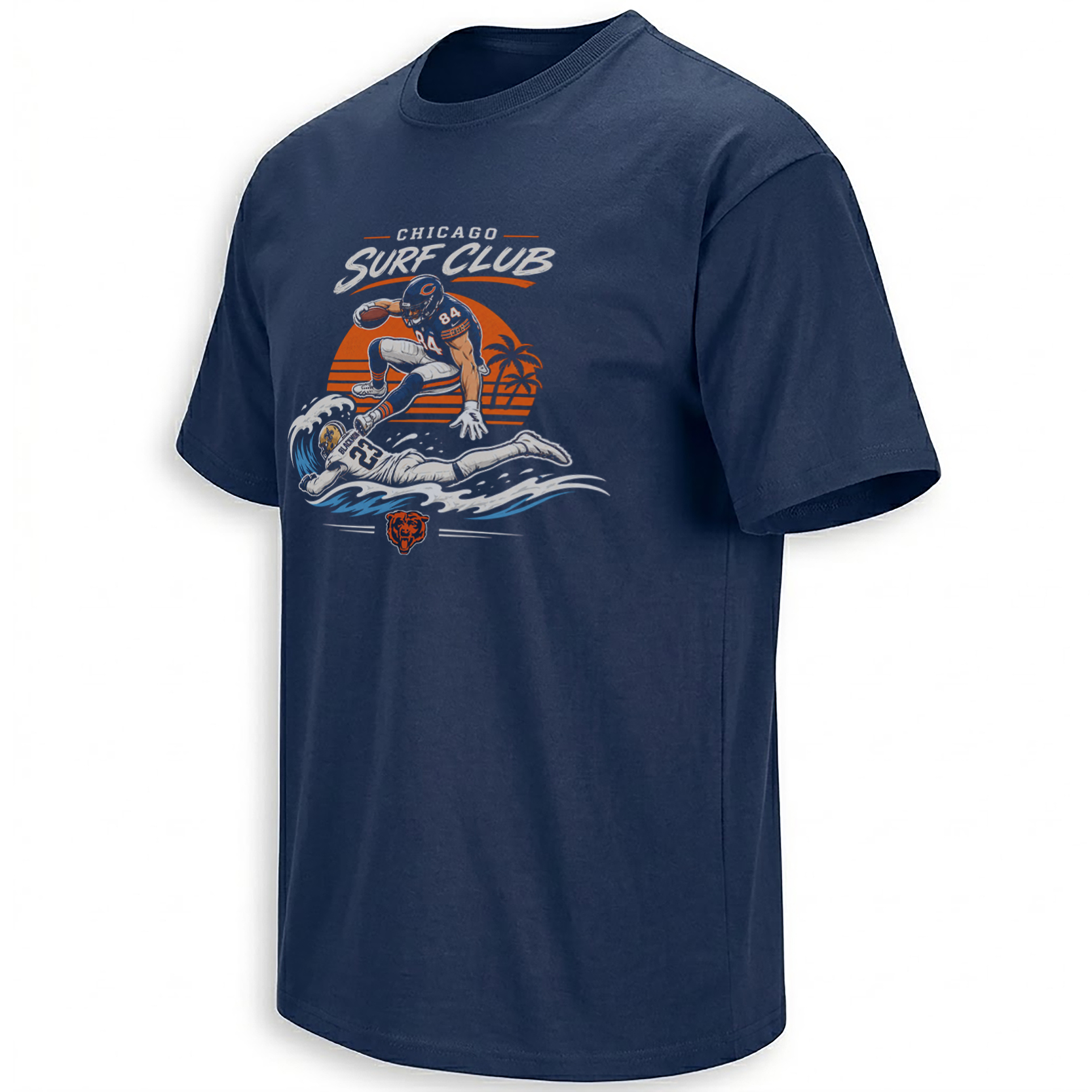 03 / The Retro Club
A fictional surf-club identity built around Loveland’s leap. Retro sunset colors, stylized scenery and the player’s number give the graphic the mood of an old beach souvenir, while its real origin remains a November football afternoon in Chicago.
Explore the retro club artwork →The Bears’ Young Tight End Is Building His Own Highlight Archive
Loveland entered the 2026 season as one of Chicago’s most promising offensive players. His ability to create problems for defensive backs comes from the combination of tight-end size, receiving skills and movement that can look unusual for someone of his build.
Before the Saints game, Loveland had recorded 37 receptions for 363 yards and two touchdowns. His 15-yard scoring catch against New Orleans added another memorable play to a season in which his role in the offense continued to grow.
The touchdown also demonstrated why the passing connection with Caleb Williams matters. Williams delivered the ball to Loveland in space, and the tight end converted the reception into something dramatically larger than a conventional red-zone catch.
Those individual plays are increasingly important to how Bears fans talk about the team’s offensive identity. Loveland’s hurdle represents a specific example of a young playmaker turning an ordinary opportunity into an unmistakable highlight.
For readers following Colston Loveland designs, the surf-inspired graphics preserve the acrobatic moment rather than attempting to summarize his entire season.
How Fans Reacted to the Leap
The hurdle quickly became one of the most shared moments from Chicago’s victory. Fans discussed the difficulty of clearing Blackmon without losing the football, while commenters praised Loveland’s athleticism and the confidence required to attempt the move.
The conversation moved beyond Bears supporters. The play was striking enough to resonate across NFL highlight accounts, where unusual hurdles often attract attention regardless of the teams involved.
[Highlight] Colston Loveland hurdling right over a Saints defender into the end zone
by r/CHIBears
Original discussion from the Chicago Bears community after the November 22 touchdown. The thread includes reactions to Loveland’s athleticism and the successful hurdle over Blackmon.
The unusual movement also drew attention to the television broadcast reaction. Tom Brady, calling the game for FOX, reacted loudly as Loveland cleared the defender. That spontaneous response matched the excitement from Soldier Field and helped reinforce the play’s status as a genuine highlight rather than a routine touchdown.
Why the Chicago Surf Club Image Works
The retro surf-club interpretation is effective because it turns a precise athletic movement into a distinct visual identity. Instead of reproducing the scoreboard or illustrating the entire scoring drive, it isolates the leap and gives it an unexpected frame.
Chicago’s familiar football colors still establish the team connection. The fictional surf imagery adds contrast, allowing the graphic to feel like an alternative sports poster rather than ordinary touchdown commemorative art.
It also connects two recognizable kinds of movement: a surfer clearing a crest and a football player hurdling a defender. The physical details are different, but the visual idea is immediate. Something stands in the athlete’s path, and the athlete rises above it.
The strongest version of that idea does not require a literal beach, real surf competition or invented celebration. Loveland’s actual hurdle already supplies the drama. The wave is an artistic language used to interpret what fans witnessed.
Surfs Up emphasizes motion and humor. Cleared the Wave emphasizes the successful leap. Chicago Surf Club turns the event into a fictional retro identity. Each is a different visual interpretation of the same verified touchdown, not a separate football event.
Chicago’s Victory Was Bigger Than One Hurdle
Loveland’s touchdown contributed to a 21–13 win that strengthened Chicago’s position in the NFC North. The Bears extended their winning streak to five games, moving to 8–2 while preparing for a significant Thanksgiving matchup against the Detroit Lions.
Jeffery Simmons and the Chicago defense also played a major role, with Simmons recording three sacks as the Bears limited New Orleans’ offense. The game represented another step in Chicago’s push toward the postseason, even if the offense did not dominate for four quarters.
Against that broader backdrop, Loveland’s airborne touchdown became the afternoon’s most memorable offensive image. It combined the practical value of a scoring play with the kind of individual athleticism that survives in highlight reels.
The wider NFL collection shows how such moments develop their own visual identities across the league. Some graphics commemorate victories; others preserve one leap, catch or unexpected piece of football culture.
Frequently Asked Questions
When did Colston Loveland hurdle a Saints defender?
Loveland hurdled New Orleans Saints safety Julian Blackmon on November 22, 2026, during the Chicago Bears’ 21–13 victory at Soldier Field.
Who did Colston Loveland jump over?
Loveland jumped over Saints safety Julian Blackmon after catching a pass from Caleb Williams in the second quarter.
How long was Loveland’s hurdle touchdown?
The scoring play was a 15-yard touchdown reception from quarterback Caleb Williams, extending Chicago’s lead to 16–0.
Did the Bears beat the Saints after the hurdle?
Yes. Chicago defeated New Orleans 21–13, improving to 8–2 and earning its fifth consecutive victory.
Why is Loveland’s hurdle compared to surfing?
The surf analogy is a creative interpretation of his airborne movement. The graphics compare Loveland clearing a defender with a surfer rising above a wave; no actual surfing occurred.
What does Chicago Surf Club mean?
Chicago Surf Club is a fictional retro graphic concept inspired by Loveland’s hurdle touchdown. It combines Bears football identity with vintage surfing imagery and sunset colors.
Why did the Loveland hurdle go viral?
Loveland’s size, athletic leap over Julian Blackmon, clean landing and immediate touchdown created a dramatic highlight that attracted attention from NFL media and football fans.
One 15-yard touchdown, one airborne tight end and three ways to remember the play. The Surfs Up, Cleared the Wave and Chicago Surf Club graphics capture different sides of Loveland’s remarkable touchdown, while the Chicago Bears archive follows the wider visual story of the team’s 2026 season.
Colston Loveland’s 15-yard hurdle touchdown over Julian Blackmon helped the Chicago Bears defeat the New Orleans Saints 21–13 on November 22, 2026. Explore how the airborne play inspired Surfs Up, Cleared the Wave and Chicago Surf Club — three retro, surf-themed interpretations of a memorable NFL highlight.