Minnesota Timberwolves 2026: Defiance. Belief. The Howl.
Jaden McDaniels challenged Denver’s defense. Anthony Edwards gained a new backcourt partner in LaMelo Ball. Through it all, Minnesota fans kept their most recognizable tradition alive: the howl.
Few NBA teams entered the second half of 2026 with a story quite like Minnesota’s. The Timberwolves had emerged from an intense playoff confrontation with Denver, reshaped their roster through a major summer trade and entered another season carrying the unmistakable confidence of a fan base that had learned to expect meaningful basketball.
Three different images capture that period. Jaden McDaniels’ blunt assessment of the Denver Nuggets became a widely discussed playoff quote. Anthony Edwards and LaMelo Ball appeared together in fan artwork built around the phrase “Believe Us.” And the words “Howling Uncontrollably” drew on a tradition that had connected Minnesota basketball supporters since the franchise’s earliest seasons.
These are not three chapters of one game. They represent different sides of the same basketball identity: competitive defiance, optimism surrounding a new partnership and the shared language of the Wolves community.
Together, they belong to the larger Minnesota Timberwolves collection, where memorable quotes, player partnerships and long-established fan traditions become recognizable pieces of basketball visual culture.
Jaden McDaniels and the Quote That Challenged Denver
On April 20, 2026, the Timberwolves pulled off one of the defining early comebacks of their playoff run. Down by as many as 19 points to the Denver Nuggets, Minnesota rallied to win 119–114 at Ball Arena and even the first-round series at one game apiece.
Anthony Edwards led the team with 30 points and 10 rebounds, while Julius Randle contributed 24 points. Jaden McDaniels added 14, but his most widely discussed contribution came after the final buzzer.
Asked about Minnesota’s offensive approach, McDaniels explained that the team wanted to attack individual Denver defenders. He mentioned Nikola Jokić, Jamal Murray, Tim Hardaway Jr., Cameron Johnson and Aaron Gordon. When a reporter clarified whether he was criticizing the entire group, his response was unmistakable:
“Yeah, they’re all bad defenders.”
The comment was not an objective scouting report. It was playoff trash talk from a player known for his own defensive ability. Its blunt delivery immediately created a debate between Minnesota supporters, Denver fans and basketball commentators.
Denver coach David Adelman and several players responded publicly, while McDaniels continued expressing confidence in his original assessment. The exchange became part of the larger first-round rivalry rather than a single isolated interview. CBS Sports documented Denver’s response.
The Real Playoff Image Behind the Traffic-Cone Joke
In the basketball vocabulary, a traffic cone is a defender who offers little resistance as an opponent moves toward the basket. That is why five numbered orange cones became such an effective visual interpretation of McDaniels’ comments.
The official Timberwolves postgame interview preserved the exact exchange. The moment became particularly memorable because McDaniels delivered the comment without the theatrics usually associated with aggressive sports trash talk.
The traffic-cone image makes that attitude visible. Rather than using Denver player portraits, the graphic assigns five Nuggets jersey numbers to orange construction cones: 23 for Cameron Johnson, 32 for Aaron Gordon, 15 for Nikola Jokić, 27 for Jamal Murray and 10 for Tim Hardaway Jr.
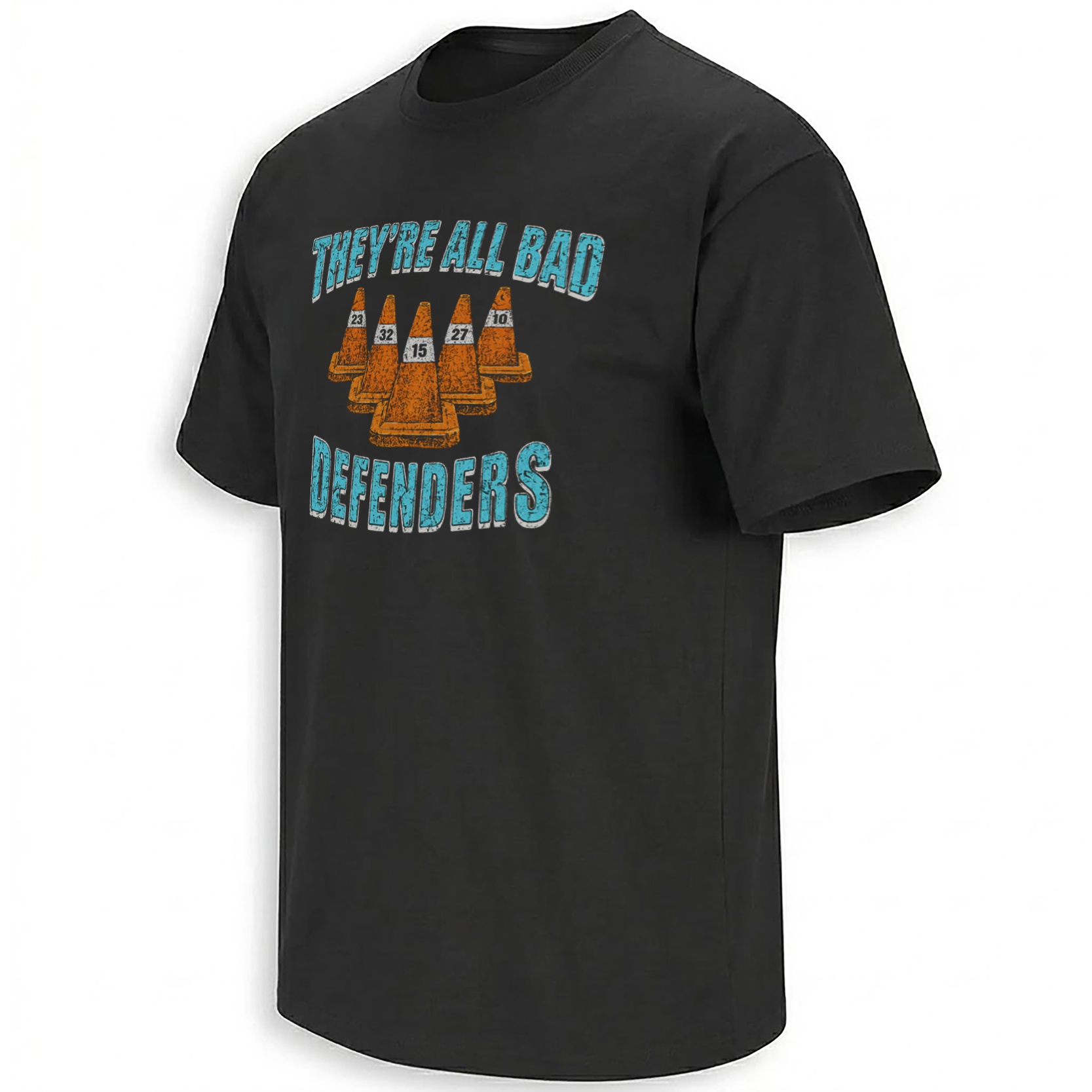
A memorable quote turned into basketball satire. Five numbered traffic cones replace Denver’s defenders, preserving the confrontational humor of the April playoff series.
Explore the graphic →The reaction continued in basketball communities. Minnesota fans enjoyed McDaniels’ refusal to soften his statement, while Denver supporters questioned whether he had given the Nuggets additional motivation.
Believe Us: Anthony Edwards and LaMelo Ball’s New Minnesota Era
By summer, the conversation around the Timberwolves had shifted from playoff confrontation to roster ambition. Minnesota agreed to acquire LaMelo Ball from the Charlotte Hornets in a major four-team trade, later completing the transaction in July 2026.
The deal sent Naz Reid to Charlotte and Julius Randle to Brooklyn as part of the wider transaction. It placed Ball alongside Anthony Edwards, bringing together two players selected near the top of the 2020 NBA Draft.
Edwards had been chosen first overall by Minnesota. Ball went third to Charlotte. Six years later, the two were finally preparing to share the same backcourt. The transaction is detailed in the Timberwolves’ official trade announcement.
The basketball questions were obvious. Edwards brought explosive scoring, attacking instincts and established Minnesota leadership. Ball offered passing creativity, court vision and the ability to change the rhythm of a possession.
The idea of that partnership quickly inspired fan-made graphics. Designer Alex Glassman created a speculative Edwards–Ball concept that adapted the visual language of Anthony Edwards’ Adidas-associated “Believe That” campaign into the phrase “Believe Us.”
Glassman later described the project in his professional portfolio, reporting that the concept received more than one million views. It was an example of how a roster move can create an immediate visual identity before the new lineup has built a complete season of shared highlights.
“Believe Us” is associated with fan-created artwork responding to the Edwards–Ball partnership. It should not be presented as a verified official Timberwolves team slogan or an official Adidas campaign. The original designer’s work is documented at AG Edits.
The Believe Us graphic interprets the partnership through two dark player portraits, electric-blue lettering and a Twin Cities skyline. The distressed typography gives the composition the character of a streetwear poster rather than a conventional team announcement.
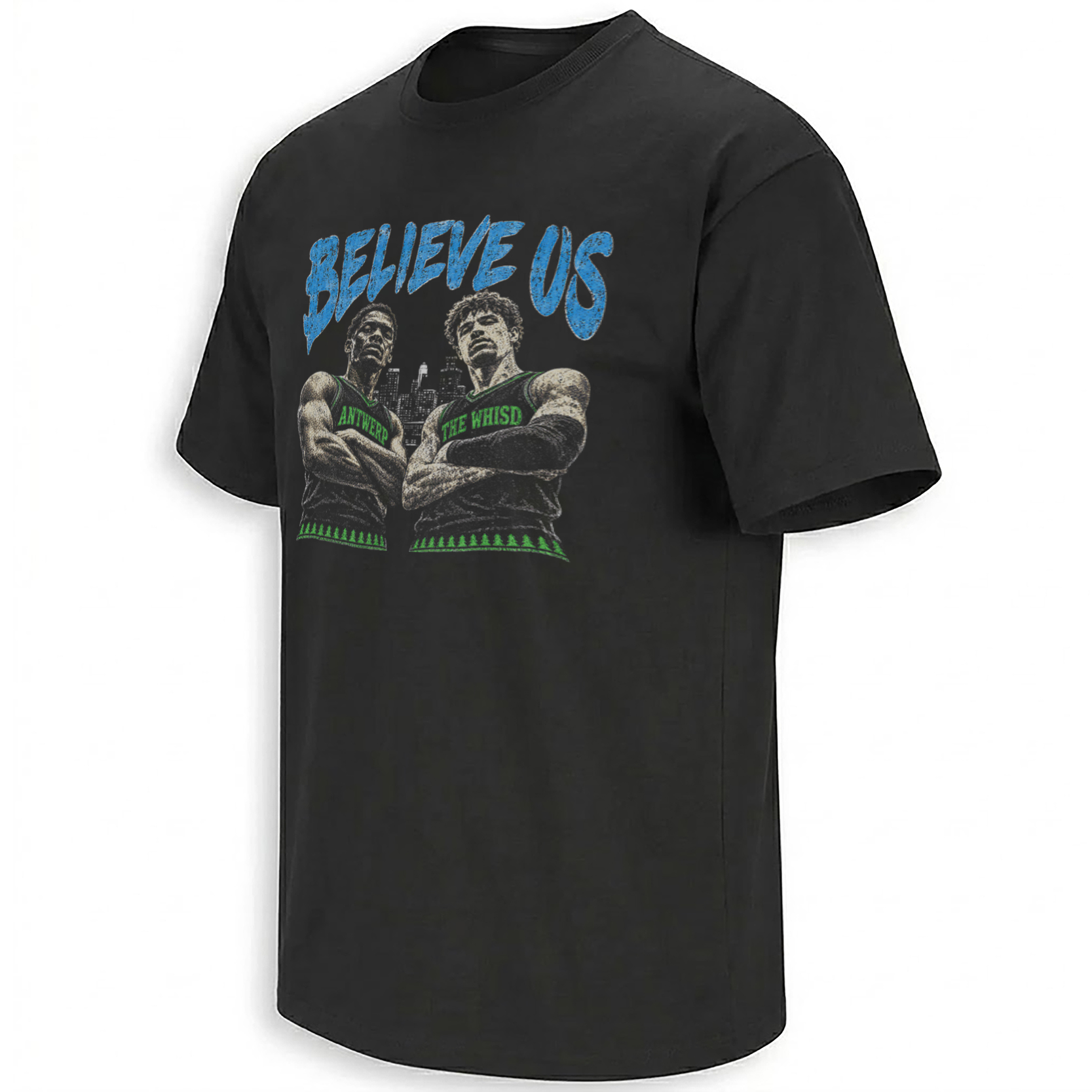
Edwards and Ball appear shoulder to shoulder beneath distressed blue typography. The city skyline and green-accented jerseys frame the anticipation around Minnesota’s new partnership.
View the visual interpretation →Unlike the McDaniels graphic, which preserves one verified interview after one game, Believe Us represents a broader cultural moment. It captures what fans imagined might become possible when the franchise placed two dynamic guards together.
That distinction gives the design a different emotional tone. The traffic cones are confrontational. Believe Us is aspirational. It asks viewers to picture a new Minnesota basketball identity built around two distinctive personalities.
Howling Uncontrollably: A Tradition Older Than the Current Roster
Some Timberwolves references belong to one player or one postseason. The wolf howl belongs to the franchise itself.
Since Minnesota began NBA play in 1989, the animal behind the team’s name has provided an unmistakable form of crowd participation. Wolves fans howl to celebrate, to express excitement and to turn ordinary arena noise into something uniquely associated with Minnesota basketball.
The tradition has a documented history. On January 2, 1992, the franchise distributed an early version of the Crunch Howler, a novelty megaphone designed around the team’s wolf identity. The Timberwolves later revived the item as part of their 35th-anniversary celebrations.
The team’s own history of the Crunch Howler shows how deeply the tradition is connected to the franchise’s culture.
The roster changes. The rivalries change. The Wolves’ howl remains one of Minnesota basketball’s most recognizable sounds.
The phrase “Howling Uncontrollably” turns that established tradition into deliberately excessive fan humor. It is not being attributed to a specific player, verified interview or November 2026 matchup. Instead, it exaggerates the emotional behavior of a supporter who has become completely absorbed in the team.
The graphic uses blue collegiate-style lettering with small green evergreen trees. Those trees are an important visual choice. Minnesota’s basketball identity has long incorporated northern forest imagery, including the distinctive tree detailing of its classic uniforms.
The result connects two familiar symbols without needing a player portrait: the sound of a wolf and the landscape associated with Minnesota.
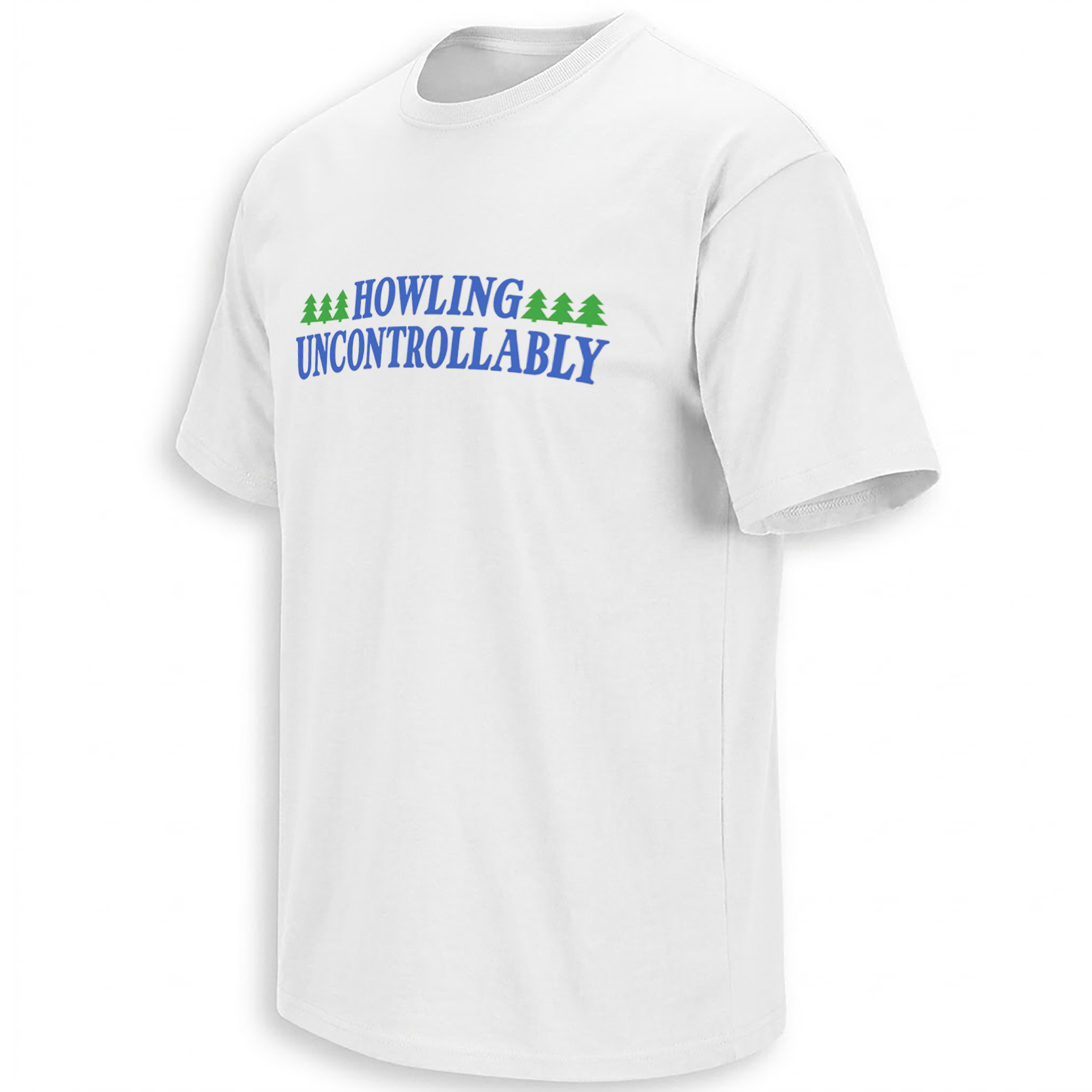
A minimalist graphic rooted in Minnesota’s long-running wolf-howl tradition. Blue collegiate type and green evergreens reference the team’s distinctive northern basketball identity.
Explore the howling graphic →What Connects the Three Designs?
At first glance, the three graphics seem unrelated. One attacks a rival’s defense with a joke. One presents a star backcourt partnership. The third uses nothing more than a familiar fan phrase and a pair of trees.
Their connection becomes clearer when viewed through the Timberwolves’ 2026 identity. McDaniels represents competitive edge. Edwards and Ball represent the excitement of a roster built around attacking creativity. Howling Uncontrollably represents the community that remains invested regardless of personnel changes.
They also use very different visual techniques. The traffic-cone parody translates a quote into objects. Believe Us uses portraits and urban imagery to communicate confidence. The howling graphic uses minimal typography and symbolic foliage to evoke a much older team tradition.
None requires an invented championship claim or a fabricated viral reaction. Each comes from a distinct, verifiable context, although the final graphics interpret those contexts creatively.
Minnesota’s Basketball Identity Beyond a Single Game
Timberwolves culture has become increasingly recognizable across the league because of its combination of star personalities, defensive intensity and a fan community with a clear sense of humor.
The McDaniels quote became meaningful because it emerged during a high-pressure playoff series and provoked an immediate response. Believe Us attracted attention because Ball’s arrival created real questions about what the Edwards-led offense could become. The howl remains familiar because it has been repeated through decades of Minnesota basketball history.
In that sense, the three designs document three different ways fans remember basketball: a moment of confrontation, anticipation of a new era and an identity that outlasts both.
Readers following Jaden McDaniels, Anthony Edwards or LaMelo Ball can explore different player-centered chapters, while the wider NBA collection places those Minnesota stories alongside the broader culture of basketball rivalries, trades and fan expression.
Frequently Asked Questions
When did Jaden McDaniels say the Nuggets were all bad defenders?
McDaniels made the comment after Minnesota’s 119–114 comeback victory over Denver in Game 2 of their first-round NBA playoff series on April 20, 2026.
What do the traffic cones in the McDaniels design represent?
The five cones represent Denver players criticized in McDaniels’ interview: Cameron Johnson, Aaron Gordon, Nikola Jokić, Jamal Murray and Tim Hardaway Jr. Their jersey numbers appear on the cones.
Did LaMelo Ball join the Minnesota Timberwolves in 2026?
Yes. Minnesota acquired LaMelo Ball from the Charlotte Hornets in a multi-team trade completed in July 2026, pairing him with Anthony Edwards.
What does Believe Us mean for the Timberwolves?
Believe Us became a fan-art expression associated with the Anthony Edwards and LaMelo Ball partnership. Designer Alex Glassman adapted the phrase from Edwards-associated Believe That branding into a two-player concept.
Is Believe Us an official Timberwolves slogan?
It is documented here as a fan-created design expression, not as a verified official Minnesota Timberwolves or Adidas slogan.
Why do Minnesota Timberwolves fans howl?
The howl is tied to the franchise’s wolf identity and has been part of Minnesota basketball fan culture since the team’s early years, including the Crunch Howler giveaway introduced in 1992.
What does Howling Uncontrollably refer to?
It humorously exaggerates the way enthusiastic Timberwolves fans howl during games. The phrase is not presented as a verified quotation from a particular player.
From McDaniels’ unforgettable Denver trash-talk graphic to the Edwards–Ball Believe Us portrait and the Howling Uncontrollably design, Minnesota’s basketball culture tells several different stories at once. The Timberwolves archive brings those stories together through visual references that fans already recognize.
Minnesota Timberwolves basketball culture in 2026 spans Jaden McDaniels’ unforgettable Denver Nuggets trash talk, Anthony Edwards and LaMelo Ball’s Believe Us partnership, and the franchise’s longstanding tradition of howling. Three distinct graphics preserve those moments through traffic-cone satire, basketball portraiture and retro pine-tree symbolism.