
Don’t Talk to Me Until I’ve Had My Gabapentin
A familiar coffee slogan is rewritten for people whose mornings may begin with nerve pain, medication schedules and the exhausting work of appearing completely fine.
HEALTH-HUMOR DESIGN FEATURE · UPDATED JULY 27, 2026
“Don’t talk to me until I’ve had my coffee” is one of the safest and most overused morning jokes in American culture. Replacing coffee with gabapentin changes every part of that sentence while preserving its instantly recognizable rhythm.
The rewritten line is funny because gabapentin is not a trendy latte ingredient or a productivity ritual. It is a prescription medication associated with serious, often invisible health experiences. The contrast turns a generic slogan into an insider signal.
For someone who manages nerve pain, seizures or another condition for which gabapentin has been prescribed, the shirt can express a complicated morning in one dry sentence: please allow time for the body, the medication schedule and the person inside that body to reach an understanding.
How the coffee parody works
The original coffee phrase presents caffeine as a switch that transforms someone from unreachable to sociable. This design keeps that basic structure but replaces a voluntary beverage with a prescribed medicine.
That substitution creates the surprise. The viewer begins reading a lifestyle cliché, anticipates “coffee” and instead encounters a medication name with five syllables and no conventional place in cheerful kitchen décor.
Coffee belongs to mugs, cafés and morning routines. Gabapentin belongs to prescription labels and conversations with clinicians. Placing the second inside the cultural frame of the first produces the joke.
The capsule and coffee imagery helps preserve both sides of the comparison. One visual language says familiar morning humor; the other reveals that this routine has a medical dimension.
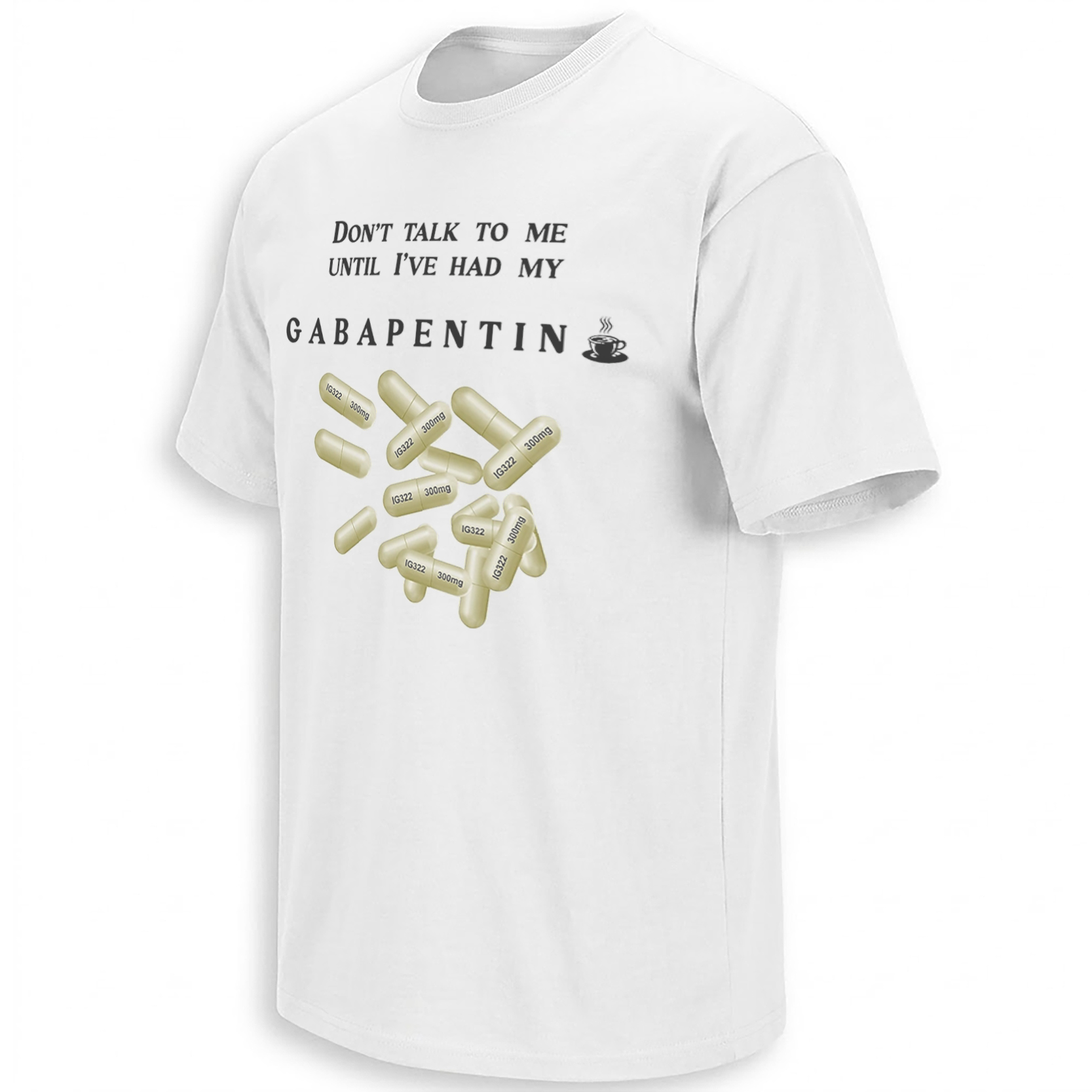
Chronic-illness humor often works by placing an experience that is difficult to explain inside a sentence everybody already understands.
What gabapentin actually is
Gabapentin is an anticonvulsant prescription medicine. In the United States, standard gabapentin labeling includes the management of postherpetic neuralgia in adults and adjunctive treatment for certain partial-onset seizures.
Clinicians also use gabapentin in broader pain-management contexts. That is why many people primarily recognize the name through conversations about neuropathic or nerve-related pain rather than epilepsy.
Nerve pain can be described as burning, shooting, stabbing, electric or tingling. Those sensations may be severe even when there is no cast, bandage or other visible sign that explains them to an observer.
Why medication jokes resonate with chronic-pain communities
Living with a long-term condition often requires repetition: taking medication, monitoring symptoms, answering the same questions and explaining why plans sometimes change. Humor gives the person experiencing that repetition some authorship over it.
The joke does not need to claim that medication makes everything perfect. Its appeal may come from admitting the opposite—that simply reaching a workable part of the day can involve a routine other people never see.
This is also why the phrase feels different when worn by someone with direct experience. It can operate as a boundary, a conversation starter or a quiet signal to another person who recognizes the medication name immediately.
Caregivers, pharmacy workers, nurses and members of a patient’s support network may read the joke through another lens. They understand how a small bottle on the nightstand can represent appointments, trial and error, disrupted sleep and the hope for a more manageable day.
The shirt is a joke, not dosing advice
The coffee structure should not be interpreted literally. Gabapentin is not an instant morning stimulant, and its effects, schedule and clinical purpose vary from one patient to another.
Take gabapentin only as prescribed and do not change or abruptly stop a regimen without professional guidance. Drowsiness and dizziness can occur. The National Library of Medicine provides patient information, while the FDA warns of serious breathing risks for some patients, particularly when gabapentin is combined with opioids or other central-nervous-system depressants.
The humor therefore rests on recognition, not instruction. It should never be used to recommend the medication, share a prescription or suggest that someone take more than directed.
Why specificity makes the design memorable
Generic chronic-pain slogans can speak to a large audience, but they often lose the intimate precision that makes a joke feel discovered rather than manufactured.
“Gabapentin” is unusually specific. It is long, visually distinctive and immediately meaningful to a narrower group. That specificity makes the design less universal but more emotionally accurate for the people who connect with it.
The line also avoids a lengthy explanation. A person who knows the context understands it immediately. Someone unfamiliar with the medication may ask, creating an opportunity for the wearer to explain as much—or as little—as desired.
Reading the artwork as a cultural object
The design belongs to a wider tradition in which medical language escapes the clinic and enters stickers, mugs, memes and apparel. This does not necessarily trivialize the underlying condition. In many cases, it reflects patients reclaiming vocabulary that already occupies a large part of their lives.
The coffee-parody styling is especially effective because it makes the graphic initially approachable. Rather than resembling a medical brochure, it looks like familiar novelty merchandise until the medication name changes the viewer’s interpretation.
That shift is the cultural value of the shirt. It places chronic-pain experience inside everyday visual culture instead of treating it as something that must remain private, solemn or hidden.
Who understands the joke best?
The most natural audience includes people who have personally been prescribed gabapentin and already use humor to discuss the routines surrounding it.
It may also connect with caregivers, chronic-pain advocates and healthcare professionals who understand that the joke refers to a lived routine rather than treating prescription medication as a novelty substance.
Because health experiences differ, the design will not represent every patient. Some people enjoy medication humor; others prefer not to make their treatment visible. Its value lies in giving those who do identify with the line a compact way to tell their own story.
A small boundary disguised as a punchline
“Don’t talk to me” sounds antisocial, but novelty shirts rarely function as literal bans on conversation. The exaggeration creates comic distance around a reasonable request: mornings can be difficult, and some people need time before they are ready to engage.
For a wearer managing pain or medication effects, that boundary may feel more substantial than the ordinary coffee version. The sentence creates room without requiring a public symptom report.
The shirt joins the newest designs collection as a highly specific example of health humor becoming wearable language: part parody, part recognition signal and part explanation for a morning routine that cannot be reduced to coffee.
Gabapentin Shirt FAQ
What does the “Don’t Talk to Me Until I’ve Had My Gabapentin” shirt mean?
It parodies the familiar “don’t talk to me until I’ve had my coffee” slogan by replacing coffee with a prescription medication associated with seizures and nerve-pain treatment.
Is gabapentin a painkiller?
Gabapentin is classified as an anticonvulsant. It is also prescribed in certain nerve-pain contexts, but it is different from conventional over-the-counter pain relievers and opioid medicines.
Is the shirt giving medical advice?
No. It is a piece of medication-related humor. Gabapentin should be taken only according to instructions from a qualified prescriber.
Why does the joke use a coffee slogan?
The audience anticipates the familiar word “coffee.” Replacing it with the more clinical and unexpected word “gabapentin” creates the punchline.
Who might relate to this design?
People prescribed gabapentin, chronic-pain patients, caregivers and healthcare workers may recognize the routines and invisible experiences behind the joke.
Can gabapentin cause drowsiness or dizziness?
Yes. Drowsiness and dizziness are recognized potential effects. Patients should follow their medication instructions and ask a clinician or pharmacist about personal safety concerns.
When coffee humor meets prescription reality
Explore the design that turns a familiar morning slogan into a knowing piece of nerve-pain and medication humor.