Who Is Jimothy? Meet Seattle’s Viral Raccoon
A brief Ballard sighting became millions of views, a stadium cheer, neighborhood art and an official “Jimothy Summer”—all because one compact raccoon refused to resemble anybody else.
REAL-TIME INTERNET CULTURE FEATURE · UPDATED JULY 27, 2026
Jimothy did not arrive through a studio campaign or a carefully planned mascot launch. The raccoon simply crossed a path in Seattle with a body shape so distinctive that the internet immediately decided a new main character had appeared.
The original viral encounter came from Seattle resident Kiana Hall, who filmed the unusually short and rounded animal while walking with her husband in the Ballard neighborhood. Her startled reaction—essentially asking what she was seeing—became part of the clip’s charm.
Hall named the raccoon Jimothy because the animal simply looked like a Jimothy. Within days, that spontaneous name had escaped the original post and entered Seattle’s civic, sports and meme vocabulary.
Why does Jimothy look different?
Jimothy has a shortened body, rounded back, low head position and distinctive gait. Wildlife experts have suggested that the appearance may result from a congenital spinal deformity resembling short spine syndrome.
That explanation must remain qualified. Jimothy is a wild raccoon and has not received the kind of veterinary examination required for a definitive diagnosis. “Likely” or “believed to have” is more accurate than declaring a confirmed medical condition.
Jimothy looks unusually compact, moves independently through the urban environment and has displayed enough agility to navigate the neighborhood. The exact medical explanation remains unconfirmed.
Reports also indicate that the raccoon may have been seen as a baby living with a family group. Earlier footage appeared to show a small, clumsy young raccoon receiving patience and assistance from its mother and siblings.
Jimothy became a mascot without auditioning for the job: strange enough to stop the scroll, local enough to unite a city and resilient enough to inspire affection without needing to perform.
How a Ballard sighting became a global meme
The first ingredient was visual recognition. Even in a short, imperfectly framed clip, Jimothy’s silhouette is immediately different from that of a typical raccoon. Viewers do not need a caption to understand why Hall stopped filming her walk and focused on the animal.
The second ingredient was the name. “Jimothy” sounds formal, awkward and strangely appropriate. It gives the raccoon the comic dignity of a neighborhood eccentric rather than reducing the animal to a medical label.
The third was timing. Online audiences exhausted by conflict and bad news found an unusually positive subject around which they could build jokes, artwork and local pride.
From neighborhood raccoon to Seattle folk mascot
Jimothy’s rise quickly escaped social media. The Seattle Mariners encouraged the crowd to “make noise for Jimothy,” translating the meme into the familiar language of a stadium rally.
A Ballard mural depicted the raccoon near a trash container, while an artwork auction reportedly raised $6,500 for a local food bank. Online tributes expanded into custom LEGO builds, an 8-bit game, role-playing concepts and tattoos.
NASA joined the joke by highlighting Seattle in an image taken from the International Space Station and identifying it as the home of the now-iconic raccoon. The exaggeration—that a small urban animal suddenly “runs this city”—is central to Jimothy’s comic mythology.
Then the city made the summer official. On July 26, Seattle City Councilmembers Alexis Mercedes Rinck and Dan Strauss hosted a Ballard celebration and proclamation designating summer 2026 as “Jimothy Summer.” A local sighting had become civic folklore in less than two weeks.
Why the response needs more than pity
Much of the affection surrounding Jimothy is supportive, but the story can become uncomfortable when the raccoon is framed only as an unfortunate creature who deserves love despite looking different.
UCLA disability-studies scholar Helen Deutsch offered a more useful interpretation: Jimothy is an interesting creature who does not need to be fixed in order to justify public fascination. Difference can inspire wonder without being converted into pity.
That distinction changes the meaning of the meme. Jimothy is not beloved merely for overcoming an imperfect body. The raccoon appears to be living an active wild life on its own terms, while the audience gradually recognizes how narrow its expectations of a “normal” animal had been.
Even Jimothy’s gender has not been confirmed. The internet frequently uses masculine language and “short king” jokes, but those are parts of the fan-created character, not established biological information.
Admire the mascot, leave the animal alone
Jimothy’s fame does not turn a wild raccoon into a public pet. The Washington Department of Fish and Wildlife’s reported guidance is to leave the animal alone.
Do not approach, chase, touch or feed the raccoon for a photograph. Admiration is safest when Jimothy remains free to move through the neighborhood without crowds changing that behavior.
This is especially important because viral attention can redirect large numbers of people toward a location faster than wildlife officials or residents can respond. The most respectful version of the fandom celebrates the story without demanding another performance from its subject.
Reading the shirt as a vintage mascot artifact
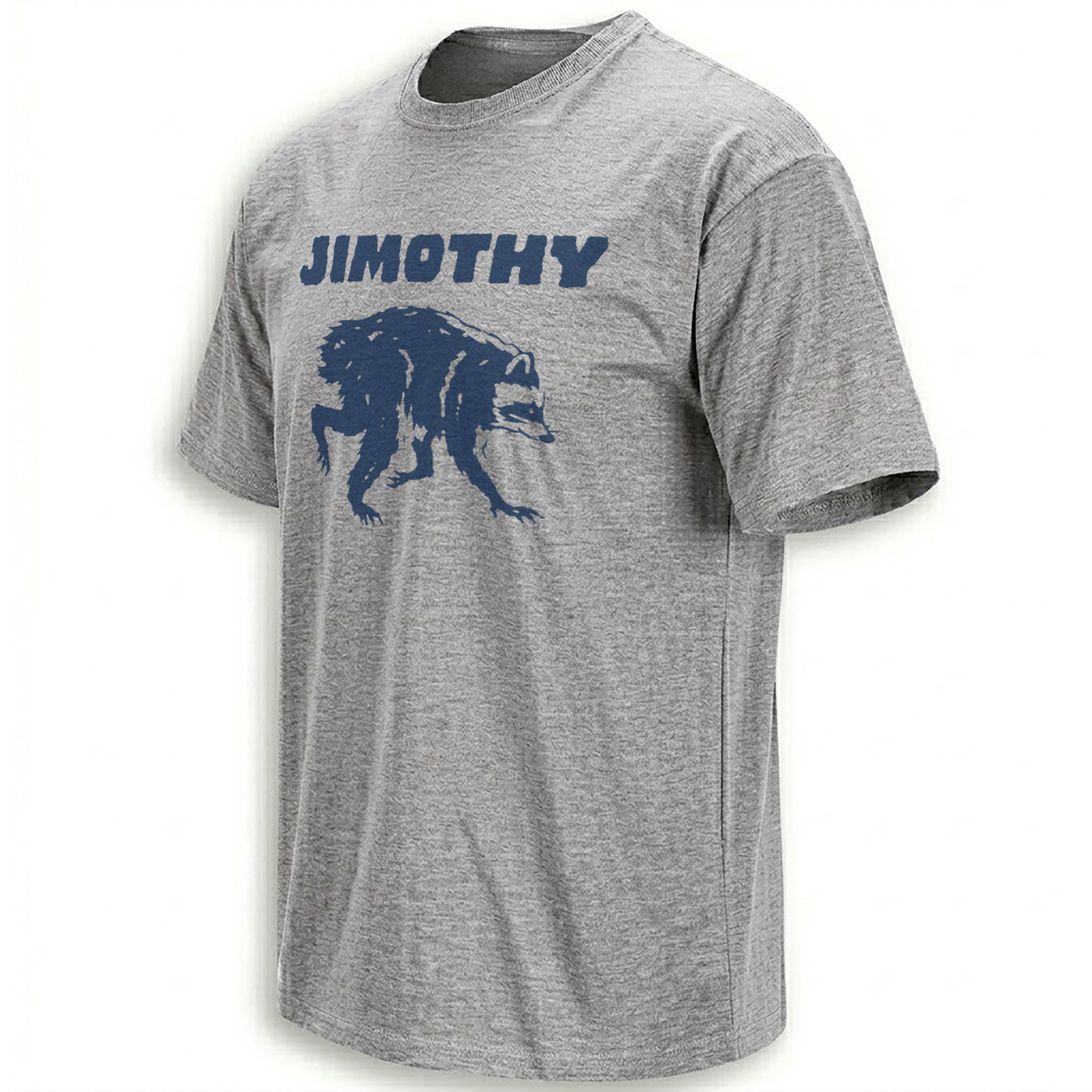
The artwork avoids turning Jimothy into a glossy cartoon. A rough, single-color illustration preserves the low stance, arched back, lowered head and compact middle that made the original silhouette recognizable.
The navy ink carries the visual language of Seattle sports and old collegiate practice shirts without assigning Jimothy to one official team. Above the animal, the name appears in heavy, slightly irregular block letters.
That simplicity gives the shirt the appearance of an emblem that existed before the viral video—as if Ballard had maintained a secret Jimothy club for decades and somebody had just discovered the uniform.
The sport-grey version strengthens that illusion through its heather texture. White provides the cleanest contrast, while sand pushes the composition closer to a vintage Pacific Northwest field-guide palette.
Why Jimothy became the right mascot for 2026
Traditional mascots are designed to be powerful, fast, symmetrical and instantly marketable. Jimothy reached the same cultural position by embodying almost the opposite idea.
The raccoon’s proportions are unconventional. The name is faintly ridiculous. The story began with genuine confusion rather than admiration. Yet those qualities produced a character more emotionally persuasive than many planned campaigns.
Jimothy offers an identity flexible enough for several audiences at once: Seattle local, Ballard cryptid, internet short king, wildlife celebrity and symbol of doing reasonably well in a body that does not match the standard template.
The full Jimothy collection now functions as a visual archive of that rapid transformation, from one neighborhood animal to the subject of rally cries, trading-card treatments and vintage mascot graphics. The broader newest designs collection places the phenomenon alongside the other phrases and images defining the summer of 2026.
A timestamp from Jimothy Summer
Internet animal celebrities eventually surrender the main-character position to something new. That does not make their moment meaningless. It gives objects created during the peak of attention a clear cultural timestamp.
This shirt records the week when Seattle decided that an unusually shaped raccoon deserved a proper name, a stadium cheer, public art and an official season.
Jimothy never asked to symbolize resilience, local weirdness or freedom from conventional proportions. The internet assigned those meanings afterward. Underneath them remains the most important fact: a wild raccoon crossed a path in Ballard and continued going wherever Jimothy intended to go.
Jimothy the Raccoon FAQ
Who is Jimothy?
Jimothy is a wild raccoon living in Seattle whose unusually short, rounded appearance made a Ballard sighting go viral in July 2026.
Who named Jimothy?
Seattle resident Kiana Hall named the raccoon after filming the animal during a walk with her husband in Ballard. She explained that the raccoon simply looked like a Jimothy.
Does Jimothy definitely have short spine syndrome?
No definitive diagnosis has been announced. Wildlife experts believe Jimothy may have a congenital spinal deformity resembling short spine syndrome, but confirming it would require an examination.
What is Jimothy Summer?
Jimothy Summer is Seattle’s official 2026 celebration of the viral raccoon. City Councilmembers Alexis Mercedes Rinck and Dan Strauss hosted the proclamation event in Ballard on July 26.
Did the Seattle Mariners recognize Jimothy?
Yes. The Mariners joined the local phenomenon by encouraging fans at the stadium to make noise for Jimothy.
Should people try to find or approach Jimothy?
No. Jimothy is a wild animal. Wildlife guidance is to leave the raccoon alone and avoid approaching, chasing, touching or feeding it.
What does the Jimothy shirt artwork look like?
It uses a rough navy illustration of Jimothy’s compact silhouette beneath bold vintage-style lettering. The supplied mockups include sport grey, white and sand shirts.
A field emblem for Jimothy Summer
Explore the vintage mascot graphic inspired by Ballard’s most recognizable wild neighbor and Seattle’s unexpected 2026 folk hero.