
DAWG+ Attack. Compete. Finish.
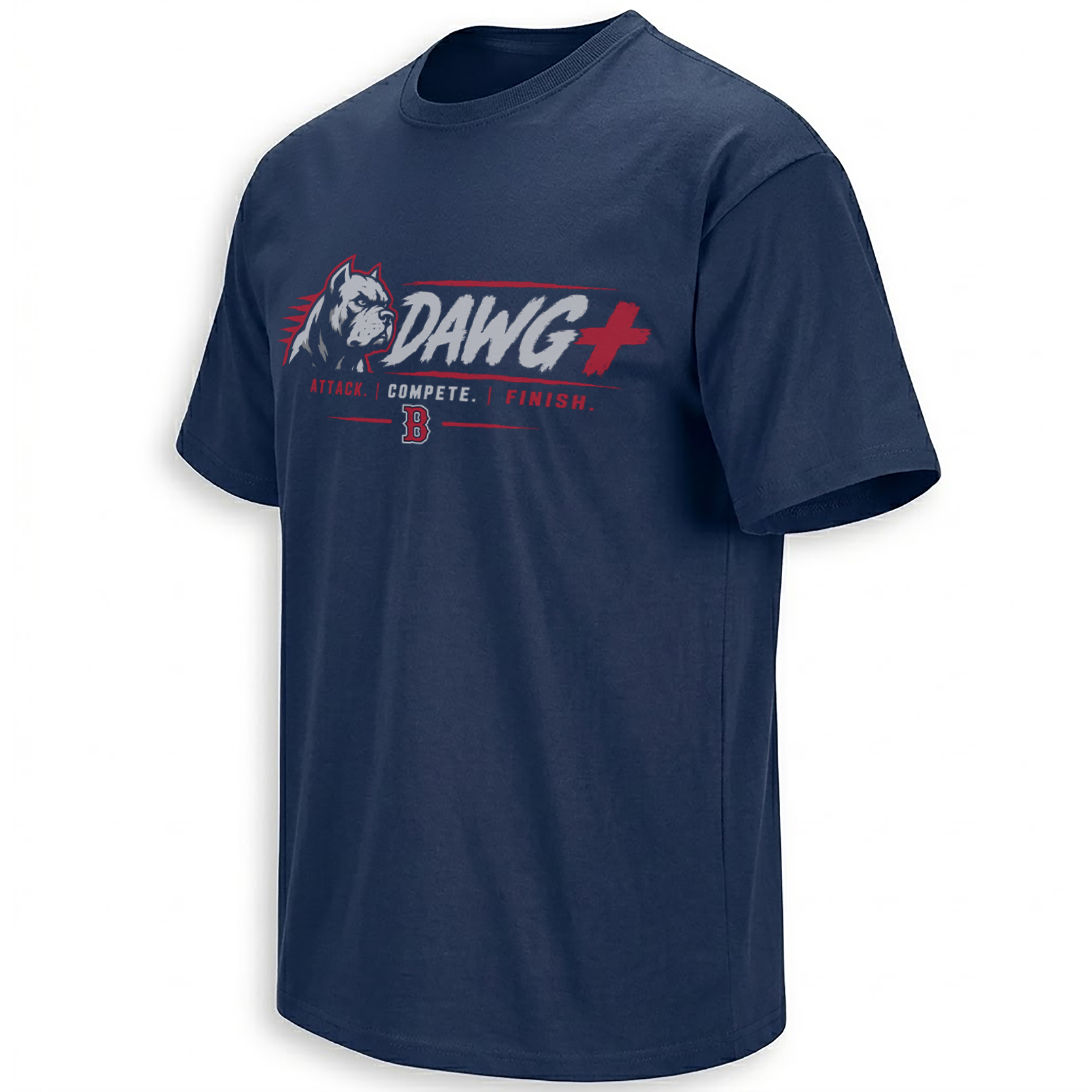
A snarling bulldog, one mathematical symbol and three forceful verbs transform baseball’s favorite personality compliment into a complete competitive code.
REAL-TIME BASEBALL CULTURE FEATURE · UPDATED JULY 27, 2026
In current sports language, saying that an athlete “has that dawg in him” is not a comment about size, pedigree or literal aggression. It is shorthand for competitive appetite—the visible refusal to treat a difficult play, at-bat or inning as already lost.
The DAWG+ design turns that flexible piece of player slang into something more structured. The bulldog supplies the visual attitude. The plus sign suggests an upgraded standard. “Attack, Compete, Finish” explains how that attitude should appear once the game begins.
Placed in a Boston Red Sox context, the message feels at home in a baseball culture that values dirt, pressure, late innings and the willingness to keep fighting through an imperfect game.
What does DAWG+ mean?
“Dawg” has become one of the most common compliments in modern American sports. Coaches, teammates and fans use it for players who appear fearless, relentless, physically committed or especially comfortable under pressure.
The plus sign changes the phrase from a nickname into a category. DAWG+ reads like a premium rating, advanced program or performance standard: ordinary competitiveness, followed by something extra.
The three-part line underneath provides the practical definition. Being a “dawg” is not merely looking intense. It means attacking the opportunity, remaining competitive through resistance and finishing the sequence.
DAWG+ is not a statistic. It is the quality fans believe they can recognize before the box score knows how to measure it.
Breaking down “Attack, Compete, Finish”
The sequence matters. These are not three interchangeable motivational words. Together, they describe the beginning, middle and end of a competitive action.
Baseball is particularly suited to that three-stage message because failure is built into the sport. A hitter can execute a strong swing and still make an out. A pitcher can make a good pitch and watch it become a bloop single. Competing means returning to the next decision without allowing the previous result to control it.
Why the phrase feels connected to the Red Sox
The words have become visible around contemporary baseball imagery, including material shared through official Boston Red Sox social media during the 2026 season. That visibility gives fans a recognizable link between the phrase and the team’s current visual environment.
Official Red Sox posts from the spring and summer have repeatedly placed “DAWG — ATTACK. COMPETE. FINISH.” within team imagery, including an April “Ready to roll” post and later batting-practice content. The recurrence is more meaningful than a single isolated screenshot: the phrase has remained present as the season has moved from preparation into daily competition.
The phrase is clearly visible in current Red Sox-related imagery, but no public team announcement located for this article formally designates it as the franchise’s official 2026 motto. It is most accurate to describe it as a recurring competitive message associated with the team environment, not a confirmed replacement for an official slogan.
That distinction does not weaken the shirt. Fan culture often forms from what viewers notice repeatedly around a team: dugout rituals, warm-up clothing, handwritten signs, celebration phrases and small pieces of visual language that never receive a press release.
The bulldog as a baseball archetype
A bulldog is not the fastest or most elegant mascot choice. Its cultural meaning comes from stance, persistence and the impression that it will not willingly surrender ground.
Those qualities map naturally onto baseball’s “dawg” vocabulary. The animal makes the slang visible without requiring a named player. A clenched jaw, broad head and forward posture communicate the competitive premise before the viewer reads the smaller words.
The Boston treatment pushes the bulldog beyond generic motivational apparel. Team-associated colors and baseball cues turn it into an unofficial clubhouse creature: part guard dog, part rally emblem and part personification of a grinding at-bat.
Why this is not just an aggression slogan
“Attack” can sound reckless when removed from context, but productive baseball aggression is controlled. A hitter who swings at every pitch is not attacking well; a pitcher who ignores the scouting plan is not competing intelligently.
The strongest interpretation combines urgency with execution. Attack means choosing the moment. Compete means adjusting when the opponent responds. Finish means maintaining concentration long enough to complete the play.
This is why the word sequence feels more credible than a simple “be tough” slogan. It leaves room for preparation, discipline and resilience instead of celebrating anger for its own sake.
The plus sign does more work than it appears
Without the plus, “DAWG” functions mainly as a label. The added symbol suggests that the identity is expandable. Talent alone is not enough; energy alone is not enough; toughness alone is not enough. Something must be added.
Visually, the plus also resembles a grading mark, medical cross, roster designation or upgraded subscription tier. That mixture of meanings makes DAWG+ feel modern even when the bulldog artwork uses the rough visual language of older athletic programs.
The symbol encourages the viewer to complete the equation personally. For one player, the additional quality might be preparation. For another, it may be accountability, composure or the willingness to make an unglamorous play.
A whole-team idea instead of a player slogan
Many baseball shirts depend on one star, one home run or one night. DAWG+ works differently because the concept can migrate across a roster.
A starting pitcher can embody it by attacking the strike zone. A bench player can embody it by staying prepared for one late plate appearance. A defender can embody it by completing a difficult play after the ball takes an unpredictable bounce.
That flexibility makes the design suitable for a season rather than a single highlight. It records an attitude fans want the entire team to carry, regardless of which player produces the next memorable moment.
Why Boston fans respond to the aesthetic
Boston baseball identity has rarely depended on polish alone. Fan mythology favors players described as grinders, dirt dogs, clubhouse engines and pressure performers—people whose value seems larger than the cleanest statistical summary.
DAWG+ belongs to that vocabulary. The design is confrontational enough for game day but broad enough to survive a changing lineup. It celebrates the type of player rather than requiring one permanent hero.
The bulldog’s physical weight also balances the short wording. “Attack, Compete, Finish” could resemble a corporate training slogan by itself. Pairing it with a fierce animal returns the phrase to the visceral language of a dugout.
A timestamp from the 2026 baseball season
The design captures the way modern sports culture travels. A phrase becomes visible in team imagery, fans isolate it, social platforms repeat it and apparel turns it into a standalone emblem.
That process can happen without an official campaign. In fact, the partial mystery often makes the phrase more attractive. Fans feel that they have noticed a piece of clubhouse language rather than simply received another scheduled marketing slogan.
The shirt belongs naturally within Ellie Shirt’s Boston Red Sox collection, where player moments and fan vocabulary form an evolving visual record of the season. It also connects to the broader MLB collection and the newest designs documenting baseball culture as it happens.
The message after the final out
Not every game rewards effort cleanly. A team can attack, compete and finish its assignments while still losing. That does not make the language meaningless; it clarifies what the words can and cannot promise.
DAWG+ is a standard of behavior, not a guarantee of outcome. It asks whether the opportunity was confronted, whether resistance changed the level of engagement and whether concentration survived until the end.
For Boston fans, that is the shirt’s most durable idea. Scores change, rosters turn over and viral phrases disappear. The demand to attack the moment, compete through difficulty and finish the job remains recognizable in every baseball season.
DAWG+ Shirt FAQ
What does DAWG+ mean in sports?
It represents an elevated version of having “that dawg”—competitive intensity, resilience and the willingness to engage difficult moments rather than retreat from them.
What does “Attack, Compete, Finish” mean?
Attack means entering the opportunity with intent, compete means continuing to adjust through resistance, and finish means maintaining focus until the play or game is complete.
Is DAWG+ the official 2026 Boston Red Sox motto?
The phrase has appeared repeatedly in current Red Sox-related imagery, but no public announcement located for this article formally names it the team’s official season motto.
Why is there a bulldog on the shirt?
The bulldog visually represents persistence, toughness and refusal to surrender ground—the same qualities implied by modern sports uses of the word “dawg.”
What does the plus sign add to DAWG?
It suggests an upgraded standard and invites the viewer to imagine the additional qualities—such as preparation, discipline or execution—that turn raw intensity into productive competition.
Is the design connected to one Red Sox player?
No single player is required to understand the design. Its three-part mentality can apply to hitters, pitchers, defenders, starters, role players and the team as a whole.
Where can fans find more Boston baseball designs?
More current and historical Boston-inspired apparel appears in Ellie Shirt’s dedicated Boston Red Sox collection.
Three verbs. Nine innings. One standard.
Explore the bulldog design that converts contemporary baseball’s “dawg” mentality into a Boston-ready competitive code.