
How a Teddy Bear Became Chicago Hockey’s Softest Centennial Symbol
A bear in a helmet, skates and a red hockey sweater looks deliberately gentle. That contrast is precisely what makes the image work inside one of the NHL’s oldest, loudest and most history-conscious fan cultures.
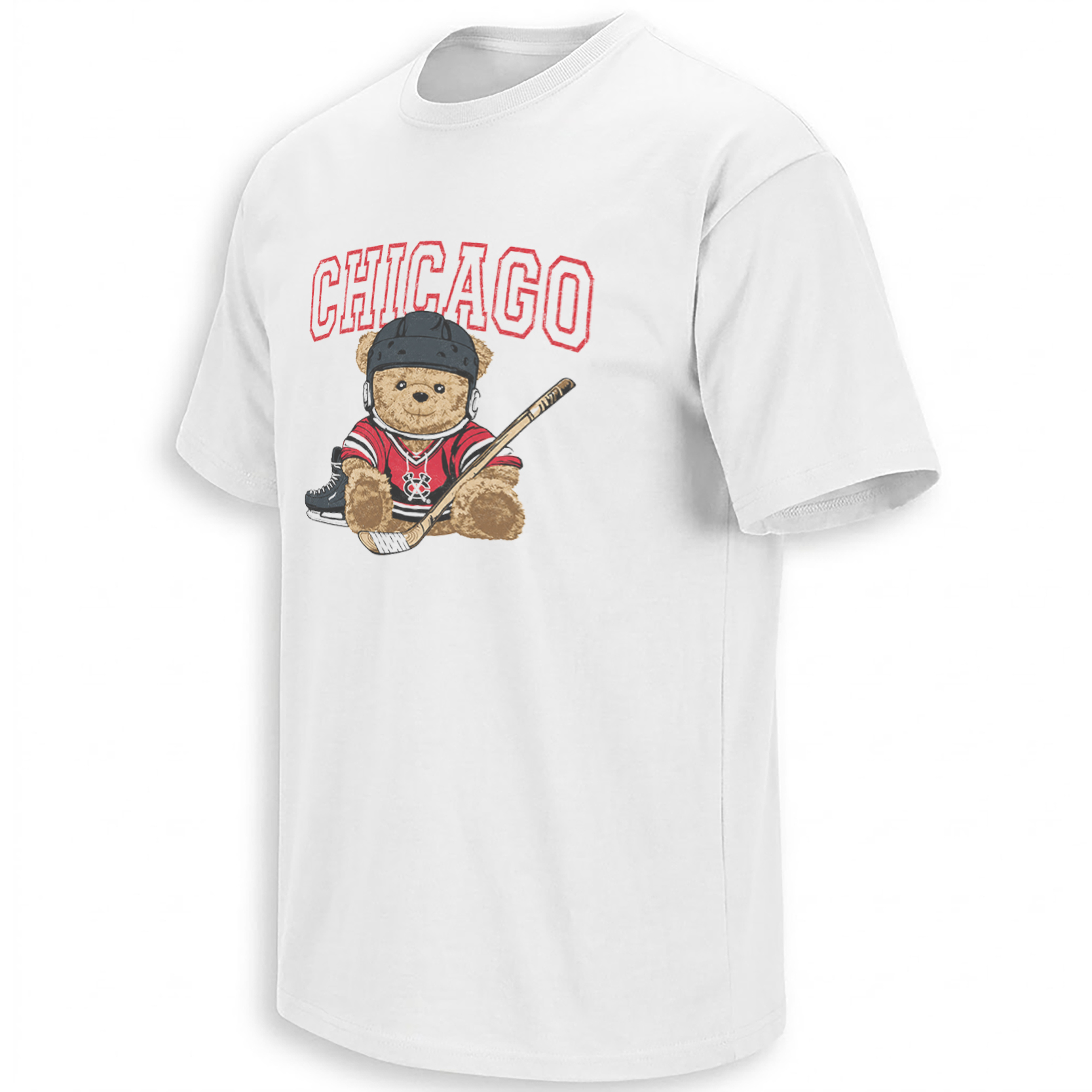
Hockey merchandise usually reaches for speed, impact and intimidation. The Chicago hockey bear chooses the opposite direction. Its central figure sits on the ice with a small smile, one skate beside its body and a stick resting across its paws.
Nothing in the pose suggests confrontation. Yet the helmet, red sweater, crossed hockey marks and varsity “CHICAGO” lettering make the affiliation unmistakable. The result is not a rejection of serious hockey identity but a softer method of carrying it.
That balance feels especially relevant in 2026. The Chicago Blackhawks entered the NHL in 1926, making the 2025–26 campaign the franchise’s centennial season. A hundred-year anniversary naturally produces grand retrospectives, banner ceremonies and commemorative insignia. The bear works at the opposite scale: personal, playful and immediately approachable.
The bear does not make Chicago hockey less historic. It makes a century of hockey feel personal enough to hug.
A century of Chicago hockey behind one small character
The Blackhawks were officially voted into the NHL on September 25, 1926. Over the following century, the franchise became part of the league’s Original Six identity and accumulated six Stanley Cup championships.
Chicago’s official centennial programming has revisited the early championships of 1934, 1938 and 1961, followed by the modern run of 2010, 2013 and 2015. The latter era restored the franchise to the center of hockey culture and gave a new generation of fans its own championship memories.
A design does not need to reproduce those trophies to carry their emotional weight. The single word “CHICAGO” acts as shorthand for the entire inheritance—arena nights, winter streets, family rituals and memories transferred between generations.
Why a teddy bear belongs in hockey culture
The apparent contradiction between a soft toy and a physical sport is the foundation of the image. Hockey depends on hard surfaces, sharp blades, fast collisions and cold air. A teddy bear represents softness, familiarity and childhood comfort.
Placing one inside hockey equipment makes the sport feel welcoming without removing its recognizable codes. The bear has not wandered accidentally onto the ice. It is dressed, equipped and ready to belong there.
Speed, ice, protective equipment, physical contact, team history and competitive intensity.
Comfort, nostalgia, childhood memory, gift culture and an accessible form of team affection.
Chicago’s official mascot is Tommy Hawk, a bird known for dancing and “mascot mayhem.” The teddy bear operates differently: it is an independent fan-culture character rather than a representation of Tommy Hawk.
The artwork borrows the language of a vintage college sweatshirt
The Chicago Hockey Bear Shirt places arched varsity lettering above the character, giving the composition the familiar structure of campus and heritage-sports apparel.
The letters are white with red outlines, leaving enough negative space for the brown bear to remain the focal point. Its black helmet and skate anchor the lighter illustration, while the red sweater connects the figure to Chicago hockey color without overwhelming its textured fur.
Small details keep the character from feeling generic: the helmet covers the ears imperfectly, the skate sits beside the bear rather than on its paw, and the wooden stick crosses the body at a relaxed diagonal. The pose feels more like a childhood team portrait than an action shot.
Why the same graphic works on a T-shirt and sweatshirt
On a white T-shirt, the bear reads as a clean character graphic with generous open space around it. The lightweight presentation emphasizes charm and makes the red outlines especially visible.
On a sweatshirt, the same composition moves closer to its visual ancestry. Varsity lettering, textured fur and hockey equipment naturally resemble the kind of cold-weather campus graphic worn to an arena or through a Chicago winter.
That adaptability explains why sports-bear artwork survives beyond one season. It can function as game-day clothing, a nostalgic gift, a family-friendly team reference or simply a quieter alternative to aggressive logo-heavy designs.
Fan identity does not always have to shout
Sports culture is often described through noise: chants, goal horns, packed stands and public celebration. Yet much of fandom is private and domestic. It begins with a first game, a gift from a relative, a child’s toy or an old sweatshirt that becomes associated with a particular season.
The teddy bear belongs to that quieter archive. During a centennial year filled with monumental history, it represents the intimate way a franchise survives—from one fan, household and generation to the next.
Within Ellie Shirt’s Chicago Blackhawks collection, the graphic offers a playful counterpoint to roster, championship and arena-centered artwork while remaining firmly connected to Chicago hockey identity.
Frequently Asked Questions
What does the Chicago Hockey Bear design show?
It features a seated teddy bear wearing a black hockey helmet and red sweater, accompanied by a skate and hockey stick beneath arched CHICAGO lettering.
Is the teddy bear the Chicago Blackhawks’ official mascot?
No. The official mascot is Tommy Hawk. The bear is a separate fan-art character that combines teddy-bear nostalgia with Chicago hockey imagery.
Why is 2026 significant for Chicago hockey history?
The franchise joined the NHL in 1926, making the 2025–26 season its centennial campaign and a celebration of one hundred years of Chicago hockey.
How many Stanley Cups have the Chicago Blackhawks won?
Chicago has won six Stanley Cups: 1934, 1938, 1961, 2010, 2013 and 2015.
Why does the design use varsity lettering?
Arched varsity lettering gives the graphic a heritage-sports appearance and reinforces its connection to vintage sweatshirts, campus apparel and nostalgic hockey culture.
The complete Chicago Hockey Bear graphic turns a century of team identity into a small, approachable character carrying Chicago’s colors onto the ice.
Chicago Hockey Bear Shirt gives Original Six fan culture a softer centennial-era symbol. Its helmeted teddy bear, red sweater and varsity lettering combine hockey identity with warmth, nostalgia and gift-friendly charm.