
How One Anthony Bourdain Joke Connects Parts Unknown and No Reservations
The line works because it does more than mention a famous chef. It converts the titles of Anthony Bourdain’s two defining travel programs into one knowingly adult double entendre—and assumes the audience will recognize both references.
“She calls me Anthony Bourdain because I eat her parts unknown, no reservations” is built like a test of cultural fluency. Someone unfamiliar with Bourdain sees an outrageous sentence. A longtime viewer sees two television titles connected in exactly the right order.
The first reference is Anthony Bourdain: Parts Unknown, the CNN series that used meals as entry points into politics, history and everyday life. The closing phrase invokes Anthony Bourdain: No Reservations, his earlier Travel Channel program.
Neither title was originally sexual. The joke works by removing both from travel television and placing them inside a private romantic boast. “Parts unknown” becomes anatomy rather than geography; “no reservations” shifts from adventurous travel to exaggerated confidence.
The punch line travels only because Bourdain’s show titles became recognizable cultural phrases beyond the programs themselves.
The two television eras hidden inside the sentence
No Reservations established Bourdain as a television traveler willing to move beyond conventional restaurant coverage. Food remained central, but episodes increasingly used it to examine people, neighborhoods, conflict and the complicated identities of places.
Parts Unknown, which premiered on CNN in 2013, expanded that method. Across 12 seasons, the series visited familiar cities and less-represented communities while treating eating as an act of listening rather than merely consumption.
The later series received major recognition, including a Peabody Award and multiple Emmy Awards. Yet its deeper influence was tonal. Bourdain made curiosity appear more valuable than expertise and allowed a shared table to reveal what a formal interview might miss.
CNN’s remembrance of Bourdain described his work as journalistic and deeply human: he learned about people by sitting with them, sharing their food and allowing them to explain their own communities.
Why the joke requires familiarity rather than explanation
Effective reference humor gives the audience just enough information to recognize the source. This design does not include a portrait, chef’s knife, map or television logo. The name “Anthony Bourdain” and the two repurposed titles carry the entire structure.
A viewer who remembers only Parts Unknown may understand the first half. Recognizing No Reservations completes the construction and creates the satisfaction of catching the second reference before the sentence ends.
That layered recognition separates the line from a generic adult slogan. Remove Bourdain’s name and the sentence loses its cultural mechanism. Remove either program title and the joke becomes much less precise.
A crude joke wearing the voice of travel writing
The wording is intentionally provocative, but its rhythm is unusually controlled. It begins with the familiar setup “She calls me…” before delaying the explanation across several short lines.
The humor also borrows a faint echo of Bourdain’s public persona: worldly, direct, irreverent and suspicious of polished respectability. That does not make the phrase a Bourdain quotation. It is fan-created wordplay using his name and work, not something attributed to him.
An adult boast turns travel language into romantic and anatomical innuendo.
Two distinct periods of Bourdain’s television career are compressed into one sentence.
Typography that resembles a late-night bar sign
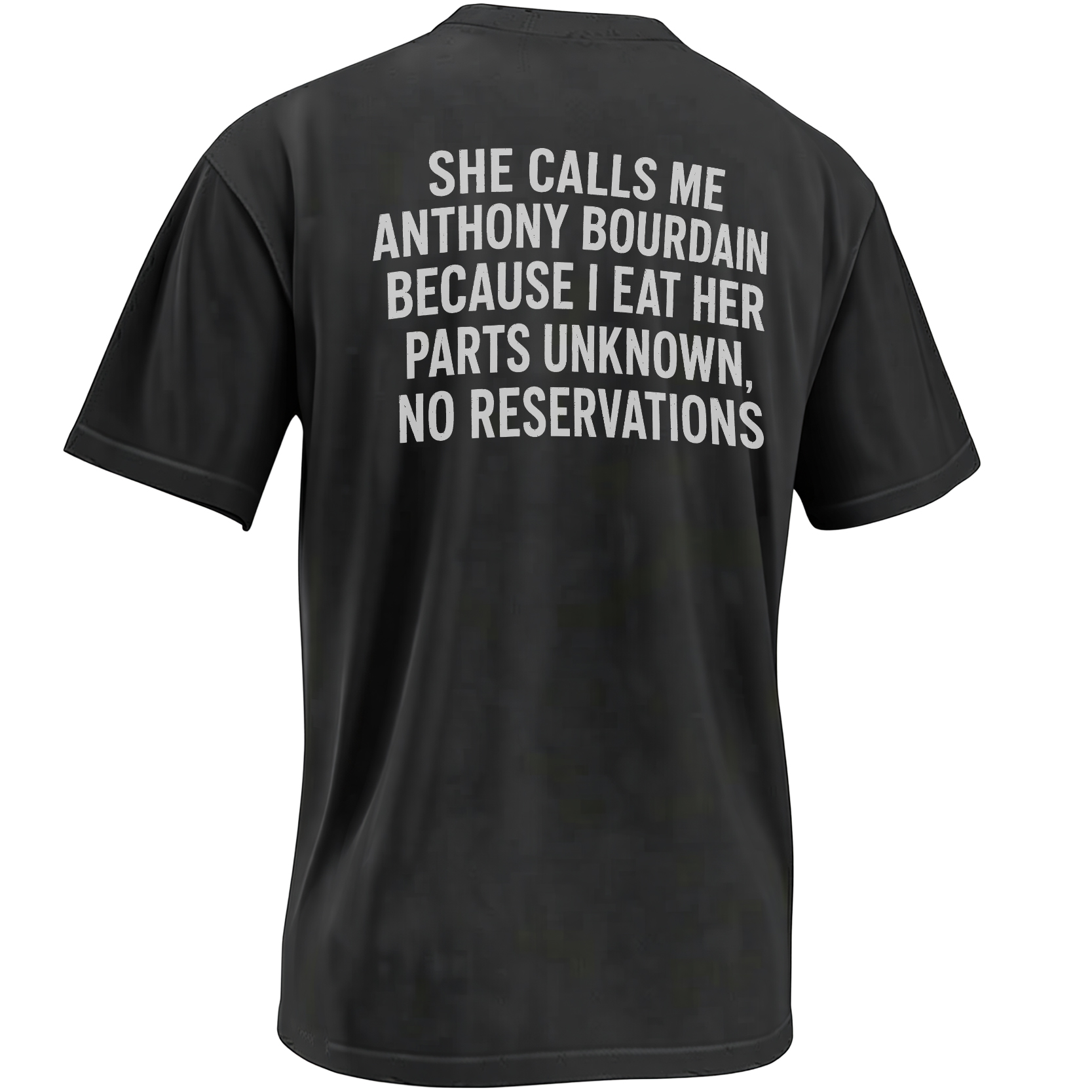
The She Calls Me Anthony Bourdain Shirt uses tall distressed white lettering against black fabric. The treatment feels closer to a chalkboard special, concert handbill or weathered kitchen notice than a polished television graphic.
Every line is centered, but the changing widths prevent the block from feeling mechanical. “ANTHONY BOURDAIN” occupies its own prominent line, giving the viewer enough time to identify the reference before reaching “PARTS UNKNOWN” and “NO RESERVATIONS.”
The final comma acts almost like a cut between programs. “Parts unknown” completes the first meaning; “no reservations” arrives as the second title and the last escalation of the joke.
Why Bourdain references still travel through culture
Bourdain’s programs were never only about identifying where to eat. Their enduring appeal comes from the way he connected meals to migration, labor, conflict, class and memory.
That influence allows references to his work to circulate among several audiences at once: professional cooks, travelers, television viewers, writers and people who associate him with a particular kind of restless curiosity.
The joke uses only the most mischievous edge of that legacy, but it still depends upon the larger cultural footprint. The audience must believe that “Anthony Bourdain,” “Parts Unknown” and “No Reservations” belong together without explanation.
A reference artifact for the viewers who catch both titles
The design is not a summary of Bourdain’s work and should not be mistaken for one. It is a piece of adult fan humor built from the fact that his program titles became memorable enough to acquire second lives.
Its cultural timestamp lies in that recognition. Years after the programs concluded, their names remain sufficiently familiar to support a joke whose setup, internal turn and closing punch line all depend on television memory.
Within Ellie Shirt’s newest pop-culture graphics, it belongs to a category of designs made for viewers who enjoy recognizing the source before anyone has to explain it.
Frequently Asked Questions
What does the “She Calls Me Anthony Bourdain” joke mean?
It is an adult double entendre that repurposes the titles Parts Unknown and No Reservations as parts of a romantic boast.
What are Parts Unknown and No Reservations?
They are two travel-and-food television programs hosted by Anthony Bourdain. No Reservations aired on the Travel Channel, while Parts Unknown aired on CNN.
Did Anthony Bourdain actually say this phrase?
There is no indication that it is a Bourdain quotation. It is fan-created wordplay based on his name and the titles of his television programs.
Why does the joke use both television titles?
“Parts unknown” establishes the first double meaning, while “no reservations” completes the joke and rewards viewers familiar with both stages of Bourdain’s career.
Why is the graphic text-only?
The reference depends on language rather than portraiture. Distressed typography keeps attention on the sequence of Bourdain’s name, Parts Unknown and No Reservations.
The complete She Calls Me Anthony Bourdain graphic turns two landmark travel-show titles into one deliberately adult test of pop-culture recognition.
She Calls Me Anthony Bourdain Shirt connects Parts Unknown and No Reservations through a knowingly adult double entendre. Its distressed typography rewards viewers who recognize both eras of Bourdain’s television legacy.