
When “Liberal” Becomes an Argument Before Anyone Speaks
“Lacking in Basic Education, Reasoning and Logic” is not a definition. It is a seven-line partisan attack built from one familiar political label—and a revealing example of how American politics now turns identity itself into the punch line.
Acronyms usually shorten complicated language. Political acronyms often do the opposite: they take one short word, expand it into a complete accusation and make the accusation feel as though it had always been hidden inside the original label.
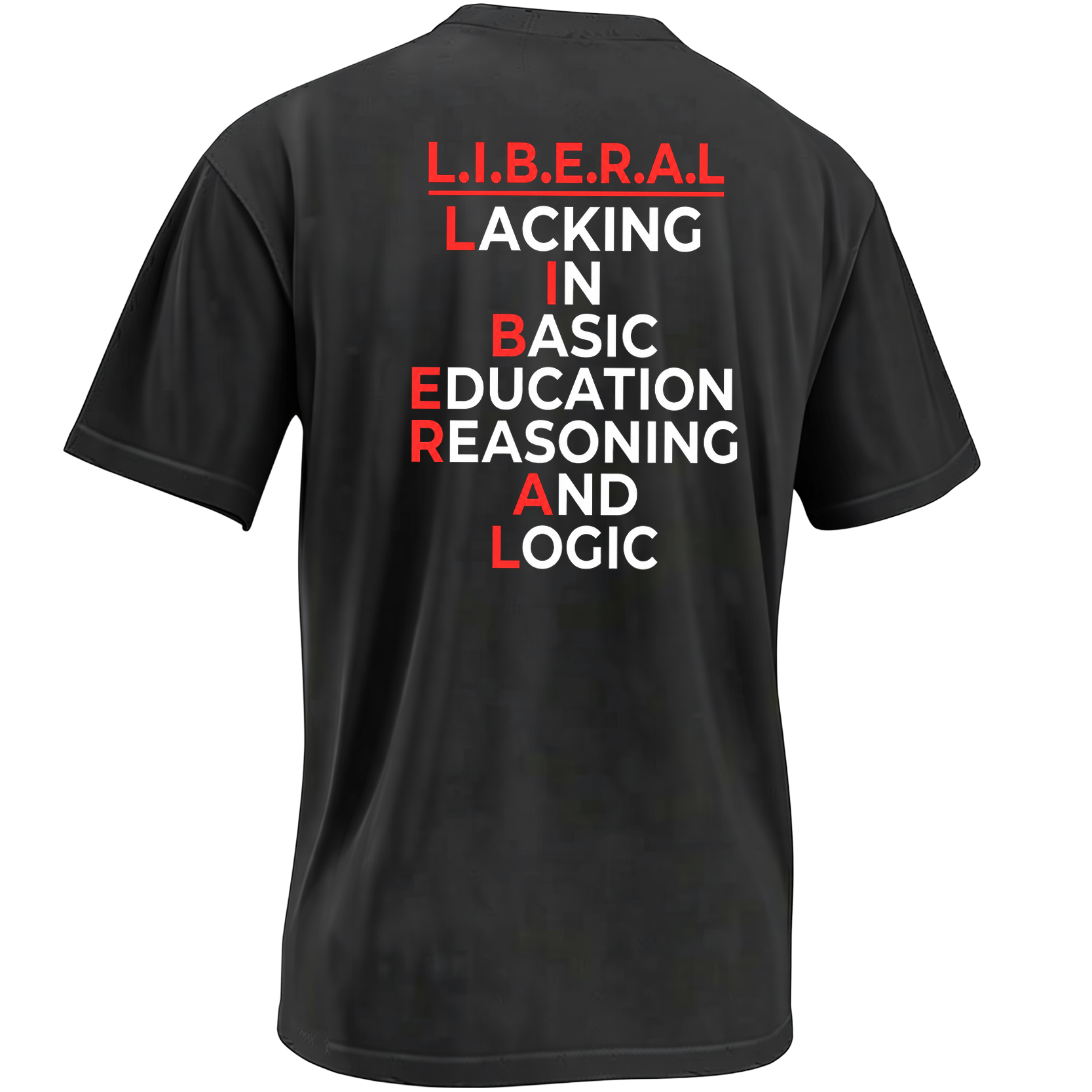
The L.I.B.E.R.A.L. graphic follows that tradition with almost mathematical efficiency. Each red initial extracts another word from the phrase “Lacking in Basic Education, Reasoning and Logic.” By the time the viewer reaches the final line, a political identity has been transformed into a verdict about intelligence.
The phrase belongs to a recognizable form of partisan merchandise in which the purpose is not persuasion. It does not present evidence, defend a policy or invite debate. It gives the wearer a compressed expression of frustration with the opposing side and makes that position immediately legible from across a room.
I
B
E
R
A
L
The design does not attempt to win an argument. It turns the existence of the opposing identity into the argument.
Why intelligence has become a partisan battlefield
Americans have long criticized opposing political ideas. The more significant contemporary change is the tendency to attach negative qualities directly to the people holding those ideas.
Pew Research Center found that majorities in both parties increasingly describe members of the other party as dishonest, immoral or closed-minded. Its research also documented growth in the share of Republicans and Democrats who regard political opponents as less intelligent than other Americans.
The 2026 Pew political typology adds an important complication: beneath the red-versus-blue divide, many Americans hold combinations of beliefs that do not fit neatly inside either major party.
That complexity disappears inside the acronym. “Liberal” becomes a single, uniform personality type, and disagreement becomes proof of an intellectual defect. This is precisely why the joke travels so easily: nuance would interrupt the rhythm.
Political disagreement becomes affective when people do not merely reject the opposing party’s positions; they develop broad negative feelings about the people associated with that party. The shirt functions inside that emotional environment.
The acronym creates the illusion of a hidden definition
Visually, an acronym can feel like discovery. The red letters appear to reveal that the word LIBERAL secretly contained its own criticism all along. Of course, the expanded phrase was constructed backward to fit the letters. That artificiality is part of the joke, not a flaw in it.
This technique has circulated for decades across bumper stickers, email forwards, protest signs and social media graphics. It remains effective because readers experience two small moments of recognition: first the political label, then the realization that each letter begins a new insult.
The acronym feels like a concise statement of accumulated frustration with progressive politics, institutions and public discourse.
The graphic may read as evidence that partisan mockery has replaced meaningful engagement with liberal ideas or voters.
A design arranged to be decoded in seconds
The L.I.B.E.R.A.L. Shirt uses only black, white and red—the visual vocabulary of warning signs, tabloid headlines and confrontational political posters.
“L.I.B.E.R.A.L.” is isolated across the top in red capitals and underlined like a term awaiting definition. Beneath it, the seven initials descend through the composition in red while the remaining letters stay white.
That color separation allows the eye to read the image in two directions. Horizontally, it receives the full insult. Vertically, it reconstructs the original political label. The viewer understands the trick without needing an illustration, symbol or candidate’s face.
Why text-only political designs remain powerful
Candidate-centered merchandise can age as soon as an election ends. A partisan label lasts much longer. “Liberal” remains recognizable across candidates, controversies and election cycles, allowing the same visual argument to survive changes in the daily news.
Text also requires the reader to complete the performance. The artwork provides no facial expression and no scene telling the audience how to react. Agreement, irritation or laughter arrives from the viewer’s existing political identity.
In that sense, the wearer is not simply displaying a joke. The wearer is testing a room, identifying allies and announcing which side of the political boundary the design considers reasonable.
A cultural artifact of politics as personal identity
The most revealing feature of the acronym is not whether its claim is fair. Its cultural importance lies in how naturally a policy label becomes a judgment about education, reasoning and logic.
The graphic records a political culture in which Americans increasingly encounter one another as categories before they meet as individuals. It is intentionally one-sided, but that one-sidedness is itself evidence of the moment that produced it.
Alongside Ellie Shirt’s newest cultural graphics, the design belongs to an evolving archive of slogans that turn political affiliation into personality, humor and public confrontation.
Frequently Asked Questions
What does L.I.B.E.R.A.L. mean on the shirt?
The acronym expands to “Lacking in Basic Education, Reasoning and Logic.” It is a partisan joke aimed at people identified as politically liberal.
Is this an official definition of liberal?
No. It is a deliberately constructed political acronym and insult, not a dictionary definition or neutral description of liberal ideology.
Why are the initials printed in red?
Red separates the initials from the remaining white letters, allowing readers to reconstruct LIBERAL vertically while reading the expanded phrase horizontally.
Why do partisan acronym jokes remain popular?
They are easy to understand, compact enough for shirts and social media, and allow people to express political identity without explaining a detailed policy position.
What does the design reveal about political polarization?
It shows how disagreement can become a judgment about the character or intelligence of people on the opposing side rather than a debate over specific ideas.
The complete L.I.B.E.R.A.L. acronym graphic preserves one intentionally confrontational example of how American political identity is compressed into wearable language.
The L.I.B.E.R.A.L. acronym graphic turns a political label into a seven-line partisan insult. Its red-and-white typography captures how identity, mockery and polarization now converge in American political culture.