
The Country Is 250. The Argument Over Loving It Is Still Unfinished.
“Imagine a country so great that even the people who hate it refuse to leave” sounds like a simple patriotic punch line. In the summer of America’s 250th anniversary, however, it also reveals how differently Americans define loyalty, criticism and belonging.
On July 4, 2026, the United States commemorated 250 years since the adoption of the Declaration of Independence. Official ceremonies, community celebrations and an America250 time capsule presented the anniversary as a rare national checkpoint: a moment to consider not only what the country has accomplished, but what its founding promises still require.
The celebration unfolded inside a deeply divided political culture. Pride, anxiety, gratitude and disappointment occupied the same anniversary. Americans were not arguing only about whether the country is great. They were arguing about who gets to define greatness—and whether criticism represents rejection or a demand that the country live more fully by its own ideals.
That is why the phrase “Imagine a country so great that even the people who hate it refuse to leave” carries unusual force in 2026. It works as a confident patriotic retort, but it also turns a complicated national conversation into one deliberately provocative sentence.
A country’s strength can be measured by the loyalty it inspires—but also by how much disagreement it is willing to hear.
Why the phrase feels especially charged after America250
The official America250 commemoration described July 4, 2026 as the 250th anniversary of the Declaration’s signing. That milestone naturally revived the language of liberty, opportunity and national endurance.
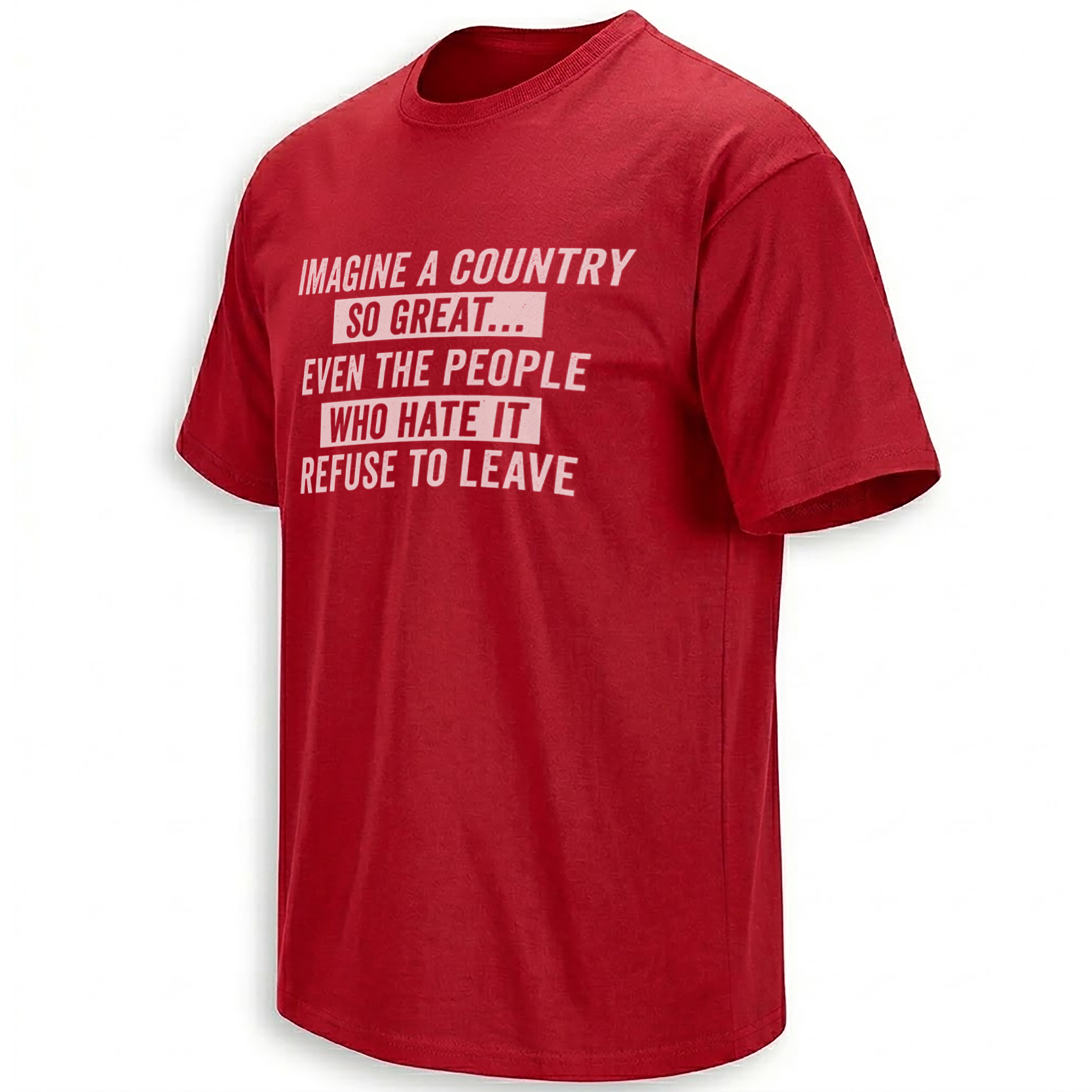
The shirt’s quotation belongs to one recognizable strand of that conversation. Its argument is that continued residence functions as evidence: despite complaints, people remain because the United States offers freedoms, opportunities, communities or personal roots they are unwilling to abandon.
The line gains its humor from compressing all of those possible reasons into a single accusation. The critic does not merely disagree; the critic “hates” the country. Staying then becomes the punch line that supposedly exposes the contradiction.
The quote converts a serious dispute over patriotism into a challenge: if America is as terrible as its critics claim, why do they remain? Its effectiveness comes from simplicity, even though real decisions about home, family, citizenship and belonging are rarely simple.
Patriotism and criticism are not clean opposites
The line resonates because many Americans have encountered criticism that feels less like reform and more like contempt. National symbols, military sacrifice and family histories can make dismissive language feel personal. For that audience, the quote provides a compact defense of a country they believe is too often judged without recognition of what it makes possible.
Another reading begins with a different American tradition. Speech critical of government is not foreign to the nation’s history; it is embedded in the country’s constitutional culture. The National Archives notes that the Alien and Sedition Acts of 1798 produced one of the earliest major conflicts over efforts to restrict criticism of the federal government.
From that perspective, remaining in the country while demanding change is not necessarily evidence of hypocrisy. It may indicate that a person considers the country worth contesting, improving or holding accountable.
The willingness to remain reflects the country’s enduring freedom, stability, opportunity and cultural pull.
Criticism can reflect investment in the American promise rather than a desire to abandon it.
A text-only design that refuses patriotic decoration
The Imagine a Country So Great Shirt does not depend on an eagle, flag collage, fireworks or military imagery. The red garment supplies the patriotic association, while condensed cream lettering carries the entire argument.
That restraint makes the design feel closer to a placard or editorial headline than a conventional Independence Day graphic. “SO GREAT…” and “WHO HATE IT” are isolated inside pale rectangular fields, creating visual pauses at the two emotional pressure points of the sentence.
Why “refuse to leave” is the line people remember
The final words change the phrase from praise into confrontation. Without them, “Imagine a country so great” would be a conventional statement of national optimism. “Refuse to leave” introduces an opponent and gives the wearer a position inside an argument.
That structure also explains why the slogan travels easily through social media. It is short enough to become a caption, forceful enough to invite agreement and provocative enough to attract rebuttal. People do not need to share the same definition of patriotism to understand the conflict immediately.
A wearable record of America’s unresolved anniversary
The most revealing patriotic artifacts are not always the ones everyone interprets the same way. Sometimes they preserve the disagreement itself. This graphic records a 2026 environment in which pride in America remained powerful, but consensus about how that pride should be expressed was increasingly difficult to find.
Within Ellie Shirt’s wider newest cultural graphics, the quote belongs to a continuing archive of the phrases Americans use when politics, humor and identity collapse into the same few words.
Frequently Asked Questions
What does “Imagine a country so great that even the people who hate it refuse to leave” mean?
The phrase argues that people who strongly criticize the United States still choose to remain because the country offers freedoms, opportunities, relationships or a sense of home they value.
Why does the quote feel relevant during America’s 250th anniversary?
The 2026 anniversary revived public discussion about American achievement, national identity and whether patriotism should emphasize celebration, criticism or a combination of both.
Does criticizing America necessarily mean someone hates the country?
No. The slogan deliberately frames the issue as a confrontation, but criticism can come from hostility, disappointment, reform-minded patriotism or several emotions at once.
Why does the design use only typography?
The text-only composition keeps attention on the argument. Red fabric and cream lettering provide the patriotic association without relying on flags, eagles or other conventional national imagery.
The complete Imagine a Country So Great graphic preserves one side of America’s 250th-anniversary argument in the compact visual language of a headline.
Imagine a Country So Great Shirt captures a provocative patriotic argument during America’s 250th-anniversary year. Its restrained red-and-cream typography turns the debate over pride, criticism and belonging into a cultural timestamp.