
Why Caitlin Clark and Sophie Cunningham’s “Straight Outta Indiana” Moment Feels Like Fever Fan Fiction Made Real
An E.T.-style finger touch, an old-school “Straight Outta” frame and two sharply different personalities turn a simple teammate graphic into a compact story about Indiana Fever chemistry.
Basketball chemistry is usually explained through assists, spacing and defensive communication. Internet culture prefers a stranger vocabulary: reaction clips, nicknames, screenshots and one image capable of turning two teammates into characters in a shared story.
Caitlin Clark and Sophie Cunningham have become especially compatible with that second language. Clark remains Indiana’s central playmaker and one of the WNBA’s defining public figures. Cunningham brings a more confrontational, openly expressive energy—an identity strengthened by the way she has publicly stood beside Clark during the physical and emotional pressure surrounding Fever basketball.
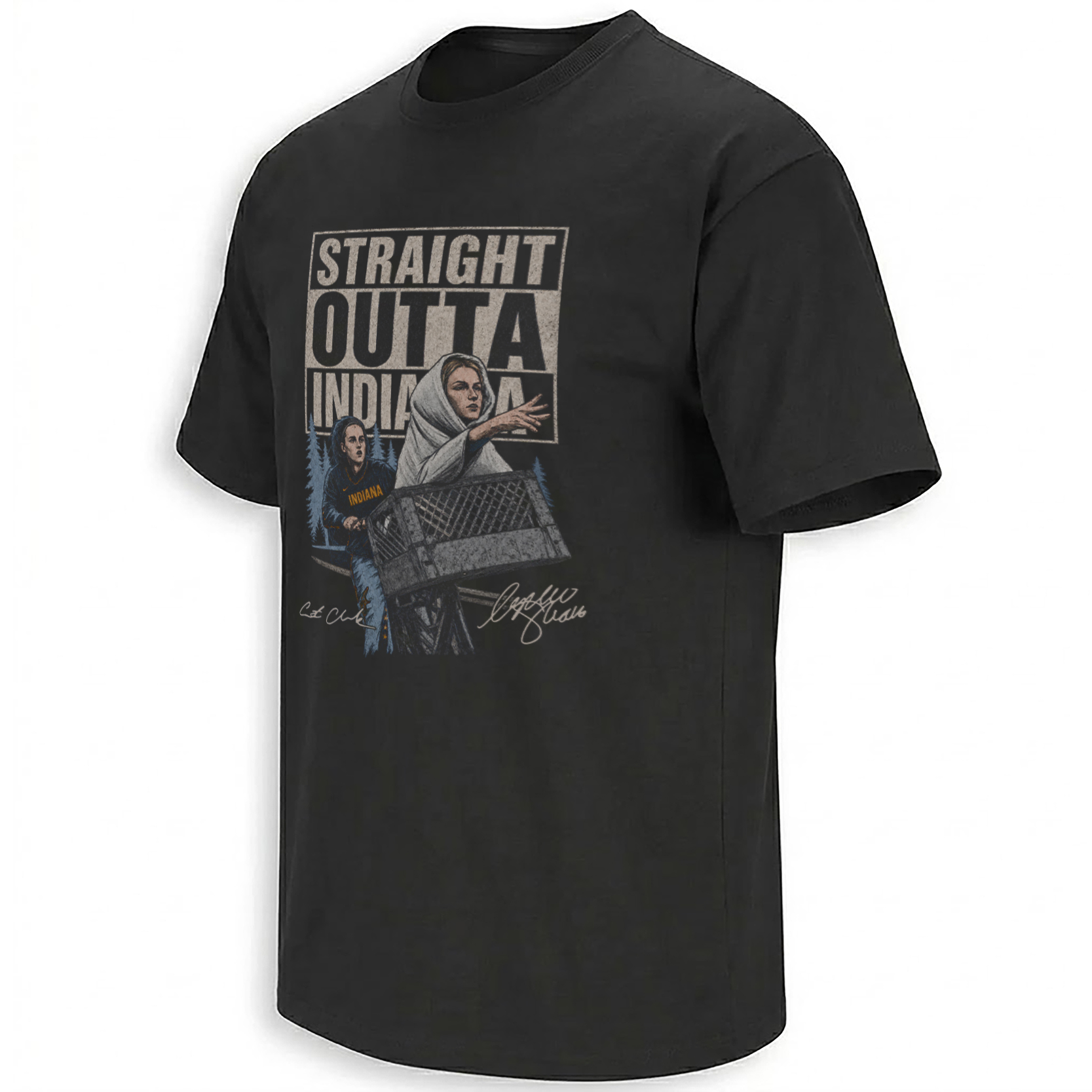
That contrast gives the Straight Outta Indiana Shirt its real narrative engine. The artwork does not reproduce a conventional game photograph. It recasts the two guards through the famous finger-touch composition associated with E.T. the Extra-Terrestrial, presenting their connection as something playful, cinematic and slightly supernatural.
The joke works because fans already read Clark and Cunningham as complementary characters: the signal and the shield, the passer and the provocateur.
A teammate relationship built for internet storytelling
Cunningham’s arrival in Indiana gave Fever fans a personality who could absorb attention without disappearing behind Clark’s enormous cultural shadow. Her value to the conversation has never been limited to a box score. She reacts visibly, speaks directly and understands how quickly a courtside gesture can become a meme.
That became especially clear during the 2026 season, when Cunningham’s prolonged finger-pointing exchange with DeWanna Bonner spread far beyond WNBA timelines. The moment followed tension involving Clark and was repeatedly reframed through edits, remixes and pop-culture compositions. Cunningham later treated the episode with humor, acknowledging its absurdity while explaining the teammate instinct behind it.
“Straight Outta Indiana” draws from the same fan perception without needing to recreate that confrontation. Here, the extended fingers are friendly rather than accusatory. The aggressive meme figure is converted into Clark’s cosmic teammate, and the hard edge of competition becomes affectionate buddy-comedy imagery.
 01
A teammate bond translated into movie-poster language
The design replaces a standard sports portrait with an instantly readable cinematic gesture, allowing Fever chemistry to become the subject.
01
A teammate bond translated into movie-poster language
The design replaces a standard sports portrait with an instantly readable cinematic gesture, allowing Fever chemistry to become the subject.
Why the E.T. reference changes the emotional temperature
The original E.T. gesture is one of American cinema’s most recognizable symbols of contact across difference. It carries wonder, trust and the feeling of two beings finding a private way to understand one another. Transferred to Clark and Cunningham, it lightly exaggerates a partnership between players with very different public personas.
Clark often appears as the focus of the storm: defenses are designed around her, cameras follow her and every physical exchange becomes a national argument. Cunningham frequently reads as the teammate stepping into that storm from the side. The glowing-finger visual therefore feels surprisingly precise. One figure sends the signal; the other completes the circuit.
“Straight Outta” gives the sweetness a harder frame
The upper typography is important because it prevents the design from becoming purely sentimental. “Straight Outta” carries the visual memory of late-1980s West Coast hip-hop and the decades of parody graphics that followed it. The stark rectangular lockup implies identity, origin and attitude.
Pairing that hard-edged language with the soft glow of the E.T. gesture creates deliberate tonal friction. It is affectionate without becoming delicate, nostalgic without being trapped in one decade and basketball-specific without relying entirely on league branding. “Indiana” becomes both a place and a shared fictional universe.
The restrained palette also matters. Dark framing gives the glowing center room to work, while Indiana colors and player imagery preserve immediate recognition. The result resembles a bootleg movie poster that could have circulated outside an arena—part sports graphic, part buddy-film advertisement and part internet in-joke.
Why fans keep turning Fever relationships into characters
Modern WNBA fandom does not only follow outcomes. It follows interpersonal dynamics: bench celebrations, tunnel outfits, protective fouls, podcast remarks and the small gestures that reveal how teammates relate to one another. Clark’s reach brings enormous numbers of new viewers into that ecosystem, while expressive teammates give those viewers additional personalities to follow.
That is why a design like this can resonate without commemorating a championship or a statistical record. It preserves a relationship narrative. Fans browsing the wider Indiana Fever collection are effectively moving through an illustrated archive of those narratives—Clark’s star power, Cunningham’s attitude and the evolving cast around them.
The broader WNBA collection shows the same change at league scale. Women’s basketball graphics increasingly record memes, personalities and fan language alongside traditional team pride. That expansion is evidence of a culture becoming deeper, noisier and more character-driven.
The cultural references behind the design
Why are Caitlin Clark and Sophie Cunningham depicted touching fingers?
The pose references the famous fingertip connection from E.T. the Extra-Terrestrial. In this design, it humorously symbolizes communication, friendship and the contrasting but complementary personalities of the two Indiana Fever teammates.
What does “Straight Outta Indiana” mean here?
It combines Indiana team identity with the widely parodied “Straight Outta” visual language associated with hip-hop culture. The harder typographic frame gives the warm E.T. parody a more confident sportswear attitude.
Why do fans associate Sophie Cunningham with protecting Caitlin Clark?
Cunningham has repeatedly spoken about the physical attention Clark receives and has visibly intervened during tense on-court moments. Those actions helped create an online image of her as an outspoken and protective teammate.
Why does this pairing work especially well as a meme?
Clark and Cunningham possess highly recognizable but contrasting public personas. Internet culture can quickly recast Clark as the high-profile signal caller and Cunningham as the expressive enforcer, making familiar movie imagery easy to adapt around them.
Seen within the Fever’s wider visual archive, the Straight Outta Indiana artwork records something statistics cannot: the playful teammate mythology developing around Indiana in real time.
Straight Outta Indiana Shirt reframes Caitlin Clark and Sophie Cunningham’s Fever chemistry through an E.T.-inspired finger touch, old-school typography and the playful character language of modern WNBA fandom.