
If You Don’t Like Dogs, You Can Fuck Off
Ricky Gervais’s line compresses his comic voice and public affection for animals into one confrontational rule: dogs receive unconditional loyalty, while anyone objecting to them receives no negotiation at all.
The Sentence Is Both a Joke and an Admission Test
The line does not attempt persuasion. It treats affection for dogs as such an obvious moral baseline that failing the test disqualifies someone from further conversation.
“If you don’t like dogs, you can fuck off” has the structure of a conditional statement and the emotional force of a pub sign. The first half appears to introduce a discussion. The second half immediately closes it.
That reversal is central to Ricky Gervais’s comic persona. He frequently builds jokes by presenting a familiar social expectation—politeness, diplomacy, concern about giving offense—and then refusing to perform it.
The profanity is not decorative. “Please leave” would sound like etiquette. “You can fuck off” turns the preference into a border: dogs are already inside the circle, and the hostile human is the one being removed.
The line asks only one question about your character—and has no appeals process.
This Is a Documented Gervais Line, Not a Random Attribution
Celebrity quote graphics are often detached from their original speaker or assigned to someone who merely seems likely to have said them. This case has a firmer trail.
Gervais shared the wording as part of advertising connected to Dutch Barn Orchard Vodka, a brand with which he is closely associated. Images of the deliberately provocative advertisement circulated through his own social accounts.
Dutch Barn also identifies the phrase as Gervais’s “iconic” quote on an official dog tennis-ball product. That commercial reuse establishes the wording as part of his recognized public persona rather than an anonymous sentence retrospectively attached to his name.
The campaign’s logic was intentionally simple: write the statement in large type, pair it with Gervais’s name and let the complaint-generating bluntness become the advertisement.
Why Dogs Are More Than a Convenient Punchline for Him
Gervais has spent years using interviews, comedy, social media and donations to support animal welfare. His public concern includes companion animals, wildlife, laboratory animals and campaigns encouraging adoption rather than commercial breeding.
In December 2025, he distributed £2.43 million among 22 animal charities following his Mortality tour. Reported recipients included PDSA, International Animal Rescue, Celia Hammond Animal Trust and Animals Asia.
That followed approximately £1.9 million directed to animal organizations from his earlier Armageddon tour. The financial record matters because it moves the subject beyond celebrity branding: the animal-welfare advocacy is a sustained part of his public work.
Gervais repeatedly describes dogs as emotionally direct, loyal and free from the social performance that complicates human relationships.
His platforms have been used to amplify adoption, rescue, wildlife protection and opposition to animal cruelty.
Major tour proceeds have been distributed to animal charities, giving the public rhetoric measurable weight.
Two Designs Translate the Same Rule Differently
Ellie Shirt’s two interpretations preserve the line but change the emotional relationship between Gervais, the dog and the viewer.
The first design functions like a broad dog-lover poster. Gervais and the dog appear as the central alliance while the surrounding text establishes the condition for anyone approaching them.
The second version places a German Shepherd more explicitly into the composition. That choice connects the statement to one of the most emotionally important canine images in Gervais’s screen work: Brandy from After Life.
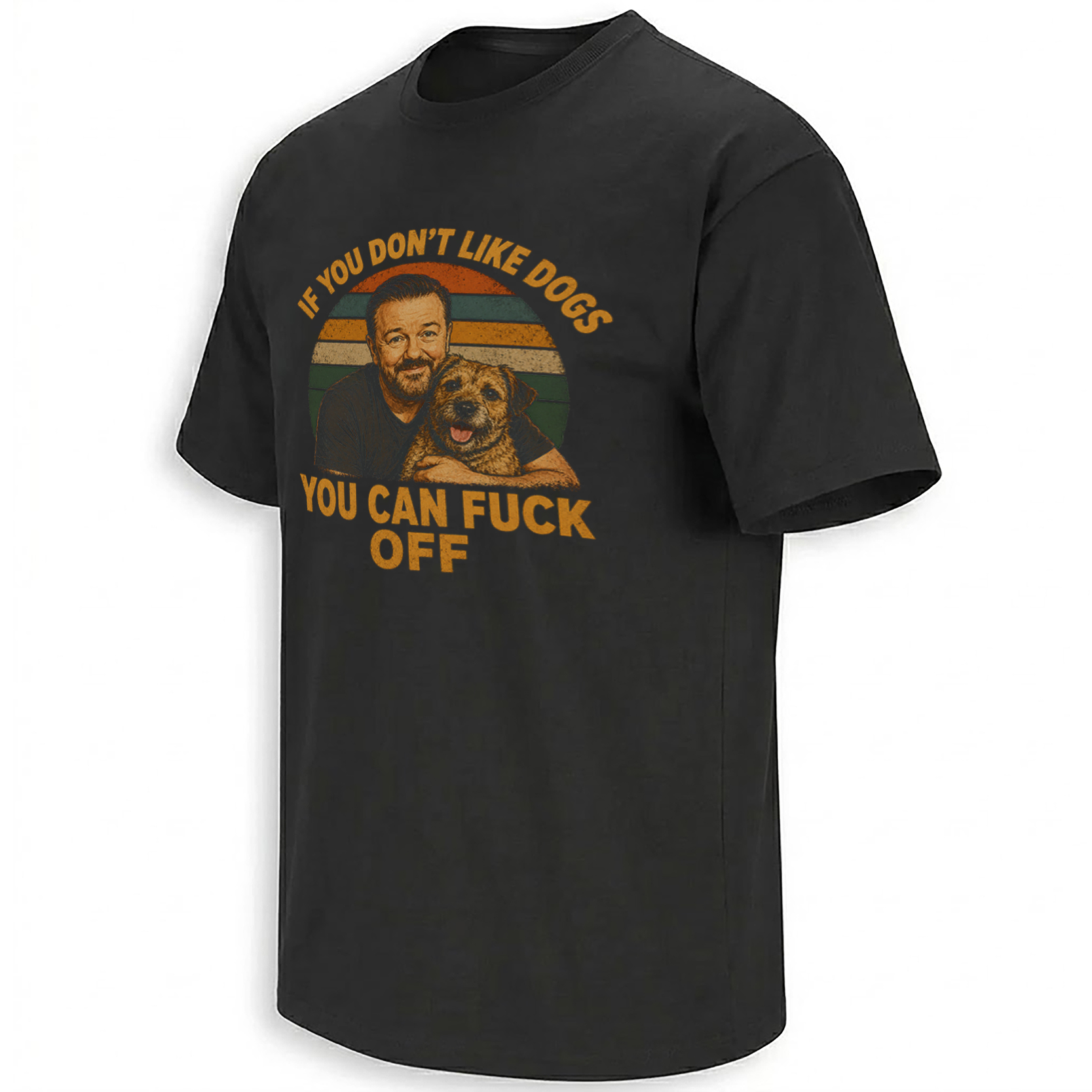
A bold portrait-led layout presents the comedian and dog as a united front against anyone failing the basic canine-affection test.
View the dog-lover artifact →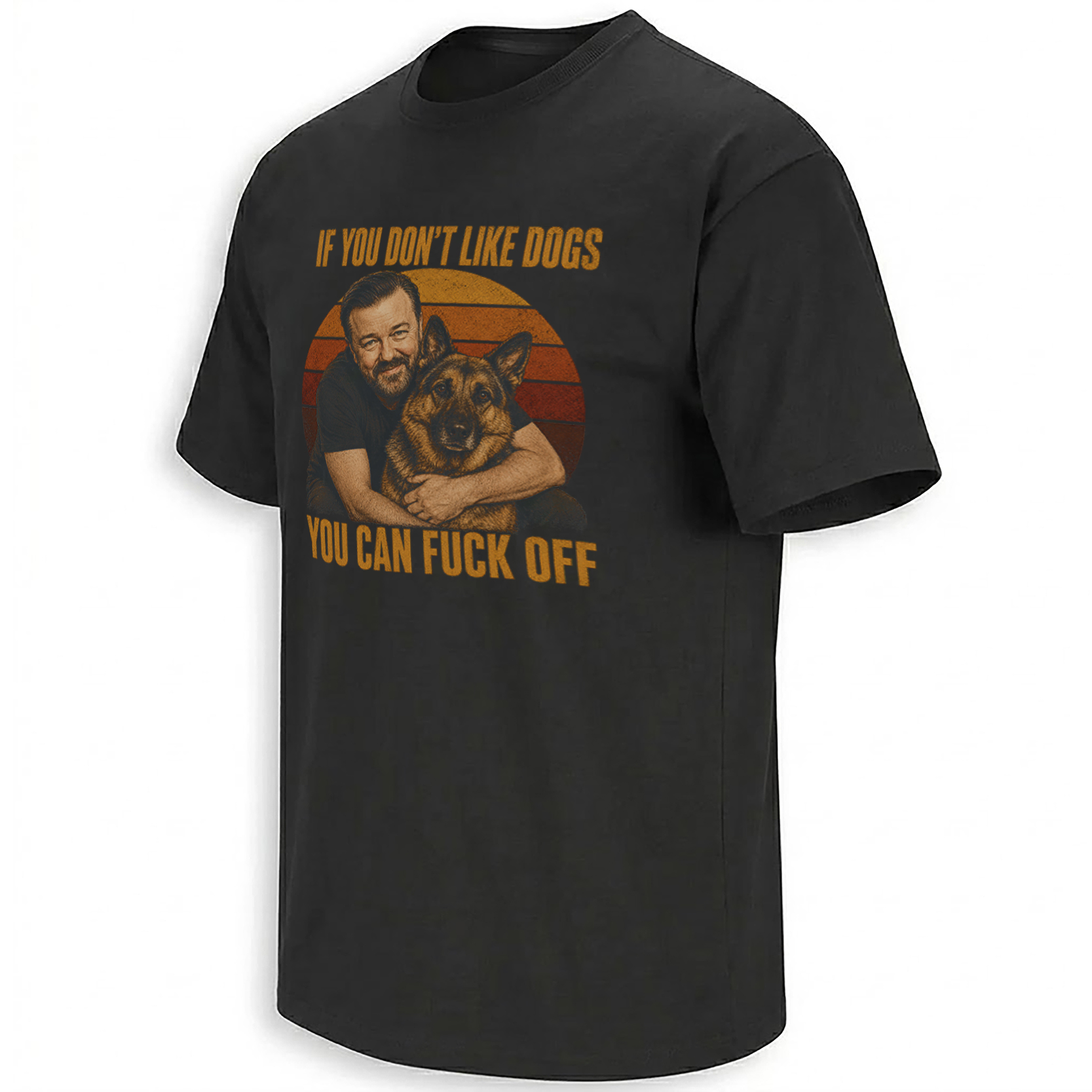
The breed’s loyalty and its emotional association with After Life give the confrontational sentence a more affectionate center.
View the German Shepherd artifact →The German Shepherd Carries an After Life Association
In Gervais’s Netflix series After Life, the German Shepherd Brandy accompanies Tony, a widower struggling with grief, anger and the question of whether he wants to continue living.
Brandy is not merely background companionship. The dog represents routine, responsibility and uncomplicated attachment when Tony has become alienated from much of the human world.
The role was played by Antilly, also known as Anti. When she died at age 13 in January 2025, Gervais publicly described her as a beautiful soul and said that working with her helped make After Life his favorite filming experience.
A generic dog supports the universal slogan. A German Shepherd also recalls Brandy’s role as protection, companionship and a reason for Tony to remain connected to life.
That association gives the second artwork two simultaneous registers. The wording remains aggressive, but the dog beside Gervais evokes one of his most compassionate stories.
Profanity Makes the Sentiment Feel More Sincere
Conventional dog-lover merchandise often uses soft declarations: “Dogs are family,” “All you need is love and a dog,” or “Home is where the dog is.”
Gervais’s wording reaches a similar emotional conclusion through exclusion rather than reassurance. It does not explain why dogs deserve love. It assumes the case has already been won.
That is why censoring the line too heavily would weaken it. The obscenity creates the disproportion between the ordinary premise and the severe consequence—and that disproportion is the joke.
It also separates the design from generalized pet sentiment. This is not merely a dog slogan with Gervais’s face added. Its refusal of politeness is recognizably aligned with his performance style.
What “Not Liking Dogs” Means Inside the Joke
Read literally, there are reasonable reasons why someone might avoid dogs. Allergies, trauma, religious customs, sensory sensitivity or lack of experience do not demonstrate bad character.
The comic version operates through exaggeration. “Not liking dogs” becomes shorthand for rejecting qualities people admire in them: loyalty, playfulness, trust and affection without social calculation.
The line is a deliberately excessive dog-lover declaration, not a serious moral assessment of every person who feels uncomfortable around dogs. Its force depends on treating a preference as though it were an absolute character test.
Why It Works So Well as Poster Art
The sentence divides naturally into two visual zones. “If you don’t like dogs” establishes the condition above the portrait. “You can fuck off” delivers the conclusion below it.
A central image of Gervais beside a dog turns the words into dialogue. The viewer no longer reads an anonymous slogan; the message appears to come directly from a recognizable speaker with the animal standing as supporting evidence.
The poster influence is especially appropriate because the wording has already lived as public advertising. Large typography, minimal explanation and immediate provocation belong to the original cultural life of the phrase.
On a shirt, the statement becomes a portable boundary marker. It tells other dog people that they have found an ally and warns everyone else that no careful debate is scheduled.
A Harsh Sentence With an Affectionate Center
The most important word in the quote is not the profanity. It is “dogs.”
Without Gervais’s long public history of animal advocacy, the line could be dismissed as an attention-seeking advertisement. That history gives it consistency. The aggressive delivery protects something he discusses with unusual tenderness.
This is why the designs can feel funny, confrontational and warm at the same time. The human face supplies the attitude. The dog supplies the reason.
Beneath the vulgarity is a simple hierarchy of trust: dogs have already earned their place. Humans are still being evaluated.
The wording’s official association with Gervais was verified through Dutch Barn’s product description and Gervais’s shared campaign artwork. His December 2025 donation of £2.43 million to 22 animal charities was checked against RTÉ’s report and The Independent. His earlier Armageddon contribution was confirmed by recipient charity Paws2Rescue.
More Designs for People Who Choose the Dog
Explore breed tributes, rescue-minded graphics and unapologetic pet humor in Ellie Shirt’s Dog Collection.
Ricky Gervais Dog Quote FAQ
Did Ricky Gervais really say “If you don’t like dogs, you can fuck off”?
Yes. The phrase appeared in advertising shared by Gervais and is identified by Dutch Barn as one of his iconic quotes.
Why is Ricky Gervais associated with dogs?
Gervais frequently discusses his love for dogs, promotes animal welfare and adoption, and has donated millions of pounds to animal charities.
What does the quote mean?
It exaggerates affection for dogs into a blunt character test: anyone who dislikes them is immediately excluded rather than persuaded.
What is the German Shepherd connection?
The German Shepherd Brandy played an emotionally important role beside Gervais’s character Tony in the Netflix series After Life.
What dog played Brandy in After Life?
Brandy was played by a German Shepherd named Antilly, also known as Anti. She died at age 13 in January 2025.
How are the two Ellie Shirt designs different?
One presents a broad Ricky Gervais dog-lover poster, while the other foregrounds a German Shepherd and carries a stronger visual association with After Life.
Is the quote meant literally?
It is comedic exaggeration. The humor treats a personal preference as an absolute moral rule and delivers the conclusion with deliberately excessive hostility.
Does the design contain adult language?
Yes. The uncensored phrase includes explicit profanity and is most appropriate for an adult audience.
Ricky Gervais’s blunt dog-lover rule combines confrontational comedy with a documented commitment to animal welfare. Two poster-style designs preserve both the profanity and the affection behind it.