
Can’t You See? Olivia Miles is already changing the picture
Olivia Miles’ SLAM 263 appearance did not arrive as a speculative introduction. It arrived while the Minnesota Lynx rookie was turning early promise into an All-Star season, record-setting production and one of the clearest new identities in women’s basketball.
Three days after SLAM published its Olivia Miles cover story, the image already felt less like a prediction than a live update. On July 13 in Minneapolis, Miles scored a career-high 33 points and added eight assists as the Minnesota Lynx defeated the Phoenix Mercury 104–100, giving the cover’s central question an answer that was still developing in real time.
The performance came during a stretch in which Miles had moved far beyond the usual language applied to a promising first-year guard. She had already been selected as a 2026 WNBA All-Star starter, becoming the only rookie in that year’s starting group and only the second rookie in Lynx history to receive that distinction. She had also collected consecutive Rookie of the Month recognition while helping Minnesota establish itself among the league’s strongest teams.
That timing is what gives the SLAM 263 visual its force. “Can’t You See?” does not read as a request for patience. It reads as a challenge to catch up. The season has been moving quickly enough that every new milestone seems to turn an earlier expectation into old information.
The cover is not asking whether Olivia Miles belongs in the picture. It is asking how anyone could still miss what is happening.
A Magazine Cover Arriving at Exactly the Right Moment
Basketball magazine covers have always done more than document fame. At their best, they recognize the instant when a player’s story changes scale — when local excitement becomes league-wide attention, when statistics become identity, and when a season begins producing images that will outlive individual box scores.
Miles reached that threshold unusually quickly. Minnesota selected her second overall in April, but the significance of her rookie season has not been limited to draft position. Her playmaking, pace control and sudden scoring eruptions have made her feel central to the Lynx immediately, even within a franchise carrying established expectations and championship-level ambition.
SLAM’s July 10 feature framed that rise through the idea of presence. The story presented Miles as someone learning how to combine her naturally calm personality with the competitive switch required at the professional level. Its final language — “Can’t you see?” and “Olivia Miles wants it all” — transformed that internal evolution into cover-line confidence.
Why the Quiet Gesture Matters
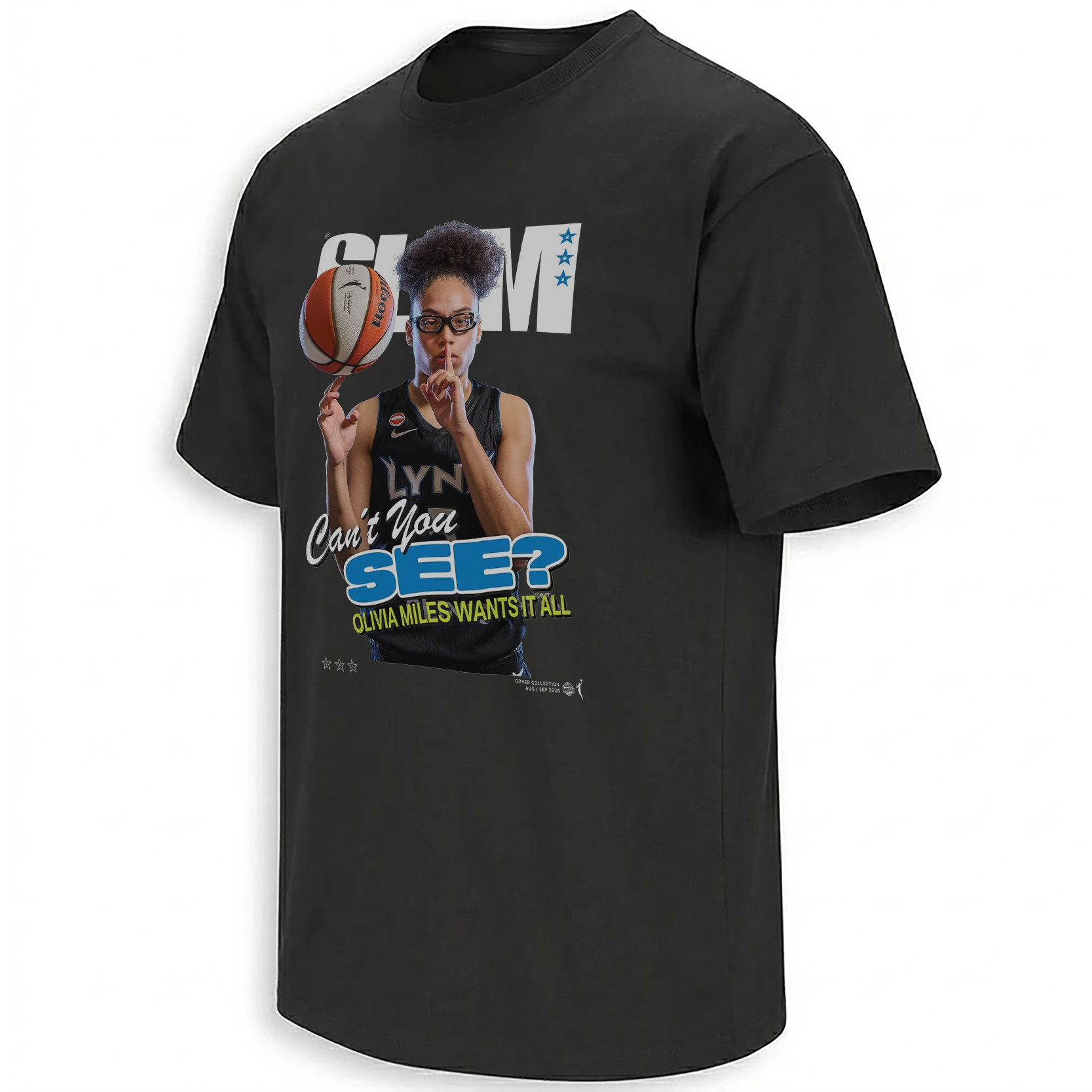
The strongest detail in the visual is not the basketball or the magazine masthead. It is Miles holding one finger to her lips. The gesture creates tension between silence and visibility. She is not shown shouting, flexing or performing exaggerated confidence. The image suggests that the performance itself has already made enough noise.
That distinction fits the public character of her early WNBA rise. Miles’ game can look composed even when she is bending a defense out of position. She manipulates pace, sees passing windows before they fully open and carries herself with a stillness that can make the next attack feel more sudden. The cover turns those qualities into visual language.
The spinning basketball adds another layer. It recalls the traditional point guard as organizer and controller, but the headline refuses to confine her to a single role. “Wants it all” expands the frame from passing talent to total ambition: scoring, leadership, recognition and the authority to shape games rather than simply facilitate them.
Glasses, a centered portrait and the quiet gesture make intelligence and composure part of the image. The pose feels deliberate rather than explosive, allowing confidence to come from control.
White script introduces the question conversationally, while the oversized blue “SEE?” lands like a scoreboard graphic. The lime line beneath it acts as the answer: Olivia Miles wants the whole stage.
From Draft Night to All-Star Starter
Rookie stories are often built around gradual adjustment. The professional game is faster, spacing is different, scouting becomes relentless and every weakness is tested repeatedly. Miles’ season has included that learning process, but it has also repeatedly escaped the limits of a normal developmental timeline.
Her WNBA debut immediately placed her alongside rare company, as she produced 21 points and eight assists in her first professional game. Weeks later, she set a rookie record with eight made three-pointers in a game. By early July, she was leading first-year players across major statistical categories and had been voted into the All-Star starting group.
The July 13 victory over Phoenix gave the story another sharp turn. Miles’ 33 points were paired with Kayla McBride’s 37, making them the first Lynx teammates to score at least 30 points in the same game. It was a reminder that Miles’ rise is not occurring outside Minnesota’s larger goals. Her emergence is becoming part of how the team wins.
SLAM 263 caught Miles between arrival and establishment. She was already an All-Star when the feature appeared, but her latest career high arrived only days later. The cover therefore functions as a timestamp from a season that keeps rewriting its own scale.
The Design Language of a Modern Basketball Cover
The artwork draws from the long tradition of magazine imagery becoming streetwear imagery. A cover condenses an athlete’s identity into a masthead, portrait, headline and a few carefully chosen visual signals. Once removed from the newsstand and placed on apparel, that composition starts behaving like a wearable archive.
Here, black creates the strongest presentation because it allows the white SLAM lettering, electric blue question and yellow-green subline to remain crisp without competing against the garment. The Lynx uniform connects the portrait to Minnesota, while the blue typography echoes the cold, bright register associated with the franchise’s visual environment.
The hierarchy is intentionally immediate. SLAM establishes basketball-media authority at the top. Miles occupies the center as the dominant human figure. “Can’t You See?” becomes the emotional headline. “Olivia Miles wants it all” provides the narrative underneath. It works like a compressed feature story that can be read in seconds.
Why “Can’t You See?” Fits the Internet Conversation
The phrase is especially effective because it mirrors how sports conversations develop online. A young player begins producing evidence. Some viewers recognize the shift immediately. Others continue using draft-night evaluations, old scouting concerns or assumptions formed before the season began. Every new performance then becomes part of an argument about who was paying attention.
Miles’ rookie year has repeatedly generated that kind of recalibration. Early questions about how quickly her shot would translate were followed by a record-setting three-point performance. Questions about whether she could handle immediate responsibility were followed by All-Star starter recognition. The discourse keeps moving from potential to proof.
That does not mean every debate has ended, nor does one half-season complete a career story. The power of the phrase comes from its timing. It captures the stage when the evidence has become visible enough that overlooking it begins to feel like a choice.
Minnesota’s Newest Star Inside a Larger Lynx Story
Miles did not enter an empty franchise. The Lynx carry one of the WNBA’s deepest championship histories, a strong regional basketball identity and a current roster shaped by experienced players such as Napheesa Collier, Kayla McBride, Courtney Williams and Natasha Howard. A rookie becoming this visible inside that environment says something about both her talent and Minnesota’s ability to place it inside meaningful basketball.
The wider Minnesota Lynx collection now reads like a visual timeline of that overlap between established identity and a new era. Older playoff references, team graphics and current player moments sit beside Miles’ emerging image, showing how a franchise archive expands when a new face begins generating its own language.
Within the broader WNBA collection, the design also belongs to a league-wide season defined by star movement, rookie attention, anniversary storytelling and rapidly changing debates about who represents the next phase of women’s basketball. Miles’ cover is one frame inside that larger transformation, but it is already one of the season’s clearest.
A Cover That May Feel Different Later
The most interesting athlete graphics change meaning over time. At first, they document the present. Later, they become evidence of when the wider culture first recognized what was coming.
That possibility hangs over this design. SLAM 263 may eventually be remembered simply as an early Olivia Miles cover, produced during a historic rookie campaign before the rest of her professional story had taken shape. Or it may be remembered as the exact moment the question stopped being whether she could become a star and became how far she intended to take it.
For now, the image remains suspended in the most compelling stage of all: the rise is visible, the achievements are accumulating, and the final scale of the story is still unknown.
Frequently Asked Questions
Why is Olivia Miles featured in SLAM 263?
SLAM featured Miles during a breakout rookie season in which she quickly became a leading scorer and playmaker for Minnesota, earned consecutive Rookie of the Month honors and was selected as a 2026 WNBA All-Star starter.
What does “Can’t You See?” mean in the Olivia Miles cover story?
The phrase presents Miles’ rise as something already visible through her performances. It challenges the audience to recognize the confidence, ambition and growing influence she has displayed during her first WNBA season.
Why is the finger-to-the-lips pose important to the artwork?
The gesture connects Miles’ calm public presence with the idea that her game can speak for itself. It creates a visual contrast between quiet composure and the increasingly loud attention surrounding her performances.
What made Olivia Miles’ 2026 rookie season historic?
Her early season included a 21-point, eight-assist debut, a rookie record of eight made three-pointers in one game, consecutive Rookie of the Month awards and selection as the only rookie starter in the 2026 WNBA All-Star Game.
Why does the SLAM 263 design work as a cultural artifact?
It preserves the exact period when Miles was moving from highly regarded draft pick to established WNBA attraction. The magazine composition, headline and portrait turn that transition into a visual timestamp of her rookie rise.
The Can’t You See? Olivia Miles design preserves the SLAM 263 image while the season behind it is still unfolding. The wider Minnesota Lynx visual archive follows the team context surrounding her rise, from veteran identity to the new moments already reshaping Minnesota basketball culture.
Can’t You See? Olivia Miles Shirt captures the Minnesota Lynx rookie’s SLAM 263 cover through the quiet finger-to-the-lips pose, spinning basketball and bold blue headline that framed her rapid rise into a 2026 WNBA All-Star starter.