
Philadelphia’s All-Star Night: When the Liberty Bell Became Baseball’s Midsummer Symbol
The 2026 MLB All-Star Game arrives at Citizens Bank Park on July 14 with Philadelphia positioned at the intersection of baseball history, civic identity and America’s 250th-anniversary summer.
Philadelphia did not spend July 14 waiting for the first pitch to become part of the 2026 MLB All-Star Game. Long before the American League and National League stars reached Citizens Bank Park, the city had already placed its own language around the event: Independence Mall, red-white-and-blue visuals, the Liberty Bell and the unmistakable confidence of a sports town hosting baseball’s largest midsummer stage.
The game marks the first MLB All-Star return to Philadelphia since 1996. That thirty-year distance matters because the baseball environment receiving the event now is dramatically different. Veterans Stadium is gone. Citizens Bank Park has become one of the league’s most recognizable modern ballparks, and the Phillies enter the occasion with a fan culture built around October expectations rather than nostalgia alone.
The timing makes the night even larger. Philadelphia is spending 2026 at the center of America’s 250th-birthday calendar, so baseball’s Midsummer Classic arrives inside a city-wide conversation about national memory. The result is an All-Star identity that does not need to borrow symbolism. The Liberty Bell, the star and the colors of the flag were already waiting.
Philadelphia did not need a generic All-Star identity. It had a bell, a ballpark and two and a half centuries of symbolism ready for the frame.
Why This All-Star Game Could Only Look Like Philadelphia
Host-city graphics usually face a difficult task. They must represent a national sporting event while still feeling unmistakably local. Philadelphia solves that problem through one of the most legible civic objects in the United States: the Liberty Bell.
In the official 2026 visual identity, the bell sits inside a star-shaped composition with red, blue and white typography. The symbol works on several levels at once. It locates the event geographically, connects baseball to the country’s anniversary year and transforms a familiar historical image into contemporary sports language.
The bell also fits Philadelphia’s emotional register. It is old, imperfect, recognizable and impossible to separate from the city. Its famous crack prevents the symbol from feeling polished or generic. That imperfection mirrors a fan culture that has never needed to present itself as quiet, neutral or universally agreeable.
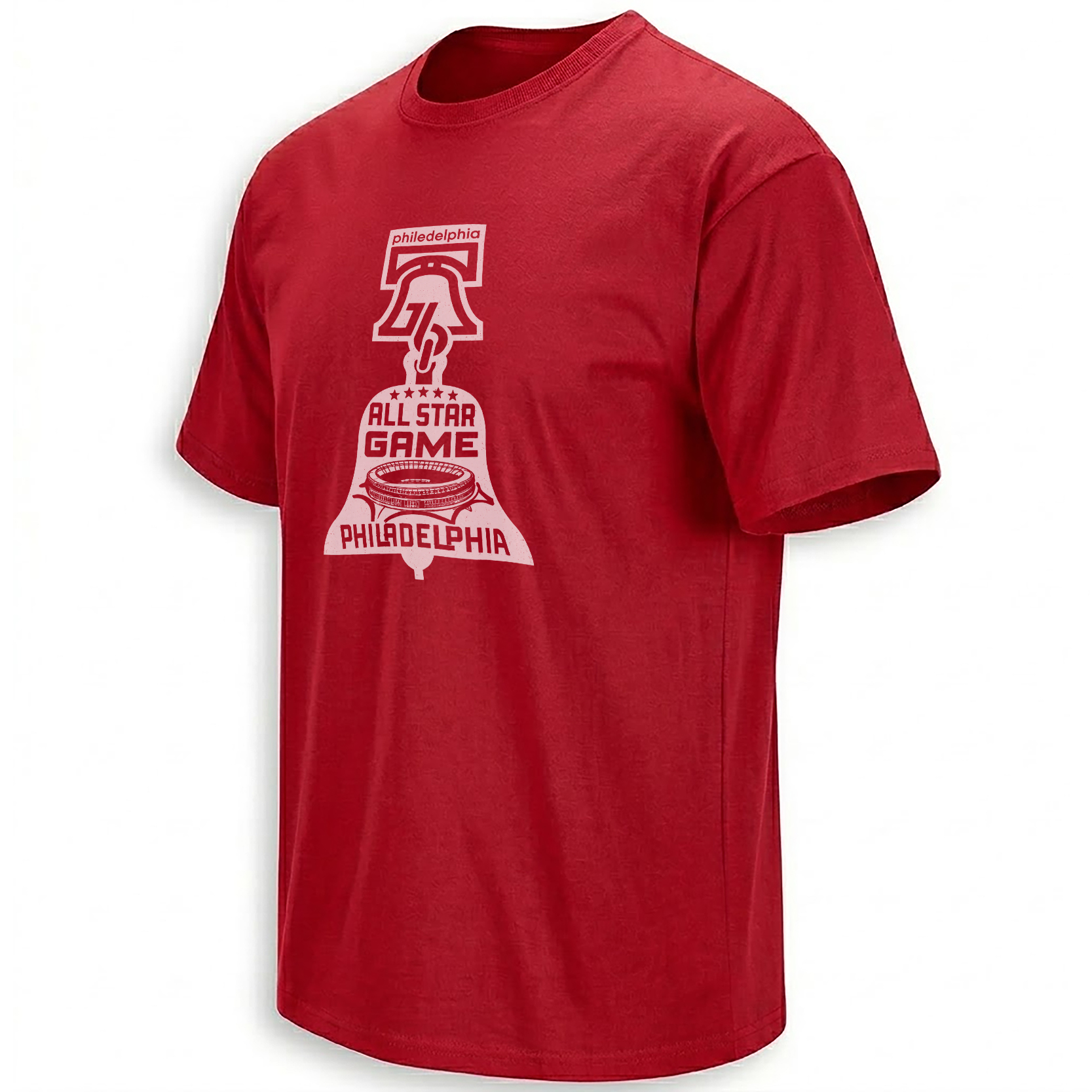
The Artwork Reads Like a City Poster, Not a Generic Event Logo
The design carries the density of a commemorative city poster. Instead of isolating one athlete, it gathers the event’s central symbols into a single vertical composition: Philadelphia, the All-Star occasion, the Liberty Bell, baseball language and the year 2026.
That crowded hierarchy is appropriate because the cultural moment itself is layered. This is not simply a neutral meeting between league stars. It is a Philadelphia-hosted game, a Phillies-era event, a national anniversary spectacle and a continuation of a baseball history that stretches back through 1996 and 1976.
Red and blue provide the expected patriotic frame, but they also belong naturally to Phillies visual culture. The white areas create separation between the headline elements, while the bell acts as the grounding object beneath the larger All-Star language. The overall effect resembles a program cover that might be saved after the game rather than discarded at the gate.
The central symbol connects the game to Philadelphia’s historical identity without requiring a skyline or a literal map of the city.
The palette works simultaneously as Phillies-adjacent baseball color and as the visual language of the 250th-anniversary summer.
Large event type and stacked imagery give the graphic the authority of a commemorative program, newspaper front or ballpark banner.
From the 1976 Bicentennial to America at 250
Philadelphia’s relationship with anniversary-year sports is not new. The city also hosted the MLB All-Star Game in 1976, when the United States marked its Bicentennial. Fifty years later, the Midsummer Classic returns during another national milestone.
That historical repetition gives 2026 a rare symmetry. Baseball returns to the birthplace of the Declaration during an anniversary summer, but the setting has changed from Veterans Stadium to Citizens Bank Park. The event therefore connects three Philadelphia baseball eras: the Bicentennial game of 1976, the 1996 All-Star Game and the present-day ballpark culture of 2026.
The artwork does not need to print that entire timeline to evoke it. The year, the bell and the All-Star language do the historical work through association. Fans familiar with Philadelphia baseball can read the deeper timeline behind the visible design.
The design functions as a compact memory map: Philadelphia’s history, the Phillies’ host identity, the 2026 All-Star Game and America’s anniversary year compressed into one visual object.
Citizens Bank Park as the Midsummer Stage
Citizens Bank Park changes the emotional texture of the event. Philadelphia’s previous All-Star Game took place at Veterans Stadium in 1996, during a very different period for both the franchise and the surrounding sports complex.
The current ballpark is closely tied to the Phillies’ modern identity: the 2008 championship generation, repeated postseason nights, home-run celebrations and one of baseball’s most immediate crowd environments. Bringing the league’s stars into that setting places the All-Star Game inside an arena already charged with local memory.
Philadelphia’s reputation also prevents the event from feeling overly ceremonial. The city is capable of respecting history without becoming quiet around it. A national baseball showcase can still feel confrontational, loud and specific when it is played in South Philadelphia.
Why the Moment Extends Beyond One Night
All-Star Games are exhibitions, but host-city memories are built from more than the final score. The red carpet, Futures Game, Home Run Derby, ballpark displays, neighborhood activations and images circulating through the city collectively define the week.
That broader atmosphere is why a host-city graphic can outlast the game itself. It records where baseball gathered, what the city looked like during the gathering and which symbols represented the occasion before the result became the main headline.
Within the Philadelphia Phillies collection, the All-Star graphic sits beside player moments, postseason references and city-specific designs that document how Philadelphia baseball culture changes from series to series. The broader MLB collection places the piece inside the larger visual history of league events, rivalries and seasonal milestones.
Frequently Asked Questions
When and where is the 2026 MLB All-Star Game?
The 2026 MLB All-Star Game is scheduled for July 14 at Citizens Bank Park in Philadelphia, with first pitch set for 8 p.m. Eastern Time.
Why is the Liberty Bell central to the 2026 All-Star identity?
The Liberty Bell immediately identifies Philadelphia while connecting the game to America’s 250th-anniversary year and the city’s role in United States history.
When did Philadelphia last host the MLB All-Star Game?
Philadelphia last hosted the event in 1996 at Veterans Stadium, making the 2026 game the city’s first MLB All-Star Game in thirty years.
How does the 2026 game connect to the 1976 Bicentennial?
Philadelphia hosted the MLB All-Star Game in 1976 during America’s Bicentennial and hosts it again in 2026 as the country marks its 250th anniversary.
Why does the Philadelphia All-Star graphic work as a cultural artifact?
It preserves the event year, host city, Liberty Bell symbolism and patriotic visual language of a rare summer when baseball and national anniversary history converged in Philadelphia.
The Philadelphia All-Star Game design captures the Liberty Bell identity of the 2026 event, while the wider Phillies visual archive follows the players, postseason memories and city language surrounding Philadelphia baseball.
Philadelphia All-Star Game Shirt captures the 2026 MLB Midsummer Classic through Liberty Bell imagery, Phillies color, patriotic baseball language and the historic return of the event to Philadelphia during America’s 250th-anniversary year.