
Brandon Bussi Climbed Aboard as Carolina’s Backup. He Finished the Ride as a Stanley Cup Hero.
The “Bussi Bus” began as an irresistible nickname for Carolina’s unexpected rookie goaltender. By the end of the 2026 Stanley Cup Final, it had become the vehicle Hurricanes fans used to describe one of hockey’s fastest journeys from waiver claim to championship legend.
When Brandon Bussi stepped into the Carolina crease during Game 3 of the 2026 Stanley Cup Final, he was not entering a comfortable assignment. The Hurricanes were trailing the Vegas Golden Knights, starting goaltender Frederik Andersen was unavailable, and the series was threatening to turn away from Carolina.
Three games later, Bussi stood inside T-Mobile Arena as a Stanley Cup champion. He had won his first postseason start, followed it with another road victory and completed the journey with 22 saves in a 3–0 Game 6 shutout that ended Carolina’s twenty-year championship wait.
The transformation was immediate. “The Bus” stopped being only a nickname produced by his surname. Fans dressed as buses, carried transit-style signs, chanted “Bussi” in Las Vegas and turned a rookie goaltender’s unlikely rise into the most joyful public-transportation metaphor in hockey.
Carolina did not know it was boarding a championship bus when Bussi entered the series. By Game 6, no one wanted to get off.
The Route Began Long Before the Stanley Cup Final
The speed of Bussi’s championship rise can make his earlier path look cleaner than it was. He was undrafted, developed through college hockey at Western Michigan and spent several seasons in the Boston Bruins organization without receiving a sustained NHL opportunity.
Florida signed him to a one-year contract in July 2025, but the Panthers placed him on waivers before the season. Carolina claimed him on October 5 as organizational goaltending depth rather than as the presumed answer to a Stanley Cup problem eight months in the future.
An injury to Pyotr Kochetkov created an opening. Bussi made the Hurricanes roster, won his NHL debut and began producing results at a pace that turned a temporary opportunity into a genuine role.
By February, he had set a league record for victories through his first 25 NHL decisions and earned a multiyear extension from Carolina. The Stanley Cup Final made him famous, but the team’s trust had been built across an entire rookie season.
Claimed from Florida, promoted through necessity, rewarded through performance and sent into the Stanley Cup Final without the benefit of a gradual introduction. The Bussi Bus reached its final stop because every earlier detour had prepared him to stay composed.
How “The Bus” Became a Hurricanes Fan Character
Sports nicknames are most effective when they are easy to understand, easy to repeat and capable of producing their own visual world. “Bussi” becoming “The Bus” satisfied all three conditions immediately.
Once Bussi started winning, the nickname expanded. Every victory became another stop. Every save kept the vehicle moving. A strong performance invited “all aboard” language, while a shutout allowed fans to imagine opponents being left behind at the station.
The metaphor was playful without weakening the seriousness of his role. Goaltending is one of the most isolating positions in sports, especially during the Stanley Cup Final. The bus language transformed that isolation into a collective ride.
Instead of describing Bussi as a solitary figure responsible for protecting Carolina’s season, fans placed themselves inside the story. The goalie drove. The roster supplied the route. Raleigh climbed aboard.
Why the Bus Graphic Fits the Story Better Than a Standard Goalie Portrait
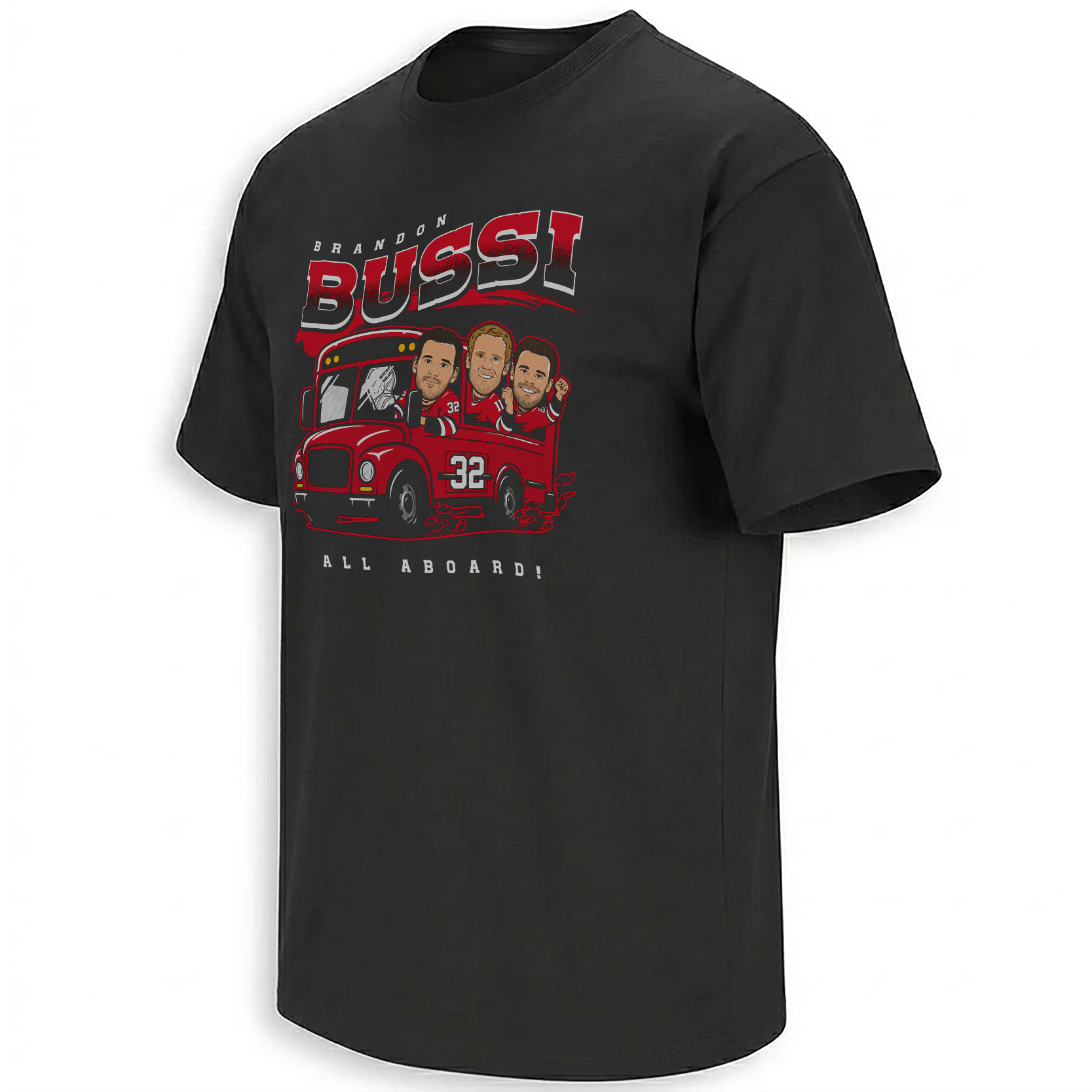
The Brandon Bussi All Aboard Shirt does not attempt to reproduce an official championship photograph. It translates the way fans experienced the run.
A conventional goalie portrait could preserve Bussi’s equipment, stance or Game 6 expression. The bus concept preserves the nickname ecosystem that formed around him: “The Bus,” “All Aboard,” the idea of a championship route and the sense that Carolina’s entire postseason suddenly depended on an unexpected driver.
The vehicle creates forward movement across the composition. Championship language supplies the destination, while Hurricanes colors keep the parody connected to Raleigh rather than allowing it to become a generic transportation joke.
Bussi remains the central character, but the artwork gives fans room inside the image. A bus is designed to carry people together. That makes it an unusually appropriate symbol for a goalie whose individual performance became part of a collective championship celebration.
The bus illustration converts a surname-based nickname into championship folklore. Route language suggests progression, the Hurricanes palette establishes place, and the Stanley Cup destination turns three extraordinary Final victories into a single completed journey.
Four Stops That Changed Bussi’s Hockey Life
Carolina acquired Bussi from Florida in October 2025 as goaltending insurance. The move received little attention compared with the significance it would carry eight months later.
Bussi’s early NHL success established that his strong start was not a novelty. His victory pace earned trust, a contract extension and a permanent place in Carolina’s plans.
Andersen’s absence forced Bussi into the Final under maximum pressure. Rather than protect himself from the moment, he played with the compact discipline that had defined his rookie year.
Twenty-two saves, no Vegas goals and one championship horn transformed the backup goalie into a permanent figure in Hurricanes history.
Game 4 Was the Moment the Ride Became Real
Bussi’s first postseason start arrived in Game 4 with Carolina facing the possibility of falling further behind in the series. The situation required the calm of a veteran even though the assignment was completely new.
He made 18 saves, the Hurricanes evened the Final and the emotional center of the night arrived after the result. Bussi saw his parents celebrating in the crowd and struggled to contain the weight of the moment during his postgame interview.
That reaction gave fans access to the person underneath the sudden cult-hero identity. The goalie had not entered the series expecting to become its central character. His family had spent years following the less visible stages of the journey, long before national television began telling the story.
The scene made the Bussi Bus feel less like a clever meme and more like a family vehicle that had been traveling for years without knowing where the route would end.
Game 5 Proved the First Victory Was Not a Coincidence
One successful start can be treated as adrenaline. A second places the performance inside a pattern.
Bussi stopped 23 shots in Game 5 as Carolina moved within one victory of the Stanley Cup. The Hurricanes controlled long stretches of the game, but the goaltender still had to prevent Vegas from creating the kind of momentum swing capable of changing the series.
His positioning remained calm. Rebounds stayed manageable. The emotional noise surrounding his story did not appear to change the compact structure of his game.
By the end of the night, “All Aboard” no longer described a novelty ride. It described the direction of the Final. Carolina had placed its championship fate behind Bussi, and the route now led directly toward Game 6.
The Shutout That Made the Nickname Permanent
Championship-clinching games are rarely as controlled as their final score suggests. Vegas created dangerous opportunities, including breakaways, odd-man rushes and late chances designed to turn the building before Carolina could finish the job.
Bussi stopped them all. He denied Brett Howden on a first-period opportunity, handled Tomas Hertl during a second-period rush and survived the final pressure as the Golden Knights searched for the goal that might reopen the night.
Taylor Hall, Jackson Blake and Nikolaj Ehlers supplied Carolina’s scoring. Bussi supplied the zero beside Vegas.
As the final minutes disappeared, Hurricanes supporters inside T-Mobile Arena began chanting his name. The player once claimed as insurance was no longer standing behind Carolina’s established goaltenders. He was standing between the franchise and the final twenty-year memory it needed to erase.
The horn made the transformation permanent: waiver claim, rookie, backup, emergency starter, Stanley Cup champion.
Frederik Andersen Remained Part of Bussi’s Championship Story
The rapid rise of a replacement goaltender can create an easy temptation to rewrite the player who came before him. Bussi resisted that framing immediately.
After winning the Cup, he emphasized Andersen’s importance to the postseason run and the support the veteran had provided. Carolina did not reach the Final without Andersen, and Bussi did not treat the crease as though it had always belonged to him.
That humility matched the way he discussed his own performance. Even after becoming one of the defining figures of the championship, Bussi continued describing the experience through team trust, preparation and the people who had helped him reach the moment.
The bus metaphor works partly because the driver is not the only person responsible for a successful route. Coaches, teammates, goaltending partners and family members all occupy seats inside the longer journey.
Why Raleigh Turned Bussi Into a Cult Hero So Quickly
Fan bases often form their strongest attachment to athletes whose rise appears unplanned. Superstars arrive with expectations already attached. Cult heroes emerge when a player appears at exactly the moment a team needs someone new to believe in.
Bussi offered everything required for that transformation. His name created an immediate nickname. His career path supplied underdog credibility. His emotional interviews made the story personal. Most importantly, the saves kept arriving.
By the championship celebration in Raleigh, fans were wearing bus costumes and chanting his name. The city had converted a short stretch of postseason hockey into a complete character identity.
Bussi’s response kept the relationship grounded. He appeared more overwhelmed than self-impressed, repeatedly returning credit to teammates and the people who had supported him before the Cup made his story visible.
The Championship Parade Became the Final Public Stop
The route that began with a waiver transaction and passed through Las Vegas returned to North Carolina in front of an enormous Raleigh crowd. The championship celebration allowed fans to act out the metaphor together.
Some arrived dressed as buses. Others carried signs built around “All Aboard” and “Bussi Bus” language. A nickname that had circulated through broadcasts and social posts became visible across the crowd.
For Bussi, the parade was also the point when the scale of the achievement became harder to avoid. He had spent the Final narrowing his attention to the next save. Raleigh presented the opposite experience: tens of thousands of people reflecting the entire story back toward him at once.
The celebration confirmed that the bus concept was no longer only about a goalie. It had become one of the ways the city would remember the championship.
The Story Also Carried a Personal Family Meaning
Bussi’s public rise remained connected to the people who had followed the quieter stages of his career. He spoke openly after the championship about the support of his parents and his fiancée, Mary Raclawski, as well as the emotional importance of sharing the achievement with his family.
His custom equipment also honored his brother Dylan and the autism community, placing another deeply personal layer inside the championship imagery.
Those details matter because sudden sports fame can make a career appear to begin at the moment the wider public notices it. Bussi’s Stanley Cup Final lasted several days. The path that made those days possible lasted years.
The bus graphic simplifies that route into one joyful illustration, but the emotional power comes from knowing the vehicle had been moving long before it reached Raleigh.
Why the “All Aboard” Design Works as a Championship Artifact
Most championship graphics preserve an official result: team name, year, trophy and final designation. The Bussi Bus visual preserves the fan language that surrounded the result.
That distinction gives it a specific place inside the wider Carolina Hurricanes championship archive. A team huddle records collective unity. A Cup lift records the final ceremony. The bus records the unexpected cult hero who took control of the crease when the Final changed direction.
The broader NHL Shirts collection follows similar moments across hockey, preserving the nicknames, goalie runs and fan-created metaphors that often become as memorable as the official championship branding.
Years from now, “All Aboard” will still point toward the same compressed stretch of time: Bussi entered Game 3 as the backup, won Games 4 and 5, shut out Vegas in Game 6 and returned to Raleigh with the Stanley Cup.
Frequently Asked Questions
Why is Brandon Bussi called “The Bus”?
The nickname is a play on Bussi’s surname. As he began winning for Carolina, fans expanded it into “Bussi Bus” and “All Aboard” language, turning each strong performance into another stop on the ride.
How did Brandon Bussi enter the 2026 Stanley Cup Final?
Bussi entered during Game 3 after Frederik Andersen became unavailable. He then started the final three games of the series and won all three.
How did Bussi perform in the championship-clinching game?
He made 22 saves and recorded a shutout as Carolina defeated the Vegas Golden Knights 3–0 in Game 6 to win the Stanley Cup.
Why did the Bussi Bus idea become popular with Hurricanes fans?
The nickname was easy to visualize, while Bussi’s underdog career path, emotional personality and sudden Stanley Cup success gave fans a complete story to place around the bus metaphor.
What does the Brandon Bussi All Aboard design represent?
The graphic turns Bussi’s nickname into a championship route, connecting his No. 32 identity, three Stanley Cup Final victories and Game 6 shutout with the fan phrase “All Aboard.”
The Brandon Bussi All Aboard graphic preserves Carolina’s most unexpected championship ride, while the wider Hurricanes archive follows the players, rituals and Raleigh fan language that defined the 2026 title.
Brandon Bussi All Aboard Shirt captures the Hurricanes goalie’s journey from waiver claim to 2026 Stanley Cup hero through the Bussi Bus nickname, No. 32 identity and Game 6 championship shutout.