
The Hurricanes Raised the Stanley Cup. The Team Huddle Explained How They Reached It.
Carolina’s 2026 championship will always be remembered through the Cup lift, the final horn and Raleigh’s celebration. Yet the team huddle offers a different image of the title: players folded inward, connected by trust and briefly returning the entire journey to one circle.
When the final seconds disappeared at T-Mobile Arena on June 14, the Carolina Hurricanes had completed a 3–0 shutout, defeated the Vegas Golden Knights in six games and ended a twenty-year wait for the Stanley Cup.
The immediate images were familiar to hockey history. Sticks flew into the air. Players rushed toward Brandon Bussi. Jordan Staal received the Conn Smythe Trophy. The Cup arrived on the ice, and each individual lift created another photograph destined to survive for decades.
But the team huddle carried a quieter kind of authority. Instead of separating the captain, goaltender or leading scorer from everyone else, it compressed the roster into one shape. Helmets, shoulders, numbers and names disappeared into a circle that looked almost identical to the formation teams use before ordinary games.
The Cup lift celebrates the player holding the trophy. The huddle remembers everyone who made it possible for the trophy to arrive.
The Circle After the Storm
Championship celebrations naturally pull outward. Players skate toward family members, cameras search for recognizable faces and the trophy begins its journey from one set of hands to another. The huddle moves in the opposite direction.
Bodies turn inward. Teammates place arms around shoulders. The outside world briefly becomes secondary. Even inside a building filled with noise, the circle creates the feeling of a private conversation.
That visual fits Carolina because the Hurricanes did not reach the championship through one dominant celebrity story. Their postseason was carried through layers of contribution: veteran leadership, emerging scorers, defensive structure, special teams, goaltending resilience and a coaching identity developed across years of unfinished playoff runs.
The circle therefore feels less like a celebration pose and more like the final expression of how the roster understood itself. Carolina did not survive the playoffs by waiting for one player to solve every series. It repeatedly reduced the game to collective pressure and trusted that the next contribution could come from anywhere.
Carolina’s 16–3 playoff record was not only efficient. It reflected a team capable of absorbing injuries, lineup changes and momentum swings without abandoning the structure that had carried the franchise through years of contention.
Why This Championship Needed a Team Image
The 2026 Hurricanes produced several obvious individual stories. Jordan Staal delivered the leadership and two-way performance that earned the Conn Smythe Trophy. Brandon Bussi entered the Final unexpectedly and completed the championship with a shutout. Rod Brind’Amour connected the 2006 and 2026 titles as former captain and current coach.
Those stories deserve to stand on their own. Yet the championship becomes incomplete when reduced to any single one of them.
Sebastian Aho, Seth Jarvis, Andrei Svechnikov, Jaccob Slavin, Taylor Hall, Nikolaj Ehlers, Jackson Blake and the rest of the lineup supplied different forms of value across the postseason. Some became headline figures. Others performed work that rarely survives in a simple highlight package.
The team huddle solves that problem visually. It does not rank the contributions. It places them side by side, shoulder to shoulder, inside the same championship statement.
A Championship Graphic Without a Single Hero
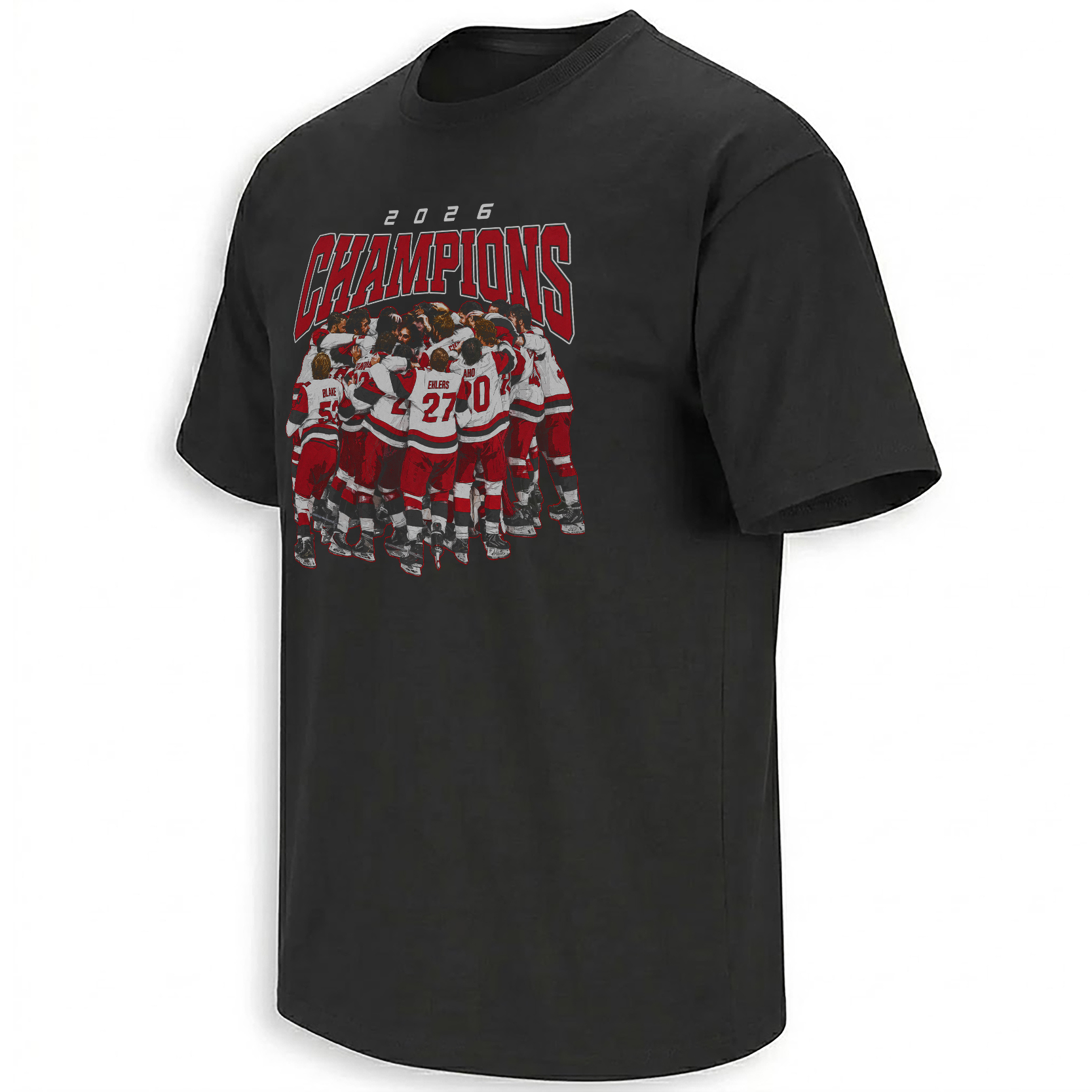
The 2026 Champions Team Huddle Shirt avoids the most common structure of championship artwork. The trophy is present as part of the larger meaning, but the composition does not isolate one player above the group.
Instead, the visual centers the formation created by the team itself. Players lean together, creating a dense circular mass of red, black and white. The shape communicates unity before the viewer begins identifying individual faces or numbers.
“2026 Champions” functions as the historical label, while the huddle supplies the emotional evidence. The words explain what happened. The body language explains what the accomplishment felt like from inside the roster.
That distinction gives the design a different tone from a standard trophy-lift piece. A Cup-raising image records the climax. The huddle records the relationship that produced it.
The circular composition removes a traditional hierarchy from the championship image. Red and black establish Carolina’s identity, while the compressed group formation makes the players read first as one unit and only afterward as individual members of the roster.
Four Meanings Inside the Huddle
A playoff huddle represents the belief that every player understands the same assignment, even when the game becomes chaotic and the season is reduced to one shift.
Captains, stars, rookies and depth players occupy the same circle, giving the image a democratic structure that a solo portrait cannot provide.
Carolina’s title followed years of strong teams and painful playoff exits. The huddle compresses that entire organizational process into one completed formation.
Future trades and retirements will change the team, but the championship circle permanently records the exact group that finished the 2026 run.
Brandon Bussi’s Shutout Became a Team Story
Game 6 created the type of goaltending story that could easily dominate the entire championship narrative. Brandon Bussi made 22 saves, completed the shutout and won his third consecutive game after entering the Final under extraordinary circumstances.
Yet even the clean sheet reflected Carolina’s collective identity. The Hurricanes protected the center of the ice, managed rebounds, disrupted Vegas entries and prevented the final game from becoming the uncontrolled exchange the Golden Knights needed.
Bussi still had to make the saves. His composure gave the performance its emotional power. But the image of teammates immediately converging around him after the horn showed how the roster understood the moment.
The goalie stood at the center because the game ended at his crease. The celebration became a huddle because the shutout belonged to everyone.
Jordan Staal’s Conn Smythe Was Leadership Made Visible
Jordan Staal’s postseason offered another example of individual distinction emerging from team structure. At 37, the captain delivered a remarkable Stanley Cup Final and became the player selected to represent Carolina’s entire playoff achievement through the Conn Smythe Trophy.
His value was not limited to scoring. Faceoffs, defensive assignments, physical presence and the ability to manage difficult shifts had defined his role long before the goals arrived in the Final.
That made Staal an appropriate figure for the award. He embodied the type of hockey Carolina had been trying to perfect: detailed, demanding and built around responsibilities that remain important even when they do not produce an immediate highlight.
In the huddle, however, the Conn Smythe winner returns to the same level as everyone else. The trophy identifies one postseason MVP. The circle identifies one champion roster.
Rod Brind’Amour Built the Culture Before the Cup Arrived
Rod Brind’Amour’s connection to the title naturally begins with 2006. He captained the first Hurricanes championship team and returned twenty years later as the coach behind the second.
The deeper connection is not only historical. Brind’Amour helped build the modern version of Carolina around conditioning, accountability, forechecking pressure and an expectation that every player remain connected to the larger structure.
That culture produced excellent regular seasons and deep playoff runs before it produced another championship. Each defeat created a question about whether the system could complete the journey, but the organization repeatedly chose continuity over emotional reinvention.
When Brind’Amour said after Game 6 that it was Carolina’s time and the team would not be denied, the statement reflected more than confidence from one night. It summarized years of returning to the same work despite receiving no guarantee that persistence would eventually become a Cup.
The Huddle Also Holds the Players Who Played Through Pain
Championship photographs often conceal the physical condition of the people inside them. Once the jerseys are on and the celebration begins, injuries become difficult to see.
Seth Jarvis later underwent surgery to repair a torn labrum and rotator cuff after playing through a shoulder problem that had followed him across multiple seasons. His 32 regular-season goals led Carolina, and he continued contributing during the playoff run despite the injury.
Other players carried their own accumulated damage, fatigue and personal pressure into the Final. That reality gives the huddle another meaning. The circle does not only contain the athletes who finished the season. It contains the private compromises required for them to remain available.
The graphic cannot display every injury or sacrifice. It can preserve the physical closeness of the group that understood those sacrifices better than anyone outside the room.
Why the Huddle Feels Different From the Cup Lift
The Stanley Cup lift is hockey’s most recognizable championship ritual. It creates a sequence of personal images: captain, veteran, first-time winner, goaltender, coach and eventually every player who receives a turn.
The team huddle removes the sequence. Everyone appears at once.
That makes the image less ceremonial and more intimate. The trophy tells the public who won. The huddle shows the winners looking toward one another rather than toward the audience.
Both images belong inside the championship archive. The wider Carolina Hurricanes collection follows those different emotional angles through trophy graphics, player moments, roster designs and Raleigh celebration pieces.
The broader NHL Shirts collection places Carolina’s title inside the larger visual culture of Stanley Cup hockey, where every championship becomes a sequence of rituals fans use to remember how the season ended.
Raleigh Celebrated the Same Collective Identity
When the championship returned to North Carolina, the scale of the celebration showed how completely the team’s identity had extended beyond the dressing room. More than 150,000 people gathered in downtown Raleigh for the official celebration, creating one of the largest public events in the city’s history.
That turnout was not only a response to the Cup itself. It reflected years of playoff investment, arena rituals, sirens, tailgates and a regional hockey culture that had grown far beyond the novelty framing once attached to the franchise.
The crowd effectively recreated the huddle at city scale. Fans gathered around the team, the stage and the trophy, transforming Raleigh into a larger circle of people who had experienced the same long wait from different positions.
Players possessed the championship rings and the names on the Cup. The city possessed the memory of living through the entire process with them.
Why Team-Huddle Graphics Become Permanent Memory Objects
Rosters are temporary by design. Contracts expire. Players are traded. Younger prospects replace veterans. Even championship teams begin changing almost immediately after the parade ends.
A huddle graphic freezes the roster before that movement begins. It records the group not as a list of transactions but as a physical relationship.
Years later, viewers may identify players who became franchise legends, players who left during the following offseason and depth contributors whose names otherwise appear less frequently in championship retrospectives.
The image keeps them together anyway. That is the central promise of the design: whatever happened before or after, this was the circle that completed the 2026 championship.
Frequently Asked Questions
When did the Carolina Hurricanes win the 2026 Stanley Cup?
Carolina clinched the Stanley Cup on June 14, 2026, by defeating the Vegas Golden Knights 3–0 in Game 6 and winning the Final four games to two.
What was Carolina’s record during the 2026 Stanley Cup Playoffs?
The Hurricanes completed the postseason with a 16–3 record, finishing one of the most efficient championship runs in franchise history.
Who won the 2026 Conn Smythe Trophy?
Carolina captain Jordan Staal received the Conn Smythe Trophy as the most valuable player of the 2026 Stanley Cup Playoffs.
Why is the Carolina Hurricanes team huddle an important championship image?
The huddle places the entire roster inside one formation, emphasizing collective trust, shared sacrifice and the team structure behind Carolina’s title rather than isolating a single player.
What does the 2026 Champions Team Huddle design represent?
The graphic preserves the Hurricanes roster as a championship circle, combining the team’s red-and-black identity with the physical unity of the players who completed the twenty-year return.
The 2026 Champions Team Huddle graphic preserves Carolina’s title as a collective image, while the wider Hurricanes championship archive follows the players, rituals and Raleigh memories surrounding the franchise’s second Stanley Cup.
2026 Champions Shirt captures the Carolina Hurricanes’ Stanley Cup team huddle as a collective portrait of the players, trust and shared sacrifice behind the franchise’s twenty-year championship return.