
LeBron James Is Leaving the Lakers. Los Angeles Is Now Measuring the Size of His Reign.
LeBron’s Lakers chapter ended without a retirement ceremony or a final farewell tour. Instead, it ended with the announcement that the King would continue elsewhere, leaving Los Angeles to process eight seasons of championships, records, family history and expectations only he could have carried.
On June 30, 2026, LeBron James informed the Lakers that he would continue his NBA career with another franchise. He was not retiring. He had not yet selected his next team. But after eight seasons in purple and gold, the Los Angeles chapter was officially complete.
The announcement immediately changed the emotional language around his Lakers career. Images that had belonged to an active present became part of an archive: the 2020 championship, the scoring-record celebration, the first game beside Bronny, the No. 23 jersey and the familiar pregame cloud of chalk.
This was not a conventional departure. LeBron was leaving while still capable of influencing another team’s championship ambitions, yet the moment carried the unmistakable atmosphere of tribute. Lakers fans were no longer waiting to see how his Los Angeles story would end. They were being asked to decide how the completed story should be remembered.
LeBron did not arrive in Los Angeles to preserve Lakers history from a distance. He entered it, carried it through crisis and left his own chapter inside the franchise mythology.
The Ending Arrived Before the Farewell Tour
Many legendary careers conclude through a carefully managed final season. Arenas prepare tribute videos. Opposing crowds stand. Every road game becomes a scheduled goodbye.
LeBron’s Lakers departure arrived differently. His agent confirmed that he intended to play a twenty-fourth NBA season, but not in Los Angeles. The next uniform remained unknown, turning one announcement into two simultaneous stories: the end of a Lakers era and the beginning of the league’s largest free-agency mystery.
That uncertainty should not be confused with uncertainty about his Los Angeles legacy. Whatever happens next belongs to another franchise chapter. The Lakers years can now be viewed as a complete body of work, beginning with his 2018 decision to join a rebuilding organization and ending after a season in which his presence still shaped every conversation around the team.
The timing also explains why tribute imagery appeared immediately. Fans did not need LeBron to retire before recognizing that something historically significant had closed.
Eight seasons linked the final prime years of one of basketball’s greatest players to the NBA’s most mythologized franchise. The relationship produced a championship, unprecedented records, painful interruptions and one father–son image no previous NBA team had created.
LeBron Chose the Weight of the Lakers
Joining the Lakers has never been a neutral basketball decision. The uniform carries expectations built by Minneapolis titles, Showtime, Kobe Bryant, Shaquille O’Neal and a fan base that interprets contention as the organization’s natural condition.
LeBron entered that environment in 2018 while the franchise was still searching for a route out of several losing seasons. He arrived as a global star with nothing left to prove in ordinary career terms, yet chose a destination where every accomplishment would be measured against retired numbers and championship banners.
The first season ended without the playoffs and demonstrated how little the Lakers name could guarantee. The response was not symbolic patience. Los Angeles traded for Anthony Davis, reconstructed the roster and placed championship pressure around the partnership immediately.
That pressure became the defining condition of LeBron’s Lakers tenure. Every roster move was evaluated through the remaining length of his prime. Every injury carried the possibility that another season of history had been lost.
The 2020 Championship Was Built Inside an Unrepeatable Year
LeBron’s clearest Lakers achievement came during the most emotionally complicated season in modern franchise history. Kobe Bryant’s death reshaped Los Angeles in January 2020, turning the basketball year into an extended act of grief before the COVID-19 pandemic stopped the season entirely.
Months later, the Lakers entered the Orlando bubble without home-court crowds, normal travel or any of the familiar rhythms surrounding a title run. LeBron and Davis carried the team through Portland, Houston, Denver and Miami before securing the franchise’s seventeenth championship.
The neutral setting has occasionally been used to diminish that title. For Lakers supporters, the unusual conditions often deepen its meaning. The roster had to maintain focus through isolation, social unrest, public grief and a basketball environment no previous champion had navigated.
LeBron earned Finals MVP and delivered the championship he had promised when he came to Los Angeles. The celebration could not fill downtown streets in the usual way, but the banner became permanent.
A Tribute Collage for a Career Too Large for One Photograph
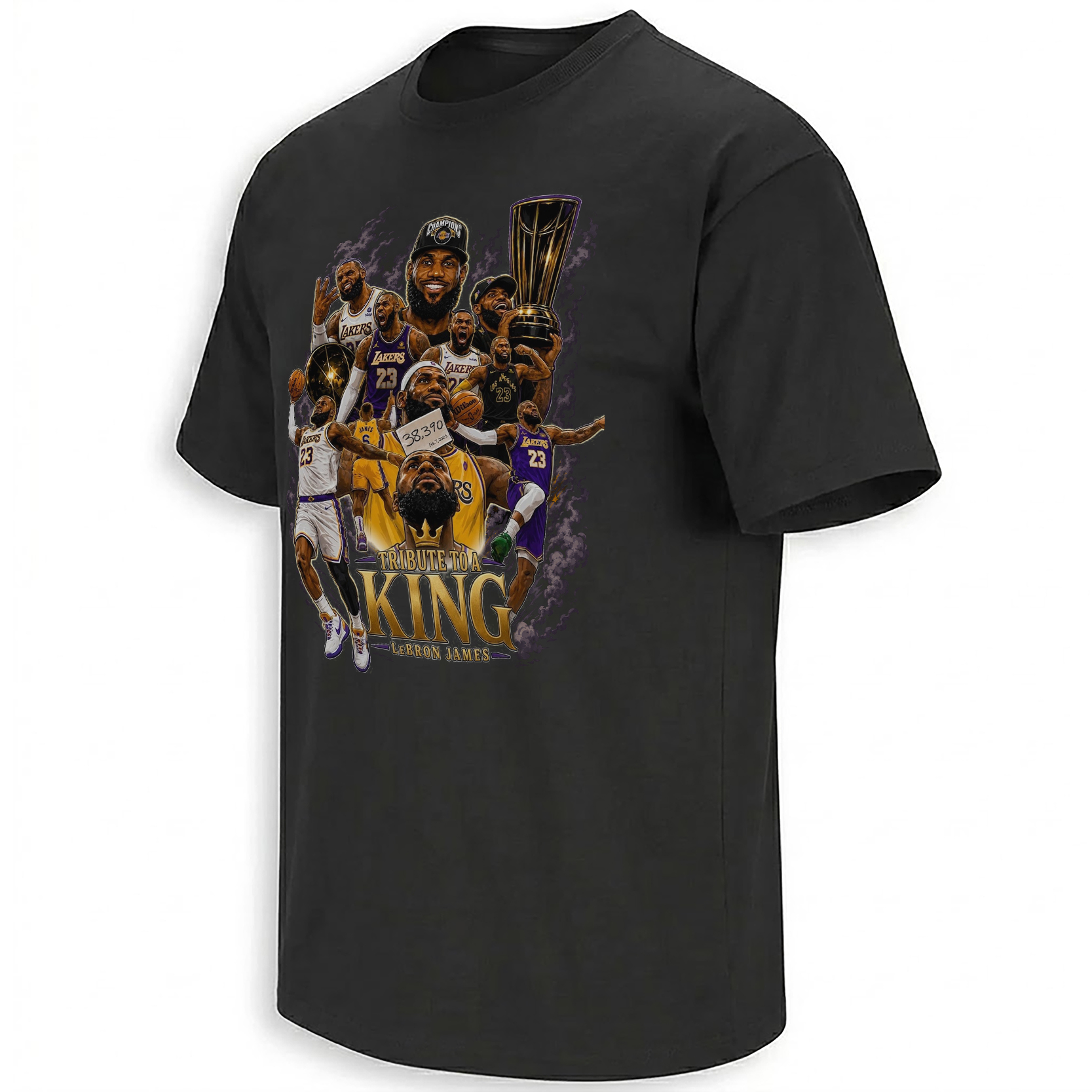
The Tribute to a King Shirt avoids reducing LeBron’s Lakers years to a single pose. Its collage structure recognizes that his Los Angeles identity was built through several versions of the same player.
There is the championship leader, the record-breaker, the veteran directing traffic, the father sharing an NBA court with his son and the larger-than-life figure whose silhouette could dominate an arena before the ball was tipped.
Why the Collage Format Matters
A single photograph creates one dominant memory. That approach works for a buzzer-beater, trophy lift or record-setting basket. LeBron’s Lakers chapter resists that level of compression.
The collage allows several timelines to coexist. Younger Lakers LeBron appears beside the veteran who entered his twenty-third season. Competitive expressions sit beside celebratory images. The crown motif creates continuity across scenes that occurred years apart.
This layered composition resembles tribute posters, arena-program covers and the unauthorized basketball graphics fans have used for decades to summarize a player’s mythology. It is intentionally larger than a normal action image because the career itself became larger than any individual game.
Purple supplies the royal framework. Gold connects the artwork to both Lakers identity and the symbolism of a crown. The darker shadows create the solemnity of an era ending without turning the piece into a memorial for a career that remains active.
The collage treats LeBron’s Lakers tenure as a living archive. Repeated portraits create motion across time, while the crown, No. 23 references and purple-and-gold palette transform separate seasons into one continuous Los Angeles reign.
Four Images That Define the Lakers Chapter
The championship remains the central proof that LeBron accepted the Lakers’ historic expectation and delivered the only result capable of satisfying it.
LeBron passed Kareem Abdul-Jabbar while wearing a Lakers uniform, placing one of basketball’s most important individual records inside the franchise’s home arena.
Father and son appearing together gave the Lakers another image no franchise had previously possessed and connected LeBron’s longevity to his family story.
His record-setting twenty-third NBA campaign transformed every Lakers appearance into another measure of endurance before the Los Angeles chapter closed.
He Broke the Scoring Record in Kareem’s Building
LeBron’s pursuit of Kareem Abdul-Jabbar’s career scoring record created one of the strangest and most fitting connections in Lakers history. The record had belonged for decades to another player whose career crossed franchises before reaching its most iconic form in Los Angeles.
LeBron passed Abdul-Jabbar in February 2023 at the Lakers’ home arena. The game stopped. Cameras surrounded him. Abdul-Jabbar transferred the symbolic ball, and a league record became part of a Lakers ceremony.
The moment demonstrated how Los Angeles changes the scale of basketball history. LeBron did not set the record privately inside a neutral statistical ledger. He did it beneath championship banners, wearing the uniform associated with the man he passed.
That connection will remain central to how future generations visualize the record, regardless of which team LeBron joins next.
Playing With Bronny Changed the Meaning of Longevity
Longevity is usually described through totals: seasons, games, points and minutes. LeBron’s career eventually made those measurements feel abstract because every year produced another unprecedented number.
Sharing the court with Bronny gave that longevity a human scale. LeBron had remained in the league long enough for the child photographed beside him during earlier championship years to become his professional teammate.
Their first regular-season appearance together made them the first father–son duo to play in the same NBA game. The image joined two timelines: LeBron’s survival across basketball generations and Bronny’s arrival under a level of public attention few rookies have experienced.
Whatever Bronny’s career becomes, that moment belongs permanently to the Lakers chapter. Los Angeles provided the uniform and the floor on which the James family crossed into league history.
The Lakers Years Were Not a Perfect Dynasty
Tribute should not flatten the record into uninterrupted success. The Lakers won one championship during LeBron’s tenure, but several seasons ended through injuries, roster imbalance or postseason disappointment.
The Russell Westbrook experiment failed to create the intended superstar structure. Davis missed significant time. LeBron’s own injuries became more frequent as the mileage of an unprecedented career accumulated. Coaching changes and constant roster reconstruction interrupted continuity.
Those frustrations are part of the legacy rather than an argument against discussing it. LeBron arrived at a franchise whose history encourages dynasty-level expectations, and one title cannot automatically resolve every comparison with earlier Lakers eras.
Yet the championship, records and cultural moments remain substantial precisely because they emerged from an unstable period. LeBron did not inherit a finished Lakers machine. His presence repeatedly forced the organization to rebuild around the urgency of the present.
The Luka Transition Changed the Final Phase
The arrival of Luka Dončić altered the internal timeline of the Lakers. Los Angeles suddenly possessed another franchise-defining superstar whose prime extended far beyond LeBron’s remaining years.
The relationship created one of the league’s most closely watched transitions. LeBron was still capable of shaping major games, but the organization’s future increasingly belonged to a younger ball-dominant creator.
That transition did not erase LeBron’s importance. It changed the question surrounding him. Instead of asking how long the Lakers could build entirely around James, the conversation became whether the franchise could serve two timelines without compromising either.
His departure resolves that tension. Dončić becomes the undisputed center of the next Lakers era, while LeBron searches for a final competitive chapter elsewhere.
Why Leaving Does Not Make the Tribute Premature
The phrase “Tribute to a King” can sound like retirement language, but the 2026 moment requires a more precise reading. LeBron has stated that he intends to keep playing. The career remains unfinished.
The tribute belongs specifically to the Los Angeles chapter. Sports careers are built from several identities, and a chapter can close permanently even while the athlete continues.
Cleveland owns the homecoming story. Miami owns the first championship breakthrough and the Heat-era peak. Los Angeles owns the late-career reinvention, the 2020 title, the scoring record and the father–son milestone.
Honoring one completed chapter does not predict how the entire book ends.
The Next Team Cannot Inherit the Lakers Years
LeBron’s next destination will immediately produce new images and new arguments. Cleveland would offer a second homecoming. Golden State would unite him with former rivals. Miami would revive another championship relationship. Other teams may create possibilities not yet visible.
None of those destinations can retroactively claim what happened in Los Angeles.
The 2020 banner will remain in the Lakers’ arena. The scoring record ceremony occurred on the Lakers’ floor. Bronny’s first shared NBA minutes with his father came in Lakers colors. Those moments are fixed geographically and visually.
That permanence explains the immediate emotional force behind the wider LeBron James collection. The graphics now function as a map of several career eras rather than updates from only one active team.
The Los Angeles Lakers collection preserves the specific purple-and-gold chapter, while the broader NBA Shirts archive follows how player movement, championships and career milestones reshape basketball culture across franchises.
Los Angeles Will Decide His Place Over Time
Immediate reactions to departures are rarely final. Some fans emphasize the championship and records. Others measure one title against the scale of LeBron’s talent and the Lakers’ historic standard.
Time will reorganize those arguments. The frustrating playoff exits will lose some of their daily emotional intensity. The permanent images will remain.
Future fans will see the 2020 banner, the scoring-record photograph and the father–son entrance before they understand every transaction that failed. The condensed version of history tends to preserve breakthroughs more clearly than roster frustration.
LeBron’s Lakers legacy will therefore continue changing after his departure. A completed era does not become static. It becomes available for memory.
Frequently Asked Questions
Is LeBron James leaving the Los Angeles Lakers?
Yes. LeBron informed the Lakers on June 30, 2026, that he intends to continue his career with another team during the 2026–27 NBA season.
Is LeBron James retiring from the NBA?
No retirement has been announced. LeBron intends to play a twenty-fourth NBA season, although his next team had not been confirmed when his Lakers departure became public.
How many seasons did LeBron James play for the Lakers?
LeBron played eight seasons for Los Angeles after joining the franchise in 2018 and completing his Lakers tenure after the 2025–26 season.
What were LeBron James’ defining Lakers achievements?
His defining Los Angeles moments include winning the 2020 NBA championship, becoming the NBA’s all-time leading scorer and playing alongside his son Bronny James.
What does the Tribute to a King design represent?
The collage preserves several versions of LeBron’s Lakers identity through championship, record-breaking and family-history imagery, treating the completed Los Angeles chapter as a living basketball archive.
The Tribute to a King collage preserves LeBron’s purple-and-gold reign through the images that defined it, while the wider LeBron James visual archive follows every era of a career that remains unfinished.
Tribute to a King Shirt captures LeBron James’ completed Lakers chapter through a layered legacy collage referencing the 2020 championship, all-time scoring record, No. 23 identity and historic seasons in Los Angeles.