
Sawtism: How Billy the Puppet Became the Face of an Autistic Horror-Fandom Joke
Part Saw obsession, part hyperfixation joke and part horror-community password, “Sawtism” turns an intense relationship with one of cinema’s longest-running trap franchises into a single deliberately uncomfortable word.
“Sawtism” sounds like a diagnosis invented in a horror fan’s group chat. That is essentially why the word works. It merges the Saw franchise with autism to describe an attachment that has moved beyond casual viewing and into memorized traps, ranked sequels, timeline debates and recurring hyperfixation.
Within fan communities, the word is often used by people joking about their own intense relationship with the films. It can describe the experience of temporarily thinking about little else, returning to the franchise whenever a new installment approaches or knowing far more about Jigsaw’s mythology than an ordinary social situation requires.
The joke becomes more complicated outside that context. When autistic people use dark humor about their own interests, the language may function as recognition and in-group solidarity. Used carelessly by outsiders, the same word can sound as though autism itself is the punch line.
A playful fandom term for an unusually intense interest in the Saw films, their traps, timeline, characters, moral puzzles and endlessly discussable franchise mythology.
The most generous reading of “Sawtism” is not “autism is horrifying.” It is “my horror fixation has become so specific that one ordinary fandom word is no longer enough.”
The Word Belongs to the Internet’s Hyperfixation Vocabulary
Online communities frequently create playful hybrid words for intense interests. The joke usually begins with a familiar subject, adds a suffix associated with obsession or identity and allows members of the community to recognize one another immediately.
“Sawtism” follows that pattern with unusually efficient phonetics. The final sound of “Saw” flows naturally into “autism,” making the combination feel discovered rather than mechanically assembled.
The word also communicates more than “I like Saw.” It implies depth: watching every sequel, comparing apprentices, debating John Kramer’s philosophy, identifying traps from a single frame and returning to the franchise through cycles of concentrated interest.
This is why the term appears naturally in discussions of hyperfixation. It gives fans a comic way to admit that the relationship has exceeded ordinary entertainment.
The joke is most legible as self-directed or community-reclaimed humor. It should not be used to imply that autistic people are frightening, violent, childish or defined only by obsessive interests.
Billy the Puppet Is the Perfect Visual Shortcut
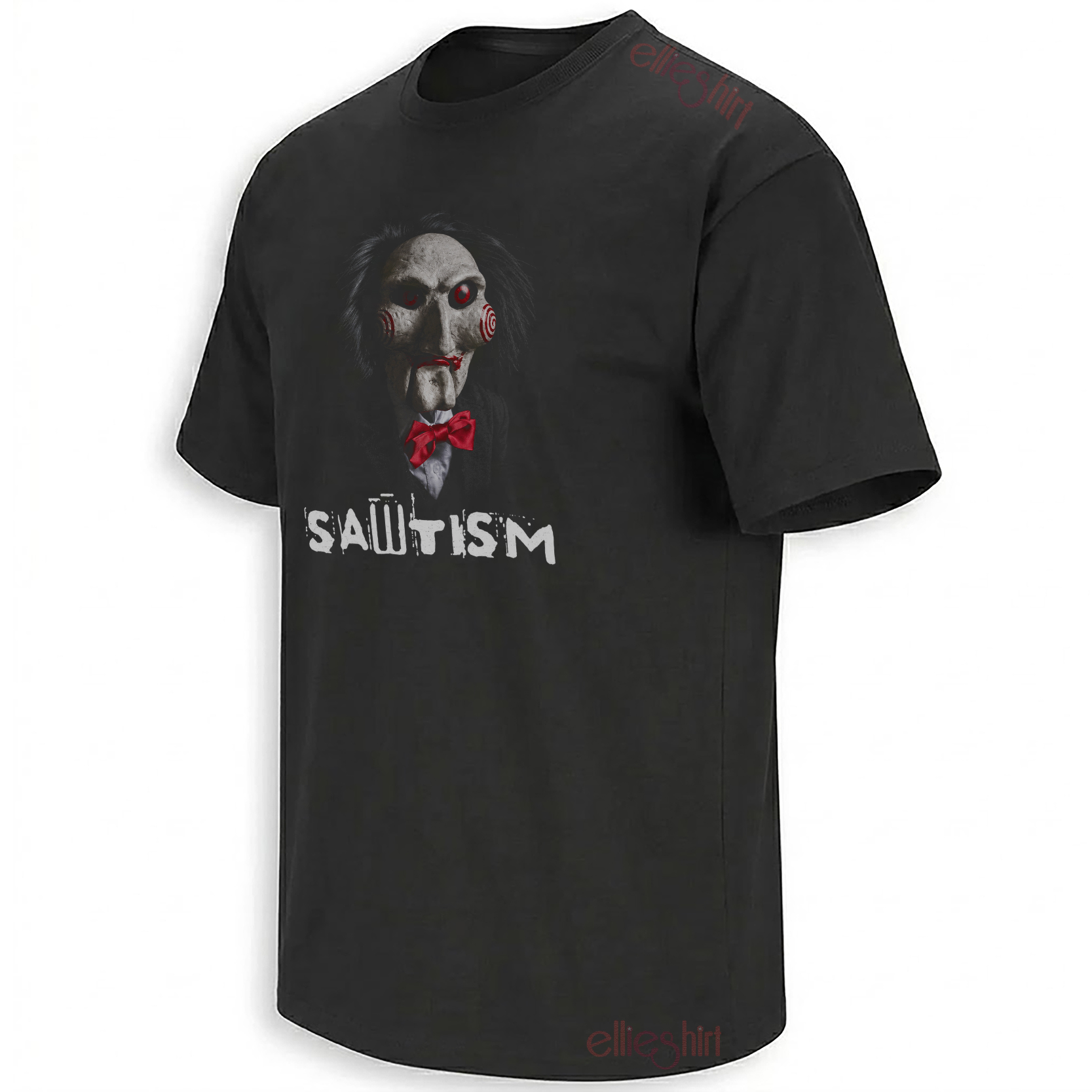
The design does not need an elaborate trap room to communicate Saw. Billy the Puppet already carries the franchise’s visual identity: white face, red spiral cheeks, black suit, red bow tie and an expression balanced between politeness and threat.
Within the films, Billy operates as Jigsaw’s messenger. The puppet appears through television screens or in physical form to deliver instructions, explain tests and place victims inside John Kramer’s theatrical moral universe.
Billy is therefore more than a creepy doll. The image signals that a game is about to begin, rules are about to be announced and an ordinary room is about to reveal itself as a constructed nightmare.
For a fandom joke, that recognizability is essential. The viewer sees the spiral cheeks and understands the first half of “Sawtism” before reading the word.
The Artwork Treats the Meme Like a Horror Diagnosis
The graphic places the pun beside Billy’s face as though he is presenting a new condition from one of Jigsaw’s recorded messages. That visual relationship gives the joke its dark theatricality.
The heavy black field creates the atmosphere of a television screen emerging from darkness. White and grey establish Billy’s mask-like face, while the red spirals and lettering provide the only aggressive color.
The distressed finish keeps the composition connected to the industrial visual language of Saw: damaged surfaces, decaying rooms, mechanical devices and recordings that appear to have survived somewhere they should not.
Why Horror Attracts Intense Fandom
Horror franchises are unusually compatible with concentrated interest because they reward cataloguing. Fans can organize killers, victims, timelines, practical effects, rules, weapons, locations and theories with almost archival precision.
Saw intensifies that tendency. The series contains interconnected flashbacks, apprentices, hidden motives, repeated visual symbols and traps whose mechanisms invite detailed analysis.
A viewer can enjoy the films simply as suspenseful entertainment. A deeply invested fan can spend years reconstructing chronology, judging the fairness of individual tests or explaining how one brief scene changes the meaning of an earlier sequel.
Billy, the red spiral, the tricycle and the industrial traps create a catalog of instantly recognizable objects.
Flashbacks and overlapping plots invite viewers to reconstruct who knew what, when each test occurred and which disciple was responsible.
Fans repeatedly debate whether Jigsaw’s philosophy is internally consistent or merely violence disguised as moral instruction.
Autistic Humor Is Not Automatically Self-Hatred
Disability-related humor is often evaluated only by looking at the word being used. That can miss the relationship between the speaker, audience and target.
An autistic person joking about the intensity of a special interest may be expressing affection, recognition or relief. The humor can say: this pattern is part of my life, other people here understand it and I do not need to present it in clinical language.
That is different from a non-autistic person using autism as a synonym for stupidity, social failure or irrational obsession. In that version, autistic people are not participating in the joke; they are being reduced by it.
The distinction is not always visible from the artwork alone. Ownership, audience and intention determine much of the meaning.
Self-directed humor and autistic community humor carry a different relationship to the language than mockery imposed from outside.
The strongest reading targets the fan’s overwhelming Saw fixation—not autistic dignity, intelligence or humanity.
A community password creates recognition among people who share the experience; a slur creates distance at someone else’s expense.
Yes. Autistic people are not one audience with one humor preference, and no reclaimed joke becomes universally comfortable.
Language Preference Is Personal, Even Within the Community
Many autistic adults prefer identity-first language such as “autistic person” because they understand autism as inseparable from perception, communication and identity rather than as an accessory attached to an otherwise unchanged person.
Other people prefer person-first language such as “person with autism.” Neither preference should be imposed on an individual who has expressed a different choice.
“Sawtism” belongs to a much less formal register. It is not appropriate diagnostic terminology, an educational definition or a respectful default label for another person. It is fandom slang.
Treating it as slang preserves both its humor and its limits.
Dark Humor Creates Distance From Clinical Language
Formal discussions of autism often revolve around assessment, support needs, accommodations and social barriers. Those conversations are necessary, but they do not contain the full emotional life of autistic people.
Meme culture supplies another register: absurd, specific, self-aware and resistant to inspirational messaging. A joke about being consumed by Saw may communicate more personality than another generic statement about awareness.
Dark humor also fits horror fandom because the genre already transforms fear, pain and taboo into controlled entertainment. Fans rehearse discomfort in a fictional space where they can pause, analyze and laugh.
“Sawtism” brings those two strategies together—using horror language to joke about the intensity of a real cognitive pattern.
Billy Is a Messenger Rather Than the Real Villain
Billy is often described casually as the killer doll from Saw, but the puppet does not independently design or execute the tests. Billy is an object used by John Kramer and his successors.
That distinction strengthens the graphic. Billy functions like a spokesperson delivering the diagnosis of fandom obsession. The puppet’s still face makes the message feel official, while viewers familiar with the films understand that another intelligence is operating behind it.
The design therefore borrows the structure of a Jigsaw tape: recognizable messenger, concise declaration and an audience expected to understand that a game has already begun.
The Pun Compresses an Entire Fan Identity
Strong fan apparel often works like a password. It does not explain every reference because explanation would destroy the pleasure of recognition.
Someone unfamiliar with Saw may read the word as strange or provocative. A fan recognizes the title embedded inside it. An autistic horror fan may recognize a second layer: the experience of having an interest become unusually detailed, persistent and emotionally regulating.
Those layers allow one word to do the work of a much longer biography.
The Graphic Is Intentionally Not an Awareness Design
Autism-related apparel is often built around awareness ribbons, inspirational phrases or messages written from the perspective of relatives and supporters.
“Sawtism” rejects that visual language. It is darker, stranger and centered on a specific interest rather than a generalized request for acceptance.
That difference can be appealing to autistic adults who do not identify with child-centered or sentimental representations of autism. It presents neurodivergence as capable of irony, horror taste and difficult humor.
It should not replace serious advocacy. It does not need to. Its function is self-expression rather than public education.
“Sawtism” is a horror-fandom pun. It should never be used to diagnose someone, dismiss support needs or suggest that liking Saw is evidence of autism.
Why Some Viewers Will Still Find It Uncomfortable
Reclaimed humor does not create universal consent. An autistic viewer may understand the intended joke and still dislike seeing a disability term merged with a horror franchise.
Another viewer may feel that the design reflects exactly how their friend group speaks. Both responses can be legitimate because autistic people do not share one aesthetic, political position or tolerance for dark humor.
The responsible interpretation is therefore neither “this is automatically offensive” nor “nobody is allowed to be offended.” Context explains the joke; it does not dictate every reaction.
The Design Works Best as Self-Identification
The most coherent wearer is someone who understands both halves of the pun and chooses the language for themselves: a Saw fan, an autistic horror fan, a neurodivergent meme enthusiast or someone whose relationship with the franchise has become an ongoing joke among friends.
In that setting, the graphic reads less like a statement about autistic people generally and more like a personal fandom badge.
The distinction is important. “This describes my fixation” is narrower, more specific and less presumptuous than “this is what autism looks like.”
Horror Fandom Has Always Valued the Outsider
Horror communities frequently attract people who feel misaligned with mainstream taste. The genre offers monsters, survivors, moral ambiguity and social discomfort rather than uncomplicated heroes.
That outsider quality can resonate with autistic fans who have experienced social difference, intense interests or the pressure to make their enthusiasm appear less visible.
A word such as “Sawtism” reverses that pressure. Instead of minimizing the interest, it exaggerates it until the obsession becomes the entire title.
A Cultural Artifact of Neurodivergent Meme Language
The Sawtism graphic belongs to a period in which autistic people increasingly discuss identity, special interests and everyday experiences through memes rather than relying exclusively on medical descriptions.
The artwork captures one highly specific intersection: autism slang, horror hyperfixation, Billy iconography and the internet’s appetite for compressed hybrid words.
Its cultural value lies in that specificity. It is not attempting to represent every autistic person or every Saw viewer. It represents the small overlap where both identities recognize the joke.
Why the Word Can Outlast One Film Release
The graphic is not attached to one Saw sequel, actor announcement or opening-weekend result. It refers to the franchise as an expandable archive.
Every return to the series can reactivate the joke. A fan may move on to another interest for months and then return when a new trailer, rewatch or timeline discussion brings the fixation back.
That cyclical quality is already part of how fans describe “Sawtism.” It can fade, return and become intense again without requiring the word to change.
Frequently Asked Questions
What does “Sawtism” mean?
“Sawtism” is an informal blend of Saw and autism, commonly used as dark fandom humor for an intense interest or hyperfixation involving the Saw horror franchise.
Is “Sawtism” a real diagnosis?
No. It is internet and fandom slang, not a clinical term, diagnostic category or reliable indication that someone is autistic.
Is the design making fun of autistic people?
Its most contextual reading is self-directed or reclaimed humor about autistic horror fandom and hyperfixation. However, meaning depends on who uses it, and some autistic people may still dislike the term.
Why does the graphic use Billy the Puppet?
Billy is one of the Saw franchise’s most recognizable visual messengers, identified through the white face, red spiral cheeks, black suit and association with Jigsaw’s recorded instructions.
What is a hyperfixation?
Hyperfixation generally describes an unusually concentrated period of attention on an activity or subject, sometimes making it difficult to shift focus toward other tasks.
Do all autistic people prefer this kind of humor?
No. Autistic people have varied humor, language and identity preferences. A reclaimed joke that feels affirming to one person may feel uncomfortable or disrespectful to another.
Does liking the Saw movies mean someone is autistic?
No. Fandom preference cannot diagnose autism. The word is a playful exaggeration, not a statement about who can enjoy horror.
The Sawtism piece combines Billy-inspired horror iconography with neurodivergent meme language, preserving the moment a deeply specific Saw fixation became its own dark-humor identity.
Sawtism Shirt combines Billy the Puppet-inspired horror imagery, distressed red typography and autistic hyperfixation humor in a dark Saw fandom graphic intended as provocative, self-aware neurodivergent expression.