
Alex Tuch Enters Washington’s Next Level: Why an 8-Bit Hockey Graphic Fits the Capitals’ New No. 89
Washington’s acquisition of Alex Tuch already carried the scale of a franchise move. Rendered as a pixel-era hockey character, the new Capital becomes something equally familiar to sports fans and gamers: a major player unlocked at the beginning of a new level.
Alex Tuch became a Washington Capital on June 24, one day after the organization acquired Jordan Kyrou and less than a week before NHL free agency opened. The timing made the move feel like part of a larger roster reset rather than a single isolated transaction.
Buffalo signed Tuch to an eight-year, $84 million contract before sending him to Washington for David Kampf and a 2027 third-round draft pick. The commitment placed him inside the long-term architecture of the Capitals immediately, while his 33 goals and 66 points from the 2025–26 season supplied the production behind the investment.
The first stage of his Washington identity arrived just as quickly. No. 89 remained attached to his name. Fan phrases began forming. Crown graphics, power-forward slogans and now an 8-bit hockey scene transformed the transaction into a visual event before Tuch had played his first shift at Capital One Arena.
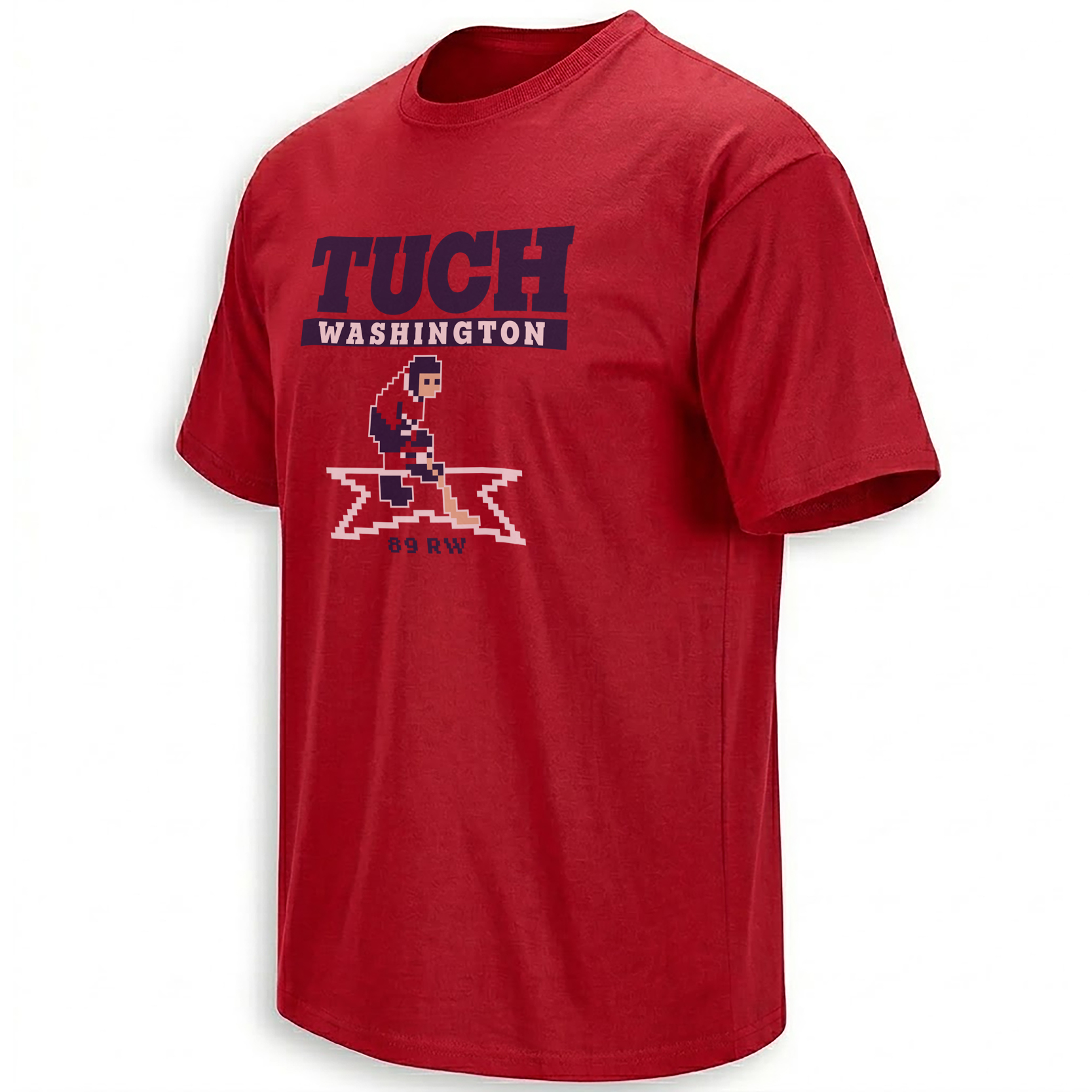
The 8-bit image captures the exact emotional logic of the trade: Washington selected a new power forward, confirmed the number and pressed start on another era.
A Trade That Looked Like a Roster-Screen Upgrade
Major sports transactions often resemble the character-selection phase of an old video game. Fans study the new player’s attributes, imagine combinations with the existing lineup and debate which weaknesses the addition is supposed to solve.
Tuch arrives with attributes that are easy to visualize. Size. Reach. Straight-line speed. Net-front presence. Penalty-killing experience. A reliable goal total and a willingness to absorb or initiate contact.
Washington did not acquire a specialist with one narrow use. It acquired a player whose value can shift according to the game state. Tuch can play on a scoring line, defend late, pressure shorthanded and create offense through possessions that begin below the circles rather than in open ice.
At 6-foot-4, Tuch can protect possession, extend plays and attack defenders with a frame built for contact.
His 33 goals in 2025–26 marked the third time in four seasons that he reached at least that total.
Tuch has contributed at even strength and on the penalty kill, giving Washington more than a one-dimensional scorer.
In gaming language, the Capitals did not add a cosmetic skin. They added a playable character expected to change how the team advances through difficult levels.
Why Pixel Art Makes the Arrival Feel Immediate
Pixel art simplifies a subject without making it emotionally empty. A few blocks of color can establish a jersey, a number, a stick position and the outline of a player moving across the ice.
That economy suits Tuch’s arrival because the essential information is already compact: Washington, No. 89, a large right wing and the beginning of a new chapter. The graphic does not need a realistic portrait to communicate who has entered the game.
The block-built style also creates distance from official transaction photography. Instead of showing Tuch holding a jersey at a press conference, it imagines the version fans are waiting to see—the player already dressed, already skating and already integrated into Washington colors.
The graphic converts a contract announcement into an imagined first shift. Pixelated ice, Capitals colors and No. 89 allow the future to appear playable before the actual season begins.
No. 89 Works Like a Player Code
Jersey numbers operate differently during an offseason arrival than they do after several years with a team. At first, the number is less a record of completed achievements than a code through which fans begin imagining the future.
Tuch’s No. 89 already carries continuity from previous stages of his NHL career. Washington did not need to introduce a completely unfamiliar identifier. It only needed to place the familiar digits inside a different color system.
Pixel art amplifies that effect because numbers are central to old game interfaces. They appear beside player ratings, score totals, life counters and roster selections. In the graphic, 89 functions as both jersey number and interface language.
The digits are also visually strong. The curved shapes remain recognizable even when reduced to blocks, making the number a natural anchor for a retro hockey composition.
Washington’s Offseason Began to Feel Like a New Game Mode
Tuch did not arrive alone. Washington acquired Jordan Kyrou one day earlier, adding a faster, more open-ice scoring profile to the same forward group. The back-to-back moves changed the mood around the club.
Rather than waiting for gradual internal change, the Capitals added two established forwards with significant term remaining on their contracts. One brings speed through transition. The other brings reach, strength and direct movement toward the crease.
That contrast gives the roster a video-game logic of complementary characters. Kyrou can attack space. Tuch can create it. Existing forwards such as Dylan Strome, Tom Wilson, Pierre-Luc Dubois and Aliaksei Protas give the coaching staff additional combinations of skill, physicality and size.
Transition offense, puck carrying and the ability to attack before defensive structure becomes settled.
Reach, finishing, forechecking and the ability to turn sustained contact into offensive-zone possession.
The Capitals are building an attack that can create through both speed and force rather than relying on one repeated pattern.
The Design Captures Hope Before Results
Offseason graphics occupy a specific place in sports culture. They are created before the player has generated defining images in the new uniform. There is no first goal, rivalry moment or playoff shift available yet.
The design therefore records expectation. It captures the period when every line combination remains possible and every projected role can still become larger than imagined.
An 8-bit treatment is especially effective in that space because video games begin with potential. A player appears on the screen with an identity and a set of attributes, but the story depends on what happens after the game starts.
Tuch’s Washington chapter is currently in that opening-screen phase. The contract is signed. The number is established. The role is visible. The first meaningful action remains ahead.
Retro Gaming and Hockey Share the Same Memory Logic
Old hockey games survive in fan memory through simplified movement, exaggerated checks and limited but instantly recognizable team colors. Their graphics could not reproduce the full detail of an arena, so they reduced hockey to its most readable signals.
A skater leaning forward meant speed. A cluster near the crease meant danger. A flashing score meant the game had changed. The limitation created its own visual language.
Modern pixel art reuses that language intentionally. It is not attempting to outperform realistic photography. It is invoking the feeling of controlling a team, selecting a lineup and repeating a season until the desired result appears.
That connection gives the design appeal beyond ordinary nostalgia. It speaks to the shared behavior of sports and gaming fans: studying rosters, learning numbers and imagining the next outcome before it happens.
Tuch’s Game Translates Naturally Into Arcade Form
Certain hockey players fit pixel art because their movement is easy to reduce into a clear silhouette. Tuch is one of them. His size creates immediate visual distinction, while his skating prevents the image from becoming static.
He is not simply a stationary net-front forward. His best shifts often involve carrying speed through the neutral zone, using reach to maintain possession and forcing defenders backward before contact occurs.
In an arcade-style visual, that profile reads almost like a power-up: a larger character who can still move quickly enough to change the level.
The graphic’s playful style therefore does not contradict the seriousness of the contract. It translates the hockey reason behind Washington’s investment into a more culturally accessible image.
The 2018 Connection Adds a Hidden Level of Meaning
Tuch’s history with Washington did not begin with the trade. During Game 2 of the 2018 Stanley Cup Final, Braden Holtby denied him with the paddle save that became one of the most famous moments in Capitals history.
Washington protected the 3–2 lead, won the series in five games and secured its first Stanley Cup. Tuch remained frozen inside the replay as the player who nearly tied the game before Holtby produced “The Save.”
That history gives his arrival a circular quality. A player once positioned as the opponent in Washington’s championship game now enters the Capitals’ roster with a long-term contract and another pursuit of the same trophy.
In a gaming metaphor, he has crossed from boss battle to playable character.
Alex Tuch was the Vegas forward stopped by Braden Holtby’s iconic paddle save in the 2018 Stanley Cup Final. Eight years later, he enters Washington as one of the players expected to shape the franchise’s next competitive chapter.
A Different Visual From King Tuch
Washington’s early Tuch graphics approach the same transaction from distinct emotional angles. The King Tuch design treats the acquisition as a coronation. The No. 89 warning graphic emphasizes physical expectation.
The 8-bit version is lighter and more future-oriented. It focuses less on status or intimidation and more on the excitement of adding a new character to the lineup.
That difference matters because no single image can contain every aspect of a major player arrival. The crown records the contract’s scale. The warning records the power-forward identity. The pixel scene records anticipation.
Together, they form a visual sequence of the offseason: announcement, identity and imagined action.
Washington Hockey as a Living Visual Archive
The broader NHL Shirts archive follows how trades, jersey numbers, playoff memories and fan phrases become cultural objects rather than disappearing into transaction logs.
The Tuch Washington 8-bit graphic preserves one exact stage of that process: the moment No. 89 became playable in Capitals colors.
It sits naturally beside the earlier King Tuch crown design and Tuch Around and Find Out graphic, each translating the same arrival into a different part of fan language.
Why the Graphic Can Outlast the Offseason
Transaction graphics often feel most relevant during the first days after the announcement. Once the season begins, they risk being replaced by real photographs and actual game moments.
Retro gaming artwork can survive longer because its meaning is not limited to reporting the move. It preserves the emotional state of the move—the feeling that Washington had selected a new player and was waiting to see how the season would unfold.
Even after Tuch records his first goal, the pixel graphic will still point backward to the opening screen. It will recall the period when No. 89 existed primarily as possibility.
That makes it a useful memory object regardless of the exact first-game result. It does not predict the final score. It remembers when the game began.
Frequently Asked Questions
When did Alex Tuch join the Washington Capitals?
Washington acquired Alex Tuch from the Buffalo Sabres on June 24, 2026, after Buffalo signed him to an eight-year contract extension.
What contract did Alex Tuch sign?
Tuch signed an eight-year, $84 million contract with an average annual value of $10.5 million before being traded to Washington.
How many points did Alex Tuch record in 2025–26?
Tuch recorded 33 goals and 33 assists for 66 points in 79 regular-season games with Buffalo.
What number is associated with Alex Tuch in Washington?
Tuch is associated with No. 89, the jersey number used as the central player code in the 8-bit Capitals graphic.
Why is Alex Tuch shown in an 8-bit hockey style?
The pixel-art treatment turns his Capitals arrival into a retro player-selection moment, emphasizing the excitement of adding a new power-forward character to Washington’s lineup.
How does the design connect hockey with gaming culture?
The artwork uses simplified player shapes, team colors and No. 89 like a character code, reflecting how both hockey and video-game fans study rosters, attributes and possible line combinations.
The Tuch Washington 8-bit piece captures Alex Tuch as the Capitals’ newly unlocked No. 89, while the broader hockey archive follows the trades, player identities and fan language shaping the league’s next era.
Tuch Washington Shirt transforms Alex Tuch’s Capitals arrival into an 8-bit hockey player-select scene, pairing No. 89 with Washington colors and the retro-gaming excitement surrounding his eight-year contract and 33-goal season.