
Washington’s 8-Bit Lineup: How Ovechkin, Wilson and Tuch Turn Three Capitals Eras Into One Screen
Alex Ovechkin represents the record-setting history Washington already owns. Tom Wilson carries the physical identity that survived multiple roster cycles. Alex Tuch arrives as the newly unlocked No. 89. Rendered in pixels, the three become a Capitals player-select screen built from legacy, continuity and possibility.
Washington’s hockey future changed shape on June 24 when the Capitals acquired Alex Tuch from Buffalo after an eight-year, $84 million extension. The move followed the acquisition of Jordan Kyrou one day earlier and gave the organization another established scorer at a moment when its most important question remained unanswered.
Alex Ovechkin, the NHL’s all-time goals leader and the central figure in more than two decades of Capitals history, was still considering whether to return for a 22nd season. Tom Wilson, meanwhile, remained the long-tenured bridge between the championship era and whatever Washington builds next.
That uncertainty gives the three 8-bit graphics unusual emotional range. They should not be read as confirmation that Ovechkin, Wilson and Tuch will definitely begin the next season together. They function instead as a visual map of Washington hockey right now: the icon whose decision could close or extend an era, the culture carrier already under contract and the major new player selected for the future.
The pixels do not flatten Washington’s history. They arrange it like a roster screen: the legend, the enforcer-scorer and the new power forward waiting for the next level to load.
Three Players, Three Different Meanings of Washington
A traditional team collage might place Ovechkin, Wilson and Tuch beside one another and allow their visual familiarity to carry the composition. Pixel art demands a more essential reading. Every player has to be reduced to a number, silhouette, posture and recognizable role.
That reduction reveals why the trio works. Ovechkin is not simply another winger in Capitals colors. He is the record, the captain, the one-timer and the figure through whom an entire generation learned to recognize Washington hockey.
Wilson is the player who preserved the team’s confrontational personality while expanding beyond the old label of enforcer. His scoring growth, leadership and willingness to defend teammates made No. 43 part of the club’s competitive architecture rather than a supporting detail.
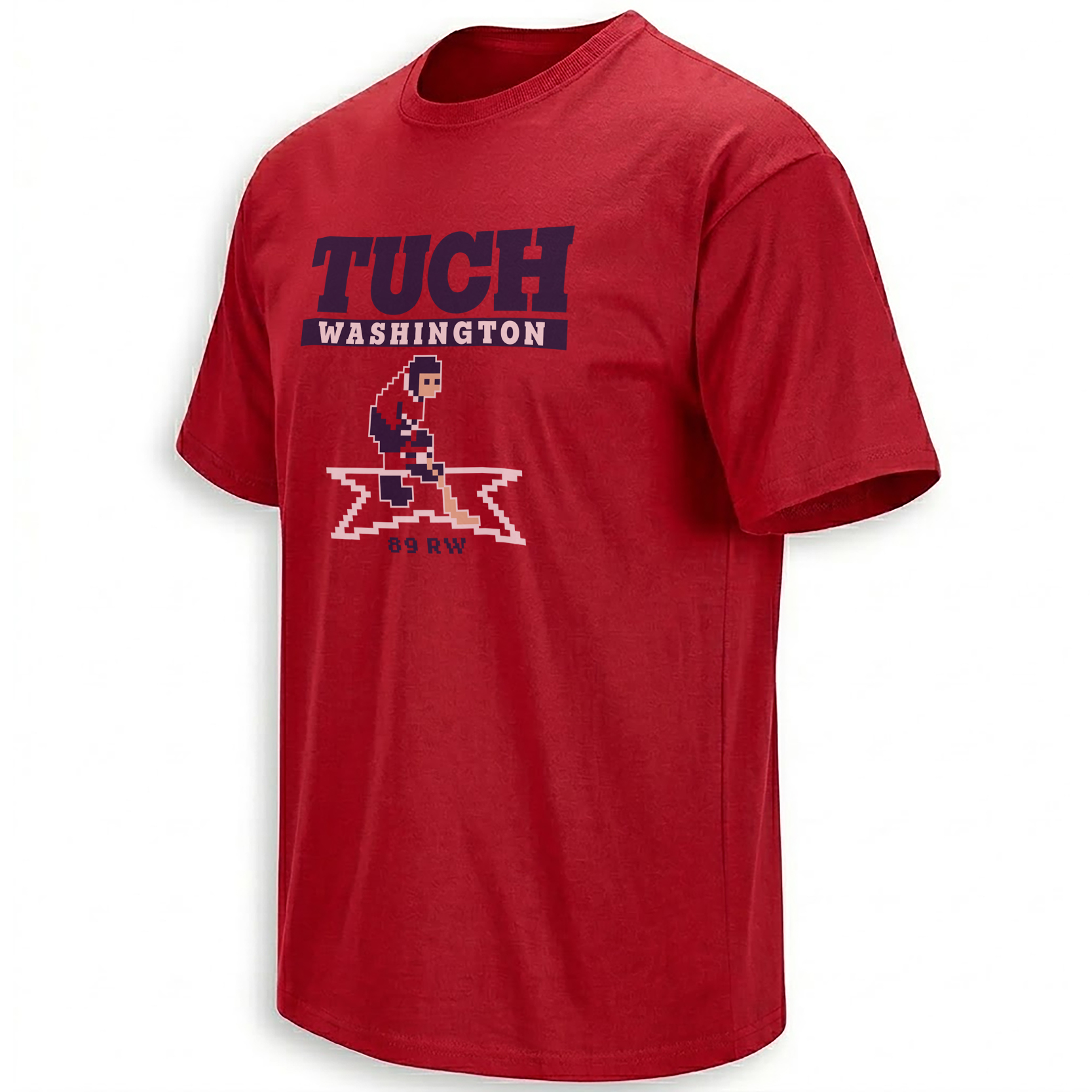
Tuch is the new selection. His Washington résumé remains unwritten, but the reasons for the investment are already visible: 33 goals in 2025–26, a 6-foot-4 frame, penalty-killing value and an eight-year commitment that identifies him as part of the next core.
The NHL’s all-time goals leader and the face of Washington’s transformation from ambitious franchise to Stanley Cup champion.
A physical culture carrier whose game combines contact, net pressure, leadership and increasingly substantial scoring.
The long-term addition whose size, reach and 33-goal season give Washington a new power-forward identity to develop.
Ovechkin Is the Character Who Changed the Entire Game
Every long-running sports game eventually develops one player whose presence changes the scale of the franchise. For Washington, that player is Ovechkin. His identity cannot be separated from the Capitals’ modern visual culture: red jersey, yellow laces, No. 8, left circle and the low-slung shooting posture recognized before the puck leaves his stick.
In April 2025, Ovechkin scored career goal No. 895 and passed Wayne Gretzky to become the NHL’s all-time leading goal scorer. The record converted a pursuit that had followed Washington for years into permanent league history.
His 8-bit design works because the movement has already become iconic enough to survive simplification. A few blocks can suggest the raised stick, the shooting angle and the Capitals uniform. The viewer supplies the rest from memory.
The graphic also arrives during a period of uncertainty. Ovechkin completed the final season of his contract in 2025–26 and said he would consider his future with his family. That status should remain part of the interpretation. The pixel image preserves the Capitals version of Ovechkin regardless of whether another playable season follows.
Ovechkin’s 8-bit graphic represents his established Washington legacy. At the time of publication, his decision about returning for another NHL season had not been publicly finalized.
Wilson Is the Character Who Survived Every Difficulty Setting
Tom Wilson’s place in Washington culture was originally built through force. Heavy checks, fights, confrontations and a willingness to enter the most volatile part of a game made him immediately recognizable.
Over time, that identity became more complete. Wilson developed into a top-six forward, penalty killer, power-play option and dressing-room leader. His 33-goal, 65-point performance in 2024–25 established career highs and demonstrated that the physical persona no longer explained the full player.
During 2025–26, Wilson reached 200 NHL goals and represented Canada at the Milano Cortina Winter Olympics. Those milestones moved him further from caricature. No. 43 still represents confrontation, but it also represents longevity and the ability to remain valuable as the league changes.
In video-game language, Wilson is not a one-attribute character. His profile combines strength, finishing, leadership and durability. The opponent may notice the hit first, but Washington now expects the shift to produce offense as well.
Tuch Is the New Player Washington Just Unlocked
Tuch’s graphic carries a different emotional charge because it imagines action before Washington fans have seen it. The number is confirmed. The contract is real. The role is projected. The first Capitals goal remains in the future.
That makes the 8-bit treatment particularly appropriate. Video-game selection screens introduce characters through possibility. Players arrive with measurable attributes, but the experience depends on what happens after the selection is made.
Tuch enters Washington with an eight-year contract carrying a $10.5 million annual value. He scored 33 goals and 66 points in 79 games for Buffalo during 2025–26, while also contributing defensively and on the penalty kill.
His size adds another immediate layer. Tuch is listed at 6-foot-4 and 219 pounds, giving the Capitals a forward capable of combining reach, skating and direct movement toward the net. In arcade form, he resembles the larger character who can still travel quickly enough to alter the level.
Why the Three-Player Screen Feels Bigger Than a Roster
Taken separately, the graphics celebrate three individual players. Viewed together, they form a compressed history of how a franchise changes without losing every part of itself.
Ovechkin represents the transformative era—the period in which Washington found its global superstar, broke the championship barrier and eventually watched its captain rewrite the NHL goals record.
Wilson represents continuity. He played beside the championship core, remained after many familiar teammates departed and developed into one of the players responsible for transmitting Capitals culture into a younger room.
Tuch represents intentional succession without pretending to be a direct replacement. Washington cannot recreate Ovechkin by acquiring another winger. It can, however, build a new forward group around established scorers whose identities fit the club’s preference for direct, difficult hockey.
The collection is best understood as a Washington hockey timeline, not as confirmation of a final opening-night line: Ovechkin as legacy, Wilson as continuity and Tuch as the newly selected future.
The 8-Bit Style Removes the Normal Hierarchy
Realistic sports imagery naturally creates hierarchy through fame, facial recognition and photographic drama. Ovechkin would dominate almost any conventional Capitals collage because his historical scale is impossible to ignore.
Pixel art changes that relationship. Each player becomes part of the same visual system. The body is built from comparable blocks. Team colors repeat. Names and numbers perform more of the identifying work.
That does not make the players equal in historical achievement. It makes them compatible inside one design language. The legend, the veteran power forward and the newcomer can occupy adjacent screens without the composition pretending their stories began at the same time.
This is one reason gaming culture works so effectively as a sports metaphor. Every roster contains characters with different ratings, histories and roles, but all become available through the same interface.
The Numbers Create a Capitals Cheat Code
No. 8, No. 43 and No. 89 already carry distinct emotional meanings for Washington fans. Placed together, the digits read almost like an arcade code.
Eight belongs to the franchise’s central icon. Forty-three belongs to the player who made physical commitment inseparable from his Capitals identity. Eighty-nine is the new number, newly dressed in red, white and blue.
Sports numbers work especially well in pixel graphics because early games relied on them for identification. Faces could not carry enough detail, so the number became the shortest route to the player.
The same process occurs here. The viewer may notice the blocks first, but recognition is completed by the digits: Ovi, Willy and Tuch.
Three Graphics, Three Types of Washington Energy
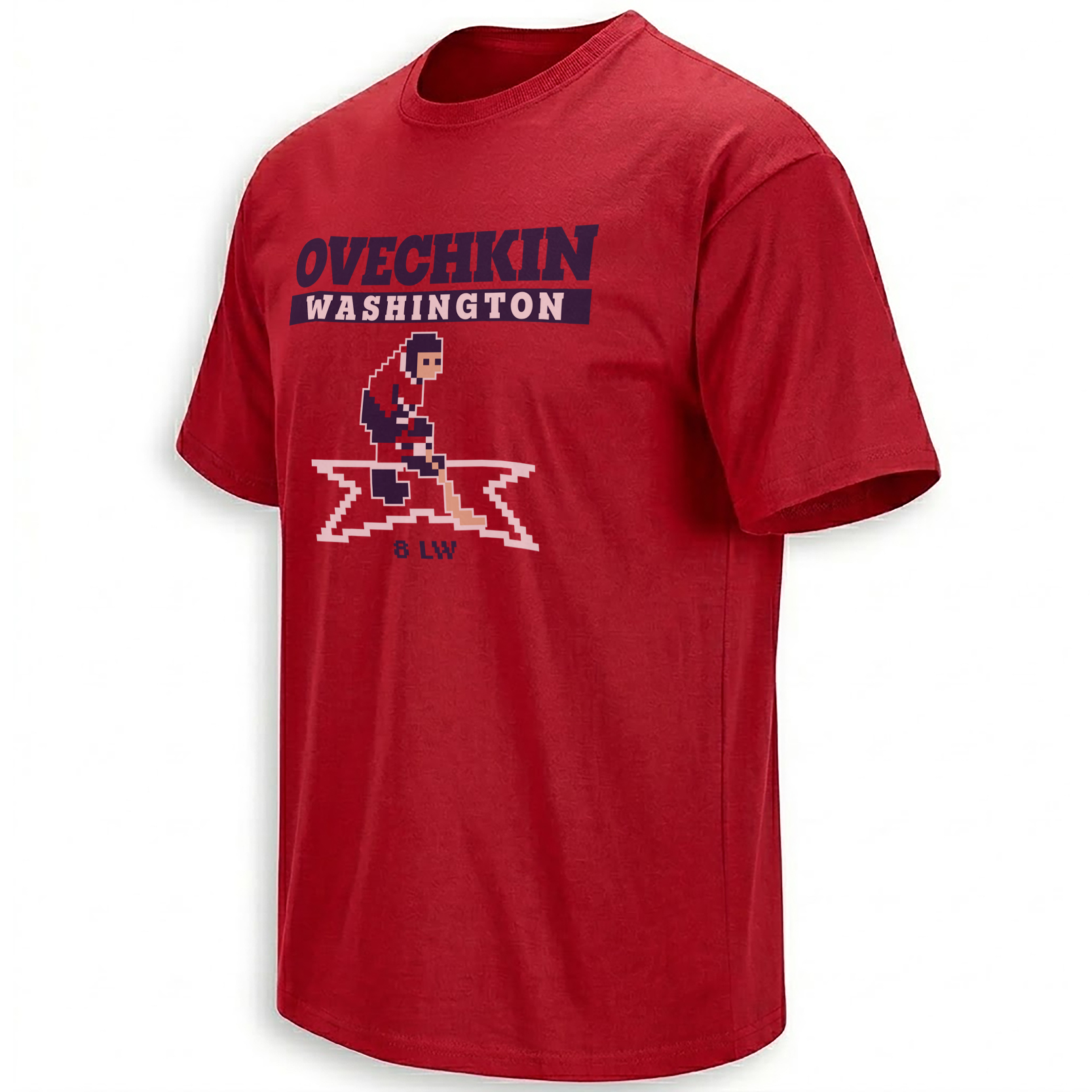
The historic character: Washington’s captain, Stanley Cup icon and NHL goals-record holder translated into pixel-era hockey language.
Open the Ovechkin screen →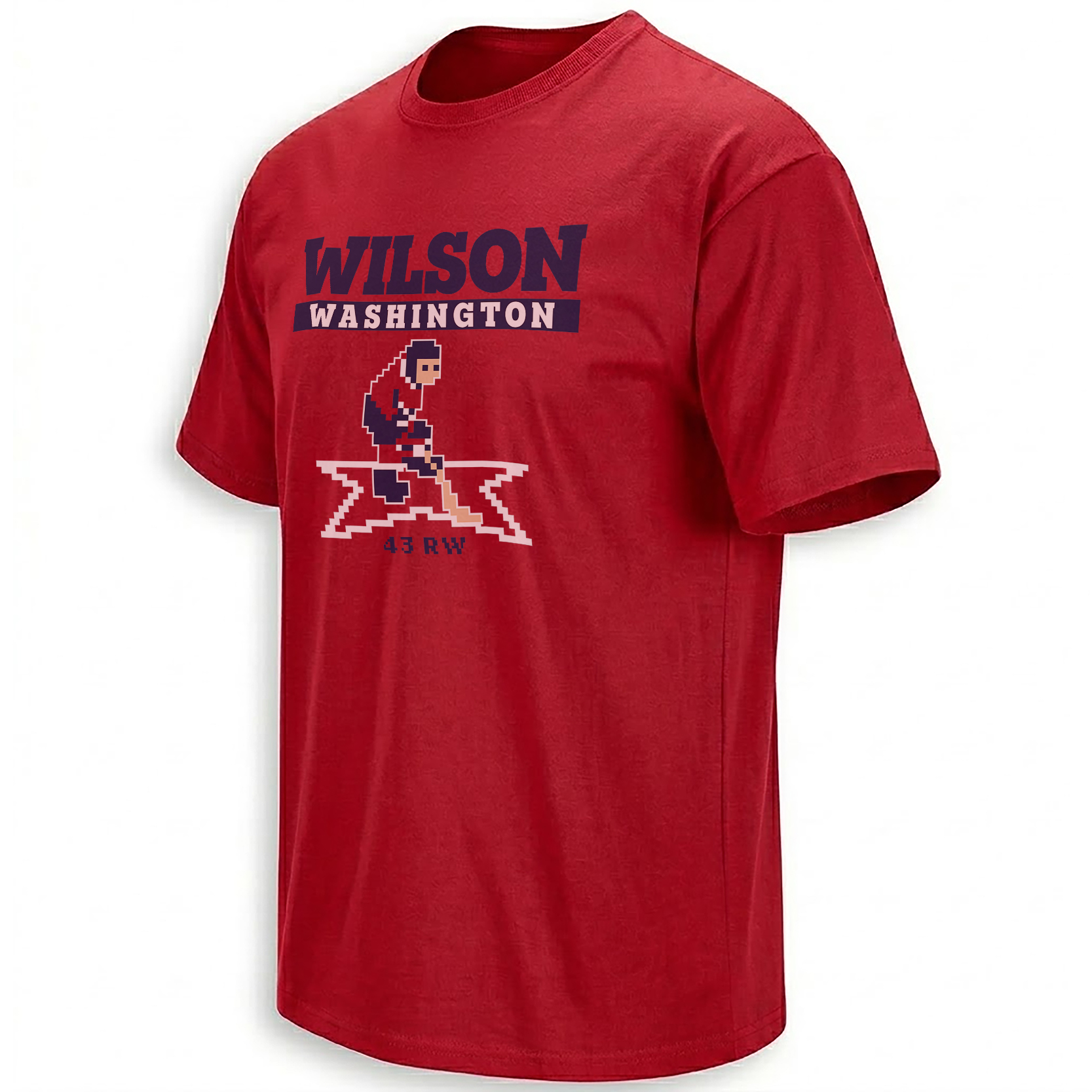
The power character: physical authority, scoring growth and the competitive personality that connects Washington’s eras.
Open the Wilson screen →
The newly unlocked character: a 33-goal power forward entering Washington on an eight-year commitment.
Open the Tuch screen →Ovechkin and Wilson Already Share Championship Memory
Ovechkin and Wilson are not merely long-serving teammates. They belong to Washington’s 2018 Stanley Cup championship image. Both experienced the rounds of frustration that preceded the breakthrough and the road victories that finally carried the Capitals through Vegas.
Their relationship gives the first two graphics a shared historical foundation. Ovechkin was the captain and Conn Smythe Trophy winner. Wilson supplied size, scoring and the emotional volatility that made Washington difficult to contain.
As other members of that team retired or moved elsewhere, Nos. 8 and 43 remained recognizable links to the Cup run. Their continued presence allowed Washington to evolve without making the championship era feel entirely sealed behind glass.
The 8-bit versions resemble old save files from that history—familiar characters carried forward even as the surrounding roster changes.
Tuch Has Already Appeared in Washington’s Championship Game
Tuch’s connection to Capitals history began from the opposite side. As a Vegas Golden Knights rookie in the 2018 Stanley Cup Final, he was the forward denied by Braden Holtby’s extraordinary paddle save late in Game 2.
“The Save” protected a 3–2 Washington lead and became one of the defining frames of the championship run. Tuch remained forever visible inside the replay as the player positioned at the edge of a tying goal.
His move to Washington eight years later gives the three-player collection a hidden narrative. Ovechkin and Wilson were on the championship team protected by Holtby’s save. Tuch was the opponent stopped by it.
Now all three can appear within one Capitals visual universe. In the language of gaming, a former boss-level opponent has been added to the playable roster.
Wilson and Tuch Could Give Washington a Different Kind of Scale
Wilson and Tuch are both large right wings, but reducing them to size would miss the tactical reason their presence is intriguing. Each has developed scoring value substantial enough to occupy a top-six role.
Wilson reached 33 goals during his career-best 2024–25 campaign. Tuch scored at least 33 goals in three of the four seasons preceding his move to Washington. Both can play through traffic, reach the net and make defensive possessions physically expensive.
Their coexistence could give Washington multiple ways to distribute difficult minutes. One line would not need to contain all of the forechecking, net-front work or deterrence. The physical identity could move through the lineup.
That possibility explains why the Wilson and Tuch pixel characters feel related without being interchangeable. They belong to the same power category, but each arrives with a different history and a different place in Washington’s timeline.
The Ovechkin Decision Changes the Meaning of the Screen
Should Ovechkin return, the collection can be read as an imagined overlap between Washington’s defining superstar, its established culture carrier and its major new forward.
Should he decide not to return, the Ovechkin graphic takes on a more archival role. It becomes the legacy character positioned beside two players carrying parts of the franchise forward.
Neither interpretation weakens the visual concept. The uncertainty is part of the reason it feels timely. Washington is currently suspended between preserving one more year of the familiar era and accepting that the transition may already be fully underway.
Pixel art is unusually capable of holding both emotions. Old games preserve characters even after the real rosters change. The player remains selectable inside memory.
Why Retro Gaming Fits Capitals Fandom
Washington’s modern rise overlaps with generations that experienced hockey through both live broadcasts and sports video games. Fans learned rosters by playing seasons, repeating matchups and assigning exaggerated meaning to digital versions of familiar players.
Early hockey games could not reproduce individual faces with realism. Identity came from color, number, handedness and the movement players imagined onto the blocks.
The Capitals trio uses that memory structure deliberately. Red, white and blue establish Washington. No. 8, No. 43 and No. 89 establish the players. The viewer converts the remaining pixels into slap shots, hits, forechecks and drives toward the crease.
The designs therefore do not simply make hockey look old. They recall the participatory way fans once built entire seasons from limited graphics.
The Collection Functions Like a Franchise Save File
Sports teams rarely move cleanly from one era to another. Older identities remain active while new ones begin forming. Veterans carry habits forward. New arrivals change the tactical balance. Icons become reference points even after their playing status changes.
The three Washington graphics preserve that overlap. Ovechkin is the historical file that cannot be overwritten. Wilson is the character carried into the next roster update. Tuch is the new addition whose Washington statistics still begin at zero.
Together, they create a visual save point for late June 2026—the week Washington made a major long-term move while waiting for the captain who defined the previous two decades to decide what came next.
A Wider Archive of Hockey’s Changing Rosters
The broader NHL Shirts archive follows the way trades, jersey numbers, record chases, playoff moments and fan phrases become graphic memory.
Within that archive, the Washington 8-bit series offers something more structured than three separate player images. It shows how one franchise can contain historical greatness, established physical culture and a newly acquired future at the same time.
The Ovechkin graphic preserves the icon, the Wilson graphic preserves the bridge, and the Tuch graphic records the moment a major new player was added.
Why the Pixel Trio Can Outlast One Offseason
The designs are rooted in a specific moment, but they do not depend on one projected line combination becoming reality. Their deeper subject is Washington hockey identity.
Ovechkin’s record and championship place are permanent. Wilson’s long tenure and connection to the 2018 team are already established. Tuch’s June 2026 acquisition and eight-year contract will remain part of the franchise timeline regardless of the result of his first game.
That makes the collection less fragile than ordinary offseason speculation. It does not promise a particular goal total or postseason ending. It preserves the characters Washington had selected, retained and remembered at a major transition point.
The final screen has not loaded. The player identities already have.
Frequently Asked Questions
Which Washington Capitals players appear in the 8-bit hockey series?
The series features Alex Ovechkin as No. 8, Tom Wilson as No. 43 and Alex Tuch as No. 89.
Does the artwork confirm that Ovechkin, Wilson and Tuch will play together?
No. Wilson and Tuch are part of Washington’s ongoing roster plans, while Ovechkin was still considering his NHL future at the time of publication. The trio functions as a visual timeline of Capitals legacy, continuity and change.
Why is Alex Ovechkin represented by No. 8?
No. 8 has defined Ovechkin’s Capitals career, including the 2018 Stanley Cup championship and his rise to become the NHL’s all-time leading goal scorer.
What does Tom Wilson represent in the collection?
Wilson represents Washington’s physical identity and continuity, connecting the 2018 championship team with the Capitals roster being built for the next era.
When did the Capitals acquire Alex Tuch?
Washington acquired Tuch from the Buffalo Sabres on June 24, 2026, after he signed an eight-year, $84 million contract.
Why does 8-bit art fit this Capitals trio?
Pixel art creates a shared player-select language for three different stages of Washington history: Ovechkin as the legendary character, Wilson as the established power player and Tuch as the newly unlocked addition.
Explore the Ovechkin, Wilson and Tuch 8-bit pieces as three connected screens from a Capitals franchise moving between championship memory and its next long-term roster.
Washington Capitals 8-Bit Shirt series brings Alex Ovechkin No. 8, Tom Wilson No. 43 and Alex Tuch No. 89 into one retro hockey player-select concept connecting franchise history, physical identity and Washington’s changing era.