
Oklahoma’s Championship Found Its Softest Symbol A Teddy Bear Running Home With the 2026 Title
Oklahoma’s 13–2 victory over North Carolina gave the Sooners their third baseball national championship. The teddy bear graphic translates that enormous Omaha achievement into something smaller, warmer and deeply familiar: a collegiate character that looks ready to carry the memory from one generation of OU supporters to the next.
The first images of Oklahoma’s championship were built from adrenaline. Players raced toward the mound at Charles Schwab Field, disappeared beneath a dogpile and celebrated a 13–2 victory that ended the program’s 32-year wait for another baseball national title.
By the following morning, the meaning of the victory had already begun to soften around its edges. Parents were sharing the moment with children. Supporters who remembered 1994 were placing the newest championship beside an older version of themselves. The Sooners’ third title was becoming family history almost as quickly as it had become sports history.
That emotional transition explains why a teddy bear can belong inside the championship conversation. Oklahoma won through pressure, power hitting and an unforgiving NCAA Tournament route, but fans do not preserve every title only through fierce imagery. Some memories survive because they become affectionate.
The dogpile recorded how Oklahoma won. The teddy bear records how families may remember what the victory felt like.
The Championship Was Historic Before It Became Nostalgic
Oklahoma defeated North Carolina on June 22 in the deciding third game of the Men’s College World Series championship. The Sooners had won the opener 9–3, lost Game 2 by a 6–2 score and entered Monday night with the entire season reduced to one final game.
The expected tension never fully arrived. Oklahoma scored twice in the second inning, added another run in the third and built separation with three in the fourth. The offense continued producing until Kyle Branch’s three-run home run in the eighth helped turn the final innings into a championship countdown.
Branch finished with three hits and six RBIs. Jaxon Willits reached base five times and completed an Omaha performance that earned him Most Outstanding Player recognition. LJ Mercurius delivered 5.2 innings of stabilizing relief before Jackson Cleveland struck out three consecutive hitters to end the season.
The final score gave Oklahoma its third baseball national championship, joining the title teams of 1951 and 1994. It was also the program’s first championship in 32 years, long enough for the previous victory to have moved from recent memory into inherited history.
The Sooners defeat North Carolina and move within one victory of the title.
North Carolina responds and forces a winner-take-all conclusion in Omaha.
Thirteen runs and a long relief performance complete the Sooners’ third title.
That history creates the serious foundation beneath the playful artwork. The teddy bear does not make the championship smaller. It shows how a major athletic achievement can enter everyday fan life after the official ceremony is over.
Why a Teddy Bear Belongs in College Sports Culture
Teddy bears occupy a specific place in visual culture. They represent childhood, comfort, collection and memory. In collegiate design, those associations often merge with school colors and varsity uniforms, producing characters that feel like they were discovered in an old campus bookstore.
The Sooners 2026 National Champions Shirt places that familiar character inside Oklahoma baseball history. The bear wears a crimson OU uniform and matching cap, holds a stitched baseball and runs forward beneath oversized Sooners lettering.
It is not presented as Oklahoma’s official mascot. The character works more like an imagined supporter who has stepped into the celebration, dressed for the team and taken possession of the championship ball.
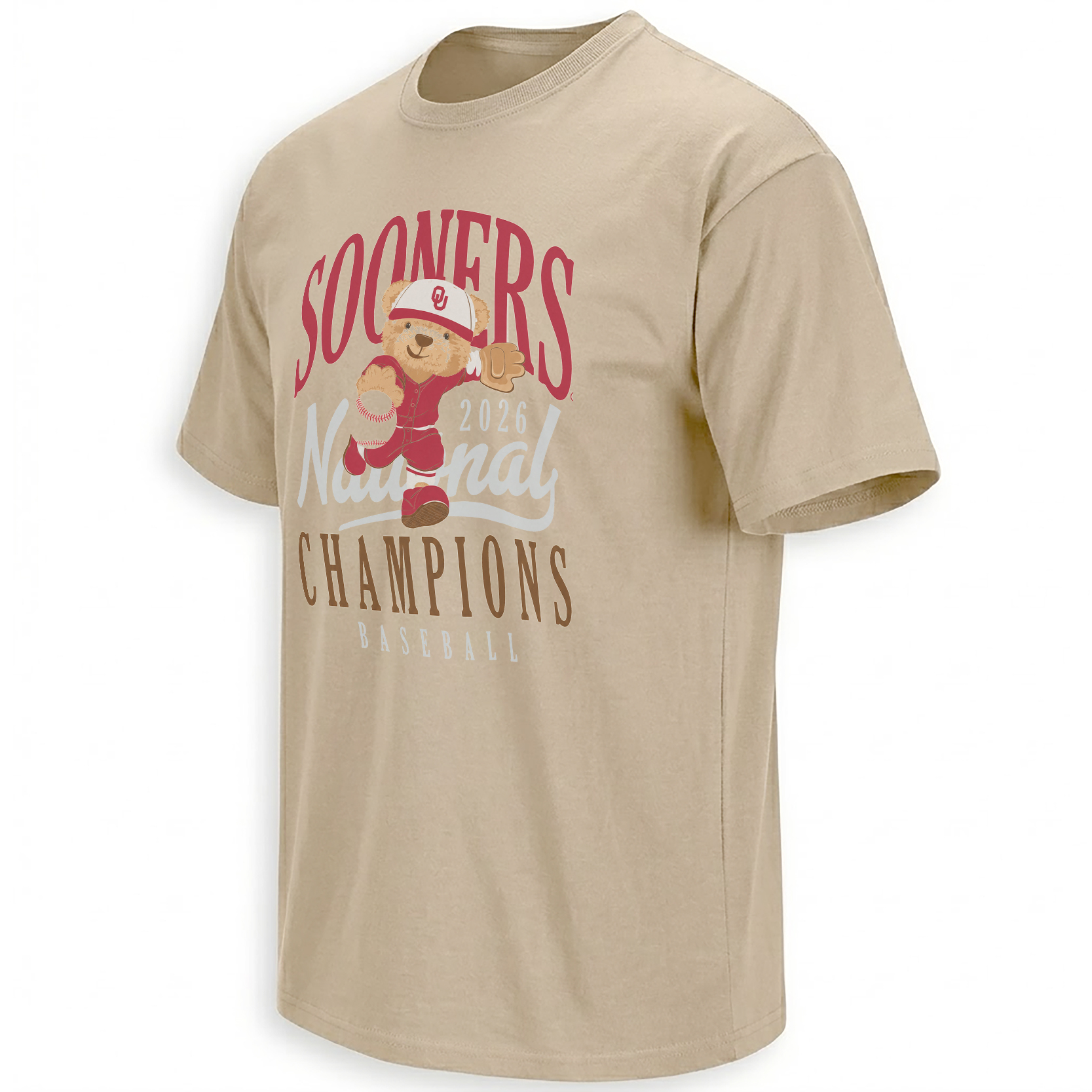
The running pose prevents the bear from feeling passive or decorative. One foot extends forward, the baseball remains visible in its paw and the raised opposite hand gives the character the energy of someone emerging directly from the dogpile.
That movement preserves the excitement of the final night while the bear’s smile changes the emotional temperature. The graphic celebrates without shouting. It turns the championship into an image that can live equally well inside student culture, family memory and a collector’s archive of unusual Oklahoma designs.
The cap, jersey and pants make the character immediately legible as part of Oklahoma baseball culture.
The ball connects the illustrated character to the sport and gives the bear something tangible to carry home.
Movement and warmth transform the title from a formal announcement into a celebratory keepsake.
The Bear Is Carrying More Than a Baseball
In a literal reading, the character holds a baseball. In the emotional reading created by the design, the bear appears to be carrying the championship itself.
The ball is positioned close to its body rather than tossed casually into the background. That choice makes the object feel protected. It resembles the instinct to hold onto a game-used ball, a ticket stub or a newspaper front page because the object has become inseparable from the memory attached to it.
The image therefore works as a small visual story. Oklahoma travels through the tournament, wins the final game in Omaha and sends this character running home with the title secured in one paw.
The bear’s other hand points outward, giving the pose the personality of a celebration photograph. It could be pointing toward the dugout, the supporters in the stands or the next generation of Sooners fans who will inherit this championship.
The teddy bear turns the championship baseball into a keepsake inside the artwork. Instead of presenting the ball as equipment, the design treats it like the object that carries every inning of Oklahoma’s postseason story back from Omaha.
The Sand Background Makes the Championship Feel Pre-Loved
The warm sand base is central to the design’s character. Oklahoma crimson normally creates an immediate, high-energy contrast against white, black or gray. Sand softens that relationship.
The neutral surface works naturally with the bear’s brown and tan illustration while allowing crimson to remain the most recognizable school-color accent. White lettering stays visible without becoming stark, and muted brown typography gives the lower half of the composition an older, printed-souvenir feeling.
This palette suggests age without forcing the artwork into a heavy sepia treatment. The graphic still belongs to 2026, but it looks capable of living beside older Oklahoma campus pieces.
That visual contradiction is useful. A championship design is new by definition, yet fans often want it to feel permanent immediately. The sand base helps the image appear as though it has already absorbed some of the warmth of future memory.
The Typography Moves Through Three Emotional Registers
“Sooners” arches across the top in tall crimson lettering. The narrow letterforms create a strong collegiate header and establish the school identity before the eye reaches the illustrated character.
“National” then shifts into large white script. This change introduces motion and informality, matching the bear’s running pose. It feels less like an institutional label and more like a celebratory line added after the final out.
“Champions” returns to tall brown lettering below the script, restoring structure and giving the official achievement visual weight. The smaller “Baseball” footer completes the hierarchy by identifying the sport without competing with the championship phrase.
The year 2026 is spaced around the bear, integrating the season into the character rather than isolating it in a separate badge. The result is a composition that moves from school identity to celebration, then from celebration to historical record.
The block letters announce the title. The script celebrates it. The bear makes the whole achievement feel personal.
Why the Design Feels Like a Campus Souvenir
Vintage collegiate character graphics often center on animals wearing school sweaters, varsity jackets or athletic uniforms. They occupy a space between official team branding and playful student culture.
The Oklahoma teddy bear belongs to that lineage. Its rounded body and soft expression create visual familiarity, while the OU cap and baseball uniform anchor the character to a specific school and sport.
The distressed color treatment and mixed typography make the artwork feel closer to something found in a campus shop after a championship weekend than a polished corporate identity system.
That souvenir quality matters because college fandom is tied to place. A university is not only a team. It is a campus, a period of life, a family tradition and often a collection of objects saved long after graduation.
By resembling an illustrated campus keepsake, the bear allows the 2026 title to enter that wider emotional archive.
A Championship Shared Between Generations
Thirty-two years separated Oklahoma’s second and third national championships. That span is long enough to completely change who is watching.
A student who followed the 1994 Sooners could now be watching the 2026 team with adult children. A young fan who knew the previous championship only through record books now has a final score, a dogpile and a roster belonging to their own lifetime.
This is where the teddy bear carries cultural meaning beyond its appearance. Bears are commonly passed between generations, kept on shelves or associated with childhood bedrooms. Placed inside a championship graphic, that symbolism turns the title into something that can be inherited.
The design does not demand that the viewer understand every pitching change or tournament statistic. A child can recognize the happy baseball bear. An adult can read the championship year. A longtime supporter can connect 2026 to 1994 and understand the distance Oklahoma traveled between the two.
Each viewer enters the image at a different level, but they arrive at the same conclusion: the Sooners brought another baseball title home.
The Soft Design Still Carries a Difficult Postseason
The warm character art should not obscure how demanding Oklahoma’s championship route became.
The Sooners entered the NCAA Tournament as an at-large selection and the No. 2 seed in the Atlanta Regional. They moved through Georgia Tech, swept Kansas in the Super Regional and then defeated Alabama, Georgia and North Carolina in Omaha.
Oklahoma beat a succession of nationally seeded opponents on its way to the title. The Sooners’ tournament identity was not based on receiving the safest bracket. It was built through repeatedly surviving teams that had entered the postseason with stronger seed lines.
The offense also transformed late in the year. Home-run production accelerated during the final portion of the season, giving Oklahoma a different level of scoring pressure when every game carried elimination stakes.
The bear’s confident running pose therefore contains more competitive meaning than its soft appearance initially suggests. It is not wandering into the celebration. It is charging out of a postseason Oklahoma had to fight through.
Kyle Branch Created the Final Game’s Joyful Release
Branch’s six-RBI performance supplied the deciding game with its most memorable offensive arc.
He opened the scoring with an RBI single in the second inning, added a two-run single in the sixth and hit a three-run home run during Oklahoma’s four-run eighth.
That final swing transformed a comfortable lead into emotional certainty. It allowed Sooners supporters to stop calculating the remaining outs and begin imagining the trophy presentation.
The teddy bear’s celebratory pose feels connected to that release. The character is not shown waiting nervously. It has already entered the stage after doubt, when the championship baseball can be held openly and the next motion is toward the celebration.
Jaxon Willits Gave the Championship Continuity
If Branch created the title game’s exclamation point, Willits provided the line that ran through Oklahoma’s entire Omaha stay.
The shortstop batted .500 across six Men’s College World Series games and collected 13 hits, the highest Omaha total by an Oklahoma player. He recorded multiple hits in five games and reached base five times in the championship clincher.
His Most Outstanding Player recognition captured the consistency behind Oklahoma’s run. Willits did not define the tournament through one isolated moment. He remained connected to inning after inning, repeatedly giving the offense another opportunity to apply pressure.
That steady presence complements the keepsake reading of the bear. Championships are remembered through spectacular highlights, but they are constructed through the players who repeatedly hold the season together.
Why Fans Need Playful Versions of Serious Achievements
Championship culture naturally produces formal graphics: trophy silhouettes, bracket lines, official dates, team photographs and authoritative block lettering.
Those designs are important because they record the achievement precisely. Yet fans rarely experience a title through only one visual language. Celebration also creates jokes, mascots, cartoons, hand-drawn signs and character graphics.
Playful art gives supporters another emotional entry point. It allows a championship to be displayed in spaces where a dramatic trophy graphic might feel too severe. It also makes the memory accessible to people drawn more strongly to illustration, nostalgia or character-based design.
The teddy bear does not compete with Oklahoma’s formal championship imagery. It expands the archive. The same national title can be remembered as a dominant 13–2 score, a historic dogpile, an Oklahoma state emblem, an Omaha wordplay graphic or a bear carrying the baseball home.
From the Teddy Bear to Oklahoma’s Wider Championship Archive
Oklahoma’s 2026 title generated several distinct visual identities. Some designs focus on the baseball seam. Others emphasize Omaha, the championship trophy, the final score or traditional collegiate emblems.
The teddy bear version occupies the warmest part of that spectrum. It treats the victory as something to preserve emotionally rather than only something to announce.
The wider Oklahoma Sooners collection works as a running visual archive of those different interpretations, following the team through championship seals, Omaha language, vintage collegiate graphics and character-driven artwork.
The broader College Baseball Shirts collection places Oklahoma’s title inside the culture of regionals, Super Regionals, Omaha travel and the distinctive emotional rhythm of the Men’s College World Series.
The NCAA collection connects the Sooners’ baseball championship to the larger world of school identity, inherited rivalries and college sports memories passed through families.
Frequently Asked Questions
When did Oklahoma win the 2026 baseball national championship?
Oklahoma won the title on June 22, 2026, defeating North Carolina 13–2 in the deciding third game of the Men’s College World Series championship at Charles Schwab Field in Omaha.
How many baseball national championships has Oklahoma won?
The 2026 championship was Oklahoma baseball’s third national title, following previous championships in 1951 and 1994.
Why does the design feature a teddy bear?
The teddy bear gives Oklahoma’s championship a warm, nostalgic identity inspired by vintage collegiate character graphics, childhood team loyalty and campus souvenir culture.
Is the teddy bear Oklahoma’s official mascot?
No. The artwork uses a generic teddy bear baseball character dressed in Oklahoma colors rather than depicting an official university mascot.
What is the teddy bear wearing and holding?
The bear wears a crimson Oklahoma baseball uniform and an OU cap while carrying a stitched baseball in one paw and pointing forward with the other.
Why does the sand background suit the artwork?
The warm neutral base complements the brown bear illustration, softens Oklahoma’s crimson palette and gives the newly created championship graphic a vintage campus-keepsake feeling.
The Oklahoma baseball teddy bear graphic preserves the title through character, warmth and vintage collegiate nostalgia, while the wider Sooners championship archive records the many visual languages created by Oklahoma’s return to the top of college baseball.
Sooners 2026 National Champions Shirt gives Oklahoma’s third baseball title a warm vintage identity through a running teddy bear in a crimson OU uniform, a stitched championship ball, oversized collegiate lettering and a sand-toned campus-keepsake aesthetic.