Oklahoma Went to Omaha Then Sooners Fans Renamed the City OklaOmaha
Oklahoma completed its 2026 national championship run with a 13–2 victory over North Carolina, but the final score tells only part of the story. “OklaOmaha” captures how a tournament destination became temporary Sooners territory—and how one piece of fan wordplay preserved the personality of OU’s third baseball title.
By the time the Oklahoma Sooners formed their championship dogpile at Charles Schwab Field, Omaha no longer felt like a neutral destination. Crimson had moved through the concourses, “Boomer Sooner” had followed the team north, and the city at the center of college baseball had acquired a temporary new name: OklaOmaha.
The phrase worked because it captured more than geography. Oklahoma had arrived as an at-large tournament team, moved through a bracket filled with nationally seeded opponents and finished the season with a 13–2 victory over North Carolina in the deciding third game of the championship series.
Within hours of the final out, the championship was being translated into the language fans use when official descriptions feel too formal. The Sooners were national champions, but they had also made Omaha feel like an extension of Norman, the state of Oklahoma and the culture surrounding OU athletics.
Oklahoma did not simply win in Omaha. For one championship night, it made Omaha sound like a place that had always belonged inside Sooners language.
Why “OklaOmaha” Immediately Makes Sense
The strongest fan phrases often require no explanation. “OklaOmaha” combines Oklahoma and Omaha so naturally that the meaning becomes clear before the reader has finished saying it.
Oklahoma supplies the program, the school colors, the state identity and the traditions the team carried throughout the postseason. Omaha supplies the destination—the city synonymous with the final stage of NCAA Division I baseball.
When those names merge, the result describes the entire emotional logic of a College World Series run. A team travels to a neutral city, but its supporters attempt to transform that city through attendance, color, chants and shared memory. The objective is not simply to play in Omaha. It is to leave enough identity behind that the city feels temporarily claimed.
That is what the phrase celebrates. It turns travel into takeover without needing aggressive language. Omaha remains Omaha, but the presence of the Sooners changes how their supporters experience it.
The Final Game Made the Wordplay Permanent
A phrase tied to Omaha only becomes championship language if the team finishes the journey. Oklahoma entered the final night after splitting the first two games against North Carolina, winning Game 1 by a 9–3 score before the Tar Heels forced a decider with a 6–2 victory.
Game 3 therefore carried no narrative protection. Whichever team lost would leave Omaha with an extraordinary season and an unfinished final chapter.
Oklahoma removed that uncertainty inning by inning. The Sooners scored twice in the second, once in the third, three times in the fourth, once in the fifth, twice in the sixth and four times in the eighth. The 13 runs came on 14 hits, creating the feeling of a lead that never stopped expanding.
Kyle Branch drove in six runs, including a three-run home run in the eighth. Jaxon Willits collected three hits, scored twice and drove in two. LJ Mercurius stabilized the game with 5.2 innings of relief, and Jackson Cleveland struck out the final three hitters he faced to close the season.
A 9–3 victory moves the Sooners within one win of the title.
The Tar Heels win 6–2 and force a winner-take-all Monday night.
Thirteen runs and a dominant bullpen finish secure the national championship.
That ending gave “OklaOmaha” a permanent reference point. The phrase would no longer describe only a road trip, a fan gathering or a tournament arrival. It could now describe the city where Oklahoma completed its third national championship.
The Helmet Makes the Design Feel Like It Came From the Dugout
The OklaOmaha National Champs Shirt does not organize the championship around a formal trophy presentation. Its central image is an oversized crimson batting helmet carrying the interlocking OU mark.
That choice gives the graphic a different kind of energy. A trophy represents the ending. A batting helmet represents the act of getting there: stepping into the box, seeing the pitch, absorbing pressure and returning to the dugout after every difficult at-bat.
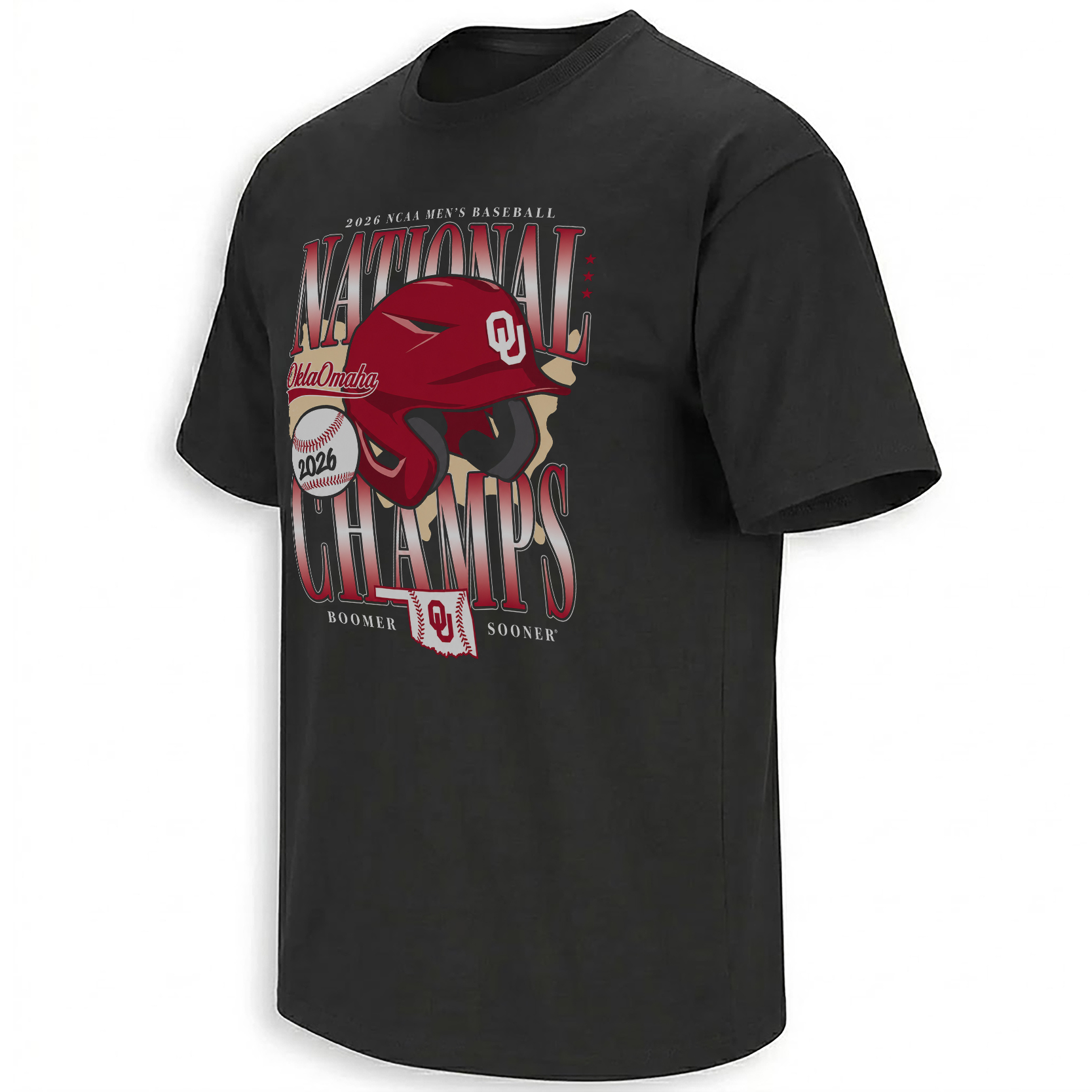
The helmet is angled rather than displayed like a static catalog object. Layered red panels, cream highlights and dark shadows give it the feeling of an illustrated sports poster. The facemask and ear guard make the object feel used and active, as though it has been lifted from the on-deck circle during the most important game of the season.
Behind it, the enormous “National” and “Champs” lettering creates vertical scale. The letters extend beyond the helmet and give the composition the visual density of a concert poster or an old bootleg sports graphic rather than a standard championship logo.
The graphic combines a dugout object, a destination-based fan phrase and oversized poster typography. Its purpose is not to reproduce the official championship ceremony. It preserves how the title felt from inside Oklahoma fan culture: loud, mobile, crimson and unmistakably tied to Omaha.
A 2026 Baseball Turns the Moment Into a Timestamp
A white baseball with crimson stitching sits beside the helmet and carries “2026” in dark numerals. It is a small element compared with the headline typography, but it performs one of the design’s most important functions.
Without the year, OklaOmaha could refer to any successful Oklahoma trip to the College World Series. The 2026 baseball fixes the phrase to one specific roster, one championship series and one final score.
It also introduces a visual contrast. The helmet is large, angular and heavily shaded. The ball is compact, pale and immediately legible. One represents the team’s identity; the other records the season.
Together they form a miniature championship sentence: Oklahoma baseball, Omaha and 2026.
The Oklahoma-Shaped Baseball Brings the Title Home
The smallest symbolic detail appears beneath the “Champs” lettering. An outline of Oklahoma is treated like a baseball, complete with stitched edges and a centered OU mark.
This closes the geographic loop created by OklaOmaha. The phrase sends Oklahoma to Nebraska. The state emblem brings the championship back home.
The shape also prevents the graphic from becoming only an Omaha souvenir. It reminds the viewer that the city was the stage, but the program, community and destination of the trophy remained Oklahoma.
Represents the hitters, dugout energy and on-field pressure carried through every postseason round.
Fixes the wordplay and championship language to one exact season in Oklahoma history.
Returns the Omaha celebration to the state, school and supporters who followed the run.
“Boomer Sooner” Gives the Poster Its Soundtrack
At the bottom of the design, “Boomer” and “Sooner” appear on opposite sides of the Oklahoma-shaped emblem. The words are visually smaller than the national championship headline, but culturally they carry enormous weight.
“Boomer Sooner” is not simply another school identifier. It is the chant, song fragment and reflexive response that travels with Oklahoma athletics. Including it in an Omaha-centered design supplies the sound that the image alone cannot reproduce.
The phrase also completes the transformation implied by OklaOmaha. A city becomes temporary Sooners territory not only because crimson appears in the stands, but because the familiar language of the fan base becomes audible inside a new environment.
In that sense, the design records three different forms of identity at once: the OU mark is visual, the Oklahoma outline is geographic and “Boomer Sooner” is communal.
The Real Story Was the Route to Omaha
Oklahoma’s title did not begin with the team positioned as an inevitable champion. The Sooners entered the NCAA Tournament as an at-large selection and the No. 2 seed in the Atlanta Regional.
From there, they repeatedly moved through nationally seeded opposition. Oklahoma defeated No. 2 Georgia Tech twice, No. 15 Kansas twice, No. 7 Alabama, No. 3 Georgia twice and No. 5 North Carolina twice during the tournament.
That list matters because it changes how the championship should be remembered. The Sooners did not benefit from one brief upset before receiving a clear path. They had to keep reproducing their best baseball against teams the bracket had positioned above them.
The journey gave OklaOmaha its emotional force. Omaha was not simply a scheduled destination. It was the place Oklahoma earned through Atlanta and Lawrence, then claimed by moving undefeated through its initial College World Series bracket.
OklaOmaha sounds playful because the journey was difficult. Fans could rename the city only after the Sooners had earned the right to own the ending.
Jaxon Willits Became the Player Attached to the Entire Tournament
Kyle Branch supplied the championship game’s loudest offensive performance, but Jaxon Willits became the player whose statistics stretched across Oklahoma’s full Omaha stay.
Willits was named the Most Outstanding Player of the 2026 Men’s College World Series after batting .500 across six games. His 13 hits were the most by an Oklahoma player in College World Series competition, and he recorded multiple hits in five of the Sooners’ six games.
In the deciding final, he went 3-for-4 with two walks, two runs and two RBIs. He reached base five times, repeatedly creating the conditions that allowed the middle and lower portions of Oklahoma’s lineup to apply pressure.
Willits’ tournament explains why the championship cannot be reduced to one hot inning. Oklahoma won through continuity. The offense kept creating traffic, the pitching staff kept preventing dramatic reversals and the team kept returning to the same confident identity.
Kyle Branch Gave the Last Night Its Signature Swing
Branch entered Game 3 without being the name most likely to dominate the championship recap. He left with six RBIs and a place inside the permanent imagery of the title.
His second-inning single drove in Oklahoma’s first run. His two-run single in the sixth increased the margin. His three-run home run in the eighth transformed the final portion of the game into a celebration.
The homer mattered beyond the score because it gave supporters a release point. Until then, the championship was increasingly probable. After the ball cleared the wall, the title felt unavoidable.
Every championship run eventually produces one play that fans can watch without remembering the anxiety surrounding it. Branch’s eighth-inning swing became that play for Oklahoma.
The Black Base Makes the Crimson Feel Like Stadium Light
The artwork is presented against black, allowing the crimson helmet and red-to-cream typography to move forward with greater force.
Black also changes the mood of Oklahoma’s familiar palette. Crimson and cream can read as traditional collegiate colors, but against black they acquire the atmosphere of a night game, a championship poster or a graphic sold outside a stadium after the final out.
Muted gold and gray prevent the image from becoming flat. They create depth around the helmet, separate the oversized letterforms and give the design a slightly weathered quality.
That controlled distressing is culturally useful. It makes a newly created championship graphic feel as though it already belongs to an archive. The piece looks less like a clean corporate badge and more like something a fan might rediscover years later alongside ticket stubs and newspaper pages from Omaha.
1951, 1994 and 2026 Now Share One Baseball History
Oklahoma’s previous baseball national championships came in 1951 and 1994. Those titles belonged to distant versions of the sport and different generations of Sooners supporters.
The newest championship reactivates the older years. Photographs from 1994 return to fan spaces. Supporters compare dogpiles, uniforms and roster stories. The program’s first two championships stop feeling like isolated historical entries and become the opening points of a three-title timeline.
For younger fans, 2026 is the first Oklahoma baseball national championship they experienced live. For older supporters, it connects a current roster to memories carried for 32 years.
“OklaOmaha” gives this third title its own voice. The earlier teams retain their years; the 2026 team receives a phrase that instantly identifies where its championship identity was completed.
Why Place-Based Puns Matter in College Sports
College sports culture is unusually dependent on place. Programs represent campuses, states, regions and inherited rivalries. Postseason events then move those identities into temporary destinations.
Fans respond by combining names, creating rhymes and turning travel into local language. These phrases often appear informal, but they perform serious cultural work. They make a distant tournament feel personal.
OklaOmaha belongs to that tradition. It allows supporters to say that Oklahoma reached the central destination in college baseball and changed it through presence.
The phrase is also easier to remember than a formal championship description. “2026 NCAA Division I Baseball National Champions” supplies precision. “OklaOmaha” supplies personality.
Together, they explain both what happened and how it felt.
From One Helmet Graphic to the Wider Sooners Championship Archive
Oklahoma’s title can be represented through several different visual languages. Trophy designs emphasize official victory. Baseball-seam graphics focus on the sport itself. Roster layouts preserve the group. Omaha wordplay records the experience of traveling to the championship city.
The helmet-centered OklaOmaha composition belongs closest to fan-poster culture. It is dramatic, compact and filled with details that reward a second look without losing the direct National Champs message.
The wider Oklahoma Sooners collection works as a visual map of those different championship interpretations, from classic title marks to Omaha slogans and designs built around the team’s postseason identity.
The broader College Baseball Shirts collection places Oklahoma’s run inside the wider culture of regionals, Super Regionals, bracket survival and the annual journey toward Omaha.
The NCAA collection connects that championship memory to the school colors, rivalries and regional identities that distinguish college sports from professional leagues.
Frequently Asked Questions
What does OklaOmaha mean?
OklaOmaha combines Oklahoma and Omaha. In 2026 championship culture, it represents the Sooners bringing their school identity, supporters and Boomer Sooner energy to the home of the Men’s College World Series.
When did Oklahoma win the 2026 baseball national championship?
Oklahoma won the title on June 22, 2026, defeating North Carolina 13–2 in the deciding third game of the Men’s College World Series championship at Charles Schwab Field in Omaha.
How many baseball national championships has Oklahoma won?
The 2026 championship was Oklahoma baseball’s third national title, following previous championships in 1951 and 1994.
Why does the OklaOmaha design feature a batting helmet?
The helmet represents the hitters, at-bats and dugout energy that carried Oklahoma through the tournament, giving the graphic a more active feeling than a traditional trophy-centered layout.
What does the 2026 baseball represent?
The stitched baseball records the exact season in which Oklahoma completed its Omaha run and returned to the top of NCAA Division I baseball.
Why is there an Oklahoma-shaped baseball in the design?
The state-shaped emblem connects the Omaha championship stage back to Oklahoma, using baseball stitching and the OU mark to show where the title ultimately came home.
The OklaOmaha National Champs graphic preserves the title through a crimson OU helmet, a stitched 2026 baseball and the fan phrase that renamed the championship city, while the wider Oklahoma Sooners archive follows the other symbols and visual stories created by the run.
OklaOmaha National Champs Shirt captures Oklahoma’s 2026 baseball championship through an oversized crimson OU helmet, towering poster typography, a stitched championship-year baseball, Boomer Sooner details and the fan wordplay that turned Omaha into Sooners territory.