
One Crimson Stitch Connected the Whole Season Oklahoma’s 2026 Title Became a Baseball Emblem
Oklahoma’s 13–2 victory over North Carolina did more than complete the 2026 Men’s College World Series. It joined 1951, 1994 and 2026 on one historical line—and gave Sooners fans a new visual language built from crimson lettering, curved baseball seams and the championship year.
The night after Oklahoma finished its season at the bottom of a dogpile in Omaha, the championship had already begun to separate into symbols. There was the final score, 13–2. There was Jaxon Willits reaching base five times. There was Kyle Branch driving in six runs. There was Jackson Cleveland striking out three straight hitters to end the season.
Then there was the simplest symbol of all: a baseball, its two curved seams moving around a sphere and holding every pitch, hit and defensive play inside one familiar shape.
That is why the baseball stitch feels so natural as the defining image of Oklahoma’s 2026 national championship. The title was won through an entire month of complicated baseball, but the memory can be reduced to one continuous line—the same kind of red stitching that runs around every ball used from the Atlanta Regional through the final inning at Charles Schwab Field.
The stitches do not represent one pitch. They represent the line that carried Oklahoma from an at-large bid to the final out of the season.
The Morning After Omaha Felt Different
Championship nights are loud, but the morning after often reveals what the title will mean. Highlights stop feeling temporary. Statistics become historical reference points. The final dogpile is no longer simply the last image on a broadcast; it becomes the image that will introduce the team decades later.
Oklahoma woke up on June 23 as the NCAA Division I baseball national champion after defeating North Carolina in the decisive third game of the championship series. The Sooners had split the first two games—winning 9–3 before losing 6–2—so Monday’s finale carried no cushion and no alternate version of the season.
Instead of producing a tense one-run ending, Oklahoma created separation inning after inning. The Sooners scored in five consecutive frames, accumulated 14 hits and turned a winner-take-all game into a 13–2 declaration.
That margin altered the emotional texture of the final innings. Fans did not have to protect themselves from every North Carolina baserunner. They could begin to understand what was happening while it was still unfolding. Each added run removed another layer of doubt until the ninth inning felt less like survival and more like a countdown.
Why Baseball Stitching Is the Right Championship Symbol
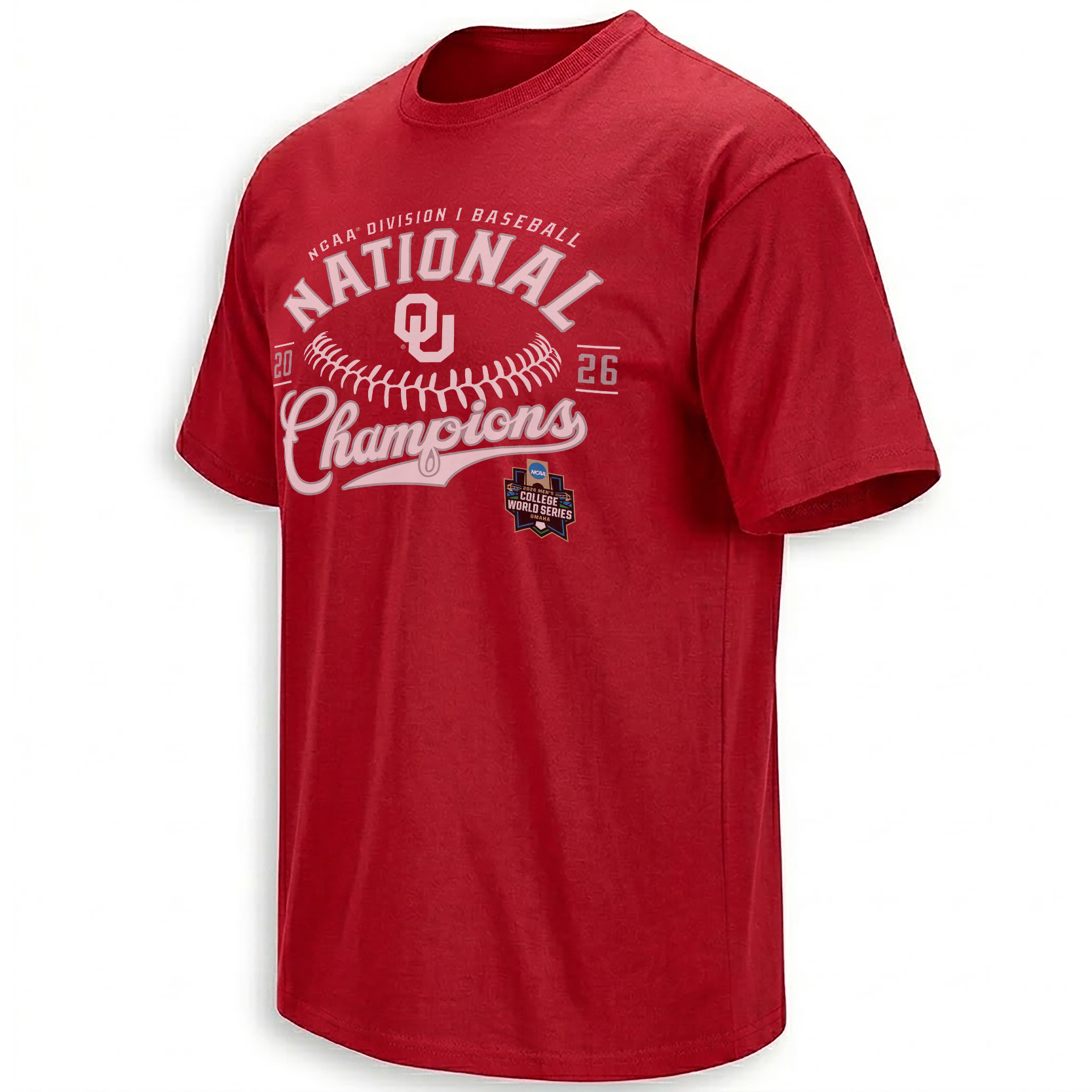
The 2026 National Champions Baseball Stitch Shirt organizes the title around the physical construction of a baseball. An arched “National” headline sits above the interlocking OU mark, while split 20 and 26 numerals establish the year on either side.
Beneath that center point, the curved white seams create the image’s central movement. They visually separate the block collegiate lettering above from the flowing “Champions” script below, but they also connect both halves of the composition. The design reads like a baseball viewed at close range, with the championship message written directly across its surface.
The stitching matters because it avoids the need to illustrate a specific player or recreate a single photograph. A baseball belongs to every inning. It was present when Oklahoma opened regional play, when the Sooners survived elimination pressure, when they arrived in Omaha and when Cleveland delivered the final strike.
That makes the seams a collective symbol. They do not belong only to Branch’s home run or Willits’ tournament performance. They belong to the pitchers who absorbed difficult innings, the defenders who prevented runs, the hitters who extended rallies and the supporters who followed the team through an improbable bracket.
The graphic uses the baseball seam as connective tissue. Traditional collegiate block lettering establishes institutional weight, the central OU mark identifies the program, flowing championship script supplies celebration and the Men’s College World Series badge fixes the entire composition to Omaha in 2026.
A Season Can Be Read Like a Single Length of Thread
A baseball is assembled through repetition. Each stitch is small, but the line only works when every stitch holds. Oklahoma’s postseason can be understood in the same way.
The Sooners did not enter the NCAA Tournament as the obvious favorite. They received an at-large bid and were placed as the No. 2 seed in the Atlanta Regional. From there, every stage added another segment to the championship line.
Oklahoma moved through a regional hosted by nationally seeded Georgia Tech, demonstrating that the Sooners’ tournament position did not define their ceiling.
A Super Regional sweep against Kansas sent Oklahoma back to Omaha and changed the conversation from a surprising run into a championship opportunity.
Victories over Alabama, Georgia and North Carolina carried the Sooners through the final field and into the program’s third national championship.
Oklahoma defeated the No. 2, No. 3, No. 5, No. 7 and No. 15 national seeds during the NCAA Tournament. The bracket did not offer the Sooners a protected route. It required them to repeatedly prove that their late-season transformation could survive against the strongest available opposition.
By the end, the tournament looked less like a string of isolated upsets and more like one uninterrupted line of competitive certainty. The Sooners kept adding stitches until there was nowhere left for the season to go except the championship.
The Final Game Was Built Through Accumulation
Oklahoma’s 13 runs did not arrive through one chaotic inning. They accumulated across the game, which made the final feel methodical rather than accidental.
Oklahoma established the first advantage and forced North Carolina to play from behind before the game reached its middle innings.
Patient at-bats and timely contact expanded the lead, giving the Sooners control of the scoreboard and the emotional pace.
Kyle Branch’s three-run home run converted a commanding lead into the defining offensive image of the championship clincher.
This pattern is reflected in the graphic’s layered typography. “National” establishes the official achievement. The OU logo names the program. The split numerals locate the year. The baseball seam identifies the sport. The flowing “Champions” script supplies the emotion that the formal headline alone cannot carry.
Each visual component performs a different task, just as different innings and players contributed distinct pieces to the final result. Remove one element and the design still makes sense, but together they create the full championship sentence.
Kyle Branch Supplied the Exclamation Point
Branch entered the deciding game without the largest statistical profile in Oklahoma’s Omaha lineup. He left it permanently attached to the championship.
The sophomore second baseman went 3-for-4 with a career-high six RBIs. He drove in the game’s first run with a second-inning single, added a two-run single in the sixth and then hit a three-run home run in the eighth.
The homer did not create the lead, but it created the emotional ending. By that moment, the Sooners were already moving toward the title. Branch’s swing gave the broadcast a visual cue that the championship was no longer theoretical. The ball cleared the left-field wall, his teammates moved toward home plate and the final innings became a celebration waiting for the clock to catch up.
In championship memory, those late emphatic plays matter because they give fans a scene to replay without anxiety. The moment can be watched again knowing nothing painful follows it.
Jaxon Willits Became the Record Inside the Run
Branch defined the final game, while Jaxon Willits defined Oklahoma’s broader Omaha stay.
The junior shortstop was named the Most Outstanding Player of the Men’s College World Series after batting .500 across six games. He finished with 13 hits, the most by an Oklahoma player in College World Series competition, and recorded multiple hits in five of the Sooners’ six Omaha games.
In the title clincher, Willits went 3-for-4 with a double, two walks and two RBIs. He reached base five times, repeatedly appearing at the center of Oklahoma innings before the scoreboard became overwhelming.
His tournament provides another way to understand the seam motif. Willits did not define Omaha through one isolated home run. He created continuity. Game after game, his name appeared in the hit column, across the bases and inside the rallies that kept Oklahoma’s offense moving.
Branch created the loudest punctuation. Willits supplied the sentence that kept running through all six games in Omaha.
LJ Mercurius Held the Middle of the Story Together
Championship graphics naturally favor hitters, dogpiles and trophy lifts, but deciding games are often shaped by the pitcher who prevents the night from changing direction.
Oklahoma turned to LJ Mercurius with one out in the third inning and a 3–1 lead. The junior right-hander responded with 5.2 innings of relief, allowing one run and striking out five without issuing a walk.
Mercurius prevented North Carolina from converting traffic into momentum. The Tar Heels recorded hits, but the Sooners continued to escape without the kind of inning that could destabilize the game.
His outing became the invisible center of the championship rout. While Oklahoma’s offense kept stretching the score, Mercurius ensured that each new run increased the distance rather than merely answering an opponent’s surge.
When Jackson Cleveland entered in the ninth, the season required only three more outs. After allowing a leadoff single, he struck out three consecutive batters. The final pitch completed the last seam in Oklahoma’s postseason.
The Typography Moves From Institution to Emotion
The upper half of the artwork uses the visual grammar of traditional college athletics. “NCAA Division I Baseball” appears in a compact curve, while the large “National” lettering resembles the block forms used on old stadium signs, varsity jackets and university championship programs.
That structure provides authority. It tells the viewer that the design is recording an official athletic accomplishment rather than an informal slogan.
The lower half changes register. “Champions” appears in flowing script, stretching horizontally with an underline and banner-like tail. Where the block letters feel institutional, the script feels handwritten and celebratory. It resembles the kind of word someone might add across a newspaper front page after the final out.
Between those two modes sits the OU logo, framed by 20 and 26. The logo acts as the fixed point while the title language moves around it. Oklahoma is not merely included in the design; the entire championship structure is organized around the program mark.
Crimson Carries a Different Meaning After a Title
Oklahoma crimson already belongs to a vast athletic archive, but championship context changes how a familiar color is read.
Before the final, crimson identifies the team. After the final, it identifies the winning team. The color begins to absorb specific memories: Omaha sunsets, dugout celebrations, the Branch home run and the final group moving toward the mound.
On the crimson presentation, lighter lettering reverses against the shirt base and gives the design stronger school-color energy. On sport gray, crimson lettering carries a more traditional locker-room quality, recalling the commemorative apparel associated with tournament brackets and championship celebrations.
Both treatments preserve the same hierarchy, but they produce different emotional readings. Crimson feels immediate and declarative. Gray feels archival, as though the image has already entered Oklahoma baseball history.
1951, 1994 and 2026 Are Now Sewn Together
Oklahoma’s first baseball national championship came in 1951. Its second arrived in 1994. Before Monday night, those two years existed as distant anchors separated by different eras, stadiums, equipment and generations of supporters.
The new title does more than add another number. It reconnects the earlier championships to the present. Images from 1994 return to timelines. Fans search for footage, compare uniforms and identify the people in old dogpile photographs. The history becomes active because a current team has given it another endpoint.
Thirty-two years separated Oklahoma’s second and third championships. That gap explains why the 2026 design carries more emotional weight than an ordinary postseason graphic. For many supporters, this was the first Oklahoma baseball national title they experienced in real time.
Others can now place two championships inside one family story: the 1994 team they remember from childhood and the 2026 team they watched with children of their own.
Why Fans Turn Championship Nights Into Objects
The urge to preserve a championship begins almost immediately because live sports are defined by disappearance. The final pitch happens once. The dogpile eventually breaks apart. The stadium lights go dark, and players who occupied the same frame begin moving toward different futures.
Fans respond by creating an archive. They save newspapers, screenshots, ticket stubs, programs, rally towels, photographs and graphics. These objects do not reproduce the entire experience. They act as triggers that return the mind to it.
The baseball stitch design functions in that tradition. It does not attempt to depict every player or list every opponent. Instead, it preserves the title through a small group of highly retrievable symbols: Oklahoma, 2026, National Champions, baseball seams and the Men’s College World Series.
Years later, those symbols will still answer the essential questions. Which team? Which sport? Which year? Which championship stage?
From One Oklahoma Graphic to the Wider Omaha Archive
Oklahoma’s championship produced more than one visual language. Some graphics focus on Omaha itself. Others use a trophy, a bracket, a pennant, a roster or the equipment associated with a baseball dugout.
The stitch composition occupies the traditional center of that spectrum. It feels closest to a classic collegiate championship mark—structured enough to look official, but expressive enough to carry the emotional force of the ending.
The wider Oklahoma Sooners collection works as a running visual archive of those different interpretations, from Omaha wordplay to national championship emblems and team-specific postseason memories.
The broader College Baseball Shirts collection places Oklahoma’s celebration inside the culture of regionals, Super Regionals, Omaha arrivals and the distinctive language surrounding the Men’s College World Series.
The NCAA collection expands that archive further, connecting the Sooners’ title to the wider world of college rivalries, school identity and championship memory.
Frequently Asked Questions
When did Oklahoma win the 2026 baseball national championship?
Oklahoma won the title on June 22, 2026, defeating North Carolina 13–2 in the deciding third game of the Men’s College World Series championship at Charles Schwab Field in Omaha.
How many baseball national championships has Oklahoma won?
The 2026 championship was Oklahoma baseball’s third national title. The Sooners previously won in 1951 and 1994.
Why is baseball stitching central to the design?
The curved seams immediately identify the sport while visually connecting the National headline, OU logo, split 2026 numerals and Champions script into one continuous championship emblem.
Who was the Most Outstanding Player of the 2026 Men’s College World Series?
Oklahoma shortstop Jaxon Willits received the honor after batting .500 with 13 hits across six games in Omaha.
What did Kyle Branch do in the championship game?
Branch went 3-for-4 with a career-high six RBIs, including a three-run home run during Oklahoma’s four-run eighth inning.
Why does the design include a Men’s College World Series badge?
The badge connects the broader National Champions statement to the specific event and location where Oklahoma completed its 2026 title run.
The Oklahoma Baseball Stitch design preserves the title through the sport’s most familiar line, while the wider Sooners championship archive records the different slogans, emblems and Omaha memories created by the 2026 run.
2026 National Champions Baseball Stitch Shirt connects the Oklahoma Sooners’ third baseball title to Omaha through arched collegiate lettering, a central OU logo, split championship-year numerals, curved baseball seams and a Men’s College World Series badge.